The Federal Reserve (FED) Chairman Powell's speech released a key signal, indicating that the balance sheet contraction (QT) may be coming to an end, and the return of liquidity will drive funds to flow in historical patterns: Bitcoin leads, ETH breaks through $5,000, and the altcoin season finally ignites.
Powell's speech releases easing signals: QT is coming to an end
On October 14, 2025, Federal Reserve Chairman Jerome Powell delivered a long-awaited message for the cryptocurrency market in his latest speech: there have been no significant changes in economic conditions since September, which means that unexpected rate hikes are not anticipated. More importantly, he stated that the Federal Reserve's current policy is functioning well, and stronger-than-expected economic growth allows them to proceed slowly without causing disruption to the market.
For cryptocurrency traders, the most important signal comes from Powell's comments about the asset balance sheet contraction (Quantitative Tightening, QT). He hinted that the Federal Reserve (FED) may soon end QT, a tightening policy that has withdrawn billions of dollars in liquidity from the market since 2022. Ending QT will help stabilize liquidity and borrowing costs, making it easier for funds to flow into risk assets like Bitcoin and alts.
How QT Strangled Altcoin Liquidity
Since June 2022, the Federal Reserve (FED) has been reducing its balance sheet by about $95 billion per month, including Treasury bonds and mortgage-backed securities (MBS). This “quantitative tightening” is equivalent to drawing blood from the financial system:
Liquidity drought effect: Interbank borrowing costs rise, making it more difficult for businesses and investors to obtain funds, with risk assets being the hardest hit.
Rising cost of capital: The federal funds rate has soared from near zero to a high of 5.25%-5.5%, significantly increasing the opportunity cost of holding non-yielding assets such as cryptocurrencies.
Risk Appetite Collapse: Why would investors take on the high volatility risk of alts when the “risk-free” yield on U.S. Treasuries reaches 5%?
In this environment, the altcoin market experienced a brutal bear market from 2022 to early 2024. Even if Bitcoin leads the recovery in 2024 due to the approval of ETFs, most altcoins are still struggling 60%-80% below their historical highs.
Three Key Messages from Powell's Speech
Although Powell's speech on October 14 was mild in tone, it contained three signals that are crucial for the crypto market:
Policy stability commitment: “No major changes in the economy” means that the Federal Reserve (FED) will not panic and adjust policies due to short-term data fluctuations, which reduces the uncertainty premium in the market.
Clear interest rate path: The market has already anticipated a reduction of at least 25 basis points by the end of October, with the possibility of further cuts before the end of the year. Lower interest rates typically reduce the cost of capital, thereby encouraging investors to take on more risk.
QT timeline: Powell hints that QT may “end soon.” Although no specific date was given, this is the first time the Federal Reserve has publicly discussed the QT exit strategy, indicating that the tightening cycle is nearing its end.
This subtle shift in tone has caught the attention of traders. The Volatility Index for the cryptocurrency derivatives market declined after the speech, indicating an increased confidence in the future policy path.
The Historical Launch Pattern of Altcoin Season
(Source: BlockchainCenter)
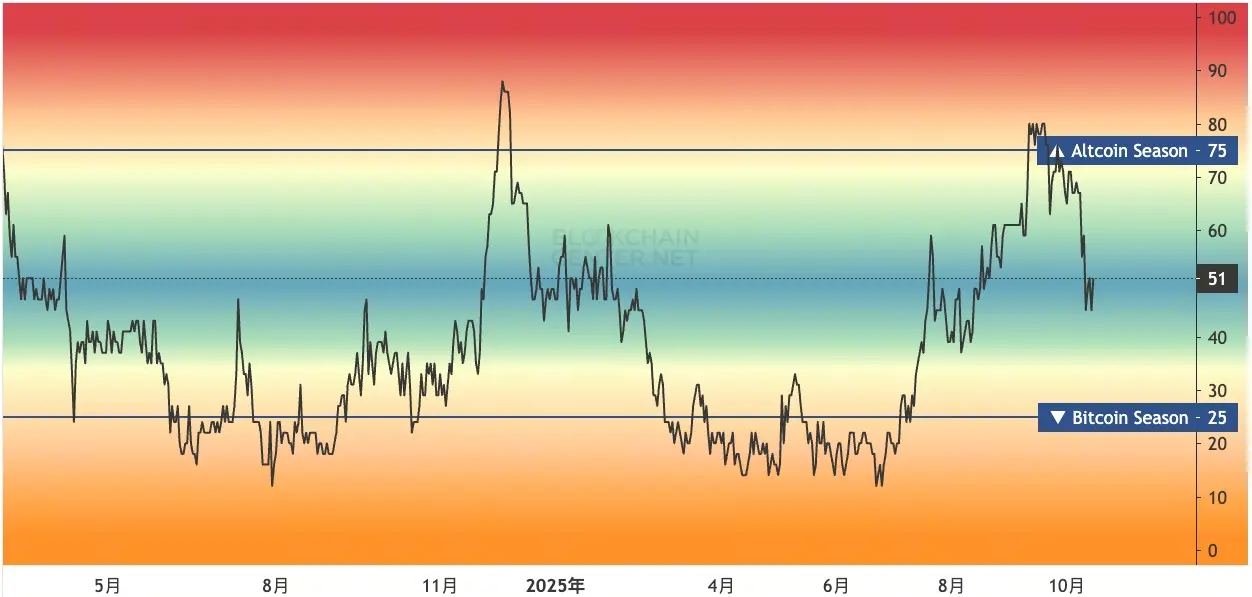
When liquidity returns, the cryptocurrency market follows a historically validated order of capital flow: Bitcoin benefits first, followed by ETH, then mid-cap alts and meme tokens. Since 2017, every major altcoin season has started in this way, preceded by the Federal Reserve (FED) adopting loose monetary policy.
2017 Bull Market: The Liquidity Roots of the ICO Frenzy
Phase 1 (Q1-Q2 2017): Bitcoin surged from $1,000 to $3,000, capturing all attention and capital inflow.
Phase 2 (Q3 2017): Ethereum skyrocketed from $50 to $400 due to the ICO craze, as investors realized the value of “programmable blockchain.”
Stage Three (Q4 2017): alts fully exploded, with projects like NEO, Cardano, and IOTA rising 10 to 50 times within a few weeks. Bitcoin's dominance (BTC.D) fell from 87% to 37%.
The macro background of this bull market is: The Federal Reserve (FED) maintained an extremely loose monetary policy from 2015 to 2018, with low funding costs driving speculative enthusiasm.
2021 Bull Market: The Dual Engines of DeFi and Layer 1
Phase 1 (Q4 2020 - Q1 2021): Bitcoin broke through from $10,000 to a historic high of $64,000, with institutional adoption becoming the main narrative.
Phase 2 (Q2 2021): Ethereum broke through $4,000, and the DeFi Total Value Locked (TVL) surged from $15 billion to $80 billion.
Phase Three (Q3-Q4 2021): Layer 1 public chains such as Solana, Avalanche, Terra, and Fantom surged one after another, with the market capitalization share of alts reaching a new high. BTC.D dropped from 70% to 40%.
The catalyst for this round of the bull market is: The Federal Reserve (FED) initiated unlimited QE (quantitative easing) in March 2020, with the federal funds rate dropping to 0%-0.25%, resulting in an unprecedented flood of liquidity.
2025: Will History Repeat Itself?
The current market structure is remarkably similar to the last two bull markets:
Bitcoin leads the way: BTC is set to break through due to ETF and halving narratives at the end of 2024 to early 2025, currently consolidating above $100,000.
Ethereum is building momentum: ETH is currently priced at about $3,800, just a 30% increase away from the key psychological level of $5,000.
Altcoins waiting: Most altcoins are still 50%-70% below the 2021 highs, with valuation compression fully realized. Once liquidity returns, the explosive potential is astonishing.
If Powell's QT ending signal materializes, this round of altcoin season may explode between Q4 2025 and Q1 2026.
Three Key Conditions Before the Start of Altcoin Season
Cryptocurrency analyst Benjamin Cowen conducted a reality check on the altcoin market. He emphasized that for a real bullish trend in altcoins to occur, three prerequisites must be met.
Condition 1: ETH must break through 5,000 USD and hold
Cowen pointed out that Ethereum is the key bridge connecting Bitcoin and alts. Historical data shows:
2017 Case: After Ethereum broke its previous high, ERC-20 tokens collectively surged, with ICO financing increasing by 400% within 3 months.
2021 Case: After Ethereum broke through $4,000, DeFi tokens (AAVE, COMP, UNI) averaged a 150% increase within 6 weeks.
Currently, ETH is fluctuating around $3,800, with a 32% upside potential to $5,000. Technically, $5,000 is an important resistance level from the 2021 bull market, and a breakthrough requires strong trading volume.
Condition 2: Bitcoin's Dominance Reaches a Cycle Peak
BTC.D is an indicator that measures the proportion of Bitcoin's market capitalization relative to the overall cryptocurrency market. Research by Cowen shows:
2017 Model: BTC.D peaked at 87% in January, then fell to 37% in December, and the alts season lasted for 11 months.
2021 Model: BTC.D peaked at 70% in January, then dropped to 40% in May, and the altcoin season lasted for 4 months.
2025 Current Status: BTC.D is currently around 58% and still rising, indicating that market funds are still concentrated in Bitcoin. This “vampire effect” must end for funds to flow into alts.
Historical patterns indicate that only after Bitcoin reaches a new historical high and its dominant position peaks will funds overflow into altcoins. Currently, Bitcoin is consolidating above $100,000; if it breaks through $120,000 and stabilizes, BTC.D may peak at 60%-65%.
Condition 3: The Federal Reserve (FED) actually cuts interest rates and ends QT
Although Powell's speech released signals, the market needs to see actual actions:
Interest rate cut schedule: The market expects a 25 basis point cut at the end of October, with another possible 25 basis point cut in December. This would lower the federal funds rate from 5.25%-5.5% to 4.75%-5.0%.
QT termination mechanism: The Federal Reserve (FED) needs to clearly announce the halt of balance sheet reduction and may imply the conditions for restarting QE in the future.
Actual liquidity improvement: the interbank lending rate has fallen, corporate financing costs have decreased, and the volatility of risk assets has receded. These are all signals of true liquidity improvement.
Only when these three conditions are met simultaneously will the alts season fully activate.
How should traders prepare for altcoin season?
Based on historical patterns and the current market structure, traders can consider the following strategies:
Phased Layout:
Current stage: Mainly holding Bitcoin and Ethereum, with a allocation of 70% BTC, 20% ETH, and 10% selected alts.
When ETH breaks above $4,500: Increase alts allocation to 30%, focusing on Layer 1, DeFi, and RWA sector leaders.
When ETH breaks $5,000 and BTC.D peaks: Altcoin allocation can be increased to 50%, including small and mid-cap projects.
Risk Management:
Set stop-loss: Alts are highly volatile, and the allocation for a single project should not exceed 5% of the total position.
Enter in batches: Do not fully invest at the beginning of the altcoin season, reserve funds to cope with corrections.
Timely profits: The altcoin season usually lasts for 3-6 months, don't be greedy for the last leg of the increase.
Catalyst Attention:
The Federal Reserve (FED) FOMC meeting minutes and Powell's speech
Key technical levels for Bitcoin (120,000 USD, 150,000 USD)
Ethereum upgrade progress and ETF fund flows
Key fundamental changes of major altcoins (protocol revenue, TVL, user growth)
Powell's speech marks a turning point
Powell's speech on October 14 may mark a turning point for the cryptocurrency market from the “tightening adaptation period” to the “loose expectation period.” Although the altcoin season has not officially started, historical patterns and the macro environment are pointing in the same direction: liquidity returning, Bitcoin leading the way, Ethereum breaking through, and alts exploding.
For investors who missed the altcoin seasons of 2017 and 2021, this could be the next opportunity to change their wealth trajectory. But remember: while the altcoin season is enticing, it also comes with extremely high risks, and only strict discipline and risk management can help you exit the frenzy unscathed.


