Grayscale, one of the largest crypto asset managers, released a research report on October 10, describing Solana as the “financial market of crypto” – a perspective that goes beyond the familiar promotions of speed and performance.
According to Grayscale, Solana is leading the industry in the number of users, transactions, and fees, thanks to a smooth experience, architectural advantages from Solana Virtual Machine (SVM), and a diverse application ecosystem – all of which create a sustainable pricing foundation.
This marks a significant change in the tone of financial institutions, as Grayscale now grants Solana the status they once used to describe Ethereum as “digital oil.”
But more importantly, the signal that Grayscale is sending is: when a traditional financial organization begins to build an investment thesis for a blockchain that was once considered “dead” after the collapse of FTX, other institutional investors will have to pay attention.
The question is: does the data have enough strength to prove this point, or is the “financial market” still just a beautiful metaphor?
On-chain data: Is Solana really leading?
Grayscale identifies three core factors that help Solana stand out in the smart contract blockchain group: users, transaction volume, and ecosystem fees.
According to the report:
- The total ecosystem fee reaches about 425 million USD/month, equivalent to an annual rate of over 5 billion USD.
- The total trading volume of DEX in the past year reached 1.2 trillion USD, mainly through Jupiter and Raydium.
- Jupiter is currently the largest DEX aggregator in the industry, while Pump.fun has over 2 million active users monthly and Helium reaches 1.5 million daily users.
- The number of full-time programmers has surpassed 1,000, the fastest growth rate in the past two years.
Technically, Solana processes blocks every 400 milliseconds, transactions are confirmed after 12-13 seconds, with an average fee of only 0.02 USD, and a daily median fee of 0.001 USD – thanks to the “local fee market” mechanism that helps isolate congestion.
The upcoming upgrade named Alpenglow will shorten the completion time to just 100–150 milliseconds.
However, Grayscale also acknowledges that Solana is not suitable as a long-term store of value like Bitcoin or Ethereum, due to supply inflation and high centralization: 99% of SOL stake is held in data centers, with 45% dominated by two storage providers.
Reality Check: Do the data support Grayscale?
According to DeFiLlama, Solana maintains about 2.6 million active addresses daily and 67 million on-chain transactions within 24 hours – consistent with the average activity rate for the year 2025.
Regarding fees, data from Token Terminal shows that the actual figure fluctuates around 30–40 million USD/month, potentially reaching 300–450 million USD/month during peak periods, closely aligned with Grayscale's estimates but not stable enough to be considered a “baseline.”
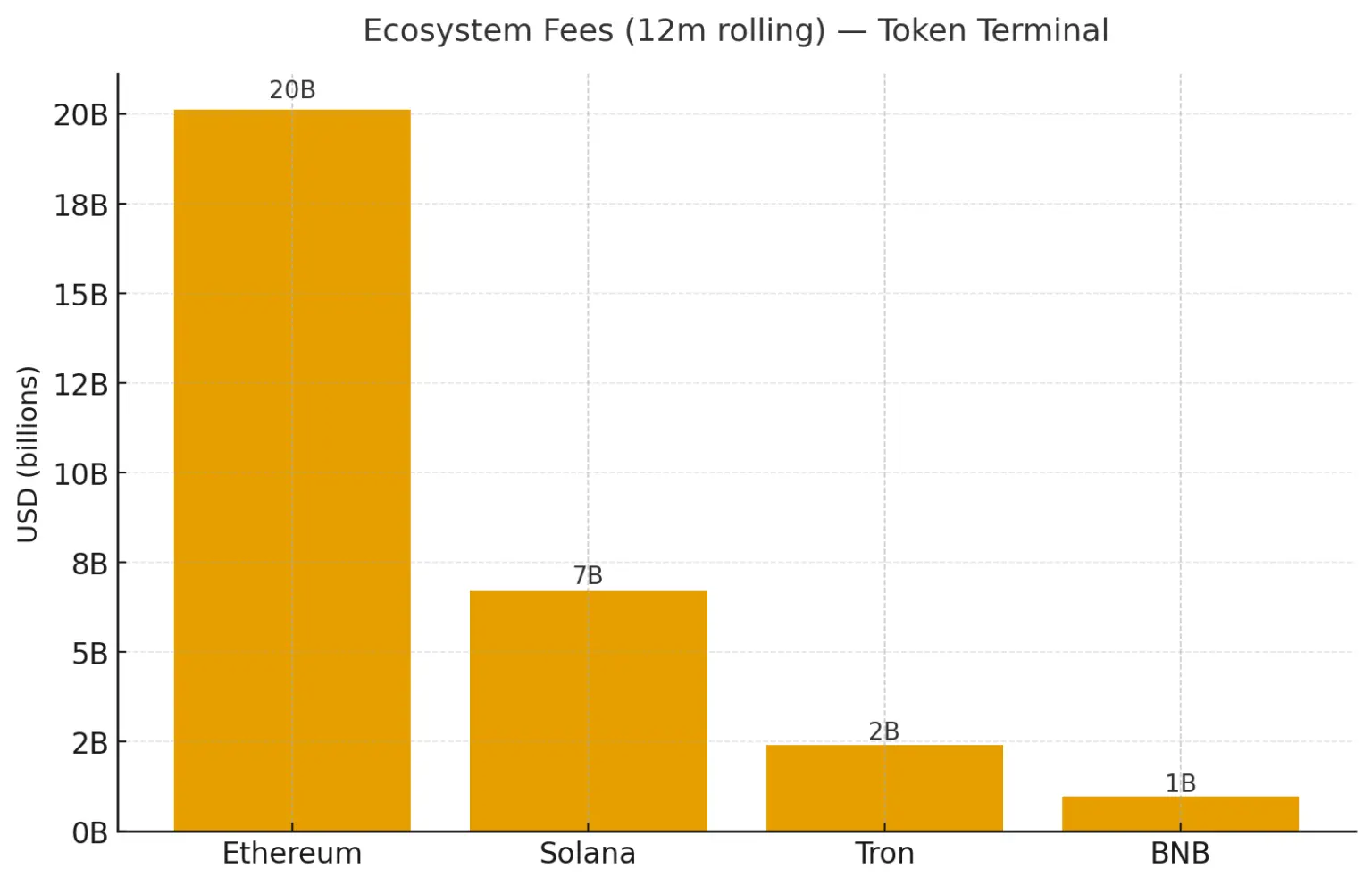 *According to data from Token Terminal, Solana generated $7 billion in ecosystem fees over the past 12 months, ranking second after Ethereum with $20 billion.*Solana generated approximately $7 billion in ecosystem fees over the past 12 months, only behind Ethereum (20 billion USD).
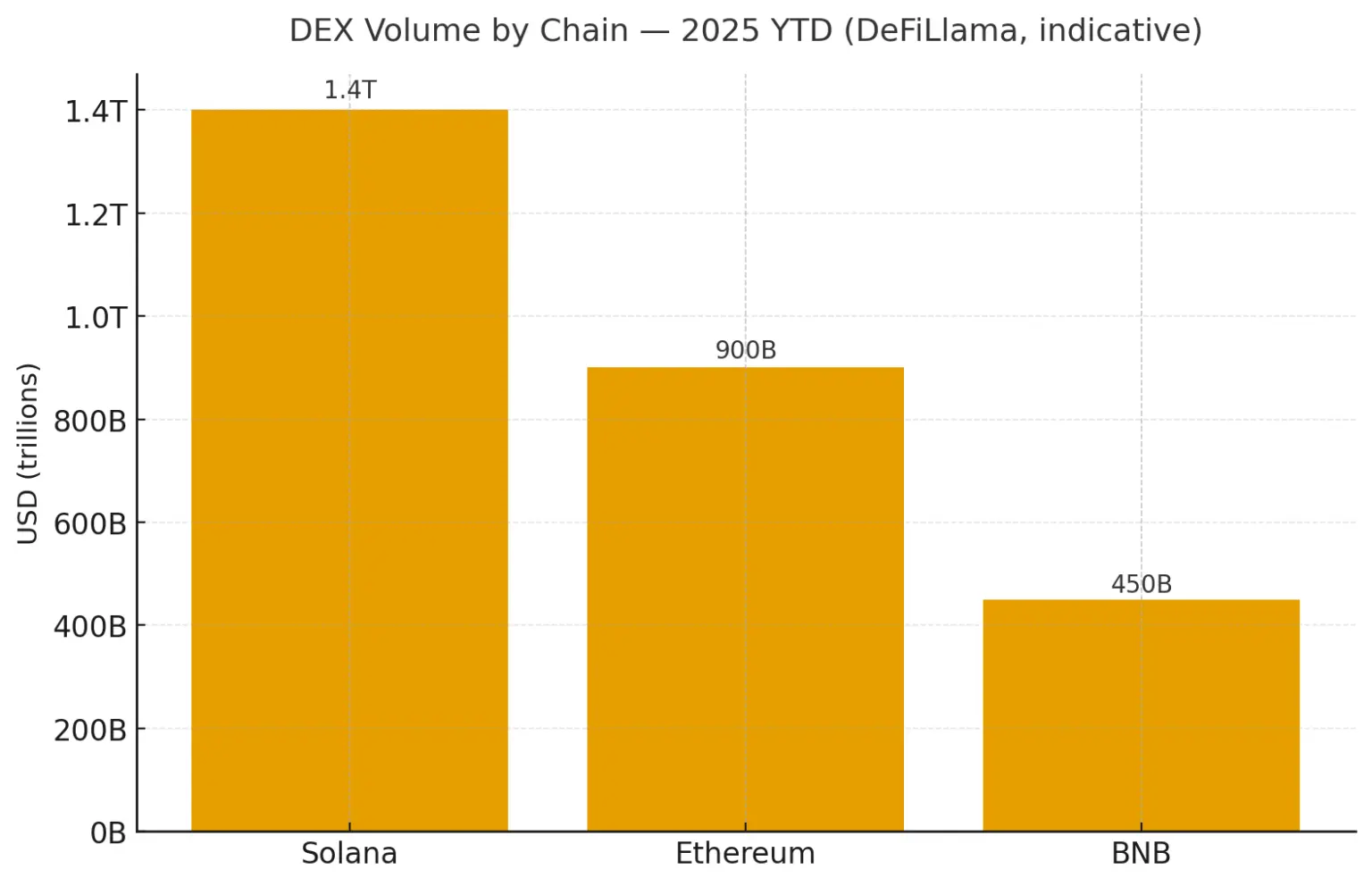 *Solana leads all chains in DEX volume to date with $1.4 trillion, surpassing Ethereum with $900 billion and BNB with $450 billion, according to DeFiLlama.*DEX trading volume is also impressive: $1.4 trillion year-to-date, exceeding Ethereum (900 billion USD) and BNB (450 billion USD).
Regarding development, according to Electric Capital, Solana has 17,700 active developers, an increase of 29% compared to last year and 62% over two years – second only to Ethereum.
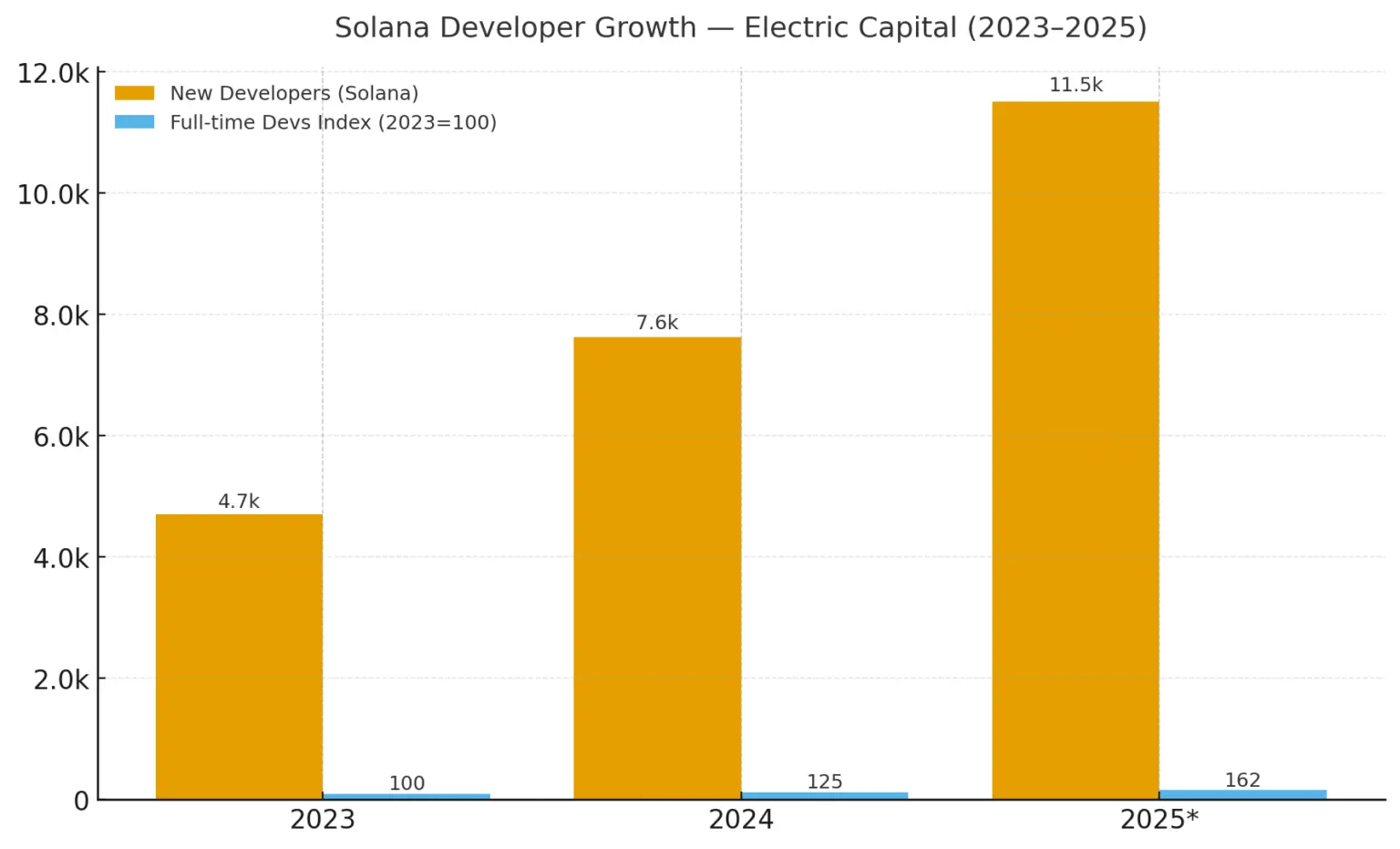 *Solana has attracted 11,500 new developers as of 2025, up from 7,600 in 2024, while the number of full-time developers increased by 62%, according to Electric Capital.*The block speed and finality time are fully consistent with the figures mentioned by Grayscale: 0.4 seconds/block and 12.8 seconds finality.
Overall, the data supports Grayscale's argument: Solana is leading in users, DEX volume, application development, and the developer team. However, some figures are still “overstated” – especially the fee of 425 million USD/month.
Why are financial institutions “warming up” to Solana?
The main reason is that the user experience is now fast enough, cheap, and stable.
The local fee market mechanism helps to separate congestion, keeping regular transactions cheap and stable – something that payment institutions or custodial exchanges value greatly.
After the network outage incident in February 2024, performance and uptime have improved significantly. Liquidity on DEXs and aggregators like Jupiter is also deeper, allowing for larger trades with less slippage.
In particular, many spot Solana ETF funds have been filed with the SEC before the agency paused operations – a sign of growing interest from traditional institutions.
The Trade-offs and Potential Risks
The high speed of Solana comes with heavy hardware requirements, causing most nodes to operate centrally at data centers – a factor that reduces the actual level of decentralization.
The Nakamoto coefficient of Solana is currently 20 (October 2025), indicating that the number of parties needed to collude to censor transactions is lower than in previous stages.
The diverse clients are still in the transition phase: Firedancer – the client developed by Jump Crypto – has not yet been fully deployed, leading to the risk of depending on a single client that still exists.
In addition, the release speed of SOL at 4-5% per year and the new fee burn policy ( only burns 50% of the base fee, stopping the burning of the priority fee ) also makes the role of SOL as a “store of value” less attractive than Bitcoin or Ethereum.
Conclusion: “Financial Market” or “Walled Garden”?
Grayscale's argument – that fast, cheap, and cohesive applications can create sustainable network value – holds true across several core metrics: users, throughput, developers, and liquidity.
However, the limitations regarding centralization, hardware, and inflation remain clear weaknesses.
If the Alpenglow ( upgrades help complete transactions in under 1 second ) and Firedancer ( successfully diversifies clients ), Solana's position in the eyes of institutions will be even stronger.
On the contrary, if hardware barriers continue to rise and the level of concentration increases, the “financial market” that Grayscale envisions could become a “walled garden” – a place with high speed but restricted freedom.
Vương Tiễn


