GAIB (GPU · AI · Blockchain) is a blockchain-agnostic protocol designed to serve as the economic layer for AI infrastructure, connecting decentralized finance (DeFi) liquidity with real-world AI assets such as GPUs, data centers, robotics, and energy systems. By tokenizing and financializing productive infrastructure, GAIB aims to create a sustainable loop where DeFi capital funds AI growth, and verified operational output returns value on-chain.
(Sources: GAIB website)
GAIB’s Core Thesis: Solving the DeFi-AI Disconnect
DeFi holds vast on-chain liquidity but often relies on endogenous, speculative mechanisms. Meanwhile, AI infrastructure faces centralized, permissioned capital formation despite explosive demand. GAIB addresses this gap by establishing a transparent framework for:
- Tokenizing real-world AI assets
- Validating operational performance
- Distributing verified rewards to participants
The protocol operates across chains with a modular architecture: tokenization, financialization, liquidity provision, and verification layers, all settled on a secure blockchain substrate.
Key Components
- Asset Tokenization & Validation
Physical AI infrastructure is tokenized with on-chain proofs of ownership and performance. The Validation Network attests real-world output, ensuring rewards reflect actual usage.
- AID: The AI Synthetic Dollar
AID is a fully reserved, non-yield-bearing synthetic dollar backed 1:1 by U.S. Treasuries, cash equivalents, and major stablecoins. It serves as the ecosystem’s unit of account and settlement currency, with cross-chain transfers via lock-attest-mint.
- sAID: Staked AI Dollar
Users stake AID into ERC-4626 vaults to receive sAID receipt tokens. Capital is deployed into verified AI portfolios, with NAV increasing based on attested performance. Unstaking returns AID at the updated ratio.
- Cross-Chain & Interoperability
GAIB uses an enhanced lock-attest-mint model secured by its Validation Network and anchored on GAIB L2 for consistent, auditable transfers.
GAIB Tokenomics and Governance Model
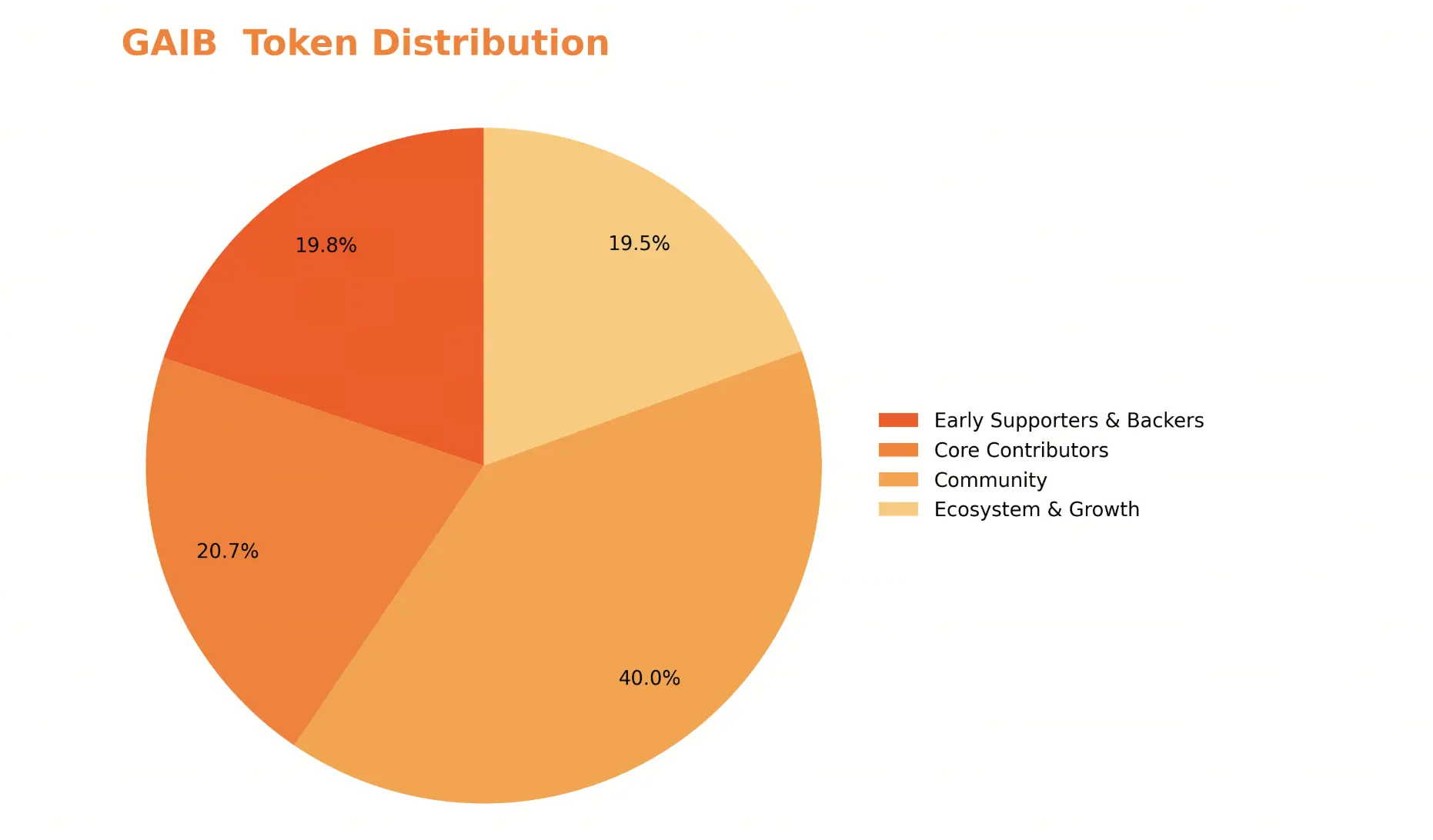
The GAIB token serves as the core coordination and security asset of the GAIB ecosystem. It underpins the protocol’s governance, validator participation, and long-term alignment between infrastructure operators, digital asset holders, and the community. The tokenomic model is built upon three design pillars: value alignment, network security, and sustainable economic growth.
Total supply: 1,000,000,000 GAIB tokens (capped)
(Sources: GAIB whitepaper)
Distribution and vesting are structured to promote balanced participation and long-term commitment, with controlled circulation during early growth. Specific allocation details and vesting schedules will be finalized through community governance as the protocol progresses toward mainnet.
Current Status and Roadmap
As of November 2025, GAIB remains in development with no public token or mainnet launch announced. The whitepaper outlines AID and sAID as the first products, focusing on compliance, verifiability, and composability for institutional and retail participation.
In summary, GAIB positions itself as the economic bridge between DeFi’s liquidity and AI’s infrastructure demand, introducing AID/sAID, a validation framework, and a capped 1 billion GAIB token supply to channel decentralized capital into productive, real-world assets.
Disclaimer: The information on this page may come from third parties and does not represent the views or opinions of Gate. The content displayed on this page is for reference only and does not constitute any financial, investment, or legal advice. Gate does not guarantee the accuracy or completeness of the information and shall not be liable for any losses arising from the use of this information. Virtual asset investments carry high risks and are subject to significant price volatility. You may lose all of your invested principal. Please fully understand the relevant risks and make prudent decisions based on your own financial situation and risk tolerance. For details, please refer to
Disclaimer.


