Japan—the country holding the largest amount of US government debt in the world—is causing concerns in the global financial markets, as analysts warn of the risk of a large-scale bond sell-off in the near future.
These worries have spilled over into the cryptocurrency sector, particularly regarding Tether—the issuer of the USDT stablecoin, which is primarily backed by over $113 billion in US Treasury bonds. Tether is currently under close scrutiny regarding its ability to maintain USDT’s stable value (depeg).
Risk of Japan Selling Off US Treasuries as Domestic Yields Surge
According to the latest data from the US Department of the Treasury, foreign investors’ demand for US Treasury bonds declined in September, with total holdings dropping slightly to $9.249 trillion compared to the previous month. However, Japan was an exception, continuing its nine-month net buying streak and raising its total holdings to $1.189 trillion—the highest level since August 2022. This solidifies Japan’s position as the largest foreign holder of US Treasuries.
Experts note that Japan has historically been an active buyer of foreign debt due to near-zero domestic bond yields, making US bonds an attractive, low-risk option. However, the macroeconomic landscape is changing rapidly; yields on Japanese government bonds have climbed to multi-year highs.
As domestic yields improve, Japan’s incentive to continue accumulating US Treasuries is fading. This raises the possibility that the country may reduce its holdings if the market or policy environment changes.
Lena Petrova commented: “Japan’s prolonged debt crisis is gradually surfacing, with public debt-to-GDP ratios reaching 230%, combined with large-scale fiscal expansion under Prime Minister Sanae Takaichi, leading to a sharp spike in bond yields and heightened investor anxiety. If Japan faces a shock, the impact will ripple globally, especially as Tokyo is the largest investor in US Treasuries, increasing risks for markets already under pressure from rising borrowing costs and shrinking fiscal space.”
Another expert pointed out that, over the past six months, the yield spread between US and Japanese bonds has narrowed from 3.5% to only 2.4%. Hedged yields on US Treasuries are becoming less attractive, and if this gap continues to shrink to 2%, repatriating capital will make economic sense.
This could prompt Japanese financial institutions to sell US Treasuries and move capital back home. Some forecast models suggest up to $500 billion could exit global markets over the next 18 months.
Additionally, the cheap-yen borrowing trade (yen carry trade)—around $1.2 trillion borrowed cheaply in yen and invested globally in yield-generating assets like stocks, cryptocurrencies, and emerging markets—is also at risk of unwinding. As Japanese rates rise and the yen strengthens, these trades become riskier, forcing investors to unwind positions and increasing selling pressure in global markets. For the past 30 years, Japanese yields have acted as an “anchor” keeping global interest rates low. But now, that anchor has been broken.
Tether and the Risks from Concentration in US Treasuries
A major question arises: if Japan begins to reduce its US Treasury holdings, how will this affect USDT? The concern stems from Tether’s reserves being heavily concentrated in an asset class now facing pressure.
According to Tether’s transparency report, more than 80% of its reserves are in US Treasuries. This not only makes Tether a key player in the global bond ecosystem but also the world’s 17th largest holder of US government debt, surpassing many sovereign nations.
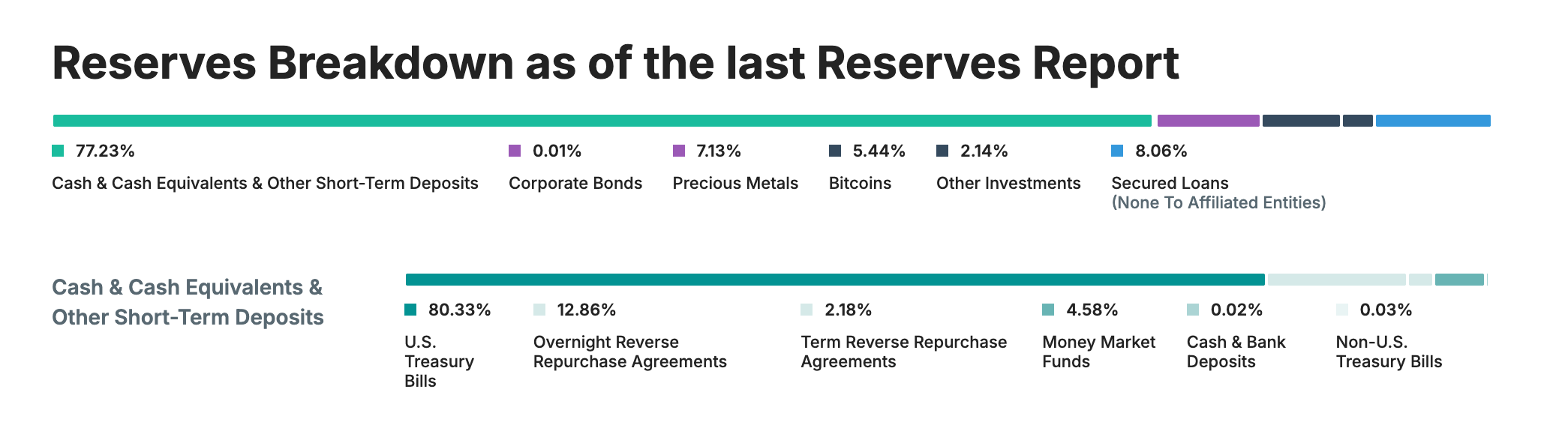 Tether Reserve Composition | Source: TetherConcentration in US Treasuries has historically provided liquidity and price stability. However, should a major creditor like Japan start to sell off, price and yield volatility could tighten liquidity conditions, indirectly pressuring large holders like Tether.
A market expert observed: “If Japan is forced to sell US Treasuries, other countries will follow suit. Tether will face a high risk of devaluation, dragging Bitcoin prices down sharply. Strategy may be forced to sell, causing Bitcoin prices to plunge further. Japan ➡️ Tether ➡️ Bitcoin, in that order.”
Furthermore, S&P Global Ratings recently downgraded Tether’s ability to maintain its peg, moving USDT from a level 4 (restricted) to level 5 (weak). According to S&P, level 5 reflects increased exposure to high-risk assets in USDT’s reserves over the past year and gaps in disclosure. These assets include bitcoin, gold, secured loans, corporate bonds, and other investments—all with limited transparency and subject to credit, market, interest rate, and FX risks.
Despite macroeconomic concerns, most investors believe that a severe USDT depeg is highly unlikely. According to prediction market Opinion, the probability of this scenario is just 0.5%, reflecting investor skepticism.
There are several reasons for this skepticism: Tether has maintained its stable value through past market crises, and the company generated $10 billion in profits in Q3/2025, providing a large buffer for reserve fluctuations.
While a Japanese sell-off of US Treasuries could have significant effects, the process is likely to be gradual. The US Treasury market is still large enough to absorb selling pressure without causing severe disruptions. However, the combination of rising Japanese yields, S&P downgrades, and Tether’s reserve structure remain factors to closely monitor going forward.
Mr. Giao
Disclaimer: The information on this page may come from third parties and does not represent the views or opinions of Gate. The content displayed on this page is for reference only and does not constitute any financial, investment, or legal advice. Gate does not guarantee the accuracy or completeness of the information and shall not be liable for any losses arising from the use of this information. Virtual asset investments carry high risks and are subject to significant price volatility. You may lose all of your invested principal. Please fully understand the relevant risks and make prudent decisions based on your own financial situation and risk tolerance. For details, please refer to
Disclaimer.
Related Articles
Delphi Digital: Sufficient collateral backing for stablecoins does not mean immunity from bank runs; the risk has shifted to the issuer level
Delphi Digital analysis points out that although Tether and Circle's stablecoins are backed by short-term Treasury bills and cash equivalents, they are not completely safe and still face bank run risks. The USDC depegging event in early 2023 demonstrated that stablecoin risks have shifted to issuers, highlighting the dangers posed by their centralization.
GateNews17h ago
Boris Johnson criticizes Bitcoin as a Ponzi scheme, with crypto industry leaders collectively refuting the claim
Former British Prime Minister Boris Johnson characterized Bitcoin as a "Ponzi scheme" and warned investors, particularly elderly individuals, to exercise caution using personal examples. Industry figures such as Michael Saylor quickly refuted the claim, pointing out that Bitcoin lacks a centralized operator, which is a key characteristic of Ponzi schemes. These remarks sparked widespread discussion and reignited controversy over the definition of Bitcoin.
MarketWhisper17h ago
Tether Announces Major AI Breakthrough, QVAC Serverless Intelligence May Usher in Open Source Era
Tether CEO Paolo Ardoino announced that a major breakthrough from the AI division will be released this week, marking progress in decentralized intelligent infrastructure. The QVAC platform aims to enable AI models to run locally on consumer-grade devices with efficient inference and task automation capabilities. Supported by Tether's financial resources, QVAC continues to iterate and involves multiple cutting-edge technologies, though its future breakthroughs still require observation of actual results.
MarketWhisper18h ago
Tether CEO Paolo Ardoino Teases 'True Breakthrough' in Decentralized AI
Tether CEO Paolo Ardoino announced on March 15, 2026, that the company's AI division will release what he described as a "true breakthrough" in the coming week, marking the next phase of the stablecoin issuer's decentralized intelligence strategy.
CryptopulseElite18h ago
Tether hints at a new "AI breakthrough," advancing the decentralized intelligence strategy
Tether's CEO announced a significant AI breakthrough coming soon, following the release of QVAC Workbench 0.4.1. This platform enables on-device AI operation without cloud servers, supported by Tether's substantial profits primarily from U.S. Treasury bonds.
TapChiBitcoin20h ago
Tether Freezes Approximately 11.96 Million USDT on Tron Chain Address
On March 15, Tether froze 11,960,680 USDT on a Tron chain address using the blacklist function of smart contracts. This action typically stems from law enforcement requests related to money laundering and fraud. Over the past several years, Tether has cumulatively frozen more than $4.2 billion in USDT.
GateNews03-15 13:15


