The number “4” has long been an iconic element in the cycles of the crypto market.
Historically, Bitcoin has often moved closely with its own halving model. In each four-year cycle, the supply shock after halving has often become a catalyst for strong price increases.
As the cycle gradually enters the mature stage, Bitcoin (BTC) often loses momentum, reverses, and falls into a bear market before establishing a new bottom.
Notably, the most recent halving is set to occur in April 2024, reducing the block reward to 3.125 BTC. This indicates that we are currently only about 18 months into the current cycle. However, unlike what has happened in the past, this cycle is showing signs of movement that do not entirely align with the familiar patterns of previous cycles.
An unusual movement cycle
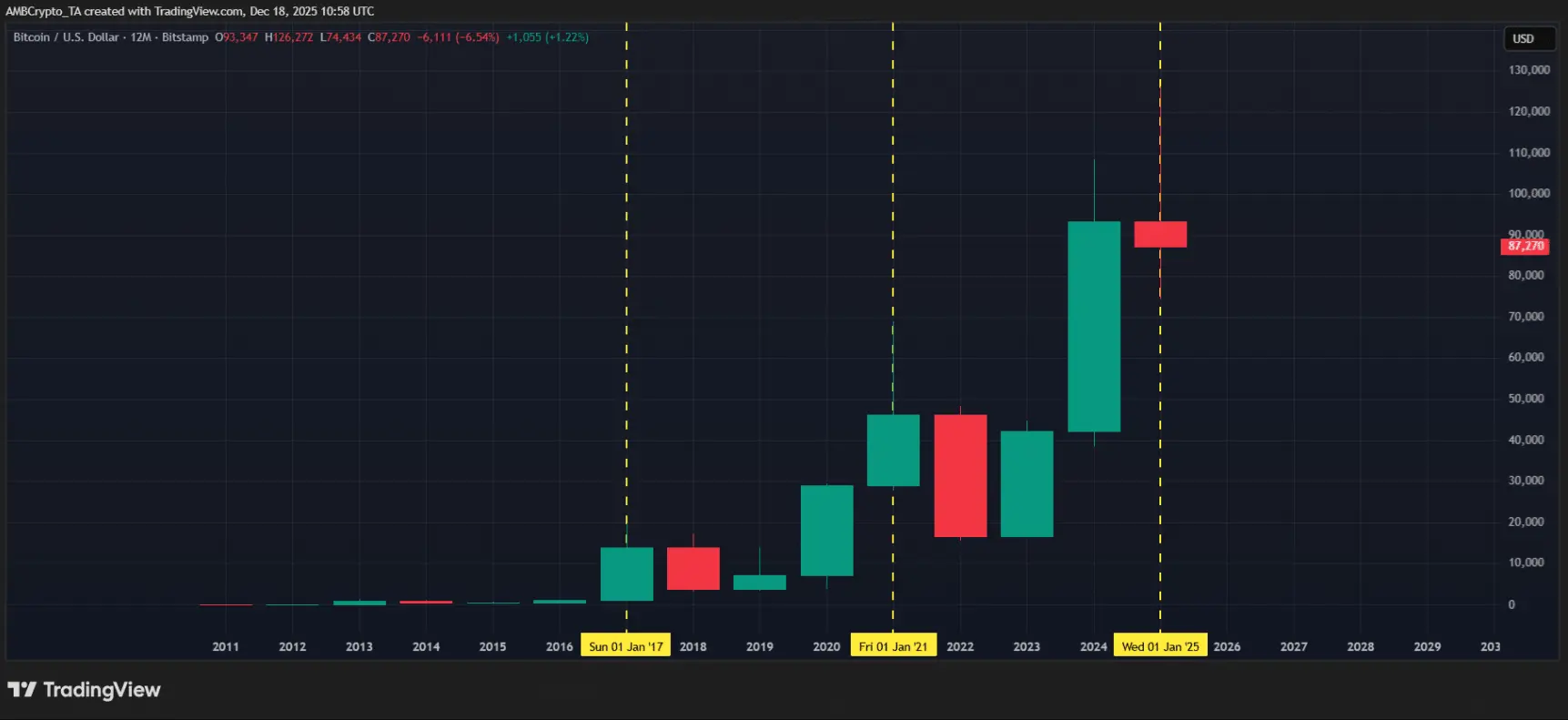 BTC/USDT chart on a 12-month timeframe | Source: TradingViewHistorically, the first year after each halving is often regarded as a “golden” period, when Bitcoin experiences substantial growth due to the supply shock.
In the 2020 cycle, the halving effect triggered a clear price surge: BTC surged about 60% in 2021. This upward momentum was then followed by a deep correction, with a decrease of 64% in 2022 as the market found the cycle's bottom, before Bitcoin made an impressive recovery, increasing by up to 153% in 2023.
However, the current cycle is following a completely different scenario. Despite the halving event occurring in 2024, Bitcoin has not mirrored the familiar trajectory of previous cycles.
From a technical perspective, BTC is facing the possibility of closing its first year after halving with a decrease of approximately 7%, as the fourth quarter has less than two weeks left to conclude.
This development raises a big question for investors: is the four-year cycle model – once considered the “guiding principle” of Bitcoin – gradually losing its effectiveness and reliability as the crypto market matures?
New foundational factors rewriting the “rules of the game” for Bitcoin
Bitcoin appears to be gradually breaking away from the four-year boom-bust cycle that has been deeply embedded in the history of the crypto market.
And this is clearly a positive signal for the bulls.
Instead of repeating the severe crashes like the 73% drop in 2018 or the 64% in 2022 — which largely stemmed from excessive exuberance — BTC is showing clear signs of transformation. Data from CryptoQuant indicates that the current market structure is different from before.
Specifically, the convergence of four key factors is helping Bitcoin move more steadily, maintaining a cyclical accumulation state, limiting sudden fluctuations, and controlling the FOMO effect. This is clearly reflected in the amount of reserves on exchanges, with over 140,000 BTC accumulated in the fourth quarter alone.
 Source: CryptoQuant Additionally, the introduction of Bitcoin ETF funds in 2024 has added an important layer of “buffer,” contributing to the sustainability of the crypto market.
When stringing together these trends, it can be seen that Bitcoin is entering a more mature phase in terms of structure.
In the previous four-year cycles, the “hype” factor often pushed BTC prices into extreme states — such as the 64% drop after a more than 300% increase following the 2020 cycle, or the 125% increase in 2016 that led to a 73% crash in 2018.
But this time, the story is different.
With a steadily solid foundation, Bitcoin is gradually breaking through the traditional pattern of sharp increases and deep declines. The current adjustments thus resemble a necessary pause in the long-term upward trend — or rather, a springboard for a forming “super cycle” of Bitcoin.
SN_Nour
Disclaimer: The information on this page may come from third parties and does not represent the views or opinions of Gate. The content displayed on this page is for reference only and does not constitute any financial, investment, or legal advice. Gate does not guarantee the accuracy or completeness of the information and shall not be liable for any losses arising from the use of this information. Virtual asset investments carry high risks and are subject to significant price volatility. You may lose all of your invested principal. Please fully understand the relevant risks and make prudent decisions based on your own financial situation and risk tolerance. For details, please refer to
Disclaimer.
Related Articles
Trading Time: Crypto Regulation Welcomes Major Positive News, Bitcoin May "Sell Off First Then Rally" After Rate Decision Meeting
# Daily Market Highlights and Trend Analysis, Produced by PANews
## Macro Market
The US-Israel strike against Iran has entered its 19th day, with Trump claiming to have "completely destroyed Iran's military forces" and stating no NATO ally assistance is needed. Iran has announced the 61st wave of attacks under "True Promise-4" operation in retaliation for the death of Larijanis, secretary of Iran's Supreme Security Council. Analysis suggests that Larijani's death will have far greater impact on Iran's regime operations than Khamenei.
On Tuesday, US stocks continued their rebound trend, with the three major indices posting marginal gains. However, the sell-off triggered by the US-Iran war is far from bottoming. Bank of America strategist Michael Hartnett warns that Middle East conflicts and private credit concerns have shattered the "bubble bull market," but current sentiment reading of 5.6 and Put/Call sell signal of 8.5 indicate the market has yet to reach historically extreme pessimism.
Ahead of the FOMC meeting early Thursday morning, Chicago...
PANews29m ago
Will U.S. Treasury debt breaking through $39 trillion prompt investors to bet on bitcoin and other safe-haven assets?
On March 18, U.S. national debt surpassed $39 trillion, drawing market attention. Rising debt is driven by persistent deficits and increased interest burdens, with investors showing growing interest in decentralized assets such as Bitcoin. Policymakers face trade-offs between debt servicing and funding new initiatives, with rising debt potentially impacting infrastructure investment and long-term economic growth. Markets should monitor how debt developments influence investment strategies.
GateNews1h ago
A certain CEX's trading volume reached $1.443 billion in the past 24 hours, with XRP, BTC, and ETH ranking in the top three.
According to Gate News, on March 18th, a certain CEX's trading volume was $1.443 billion, down 42.67%. The top five tokens were XRP, BTC, ETH, POLYX, and BTT, with trading volume shares of 12.90%, 7.95%, 6.91%, 6.10%, and 4.90% respectively.
GateNews1h ago
Federal Reserve March 2026 Interest Rate Decision Set to Be Revealed Soon, Powell's Stance Will Influence Bitcoin and Market Trends
The Federal Reserve will maintain interest rates at 3.5%-3.75% on March 18. Market attention will be on Powell's comments regarding inflation and future policy. Rising core PCE and oil price pressures limit the room for rate cuts, with only a 30% chance of easing this year. Political factors influencing Powell's tenure have led to noticeable market reactions, and risk assets as well as cryptocurrency prices are expected to be affected.
GateNews1h ago


