2025 Cryptocurrencies shift from “speculation” to “capital market infrastructure.” The Trump administration pushes the GENIUS Act to define stablecoins. Solana’s on-chain trading volume in March surpasses the total of major CEXs, with stablecoin market cap exceeding $300 billion and holders reaching 200 million. The 12 biggest winners span regulation, infrastructure, and application layers.
Regulatory Reversal: The Big Three Rewrite Industry Destiny
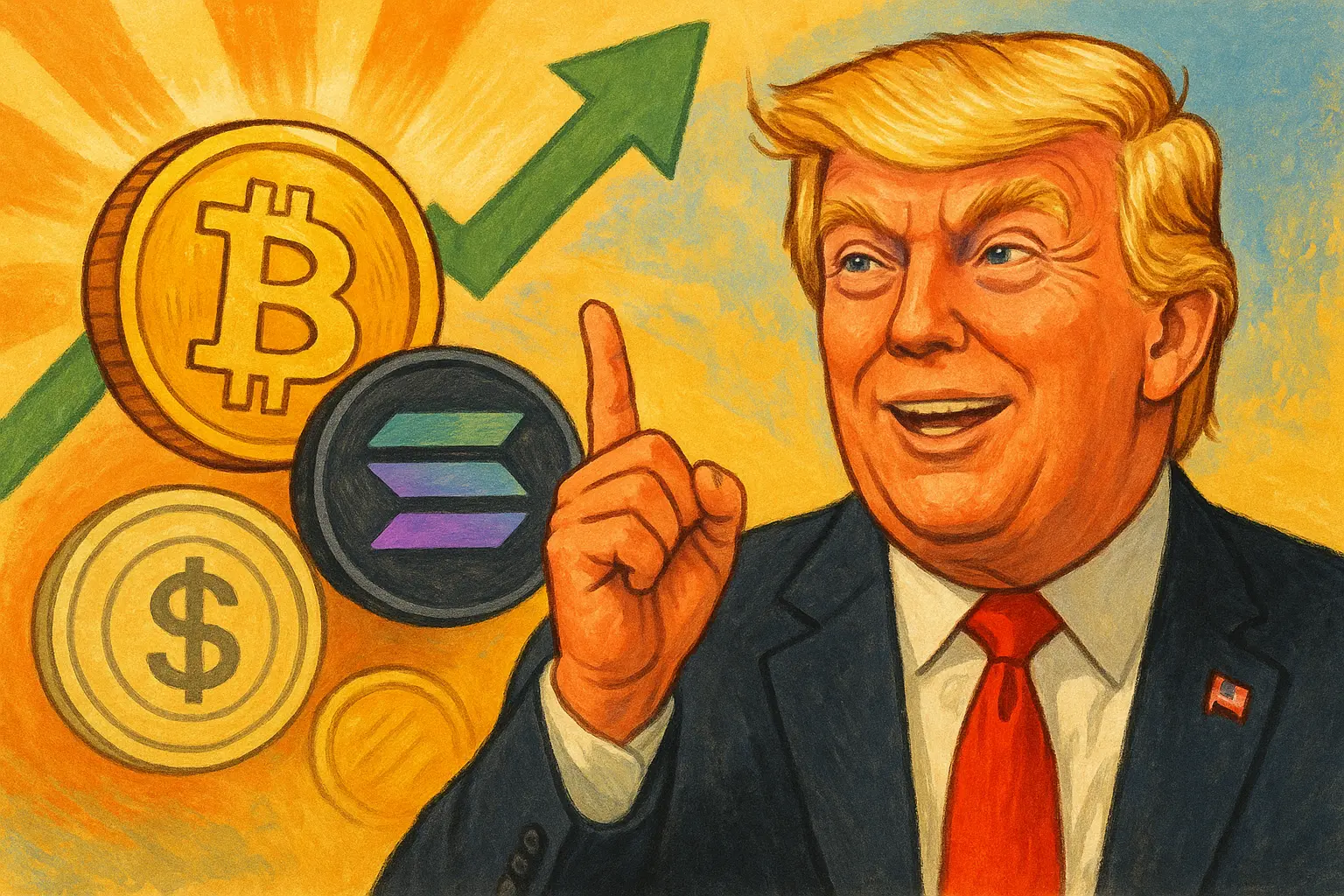
The biggest winner in 2025 cryptocurrencies is undoubtedly the complete reversal of the US regulatory environment. The Trump administration achieved long-standing industry goals in less than 12 months. The GENIUS Act signed on July 18 first provides a federal definition for stablecoins. The March “Strategic Bitcoin Reserve” executive order signals to global sovereign funds: digital assets concern national security. The January 1 executive order explicitly bans central bank digital currencies (CBDCs), clearing obstacles for private sector innovation. The US dollar will be issued by Tether, Circle, and banks, not the Federal Reserve.
Ripple and XRP, after years of legal struggles, finally gain freedom, ending the SEC lawsuit with a final ruling, clearing hurdles for institutional adoption. The narrative shifts overnight from “litigation risk” to “liquidity engine,” driving the launch of the first spot XRP ETF in November. Ripple has invested over $4 billion this year in strategic acquisitions, including major broker Hidden Road, asset management firm GTreasury, and stablecoin infrastructure provider Rail, transforming from a “payment company” into a full-stack institutional payment giant.
Hong Kong surpasses competitors in execution power. In Q3 2025, the ETP market officially overtakes Korea and Japan to become the third-largest globally, with an average daily trading volume of HKD 37.8 billion (up 150% annually). The Securities and Futures Commission (SFC) issues official licenses to major global exchanges, bringing the total licensed exchanges to 11. The stablecoin regulations effective August 1 attracted over 30 applicants before September, successfully positioning Hong Kong as the “institutional liquidity gateway” in Asia-Pacific.
Three Major Technological Breakthroughs in Infrastructure Layer Reshape the Competitive Landscape
Solana completes the most challenging transition in 2025 cryptocurrencies, upgrading from “meme coin speculation” to “global liquidity layer.” According to Artemis data, its on-chain SOL-USD trading volume has exceeded the combined spot trading volume of major CEXs for three consecutive months. This is no longer a competition with Ethereum but with Nasdaq. CoinGecko reports Solana as the most watched blockchain ecosystem for the second consecutive year, with price discovery shifting from centralized exchanges to on-chain.
Three Major Breakthroughs in Infrastructure Layer
Solana Dominates Liquidity: On-chain trading volume surpasses top CEXs, becoming the preferred platform for high-frequency sensitive trading.
Base Distribution Advantage: The largest US compliant crypto exchange Layer-2 becomes an incubator for consumer applications and stablecoins, prioritizing distribution over technological novelty.
Sustainable DEX Explosion: October monthly trading volume reaches $1.2 trillion, with Hyperliquid and Aster capturing trading volume from CEXs.
Ethereum Layer-2 Base proves that distribution is more important than technology, leveraging the large user base of the US’s largest compliant crypto exchange to become the first choice for consumer applications. It acts as a bridge between the chaotic on-chain world and the regulated environment, serving as an “ordinary” crypto incubator. These consumer-facing fintech applications use encryption technology in the backend without users being aware.
US spot ETFs continue to thrive despite poor Bitcoin performance. BlackRock’s iShares Bitcoin Trust (IBIT) becomes one of the 10 most inflow-allocated ETFs in the US, surpassing Invesco QQQ Trust and SPDR Gold Shares (GLD). In September, the SEC approved simplified listing standards, streamlining future product approvals by removing the requirement to submit a 19b-4 form for each new ticker, leading to many new products focused on Solana and XRP.
Three Killer Application Scenarios in Application Layer Verified
The “killer app” debate for stablecoins has ended. Market cap surpassed $300 billion in October, with Ethereum-based stablecoin supply reaching a record $166 billion in September. Token Terminal data shows total holders reaching about 200 million, a new high. The GENIUS Act provides legal clarity for banks to enter, transforming stablecoins from trading chips into a global fintech settlement layer.
Real-world assets (RWA) shift from “pilot projects” to “key infrastructure.” BlackRock’s BUIDL fund is accepted by Binance as OTC collateral, blurring the lines between traditional finance and crypto markets. In December, tokenized money market funds and treasury securities assets under management exceed $8 billion, with the broader RWA market reaching approximately $20 billion. Traditional financial giants like BlackRock, JPMorgan, Fidelity, Nasdaq, and DTCC heavily rely on the industry to make traditional finance more transparent and efficient.
Privacy coins emerge as the undisputed top-performing area in 2025, with Zcash leading the way in shedding the “illegal” stigma and becoming a post-monitoring economy darling. Regulatory thaw is evident, with the SEC and privacy protocol leaders holding formal meetings to discuss compliance frameworks—unimaginable a year ago. Ethereum developers accelerate privacy protection plans, and other privacy solutions are widely adopted on mainnets.
Market activity contracts are officially entering mainstream America. Kalshi and Polymarket set records this year. Traditional financial institutions and crypto-native companies are entering the space, bridging the gap between “gambling” and “finance.” As Polymarket develops through revised CFTC frameworks, event contracts shift from niche online novelty to regulated hedging tools.
Early Adopters’ Persistence Outperforms Speculation
The ultimate winners in 2025 cryptocurrencies belong to the generation that stayed. Early adopters endured the 2022 crash, Gensler’s regulatory clampdowns, and the dull 2024, and their persistence was validated in 2025. This year is not just “digital rise” but “theory proven correct.” When BlackRock, Vanguard, and sovereign funds entered strongly, they bought stocks sold by individual investors who showed foresight during the bleakest times.
Disclaimer: The information on this page may come from third parties and does not represent the views or opinions of Gate. The content displayed on this page is for reference only and does not constitute any financial, investment, or legal advice. Gate does not guarantee the accuracy or completeness of the information and shall not be liable for any losses arising from the use of this information. Virtual asset investments carry high risks and are subject to significant price volatility. You may lose all of your invested principal. Please fully understand the relevant risks and make prudent decisions based on your own financial situation and risk tolerance. For details, please refer to
Disclaimer.
Related Articles
OpenClaw Founder Issues Warning: CLAW Fake Airdrop Scams Incoming, GitHub Developers Targeted
OpenClaw founder Peter Steinberger warned users to be vigilant against phishing emails that impersonate GitHub notifications, luring users to click suspicious links to obtain fake tokens. The attack targets developers worldwide, with attackers using publicly available contact information for precision attacks. To prevent fraud, users should only trust information from official websites and delete any suspicious emails.
MarketWhisper2h ago
Bitcoin ETF Inflows for Seven Consecutive Days Set Half-Year Record, Scale Still Below 2025 Peak
US spot Bitcoin ETF sees seven consecutive days of inflows, marking the longest streak since the start of 2025. Cumulative inflows over the past three weeks reached $2.2 billion, accounting for 79% of total crypto inflows. Although market sentiment has improved somewhat, it still falls short compared to the 2025 peak, with analysis suggesting a recovery in market demand rather than the onset of a bull cycle. Solana ETF showed outstanding performance this week, while Ethereum ETF continues to face net outflow pressure.
MarketWhisper3h ago
US SOL Spot ETF Net Outflows of $295,700 Yesterday
According to SoSoValue data, on March 18 Eastern Time, the US SOL spot ETF experienced a net outflow of $295,700 in a single day, all from the VanEck Solana ETF. The total net asset value is currently $884 million, with a cumulative net inflow of $989 million in history.
GateNews4h ago
Best Crypto to Buy Now: BTC, XRP, SOL, TRX, AVAX and APEPEPE Top Picks
Quick Answer: What Is the Best Crypto to Buy Now?
The best crypto to buy now depends on your strategy, but top choices include BTC for market direction, XRP for strength, SOL for growth, TRX for stability, AVAX for rebound potential, and APEPEPE for early-stage upside.
Market Overview: Why
BlockChainReporter7h ago
Solana Price Prediction 2026: How Far Can SOL Go This Year & Why Could DeepSnitch AI 100x Morpho’s Q2 Projection After March Debut?
US-listed Spot Bitcoin exchange-traded funds (ETFs) have attracted almost $1 billion in inflows since March 8, while BTC has surged more than 12% to $74,250 over the same period. This capital flush, which has lasted over six days, marks the longest streak of fresh cash into ETFs since
CaptainAltcoin9h ago


