The crypto market is entering the new year with cyclical low activity, seemingly calm on the surface but turbulent beneath. According to the latest market analysis report from 10x Research, despite Bitcoin and Ethereum trading volumes shrinking by over 30% from average levels and the total market capitalization slightly declining to $2.96 trillion, the derivatives market is sending a completely different signal: volatility is being compressed to an extreme, funding rates are quietly rising, and leverage positions remain high. This dangerous combination of “low liquidity and high leverage,” coupled with continuous outflows from spot ETFs and stablecoin withdrawals, makes the market structure abnormally fragile. A small price fluctuation could trigger a chain of liquidations, potentially determining the subsequent major trend direction.
Market Surface: Activity Drops to Zero, but Funding Rates Reveal Bulls’ “Last Stubbornness”
As the year-end approaches, trading activity in the cryptocurrency market has shrunk noticeably. Data shows that the weekly average trading volume across the entire market has fallen to $79 billion, a 26% decrease from normal levels. Bitcoin, as the market leader, is in an even more severe situation, with weekly trading volume only $28.9 billion, down 36% below the average; Ethereum’s weekly volume is just $14.8 billion, down 32%. Extremely low on-chain transaction fees—Ethereum network Gas fees are at the 4th percentile of historical levels—are the most direct on-chain confirmation of this activity stagnation, indicating that demand for both simple transfers and complex DeFi interactions has hit rock bottom.
However, amidst this dull trading scene, the funding rates in the perpetual contract market are quietly rising, forming a stark divergence. This week, Bitcoin’s perpetual funding rate increased slightly by 3.7%, reaching an annualized rate of 8.9%, placing it in the 57th percentile over the past year. Ethereum’s funding rate also rose by 3.4% to 6.9%. Funding rates are the fees paid by long positions to short positions; an increase usually indicates a market dominated by bullish sentiment or at least more crowded long positions. In the context of weak spot buying, stagnant or even declining prices, the upward movement of funding rates is particularly conspicuous. It reveals a key fact: despite overall participation declining, the remaining traders may have even more concentrated leveraged long positions, making the market “thinner and more crowded.”
This divergence is a typical sign of market fragility. It suggests that the “fuel” driving prices higher (spot buying and incremental capital) is running out, while the “weight” (leverage long positions) remains high. Once prices move unfavorably, these high-cost long positions will face enormous liquidation pressure, and the sluggish liquidity will be unable to absorb these sell-offs effectively, easily causing a flash crash and creating a “liquidity gap.”
Structural Cracks: ETF Outflows and Stablecoin Withdrawals Both Quench the Upward Momentum
The current market weakness is not without cause; its roots lie in the simultaneous reversal of two core capital engines that supported the previous bull run. First, the spot Bitcoin ETF. Data shows that in the past 7 days, Bitcoin ETF experienced net outflows of up to $940 million, placing it in the 7th percentile of historical lows. Since the October Federal Reserve meeting, cumulative outflows have reached $5.7 billion. Ethereum ETFs are similarly bleak, with net outflows of $179 million last week. Institutional funds entering crypto through compliant channels are tightening or even reversing, exerting continuous downward pressure on market sentiment and prices.
Meanwhile, the “ammunition depot” within the crypto world—stablecoins—also shows signs of shrinking. The total market cap of USDT and USDC, the main trading media, has stagnated, and the “minting” activity of stablecoins (creating new stablecoins, usually indicating capital inflow readiness) has plummeted to the 5th percentile of history. Over the past week, the total stablecoin supply decreased by $70 million, a classic “capital withdrawal” signal. When investors convert crypto assets into stablecoins and withdraw from exchanges or the entire ecosystem, it often indicates rising risk aversion and a lack of confidence in the future market.
Market Core Divergence and Risk Signals
- Volume vs. Funding Rate Divergence: Bitcoin’s trading volume is 36% below average, but the funding rate has risen to 8.9%/year.
- Spot vs. Derivatives Divergence: Continuous large ETF outflows (spot selling pressure) but futures open interest remains high (leverage positions unchanged).
- Liquidity Supply Shrinks: Stablecoin minting activity (5th percentile) and market cap growth both stagnate, indicating a lack of new “ammunition.”
- Market Structure Weakening: Participants decrease, but remaining positions become more crowded, market depth deteriorates, increasing the risk of violent swings.
The shutdown of these two engines leaves the market without the most direct upward drivers. The report sharply states: “Without capital inflows, the market has no upward risk.” Currently, the market is more about digesting existing positions and waiting for new narratives rather than building momentum. All rebound efforts may quickly collapse due to lack of sustained buying support.
Technical and Sentiment: Volatility Collapses, Market in “Storm Eye” Calm
From technical indicators, Bitcoin and Ethereum are both in a zone of ambiguity. Bitcoin’s Relative Strength Index (RSI) is at 43%, and the Stochastics indicator is at 30%, giving slightly bullish and bearish signals respectively, showing a tug-of-war between bulls and bears. The model indicates Bitcoin is only 4.5% away from triggering a trend reversal (from downtrend to uptrend), with a key support/resistance level near $88,421. Ethereum’s situation is similar, 5% away from a trend shift, with a critical level at $2,991. This suggests the market is at an extremely sensitive equilibrium point, where any small increase in either side’s strength could break the deadlock.
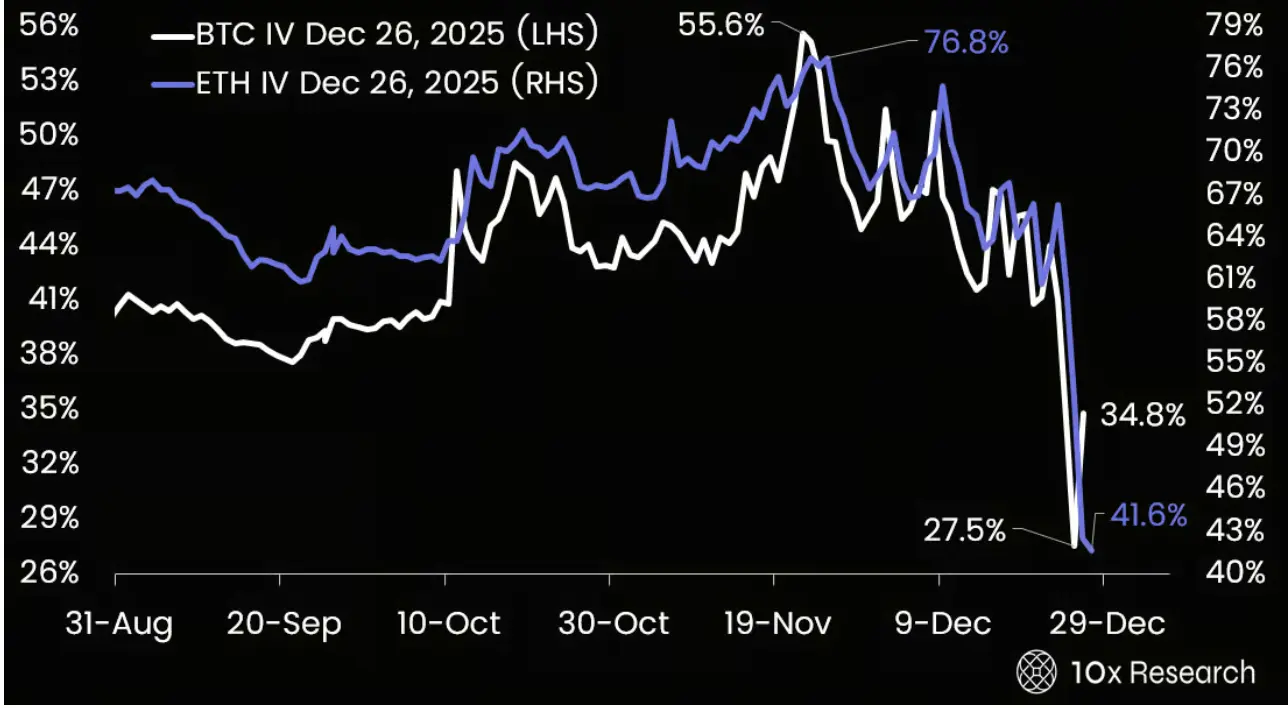
(Source: 10x Research)
More illustrative is the collapse of volatility. The 30-day realized volatility for Bitcoin and Ethereum has dropped to 38.2% and 61.2% respectively, both significantly below recent averages. Derivatives traders seem to be betting on this “calm.” Options market pricing shows traders expect Bitcoin’s volatility over the next week to be only 3.1%, Ethereum’s at 4.7%. Based on volatility estimates, there is a 68% probability Bitcoin will fluctuate between $82,800 and $92,100 in the next week, while Ethereum’s range is $2,685 to $3,185. This extremely low implied volatility is often a precursor to major trend shifts, like the calm before a storm.
Market sentiment indicators corroborate this. Bitcoin’s “Greed & Fear Index” has fallen from 32% a week ago to 24%, and Ethereum’s from 47% to 36%, both pointing to short-term negative sentiment. When market sentiment is subdued but prices do not fall sharply, and volatility is compressed to very low levels, it often indicates the market is accumulating energy for the next big move. The flow of funds in options markets is also telling: after last week’s expiry, nearly half of Bitcoin options’ notional value was removed, while new flows show traders are “mainly buying Bitcoin volatility,” and in Ethereum, more “selling call options.” This reflects professional traders’ skepticism about a sharp short-term rise in Bitcoin and their positioning for potential volatility.
Future Catalysts and Strategy Insights: Waiting for a Break in the Fragile Balance
In such a fragile and sensitive market structure, any external catalyst could be amplified. Upcoming macroeconomic data, such as the January 9 non-farm payroll report and the January 13 CPI, as well as the Federal Reserve’s meeting at the end of January, will be key tests of market resilience. Any unexpected signals regarding interest rate paths could quickly shift risk appetite. Additionally, the US government’s potential shutdown at the end of January and the EU’s new crypto tax regulation (DAC8) coming into effect are also potential market disruptors.
For traders, the current environment demands high discipline and flexibility. The report revisits a successful strategy recommended over the past six weeks: selling Bitcoin call options with a strike at $100,000 and put options at $70,000, creating a “short straddle” position. This strategy was based on the expectation that Bitcoin would remain range-bound with high implied volatility. As volatility compressed from 55% to 35%, it yielded a 2.6% (annualized about 26%) return. This exemplifies the viability of earning “time value” and “volatility decay” in a trendless market.
Looking ahead, the market’s balance will eventually be broken. The report suggests that the probability of Bitcoin and Ethereum experiencing a trend reversal (turning bullish) in January is increasing. The core task for traders is to prepare for a breakout while controlling risk. This means being alert to the “liquidity trap” risk under the current “low liquidity, high leverage” structure, avoiding being wiped out in false breakouts; and closely monitoring key resistance levels for volume breakouts, which could signal the start of a new trend. Until a clear direction emerges, adopting neutral or slightly bearish volatility strategies may be more prudent. Once key levels are convincingly broken, positions should be adjusted promptly to follow the trend. In this liquidity-driven retreat, position management and deep understanding of market microstructure are more important than ever.
Disclaimer: The information on this page may come from third parties and does not represent the views or opinions of Gate. The content displayed on this page is for reference only and does not constitute any financial, investment, or legal advice. Gate does not guarantee the accuracy or completeness of the information and shall not be liable for any losses arising from the use of this information. Virtual asset investments carry high risks and are subject to significant price volatility. You may lose all of your invested principal. Please fully understand the relevant risks and make prudent decisions based on your own financial situation and risk tolerance. For details, please refer to
Disclaimer.


