As of January 5, 2026, U.S. Representative Ritchie Torres (D-N.Y.) is preparing to introduce the Public Integrity in Financial Prediction Markets Act of 2026, a bill aimed at prohibiting federal elected officials, political appointees, and executive branch employees from trading on prediction market contracts related to government policy or political outcomes when they possess material nonpublic information.
(Sources: Polymarket)
The proposal extends traditional insider trading prohibitions—long applied to securities markets—to emerging prediction platforms like Polymarket and Kalshi. The legislation was prompted by intense scrutiny over highly timed bets on Polymarket that profited significantly from the U.S. military operation capturing Venezuelan President Nicolás Maduro on January 3, 2026.
The Maduro Capture and Prediction Market Activity
On January 3, 2026, President Donald Trump announced that U.S. forces had conducted a large-scale strike on Venezuela, capturing Maduro and his wife, Cilia Flores, during an overnight raid in Caracas. Maduro was subsequently flown to New York to face long-standing U.S. federal charges, including narco-terrorism conspiracy. The operation involved disabling Venezuelan air defenses and a Delta Force extraction, marking a rare instance of U.S. forces apprehending a sitting foreign head of state.
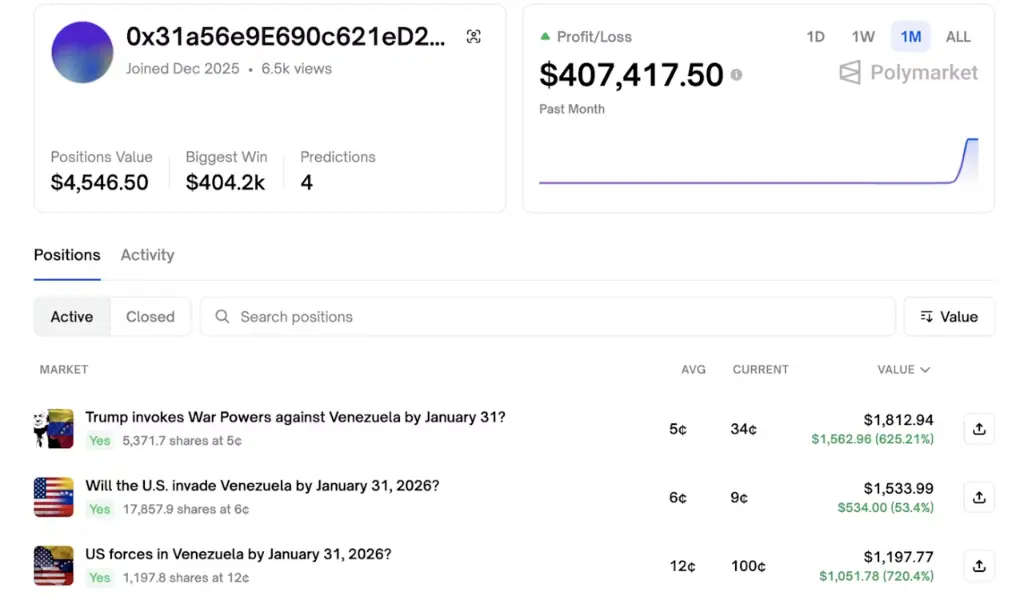
Hours before Trump’s public announcement, trading volume on Polymarket spiked dramatically on contracts betting on Maduro’s removal from power by January 31, 2026. A newly created account—opened in late December 2025—wagered approximately $32,000–$32,500 when odds were low (around 6–7 cents per share), netting over $400,000 in profits (a return exceeding 1,200%) once the contract resolved following the capture.
Blockchain analytics firm Lookonchain identified multiple wallets (some created days earlier) that collectively profited around $630,000 on similar Venezuela-related bets. While some traders attributed gains to public signals (e.g., monitoring Pentagon-area Domino’s Pizza orders as a proxy for military activity), the precise timing fueled widespread speculation of insider information leakage.
Rival platform Kalshi emphasized its rules already prohibit trading on material nonpublic information, but Polymarket operates in a regulatory gray area as a decentralized, crypto-based platform theoretically restricted for U.S. users.
Details of the Proposed Legislation
According to Punchbowl News founder Jake Sherman, citing sources familiar with the matter, the Public Integrity in Financial Prediction Markets Act of 2026 would:
- Ban federal officials and certain government employees from buying, selling, or exchanging prediction contracts tied to government actions, policy, or political outcomes on interstate commerce platforms.
- Mirror Securities and Exchange Commission (SEC) insider trading standards, preventing the exploitation of official-duty information for personal gain.
Torres’ office described the bill as addressing a growing gap in oversight as prediction markets—valued at billions in trading volume—increasingly cover sensitive geopolitical and political events. No co-sponsors have been announced yet, but the Maduro incident has accelerated its introduction.
Broader Implications for Prediction Markets
Prediction markets like Polymarket aggregate crowd wisdom to forecast events, often outperforming traditional polls. However, they remain lightly regulated compared to securities or commodities markets overseen by the SEC or Commodity Futures Trading Commission (CFTC). The CFTC generally prohibits contracts on war, terrorism, or assassination, but enforcement is challenging for offshore or decentralized platforms.
The incident highlights tensions: proponents argue insider information enhances market accuracy, while critics warn it undermines integrity and public trust. Separately, Polymarket addressed unrelated account breaches in late December 2025, attributing them to a third-party authentication vulnerability (now resolved), affecting a small number of users.
Risks and Outlook
While no direct evidence links the profitable bets to government insiders, the episode underscores vulnerabilities in unregulated platforms handling high-stakes events. If passed, Torres’ bill could set a precedent for treating prediction markets more like traditional finance, potentially impacting innovation but bolstering public confidence.
This development occurs amid heightened global scrutiny of U.S. actions in Venezuela, with international reactions ranging from condemnation to calls for Maduro’s release. Prediction markets continue to attract mainstream attention, but incidents like this may invite broader regulatory reforms in 2026.
Disclaimer: The information on this page may come from third parties and does not represent the views or opinions of Gate. The content displayed on this page is for reference only and does not constitute any financial, investment, or legal advice. Gate does not guarantee the accuracy or completeness of the information and shall not be liable for any losses arising from the use of this information. Virtual asset investments carry high risks and are subject to significant price volatility. You may lose all of your invested principal. Please fully understand the relevant risks and make prudent decisions based on your own financial situation and risk tolerance. For details, please refer to
Disclaimer.


