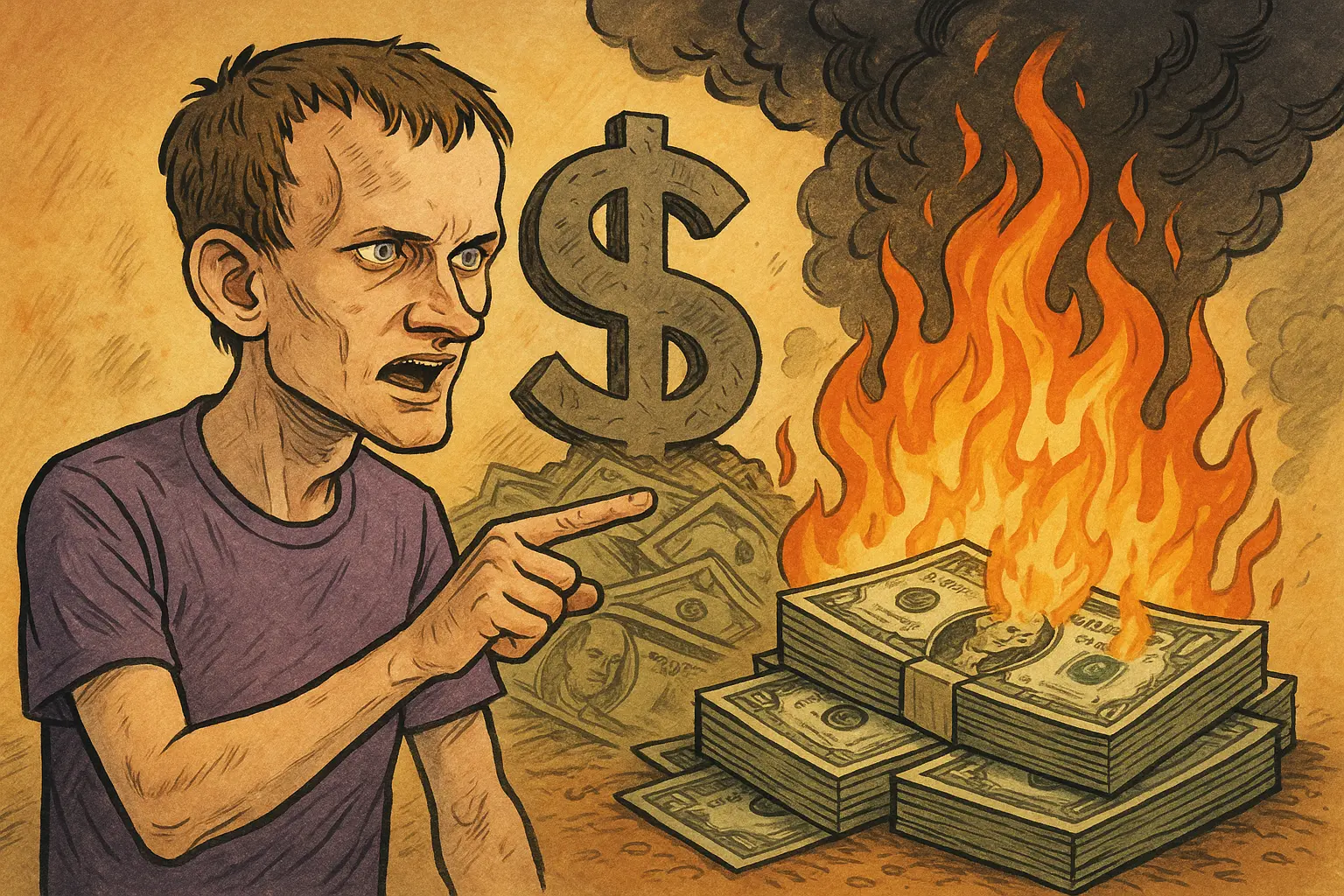
Ethereum co-founder Vitalik Buterin pointed out on X on Sunday that decentralized stablecoins face three structural challenges. The current US dollar stablecoin market size has reached $300 billion, with Tether and Circle controlling the majority supply. Vitalik warns that over a 20-year span, hyperinflation could destroy the dollar-pegged model. He previously shorted RAI for seven months, earning $92,000 to validate his theory.
Vitalik Criticizes the Three Major Structural Flaws of USD-Pegged Stablecoins
Vitalik clearly stated on X: “We need better decentralized stablecoins. In my view, there are three issues.” These are: finding a better tracking index than the dollar, designing anti-capture oracles, and solving the problem of staking yield competition. His remarks are not empty criticism but come from deep insights gained through long-term observation of the DeFi ecosystem.
The Three Deadly Flaws of Decentralized Stablecoins as Highlighted by Vitalik
Index Issue: Long-term devaluation risk of the dollar, potential for hyperinflation over 20 years
Oracle Capture: Large capital can manipulate prices feeding the oracle, forcing protocols to extract high value, harming users
Staking Yield Competition: ETH staking yields of 3% to 5% conflict fundamentally with the use of stablecoin collateral
The first issue concerns the long-term sustainability of stablecoins. Vitalik believes that short-term tracking of the dollar exchange rate may be feasible, but one of the visions for national resilience should be to reduce dependence on the dollar. He questions: “Over a 20-year span, if hyperinflation occurs—even mild hyperinflation—what would happen?” This concern is not unfounded; the dollar’s purchasing power has declined by about 40% over the past 20 years. If future monetary policies go out of control, stablecoin holders could suffer hidden losses.
The second issue involves the decentralization challenge of oracles. Vitalik warns that without anti-capture design, protocols face painful trade-offs: “You must ensure that the cost of capture exceeds the market cap of the protocol token, which in turn means protocol value extraction exceeds the discount rate, which is very unfavorable for users.” He adds that this dynamic is “a key reason I constantly criticize financialized governance: it inherently lacks defensive/offensive asymmetry, so high-resource plunder is the only way to maintain stability.”
The third issue is staking yield competition. When ETH staking yields 3% to 5%, why lock ETH as collateral for stablecoins and give up these yields? This opportunity cost makes it difficult for decentralized stablecoins to attract enough collateral, limiting their scale expansion. Vitalik suggests some possible solutions, such as reducing staking yields to “about 0.2%, basically amateur level,” or creating a new staking category, but warns these ideas should be viewed as “enumerations of potential solutions, not endorsements.”
Failure Cases of RAI Validate Vitalik’s Theory
Vitalik’s warnings are not just theoretical; the Reflexer RAI stablecoin is a prime example of failure. RAI is a non-pegged stablecoin backed by Ethereum, embodying the design philosophy Vitalik once praised as “a pure ideal type of collateralized automated stablecoin.” Paradoxically, Vitalik shorted RAI for seven months, earning $92,000.
Reflexer co-founder Ameen Soleimani used this trade to argue that the protocol’s design is flawed. “Supporting only Ethereum with RAI was a mistake,” Soleimani said, because holders cannot earn staking yields on the underlying collateral, which is exactly the third problem Vitalik emphasizes now. The failure of RAI proves that even a theoretically perfect design cannot survive in the market if it cannot address staking yield competition.
Earlier, the Terra USD case revealed the unsustainability of high yields. Terra offered nearly 20% yields via the Anchor protocol, attracting hundreds of billions of dollars, but this high yield lacked real income support, ultimately leading to a $40 billion collapse. Last month, Terraform Labs founder Do Kwon was sentenced to 15 years in prison for his role in the Terra-Luna collapse.
These two failure cases validate Vitalik’s theory from both sides: RAI failed because it could not offer competitive yields, and Terra collapsed due to unsustainable yields. Decentralized stablecoins need to balance between “zero yields attracting insufficient interest” and “high yields creating Ponzi-like structures,” but this balance has yet to be achieved.
Dominance of Centralized Giants and the Difficult Breakthrough for Decentralization
Decentralized stablecoins still account for a very small part of the overall market. According to The Block data, the US dollar-pegged stablecoin market has exceeded $291 billion, with Tether’s USDT holding about 56% market share. Circle’s USDC ranks second, with both controlling over 80% of the market combined.
The market share of decentralized stablecoins is extremely limited. Ethena’s USDe, MakerDAO’s DAI, and Sky Protocol’s USDS (an upgraded version of DAI) each hold about 3% to 4% of the market. Although some new entrants are still attracting funds—for example, major CEXs leading a $10 million funding round for Usual by the end of 2024—centralized issuers still dominate.
This market landscape reveals a harsh reality: users trust the simple logic and immediate redemption guarantees of centralized stablecoins more, while the complex mechanisms and potential risks of decentralized stablecoins hinder mainstream adoption. Tether and Circle hold reserves in US Treasuries and bank deposits, offering clear 1:1 redemption promises. In contrast, decentralized stablecoins’ collateral management, liquidation mechanisms, and oracle dependencies are too complex for ordinary users.
Vitalik’s comments respond to an article claiming Ethereum is an “inverse investment,” which opposes the trend of venture capital favoring custodial stablecoins and new crypto banking. His remarks echo his New Year’s call for developers to build “truly decentralized” applications. Regulatory frameworks around centralized stablecoins are gradually becoming clearer, with the GENUIS Act passed last year establishing the first US payment stablecoin framework.
Disclaimer: The information on this page may come from third parties and does not represent the views or opinions of Gate. The content displayed on this page is for reference only and does not constitute any financial, investment, or legal advice. Gate does not guarantee the accuracy or completeness of the information and shall not be liable for any losses arising from the use of this information. Virtual asset investments carry high risks and are subject to significant price volatility. You may lose all of your invested principal. Please fully understand the relevant risks and make prudent decisions based on your own financial situation and risk tolerance. For details, please refer to
Disclaimer.
Related Articles
Bitwise: Circle's Valuation Could Reach $75 Billion by 2030, Analysts Support Stock Price
Despite Circle's stock price falling approximately 20% recently, institutions remain optimistic about its prospects, with valuations projected to reach $75 billion by 2030. Analysts believe the expansion of the stablecoin market and Circle's market share will continue to drive growth, and its influence may be constrained by competitors' compliance processes.
BlockBeatNews6h ago
Tether Pauses $20 Billion Financing Plan, Awaits First Comprehensive Financial Audit Results
Gate News reported on March 25 that, according to Bloomberg, stablecoin issuer Tether Holdings SA has suspended its previously planned $20 billion fundraising round and is currently awaiting the results of its first comprehensive financial audit, with plans to potentially restart fundraising after the audit results are released. According to informed sources, throughout the fundraising process, potential investors and bankers have been urging Tether to improve financial transparency. However, one informed source indicated that some potential investors remain prepared to support the company before the audit results are announced.
GateNews9h ago
Tether Engages Big Four Firm for First Full Audit
Tether engages a Big Four firm for its first full audit, reviewing its $184 billion USDT reserves, aiming to enhance transparency and financial reporting amid internal leadership changes. The audit covers digital and traditional assets, indicating a commitment to stringent scrutiny.
CryptoFrontNews10h ago
Tether and Circle Freeze $2.49 Million in Stablecoins at Iranian Exchange Wallex, Assets Urgently Transferred to BSC
Tether and Circle have blacklisted the Ethereum hot wallet of Iranian exchange Wallex, freezing approximately $117,000 in USDT and USDC. Wallex transferred $2.49 million in assets to another BSC address hours before the freeze, suggesting coordinated compliance enforcement by stablecoin issuers. This incident reflects increasingly strict regulatory scrutiny of cryptocurrency platforms associated with Iran.
GateNews13h ago
Tether Signs Deal with Big Four Accounting Firms, USDT Reserves Face Biggest Audit in History
Tether announces an agreement with the Big Four accounting firms to conduct a comprehensive audit of its USDT reserves, marking the largest-scale inaugural audit in financial market history and signifying significant progress in reserve transparency. This initiative will boost market confidence and promote stablecoin compliance and mainstream adoption.
GateNews13h ago


