Image source: Visual China
Text | Hu Shixin Editing | Ye Jinyan
Produced by | Deep Web · Tencent News Xiaoman Studio
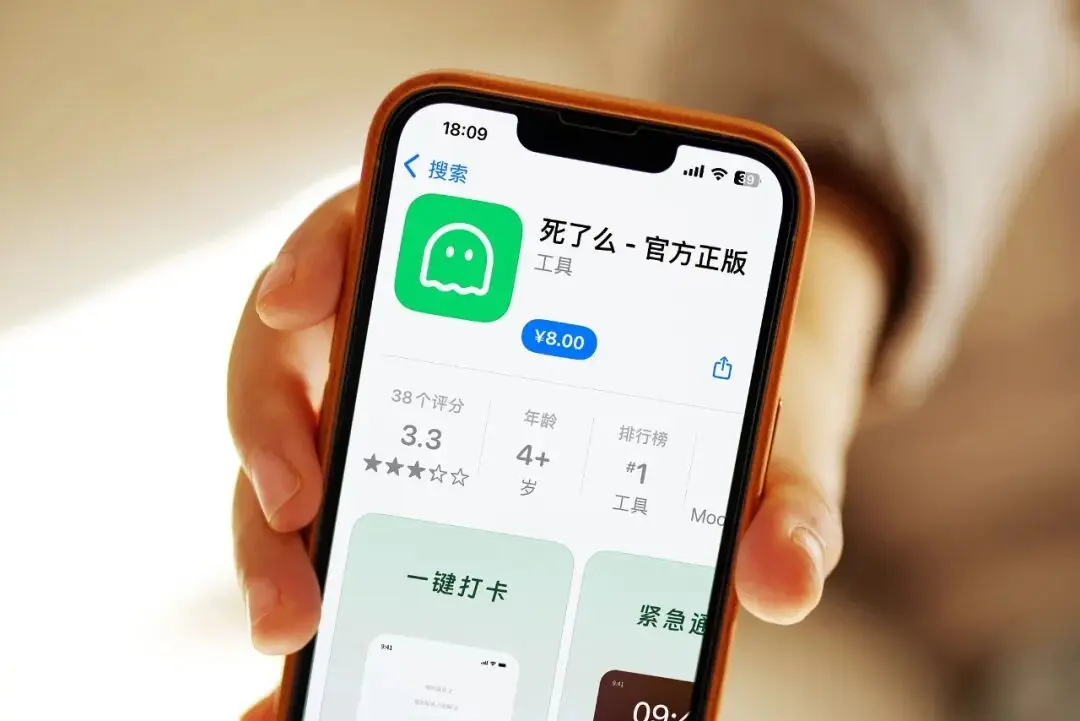
At the beginning of 2026, an app called “Dead or Not” topped the paid app chart on the Apple App Store. As of January 12, the app has been at the top for four consecutive days.
This is an app with almost no complex features: it does not monitor heart rate, connect wearable devices, or require location permissions. Users only need to tap once to check in each day; if they miss two days in a row, on the third day, the system will send reminder emails to pre-set emergency contacts in the name of the user.
It is precisely such a product, compressed to its core function, that has been rapidly amplified in just a few days. The founding team states that the development cost was about 1,500 yuan, and it has already become profitable; after going viral, the number of paying users increased by over 200 times in a short period and continues to rise.
In the current app market, most products are designed around user engagement, high-frequency interactions, and retention rates, but “Dead or Not” does not follow this path. Its core mechanism is triggered only when the user is not using the app.
This contrast makes “Dead or Not” stand out in a highly competitive app environment, and also raises a question: under the premise of not pursuing high-frequency usage, how can such a minimalist product still be monetized?
A “Small Business” Brewing from Social Anxiety
The birth of “Dead or Not” was not due to a sudden inspiration but stemmed from long-term real anxiety accumulated on social media.
“In recent years, everyone has been discussing ‘which app is necessary for everyone and will definitely be downloaded,’ and a netizen mentioned ‘Dead or Not’ app,” recalled one of the founders, Lu Gongchen. “After this idea came out, it generated a lot of discussion, so we saw the demand within it, and this matter itself is meaningful, so we tried to register the name, found it was available, and then spent a month completing the development.”
By mid-2025, the project was officially approved. On social media comment sections, “Dead or Not” is often mentioned jokingly, but behind the jokes lies a serious issue.
According to the seventh national population census, the number of single-person households in China has exceeded 125 million. For this large group of people living alone, especially young people in first- and second-tier cities with fast-paced lifestyles and infrequent contact with friends and family, what is truly unsettling is not the accident itself but the lack of awareness when an emergency occurs.
The founding team is a typical lightweight group: three post-95s, living in different cities, working remotely on product development and operations, responsible for product, design, and R&D respectively. The app’s download page shows that the developer is Yuejing (Zhengzhou) Technology Service Co., Ltd. Business registration information indicates that the company was established in 2025, located in Zhengzhou, Henan Province, with a registered capital of 100,000 yuan.
In an entrepreneurial environment emphasizing heavy capital and scale expansion, their startup costs are restrained. One of the founders, Guo Mengchu, explained that the actual development time for the app was less than a month, with an initial investment of about 1,500 yuan, almost all spent on internal expenses, with no outsourcing or marketing budget.
The team did not set a goal for rapid expansion. “We are not a company pursuing exponential growth,” they said in internal discussions. They prefer the model of a one-person or small company, often discussed in Europe and America in recent years, based on low fixed costs and quick response, prioritizing long-term operation of the product.
In Guo Mengchu’s view, the key to the product is not technological barriers but whether it dares to keep it as simple as possible. The team actively abandoned all design choices that could increase usage frequency and dwell time, leaving only the core mechanism of “disconnection fallback.” This minimalist design directly affects the cost structure and was the most controllable implementation plan the team could find at the time.
Paying for “Uncertainty”
In the App Store ecosystem, the survival environment for paid apps is not very friendly, but “Dead or Not”’s monetization path has been relatively smooth.
The initial price was set at 1 yuan, then increased to 8 yuan after gaining attention. The team also mentioned that they do not rule out further price adjustments to 10 or even 14 yuan in the future. Price changes have not significantly affected conversion rates.
As the user base rapidly expanded, the team is scaling up server resources and continuously optimizing service stability to handle the increased traffic. The founders admitted that they are still in a “barely coping” state and are also pushing for funding to ease the financial pressure caused by sustained growth.
Currently, the team plans to seek about 1 million yuan in funding, offering 10% equity, with an estimated valuation of around 10 million yuan. They said this funding will mainly be used for server costs, SMS sending, and other ongoing operational expenses, not for marketing.
Why are users willing to pay for such a low-frequency scenario?
One user commented: “You might never need this reminder in your life, but if you do once, it’s worth the money.” This feedback points to the product’s monetization logic to some extent: users are not paying for the frequency of specific features but for a form of “worst-case scenario” preparedness.
This logic is similar to insurance products; the product itself is closer to a lightweight safety service rather than a traditional tool app. Some users have experienced missed check-ins, but so far, the team has not received clear feedback confirming that it has actually played a role in real situations.
The payment logic is closely related to the characteristics of the target user group: mainly single people in first- and second-tier cities, with fast-paced work, low social contact, and high sensitivity to the risk of losing contact during emergencies or sudden illnesses. Compared to continuous manual contact, this group prefers low-intervention, sustainable technological safeguards.
Under this premise, the product itself has also formed a certain filtering mechanism. When adjusting prices, the team is clear that they aim to serve users with genuine needs. Future feature iterations will follow this principle, such as plans to launch SMS notifications and message functions, all centered around the core scenario, without introducing overly broad extensions.
“Death” Brings Traffic and Controversy
The name “Dead or Not” is a key factor in the app’s rapid attention and also a source of ongoing controversy.
In traditional Chinese cultural context, “death” has long been considered a word to avoid. On social platforms, many users have suggested that the team rename the product to “Alive or Not,” “How Are You,” or other milder expressions.
Lu Gongchen said that they have not yet received any renaming requests from relevant authorities. In his view, although “death” is rarely mentioned in daily language, it is a fact everyone must face. “When people realize their own mortality, perhaps they can face the present better.”
In response to these voices, the founding team has not wavered. Guo Mengchu said that compared to middle-aged and elderly groups, young users are more accepting of the concept of death, and this name can directly convey the product’s function, reducing the cost of explanation.
From a dissemination perspective, this emotionally charged name has obvious filtering effects in the internet environment: on one hand, it enhances the product’s recognition and discussion; on the other hand, it invisibly pre-selects the user base. Users who find this expression unacceptable tend to avoid the product at the naming stage, while those who accept or are willing to discuss it are more likely to engage with the product itself.
The team also recognizes that this name is not suitable for all demographics. For middle-aged and elderly users, they are considering launching a separate product with a more gentle name and visual presentation to reduce psychological burden.
Alongside the naming controversy, there is also discussion about the product’s replicability. From a technical perspective, the structure of “Dead or Not” is not complex, with no obvious technical barriers. In the short time after its viral success, similar or even free imitation products have appeared in app stores.
A app called “Alive or Not” has also been launched on the Apple App Store, targeting “safety tools for single people,” offering a similar check-in mechanism, and is currently free to download.
Guo Mengchu said that the team has noticed these related products and that as long as there is no infringement, the market can compete fairly. The advantage of “Dead or Not” does not lie in technical difficulty but in understanding user needs and demand.
In the team’s view, the growth logic of such products is not about an unlimited increase in user scale but about long-term existence. The single-living group as a social form will not disappear in the short term, and the associated safety needs are also ongoing. As long as the service remains stable and costs are controllable, even if popularity wanes, the product can still operate.
The founder stated that there are no plans to add personnel in the short term; the three-person team can currently cover development and operations. Compared to scaling up, they prefer to maintain a low fixed-cost operation.
Senior industry commentator Zhang Shule pointed out that the success of “Dead or Not” does not rely on complex technology but on compressing functions to cover core needs. In the single-living scenario, overly complicated designs can increase barriers to use, and the question of “whether one is still safe and alive” is a long-standing, hard-to-solve real dilemma.
From a business perspective, the value of such products does not lie in being lightweight or heavy assets but in whether they accurately meet the long-term needs of specific groups. Of course, turning paid into free, or obtaining funding through government service purchases or public welfare sponsorship, may provide more sustainable support for the app’s existence.


