Pi Network releases developer toolkit, enabling applications to integrate PI payments within 10 minutes, supporting four major frameworks. Addresses the pain point of lack of practical use cases for Pi coins, combating daily unlocking pressure of $900,000. Technical analysis forms a 3-month symmetrical triangle, with a breakout above $0.265 targeting $0.40, and long-term growth with the ecosystem could push it to $0.65.
10-Minute Integration Solves Pi Coin’s Biggest Pain Point
(Source: PiScan)
The new developer toolkit launched by Pi Network provides a fresh fundamental support for Pi coin price prediction. This feature is part of the developer toolkit, designed to reduce the configuration work for common integrations, effectively accelerating the process of DApp from prototype to launch. Ultimately, this makes Pi Network a more attractive platform to build and support a broader ecosystem, meeting the wider demand for altcoins as practical tokens that can support real-world use cases such as e-commerce.
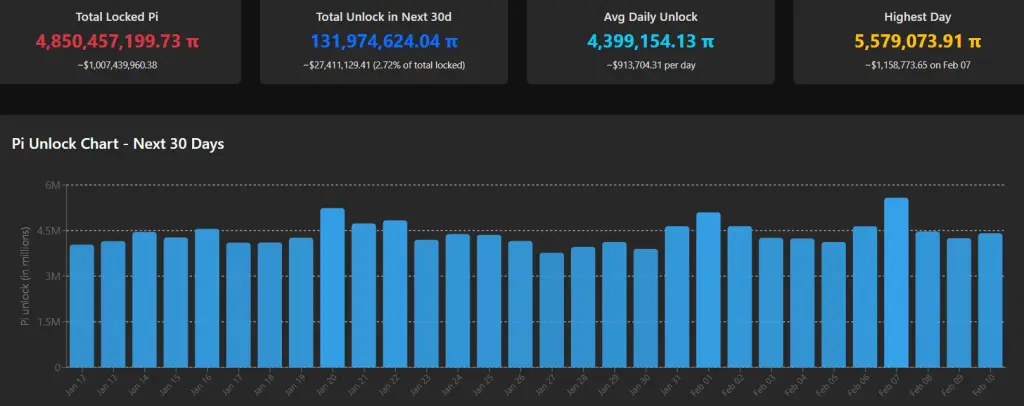
This will greatly help solve Pi Network’s biggest pain point: user adoption. The lack of effective long-term use cases for Pi coins leads to volatile prices. Short-term speculative trading exacerbates liquidity issues, and with an average of $900,000 worth of PI tokens unlocking daily, inflationary pressure increases. From the 30-day token unlock schedule, this continuous supply increase creates structural pressure on the price.
The toolkit also marks the Pi core team’s renewed engagement after months of relative inactivity, reigniting optimistic social sentiment following negative attitudes from key opinion leaders. From a developer’s perspective, 10-minute integration significantly lowers the technical barrier. Previously, developers needed to separately set up Pi SDK and backend API, which was time-consuming and resource-intensive. Now, a unified software package supports JavaScript, React, Next.js, and Ruby on Rails frameworks, covering the tech stacks of most developers.
Three Major Breakthroughs of Pi Coin Developer Toolkit
Integration Time Revolution: Reduced from hours to 10 minutes, cutting 95% of time costs
Full Framework Coverage: Supports JavaScript, React, Next.js, and Ruby on Rails, covering mainstream developers
E-commerce Scenario Unlock: Provides technical foundation for real-world use cases like e-commerce, moving away from speculation tags
Ecosystem Accelerator: Rapid prototyping capabilities attract more developers into the Pi ecosystem
From a business model perspective, the launch of this tool could trigger a positive cycle in the Pi ecosystem. When development becomes easier, more applications will integrate Pi payments; as more applications use Pi, users will have more scenarios to spend Pi coins; as demand increases, even with ongoing supply unlocks, the price may still be supported. This shift from “speculative asset” to “practical token” is the most critical fundamental change in Pi coin price prediction.
Three-Month Symmetrical Triangle Brewing Breakout
(Source: Trading View)
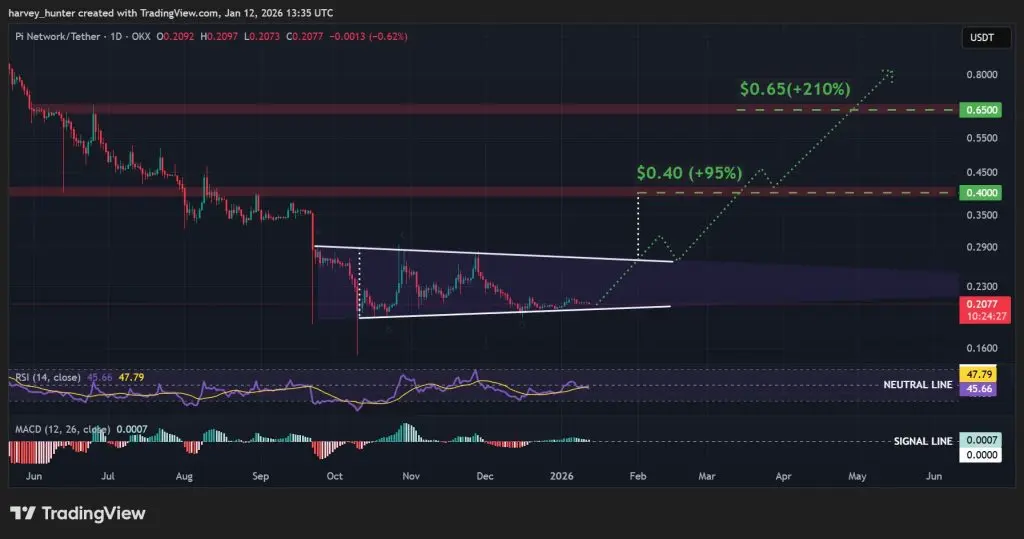
Enhancing utility, adoption, social discourse, and liquidity is expected to provide the necessary momentum for Pi Network, culminating in the formation of a 3-month brewing symmetrical triangle pattern. On the daily chart, Pi Coin is forming a typical symmetrical triangle pattern, which is often seen as a continuation pattern, indicating that the current consolidation is building momentum for the next directional breakout.
As buying pressure weakens, recent upward momentum of PI has slowed, and RSI indicator has fallen below the neutral line. Although the overall trend remains upward, MACD indicator is slightly ahead of the signal line, but with catalysts like this toolkit, it could become a strong growth platform. From a technical perspective, as the triangle pattern approaches the apex, the likelihood and strength of a breakout increase. Pi has consolidated for 3 months, nearing the late stage of the pattern, and any fundamental catalyst could trigger a breakout.
The key breakout level is around $0.265, which was previously a demand zone and now acts as resistance. The classic “support turn resistance” theory in technical analysis states that when a price breaks below a support level, that level often becomes resistance on a rebound. $0.265 is such a critical level. If this resistance is effectively broken, it could challenge higher resistance at $0.40, representing about 95% upside from the current price.
Long-term, with increased adoption by developers and users, new use cases will emerge, potentially breaking through the $0.65 resistance level, resulting in a 210% increase. This long-term target is based on ecosystem maturity assumptions: if hundreds of applications integrate Pi payments and users start using Pi coins in daily life, structural demand growth could offset or even surpass supply unlock pressures.
However, Pi coin price prediction must consider risks. Delays in mainnet launch, inflationary pressure from token unlocks, and market trust crises in Pi Network could hinder price growth. Moreover, even with the developer tools released, if high-quality applications do not materialize, this technological progress could become a “buy the rumor, sell the news” scenario. Investors should closely monitor how many applications announce integration of Pi payments in the coming weeks to validate the toolkit’s actual effectiveness.
From a risk-reward perspective, if Pi can hold above $0.20 and break above $0.265, with about 15% risk, potential gains could reach 95% or even 210%. This asymmetry is attractive to risk-tolerant investors. However, if it falls below the triangle’s lower boundary at $0.18, the pattern will fail, possibly triggering a deeper correction.
Disclaimer: The information on this page may come from third parties and does not represent the views or opinions of Gate. The content displayed on this page is for reference only and does not constitute any financial, investment, or legal advice. Gate does not guarantee the accuracy or completeness of the information and shall not be liable for any losses arising from the use of this information. Virtual asset investments carry high risks and are subject to significant price volatility. You may lose all of your invested principal. Please fully understand the relevant risks and make prudent decisions based on your own financial situation and risk tolerance. For details, please refer to
Disclaimer.


