Ukraine blocks Polymarket over lack of gaming license and ethical concerns, highlighting zero tolerance for prediction markets during wartime.
(Background: Will Ukraine join the EU by 2027? The US and UK propose a fast-track accession route, Putin advisor: We wouldn’t like that)
(Additional context: Ukraine passes “cryptocurrency legalization” and low-tax law to find economic recovery amid war)
Table of Contents
- Over a hundred million dollars in war betting
- Special legal conditions during wartime
- Regulatory blind spots
The National Commission for State Regulation of Communications and Informatization of Ukraine (NKEK) recently passed a resolution to blacklist the blockchain prediction market Polymarket, citing that the platform does not hold a local gaming license and that large-scale war-related bets are suspected of “commodifying national trauma.” The ban is now in effect, and Polymarket’s domain and traffic in Ukraine have been blocked.
Over a hundred million dollars in war betting
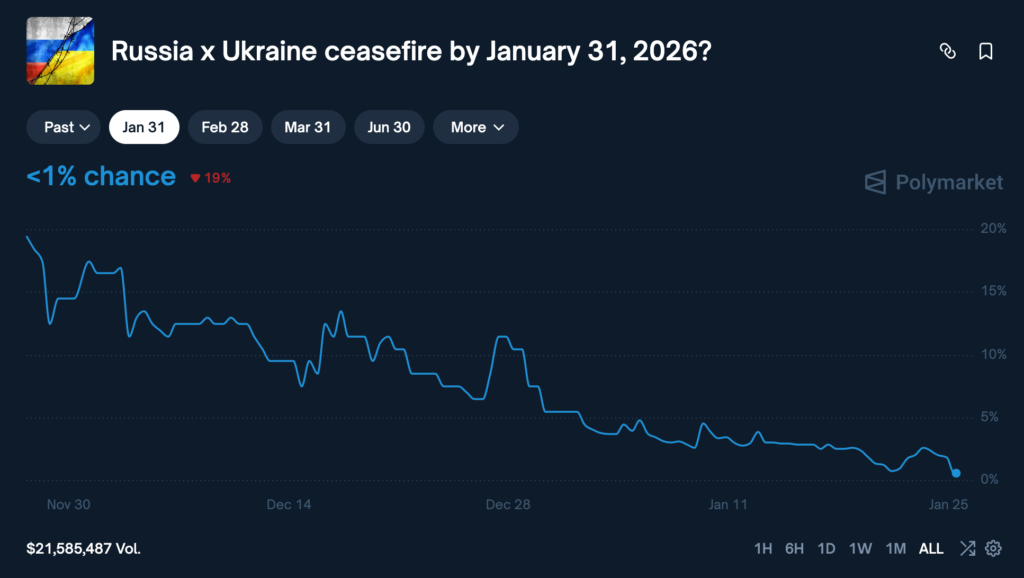
Currently, among the events related to the Russia-Ukraine conflict on Polymarket, the most active trading involves bets on when the ceasefire will occur. Other betting topics include “whether a specific city will fall within the month,” “whether drones will attack designated infrastructure,” and other specific military details.
Government officials point out that such markets not only constitute unauthorized gambling but may also undermine frontline morale and national security.
Wartime legal special conditions
Ukraine’s current laws do not recognize prediction markets in Web3 formats. Although the government has allowed blockchain services to be tested in finance and charity sectors through recent crypto sandbox regulations, and has raised over $40 million in digital asset donations after the outbreak of war, betting products related to specific military conflicts are considered moral red lines and are not included in the sandbox.
Under wartime conditions, the slow legislative process in Parliament makes it almost impossible for Polymarket to obtain legal status in the short term.
Regulatory blind spots
Internationally, countries such as France, Switzerland, Poland, Singapore, and Belgium have previously blocked the platform due to gambling regulations. Ukraine’s latest action further narrows Polymarket’s compliance space and reflects a consensus among countries to resist “detailed war predictions.”
However, this ban seems to only explicitly target the platform itself, not individual users. Currently, no legal actions have been taken against users operating Polymarket via VPNs or directly interacting with smart contracts.
Nikolaievskyi, Chief Legal Officer of Ukraine’s Digital Economy Development Office, stated: “I don’t know of any state government attempting to ban its citizens from interacting with decentralized protocols,” and he also has not seen cases where users are held accountable for bypassing the ban.
This incident once again reminds the industry: when prediction freedom encounters wartime ethics, technological neutrality must ultimately face legal and social bottom lines.

Disclaimer: The information on this page may come from third parties and does not represent the views or opinions of Gate. The content displayed on this page is for reference only and does not constitute any financial, investment, or legal advice. Gate does not guarantee the accuracy or completeness of the information and shall not be liable for any losses arising from the use of this information. Virtual asset investments carry high risks and are subject to significant price volatility. You may lose all of your invested principal. Please fully understand the relevant risks and make prudent decisions based on your own financial situation and risk tolerance. For details, please refer to
Disclaimer.


