Ethereum staking ratio first surpasses 30%! At the same time, on-chain data shows that over 4.1 million ETH, worth approximately $8 billion, are still queued to enter, indicating an exceptionally active staking market.
(Background: Ethereum staking market re-enters net inflow! Queue entries far exceed exits, possibly heralding the 2026 bull market?)
(Additional context: Bitmine bought an additional 35,268 ETH last week! Total holdings exceed 4.2 million ETH, with staked amount surging to 1.8 million ETH.)
Table of Contents
- Staking ratio first exceeds 30%, enhancing network security
- Over 4.1 million ETH queued to enter, waiting time exceeds 70 days
- Conclusion: Long-term lock-up trend takes shape, Ethereum’s economic model matures
According to the latest on-chain data, the current staked ETH accounts for 30% of the total circulating supply, hitting a new all-time high. Meanwhile, validator queue entries remain highly congested, with over 4.1 million ETH waiting to be deposited, valued at roughly $8 billion at current market prices, demonstrating strong market confidence in Ethereum’s staking returns and network security.
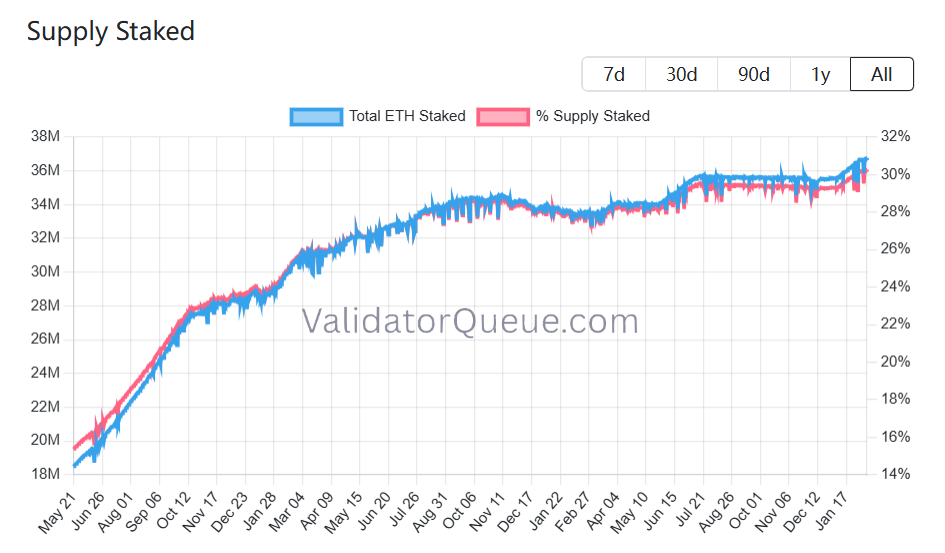
Staking ratio first exceeds 30%, further boosting network security
According to validatorqueue’s latest data, there are currently 967,856 active validators on the network, with a total staked amount of 36 million ETH, accounting for 30.0% of the total supply, setting a new record.
The rising staking ratio indicates more ETH is locked in the consensus layer to maintain network security and validate blocks. As staking scales up, Ethereum’s economic security improves correspondingly, increasing attack costs—this is positive for the entire ecosystem.
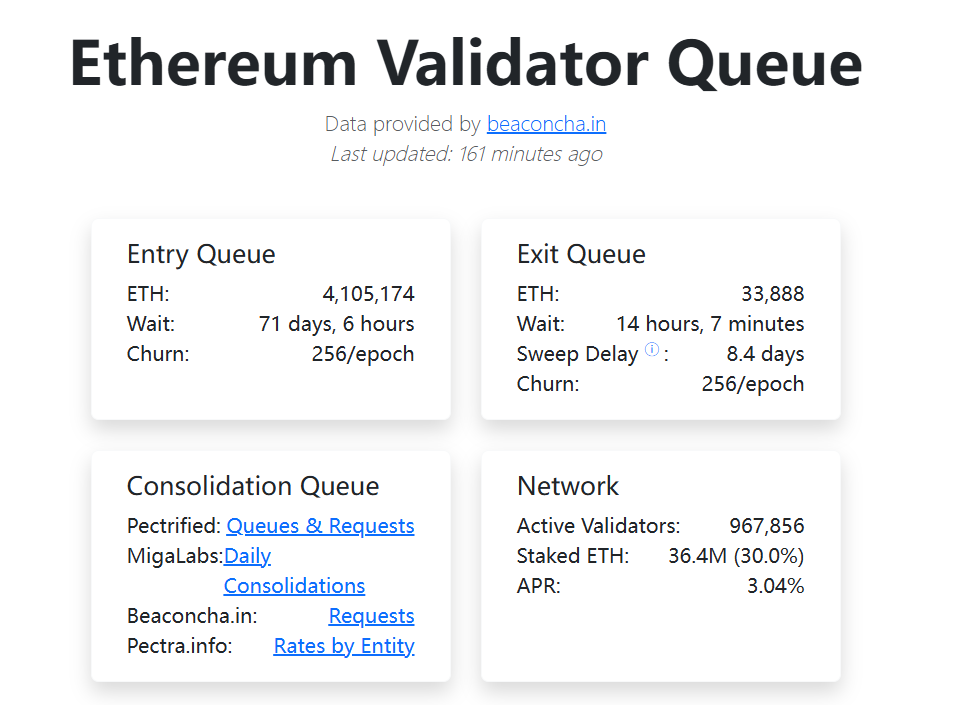
Over 4.1 million ETH queued to enter, waiting time exceeds 70 days
Notably, the validator “entry queue” remains crowded. Currently, 4,105,174 ETH are waiting to become validators, with an average wait time of 71 days and 6 hours.
Estimating at roughly $2,000 per ETH, this queued capital exceeds $8 billion, showing that even with yields falling to around 3%, a large amount of capital is willing to lock in long-term staking.
Compared to the crowded entry queue, the exit queue is significantly smaller, with only 33,888 ETH waiting to exit, with an estimated wait of about 14 hours and 7 minutes, plus approximately 8.4 days of withdrawal processing delay.
This indicates that overall, staking funds are still net inflowing rather than experiencing large-scale unlocks and sell-offs. The clear gap between entry and exit queues reflects market confidence in Ethereum’s medium- to long-term development.
Conclusion: Long-term lock-up trend takes shape, Ethereum’s economic model matures
Overall, the staking rate surpassing 30% not only signifies ongoing strengthening of network security but also indicates increased trust among ETH holders in the PoS mechanism. Even with yields declining, ETH worth $8 billion remains queued to enter, showing staking is gradually becoming part of long-term asset allocation.
Against the backdrop of continuous supply locking and relatively shrinking circulating supply, Ethereum’s economic model is entering a new equilibrium phase. Whether the staking ratio continues to rise and how yields evolve will be key indicators to watch in assessing ETH’s market structure.

Disclaimer: The information on this page may come from third parties and does not represent the views or opinions of Gate. The content displayed on this page is for reference only and does not constitute any financial, investment, or legal advice. Gate does not guarantee the accuracy or completeness of the information and shall not be liable for any losses arising from the use of this information. Virtual asset investments carry high risks and are subject to significant price volatility. You may lose all of your invested principal. Please fully understand the relevant risks and make prudent decisions based on your own financial situation and risk tolerance. For details, please refer to
Disclaimer.


