
The U.S. government informed Congress during a closed-door briefing that the costs of the Iran-U.S. conflict in the first six days have reached at least $1.13 billion. According to data tracked by BitcoinTreasuries, the U.S. government entities currently hold 328,372 Bitcoins, which at current market prices amounts to approximately $23.13 billion. The six-day war bill for Iran is equivalent to about 48.9% of this Bitcoin total market value.
War Bill Estimated in Bitcoin: Financial Speed Revealed by Digital Conversion
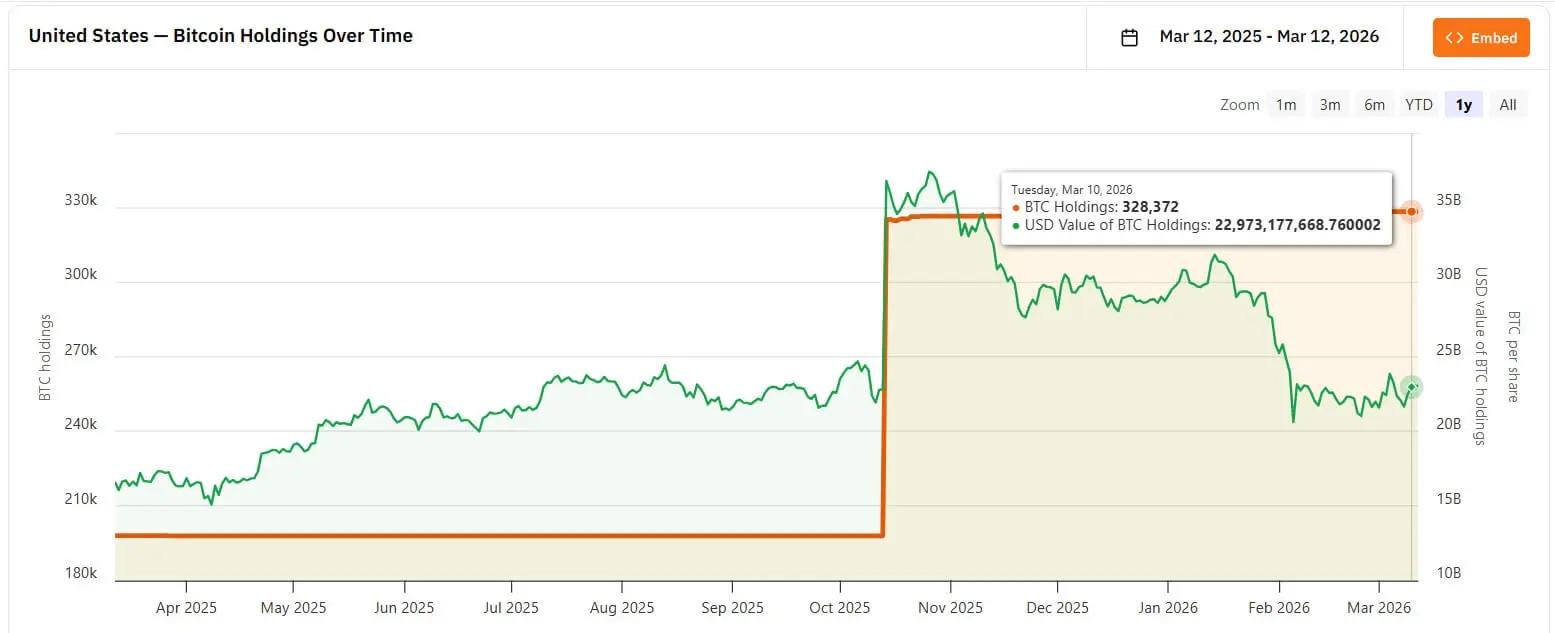
(Source: BitcoinTreasuries)
Converting the $1.13 billion six-day war expense into Bitcoin units yields an astonishing figure: approximately 160,443 Bitcoins. On average, about $188 million is spent daily, equivalent to roughly 26,700 Bitcoins per day. If this pace continues, the total market value of the 328,372 Bitcoins held by the U.S. government could only support about 12.3 days of war spending.
Furthermore, if the $50 billion supplemental funding request is approved, its scale would be about 2.16 times the current Bitcoin holdings of the U.S. government. It is important to emphasize that these calculations reflect the magnitude of U.S. war expenditures and do not imply that the government pays war costs directly in Bitcoin.
Policy Framework of the U.S. Strategic Bitcoin Reserve: Protected Assets That Cannot Be Sold
According to the White House executive order on establishing a strategic Bitcoin reserve, the Bitcoins deposited into the reserve are subject to strict restrictions:
“No Sale” Principle: Bitcoins stored in the reserve “shall not be sold,” maintaining them as U.S. reserve assets.
Limited Exceptions for Use: Court orders, victim compensation, law enforcement actions, sharing revenue with state and local partners, and legally mandated releases.
Source of Capital: Bitcoins held through the Department of the Treasury via criminal or civil asset forfeiture procedures, or obtained through civil fines.
Exclusion from Wartime Cash Mechanism: These restrictions effectively detach the federal government’s Bitcoin holdings from the normal wartime expenditure framework.
Logic of Iran War Spending, Inflationary Pressure, and Long-term Bitcoin Demand
Legendary trader Arthur Hayes has long held the view that the U.S.'s expanding war expenditures may, through increased debt financing, inflationary pressures, and demand for assets outside traditional financial systems, strengthen the long-term demand for Bitcoin. His core argument is that large-scale war spending is typically financed by issuing more government bonds, which increases the circulating dollars, gradually eroding the real purchasing power of savings, and driving demand for scarce assets with fixed supply.
In terms of market performance, Andre Dragosch, head of European research at Bitwise, pointed out that since the U.S. first launched an attack on Iran in late February, Bitcoin’s price has risen nearly 4%. He attributes this performance to “Bitcoin becoming an important institutional asset with strong liquidity and frequent participation by large, mature investors.”
Frequently Asked Questions
Why measure U.S. Iran war spending in Bitcoin?
Using Bitcoin as a unit of measurement offers a non-traditional perspective, helping to intuitively understand the scale of war expenditures. $1.13 billion is equivalent to about 48.9% of the current Bitcoin holdings of the U.S. government. This comparison reveals the fiscal scale of military spending, not that the government is actually paying war costs in Bitcoin.
Can the U.S. strategic Bitcoin reserve be used to pay for Iran war expenses?
No. According to the White House executive order, Bitcoins in the strategic reserve “shall not be sold.” Except for a few legally specified exceptions, government agencies are prohibited from selling or disposing of these digital assets, removing them from the normal wartime cash expenditure framework.
How does Arthur Hayes see the impact of the Iran war on long-term Bitcoin demand?
Hayes believes that large-scale war spending is usually financed by issuing more debt, which over time leads to inflation and erodes the real purchasing power of savings. Under this framework, the demand for Bitcoin as a hedge against inflation—an asset with a fixed supply—will benefit in the long run; when traditional assets fail to provide security, investors will turn to alternative stores of value, including Bitcoin.
Disclaimer: The information on this page may come from third parties and does not represent the views or opinions of Gate. The content displayed on this page is for reference only and does not constitute any financial, investment, or legal advice. Gate does not guarantee the accuracy or completeness of the information and shall not be liable for any losses arising from the use of this information. Virtual asset investments carry high risks and are subject to significant price volatility. You may lose all of your invested principal. Please fully understand the relevant risks and make prudent decisions based on your own financial situation and risk tolerance. For details, please refer to
Disclaimer.


