The institution reported that argt, a peso-linked stablecoin, constitutes a security, subject to the regulatory regime for capital markets for these instruments. The stablecoin, issued by Twin Finance and listed by Belo, offered up to 32% APR.
Regulator Classifies Argentine Peso Stablecoin as a Security, Blocks Operations
The Argentine equivalent of the SEC, the CNV, executed the first measure against a stablecoin linked to the national fiat currency, the Argentine peso.
On March 12, the institution issued a resolution ordering the suspension of the listing, offering, and intermediation of argt, stating that the token was classified as a security offered to investors without complying with the rules established for these assets.
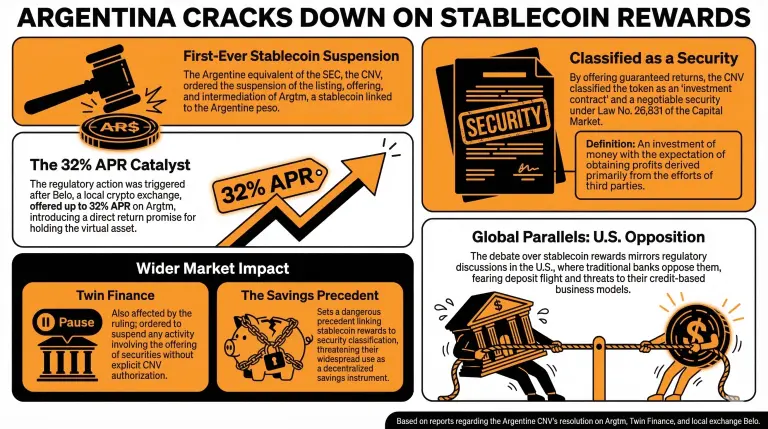
The action comes after Belo, an exchange that listed the stablecoin, offered up to 32% in APR, introducing a return promise linked to holding the virtual asset. As a consequence, the CNV assessed that this would make it “fall under the figure of an investment contract included in the definition of negotiable security provided for in article 2 of Law No. 26,831 of the Capital Market, which results in its classification as a negotiable security subject to the public offering regime.”
The institution clarified that when these assets meet the criteria of an investment contract, “an investment of money in a joint venture with the expectation of obtaining profits derived primarily from the efforts of third parties,” it can be considered a security, and will be subject to the compliance regime described for these assets.
The action also affects Twin Finance, which will have to suspend any activity, including the offering of securities, without the CNV’s authorization.
The development sets a precedent in Argentina, linking the offering of rewards for holding a stablecoin to its classification as a security, closing the potential savings use case for these instruments in the future, with no regulation tackling this issue.
The subject of stablecoin rewards is also being discussed in the U.S., as banks have opposed it, alleging that it could fuel deposit flight from the financial system and affect their credit intermediation-based business model.
FAQ
- What recent action did Argentina’s CNV take regarding a stablecoin?
The CNV suspended the listing and intermediation of argt, classifying it as a security being offered without regulatory compliance.
- Why was argt classified as a security?
The token was categorized as a security because it was linked to an investment contract promising up to 32% APR for holding the virtual asset.
- What implications does this resolution have for Twin Finance?
Twin Finance must halt all activities involving the stablecoin, including offering securities, without prior authorization from the CNV.
- What broader impact does this decision have on stablecoin offerings in Argentina?
This action sets a precedent by linking rewards for holding stablecoins to their classification as securities, potentially limiting their use for savings in the country.
Disclaimer: The information on this page may come from third parties and does not represent the views or opinions of Gate. The content displayed on this page is for reference only and does not constitute any financial, investment, or legal advice. Gate does not guarantee the accuracy or completeness of the information and shall not be liable for any losses arising from the use of this information. Virtual asset investments carry high risks and are subject to significant price volatility. You may lose all of your invested principal. Please fully understand the relevant risks and make prudent decisions based on your own financial situation and risk tolerance. For details, please refer to
Disclaimer.
Related Articles
Social media platform X submits remedial measures to the European Commission regarding blue verification mark issues
Elon Musk's social media platform X submitted a remediation plan under pressure from the European Commission, following a €120 million fine for violations including "blue badge certification" issues. The EU pointed out problems including X's paid verification, insufficient advertising transparency, and non-compliant data access.
GateNews2h ago
Bank–Crypto Clash Slows Senate Clarity Act Progress
Dispute over stablecoin reward programs between banks and crypto firms has slowed progress on the Senate Clarity Act.
Banks warn rewards could trigger deposit flight, while crypto advocates say evidence of major shifts is limited.
Lawmakers including Sens. Alsobrooks and Tillis are
CryptoFrontNews3h ago
Bitcoin Policy Institute calls for revising U.S. tax rules that currently treat all BTC payments as capital gains
Gate News reports that on March 13, the Bitcoin Policy Institute called for modifications to current U.S. tax rules. Under existing regulations, all payments made using BTC are treated as capital gains transactions, requiring the payment of corresponding taxes. The institute argues that this regulation limits the practical application of Bitcoin as a means of payment.
GateNews5h ago
The first list of "Stablecoin Licenses" in Hong Kong is about to be announced! Rumors suggest they will go to HSBC, Standard Chartered, and OSL.
Hong Kong's first batch of "Stablecoin Issuer License" list will be announced next week. The three main applicants are HSBC, Standard Chartered Bank, and virtual asset platform OSL. This licensing round may favor banks due to their capital strength and regulatory advantages, while OSL possesses rich practical experience. Although rumors suggest the main list is finalized, the actual situation may still change.
区块客5h ago
US Crypto Regulatory "Civil War" Ceasefire: SEC and CFTC's Decade-Long Power Struggle Reaches a Turning Point
The U.S. cryptocurrency industry has long faced regulatory confusion, primarily reflected in the determination of crypto asset classification and the division of regulatory authority. Divergences between the SEC and CFTC have created multiple regulatory challenges for enterprises. Recently, the two agencies signed a memorandum of understanding to begin coordinating efforts to resolve regulatory conflicts and promote the establishment of an adaptive regulatory framework, aimed at forming a comprehensive digital asset regulatory system. This marks a gradual clarification of rule-making in America's digital finance era.
PANews6h ago


