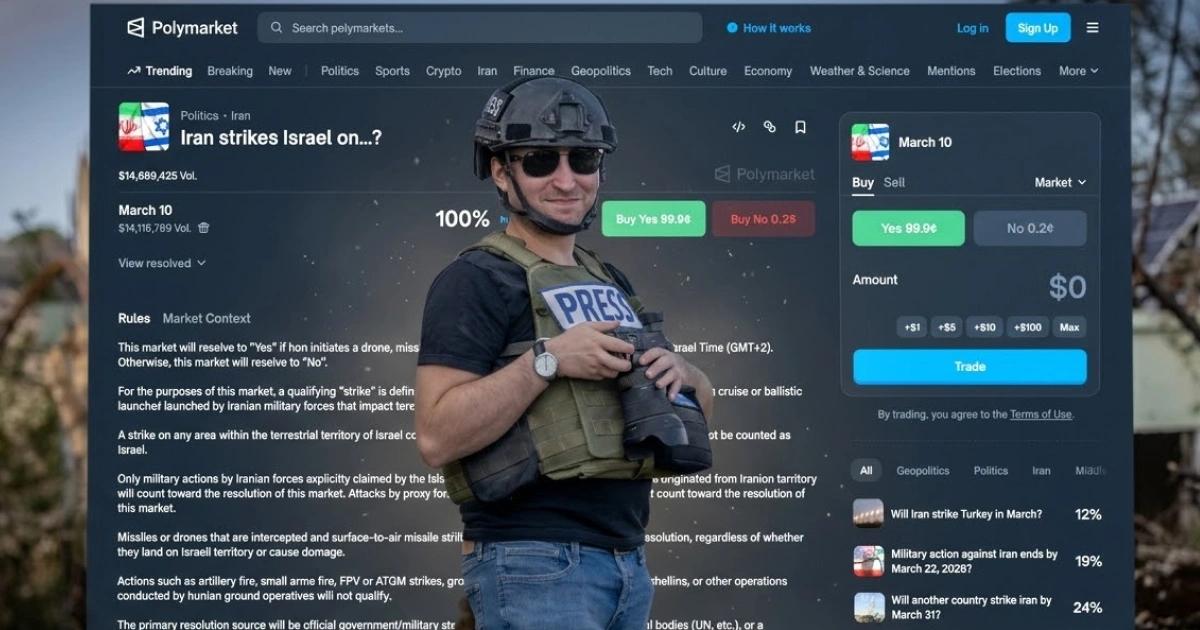
Reporter receives death threats from Polymarket bettors over Iran missile attack coverage
A military journalist received death threats from Polymarket bettors after reporting on an Iran-Israel incident, possibly reflecting the darker side of prediction markets.
According to Protos, Emanuel Fabian, a military reporter for The Times of Israel, reported on March 10 about a missile attack near Beit Shemesh, Israel.
Fabian revealed that after publishing his report, he received numerous messages and threats from Polymarket users. One email in Hebrew demanded he modify his report, changing the missile description to debris from an Israeli missile interceptor.
Fabian refused, clarifying based on Israeli military reports and on-site footage that the explosion matched the characteristics of a missile warhead loaded with hundreds of kilograms of explosives, which interceptor debris alone could not produce.
Behind the death threats lies a multi-million dollar betting dispute
Subsequently, Fabian continued to receive similar modification demands via Discord and WhatsApp. He also noticed multiple Polymarket gambling accounts commenting under his posts on platform X, making the same correction requests.
Fabian suspects that these harassers are trying to influence a betting pool on Polymarket, which has over $14 million in trading volume, predicting whether Iran would launch an attack on Israel on March 10.
Since Polymarket’s rules state that intercepted projectiles do not meet the criteria for a launch, these bettors desperately want the incident to be officially or media-acknowledged as interceptor debris, so the bet can be settled as “no attack.” Some even attempted to bribe Fabian, offering money to make the issue go away and restore peace.
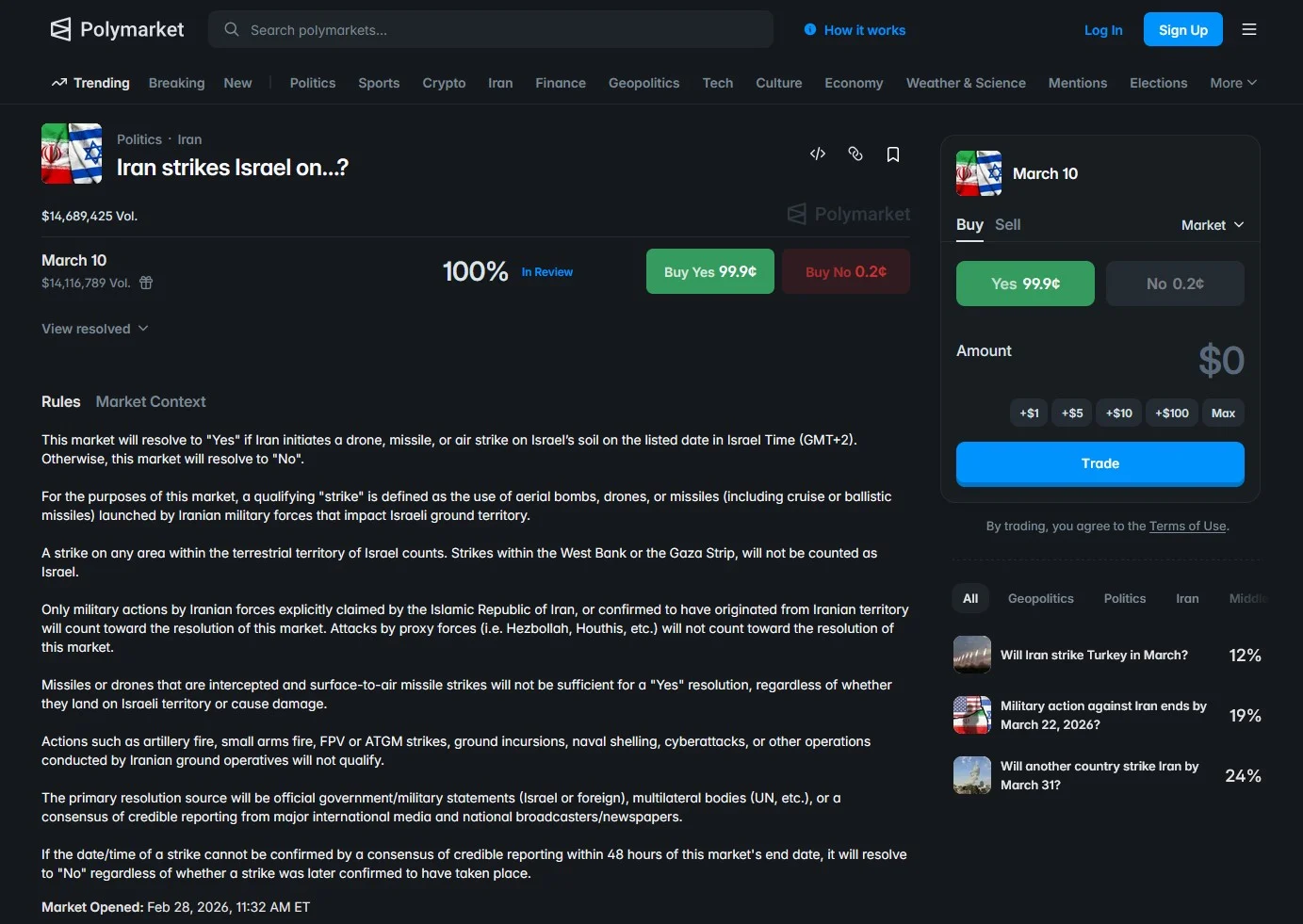
Image source: Emanuel Fabian, reporter, received death threats from Polymarket bettors over Iran-Israel attack coverage
Polymarket bettors’ death threats escalate, police investigate
Five days after the missile attack, these threats intensified into serious violence.
A WhatsApp user named Haim threatened Fabian, claiming that Fabian caused a loss of $900,000 for them, and that they would invest at least that amount to harm him, repeatedly setting deadlines for report modifications.
Haim also listed specific details about Fabian’s family and residence, even initiating a countdown to exert psychological pressure.
Another user, claiming to be Daniel, fabricated a screenshot of Fabian admitting errors in his report and circulated it online. Shortly after, someone impersonated a lawyer calling Fabian, claiming he was under investigation for market manipulation.
Fabian immediately hung up and submitted all communications to Israeli police, who are now investigating these allegations.
Will prediction markets interfere with press freedom?
In a statement, Fabian warned that this incident shows prediction markets are beginning to intersect with journalism itself. He emphasized that these bettors’ attempts to pressure reporters into changing stories to win bets have never succeeded before and will not succeed in the future.
In response, Polymarket officials condemned the harassment and threats against Fabian, stating such behavior violates platform terms of service.
Polymarket pointed out that prediction markets rely on the integrity of independent reporting, and any attempt to pressure journalists to alter reports undermines the market’s credibility. The platform has banned the involved accounts and will share user information with law enforcement.
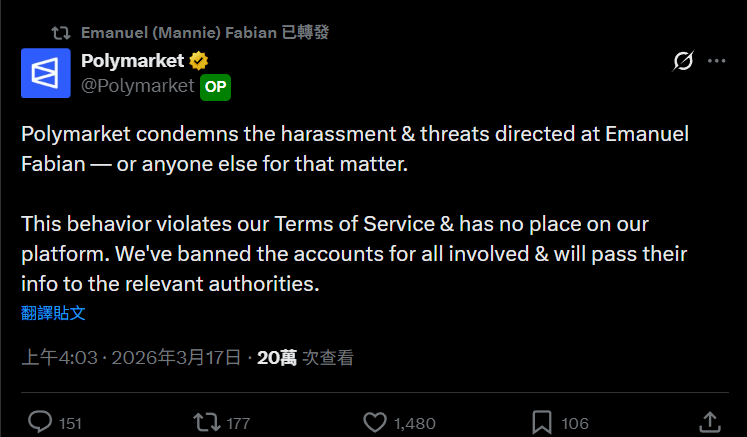
Image source: Polymarket/X Polymarket condemns harassment and threats against the reporter, stating such actions violate platform policies.
Prediction market chaos prompts US regulation
The incident where Polymarket bettors threatened violence over a report is just one example of the dark side of prediction markets.
Historically, these platforms have been involved in insider trading, such as during US airstrikes on Iran, where several wallets profited about $1.2 million from related contracts.
Additionally, contracts related to terrorism, war, and personal deaths on Polymarket have raised serious ethical concerns. Recently, the platform removed a prediction on when nuclear war might break out, and the US is working on regulation.
Crypto City previously reported that Democratic Senator Adam Schiff introduced the Death Bets Act, proposing a comprehensive ban on prediction contracts related to terrorism, war, assassination, and personal death.
The US Commodity Futures Trading Commission (CFTC) also issued regulatory guidelines to oversee these platforms. CFTC Chair Michael S. Selig emphasized that platforms offering event contracts must strictly adhere to the Commodity Exchange Act (CEA), establishing real-time monitoring systems to detect suspicious trading and prevent market manipulation and insider trading.
Further reading:
Zero tolerance for insider trading! Prediction platform Kalshi penalizes MrBeast’s editor and a former California gubernatorial candidate
Kalshi’s “Iran Leader Resignation” $50 million prediction contract settlement sparks controversy! CEO: Rejecting death arbitrage
Disclaimer: The information on this page may come from third parties and does not represent the views or opinions of Gate. The content displayed on this page is for reference only and does not constitute any financial, investment, or legal advice. Gate does not guarantee the accuracy or completeness of the information and shall not be liable for any losses arising from the use of this information. Virtual asset investments carry high risks and are subject to significant price volatility. You may lose all of your invested principal. Please fully understand the relevant risks and make prudent decisions based on your own financial situation and risk tolerance. For details, please refer to
Disclaimer.


