
On March 18, the XRP market showed two highly significant signals. First, the U.S. Securities and Exchange Commission (SEC) Chair Gary Gensler announced that XRP is classified as a “digital commodity,” ending years of regulatory uncertainty; second, Coinbase’s XRP spot order book displayed a 9:1 buy-sell ratio within the 50% price range around $1.50, the strongest bullish signal in nearly 12 months.
SEC Historic Declaration: XRP and Other Crypto Assets Officially Classified as Digital Commodities
Gensler stated at the summit: “The SEC’s long-standing failure to provide clear answers on this issue is over.” This declaration ends years of legal debate over XRP’s regulatory status, with Ripple previously settling with the SEC for $50 million over unregistered securities sales.
According to the SEC’s 68-page guidance document, crypto assets are categorized into four types:
Digital Commodities: Bitcoin, Ethereum, XRP, Solana, Dogecoin — these assets are not regulated as securities under federal law.
Digital Collectibles: Tokens with uniqueness and collectible value.
Digital Tools: Tokens with specific platform functions or use cases.
Payment Stablecoins: Stablecoins pegged to fiat currencies.
Gensler also emphasized key limitations: even if a crypto asset itself is not a security, it may still be subject to federal securities laws if offered or sold as part of an “investment contract.” Miller Whitehouse-Levine, CEO of the Solana Policy Institute, pointed out: “The real focus is on analyzing investment contracts, not just token classification.”
Notably, Gensler stressed: “Only Congress can pass comprehensive market structure legislation to ensure that regulation in this space stands the test of time.” The current SEC chair’s interpretive statement can be overturned by the next chair, and legislation remains the ultimate safeguard. Senate Banking Committee Chair Tim Scott indicated that an update draft of the CLARITY Act is expected to be released this week.
Extreme Bullish Signal from Coinbase Order Book
 (Source: Trading View)
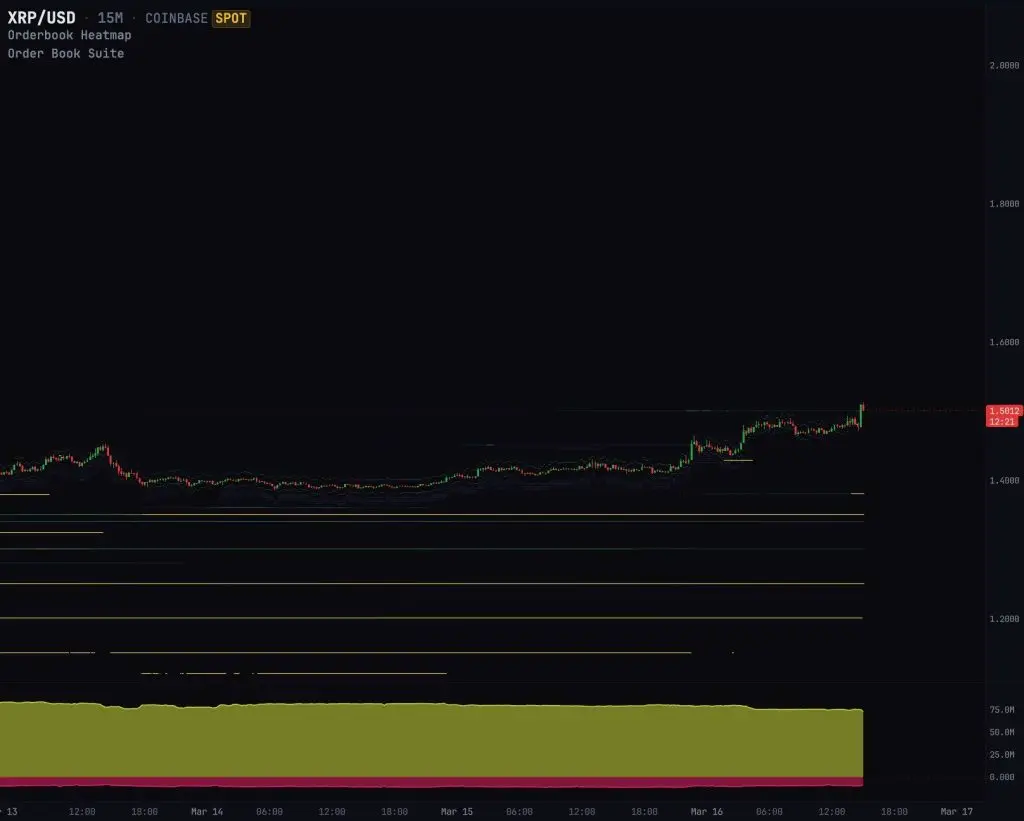
While regulatory news has driven market sentiment, technical signals have also appeared. Data from order book analyst Dom shows that in Coinbase’s spot market, XRP currently has a buy-sell ratio of 9:1 within the 50% price range around $1.50 — meaning for every $1 in sell orders, there are $9 in buy orders.
This ratio implies the following market conditions:
Normal Market: Buy-sell ratio around 1:1
Moderate Bull Market: Ratio around 2:1
Current XRP: 9:1, the strongest bullish tilt in Coinbase’s XRP spot market in nearly 12 months
Price Resistance Vacuum: Between $1.50 and $2.00, there are almost no large sell orders. If buying pressure continues, the least resistance path points toward $2.25.
Frequently Asked Questions
What does SEC classifying XRP as a digital commodity mean for Ripple and XRP holders?
This classification means that XRP spot trading is generally no longer directly regulated by SEC federal securities laws, significantly reducing compliance risks for related companies and providing a clearer legal basis for applications like XRP ETFs and other regulated financial products. For holders, it removes the biggest regulatory uncertainty previously faced, boosting institutional confidence.
Is the 9:1 buy-sell ratio on Coinbase sufficient to confirm a bullish trend?
Order book data reflect real-time supply and demand at a specific moment and are useful short-term market sentiment indicators, but they are not definitive trend signals. Orders can be withdrawn or added, and Coinbase is just one of many XRP trading venues. Technical analysts recommend combining this data with volume, RSI, and overall market conditions for a more comprehensive assessment, rather than relying solely on a single order book snapshot.
What are the key technical support and resistance levels for XRP right now?
Technical analysts identify $1.50 as the current critical support level — if this holds during a retest, the first resistance is at $1.61, with potential higher targets at $1.90 and $2.20–$2.25 upon breakout. If $1.50 fails to hold, the primary support drops to $1.30, with further support at $1.12.
Disclaimer: The information on this page may come from third parties and does not represent the views or opinions of Gate. The content displayed on this page is for reference only and does not constitute any financial, investment, or legal advice. Gate does not guarantee the accuracy or completeness of the information and shall not be liable for any losses arising from the use of this information. Virtual asset investments carry high risks and are subject to significant price volatility. You may lose all of your invested principal. Please fully understand the relevant risks and make prudent decisions based on your own financial situation and risk tolerance. For details, please refer to
Disclaimer.


