Israeli Times of Israel military reporter Emanuel Fabian recently revealed that after reporting that an Iranian ballistic missile hit a field outside Jerusalem’s Beit Shemesh, he was continuously harassed by bettors associated with Polymarket, even receiving death threats.
This incident is particularly shocking not only because it involves frontline war reporting and a prediction market with over $14 million in funds, but also because it exposes an increasingly acute issue: when market participants’ profits start to depend on media narratives, public information, or even violent events themselves, are prediction markets truly “price discovery,” or are they creating dangerous incentives in the real world?
A frontline report, why did it trigger a mob of bettors?
“That day, I reported on The Times of Israel’s live blog that the missile hit an open area, causing no casualties. The report cited rescue authorities’ information and showed footage of the missile’s warhead causing a large explosion. But I thought it was a small incident during wartime, yet it turned into days of harassment and death threats,” Fabian wrote.
On March 16, Fabian published an article stating that on March 10, when Iran launched a ballistic missile attack on Israel, he reported based on rescue unit information and on-site footage that a missile struck an open area near Beit Shemesh, causing no injuries. Over the following days, he received messages from strangers demanding he change the report from “missile hit” to “interception debris landing” or similar wording, claiming this would affect how a related market on Polymarket—about whether Iran attacked Israel that day—settled.
“You (Emanuel Fabian) caused us a loss of $900,000, and we will invest that much to thoroughly deal with you,” Fabian said he received such threats on WhatsApp.
Fabian explained that initially, the other party only asked for a correction, but the tone gradually escalated—from “this will help many people” to threatening messages, and eventually death threats via WhatsApp. He refused to alter his report, stating that military information he possesses indicates the missile warhead landed, not just interception debris; he later contacted Israeli police regarding the threats.
“My small report about a missile hitting an open field has now been entangled in a betting war. Those betting that Iran would not attack Israel on March 10 are demanding I modify the article to ensure they win big,” Fabian wrote.
The related prediction market’s trading volume exceeds $14 million, turning what seemed like a minor wording difference into a potential key to winning or losing and fund distribution. When news text is no longer just information but becomes a “manipulable settlement lever” in betting markets, journalists naturally become targets for bettors.
Polymarket Responds: Condemns Threats! But Is This Just Surface-Level Damage Control?
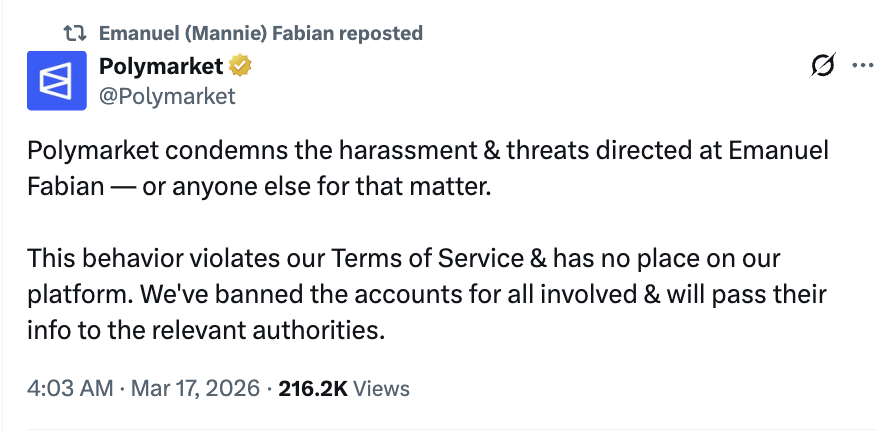
Polymarket stated that the platform condemns the harassment and threats against Emanuel Fabian, emphasizing that such behavior violates the terms of service. They asserted that prediction markets rely on the integrity of independent reporting, and any attempt to pressure journalists into changing reports not only damages journalism but also undermines the market itself. This principled stance is uncontested, because if market prices depend on external factual sources, then pressuring those sources directly erodes market integrity.
In a late Monday statement, Polymarket announced that it has “banned all involved accounts and will forward their information to relevant authorities.”
However, condemning the threats does not automatically resolve deeper structural risks. This incident reveals that when prediction markets use war, attacks, deaths, coups, dismissals, or other highly sensitive events as trading targets, participants are not just “predicting” outcomes—they may also be tempted to interfere with information sources, narratives, or even the events themselves. In other words, platforms can penalize individual threatening users but cannot easily eliminate the distorted incentives created by their market design through post-event sanctions alone. This is the real concern raised by this incident.
When “Prediction” Turns into “Pressure”: Three Risks of User Behavior in Prediction Markets
- Participants may treat media, research institutions, and official information as settlement targets that can be lobbied or even threatened. Fabian’s case is a vivid example: bettors are not merely waiting for facts to unfold but are trying to alter how facts are described to influence market outcomes. This shifts prediction markets from passive observation of reality to active interference in information production.
- Markets on highly sensitive events are prone to attract insiders with non-public information, potentially triggering “early knowledge” and “influence” scenarios. The U.S. Commodity Futures Trading Commission (CFTC) issued an enforcement notice on February 25, clarifying that event contracts are also subject to existing anti-fraud, anti-manipulation, and anti-insider trading regulations; the notice listed cases involving politicians trading on their own election-related contracts and YouTube channel affiliates using non-public information for trading.
- Events like war, death, assassination, or terrorism carry moral risks because market payouts may be linked to real-world harm. On February 23, six Democratic U.S. Senators wrote to CFTC Chairman Michael Selig, pointing out that some event contracts could enable insiders to profit from non-public information and may incentivize physical harm, mission failure, or escalation of geopolitical conflicts. The letter directly questioned whether contracts related to war, terrorism, assassination, or death violate the “public interest” prohibitions under the Commodity Exchange Act.
Legislative Concerns: From “Ethical Issues” to “Regulatory Challenges”
As this controversy unfolded, U.S. policymakers’ vigilance toward prediction markets increased significantly. CME Group CEO Terry Duffy stated that prediction markets need clearer, stricter rules to distinguish between event contracts serving as economic hedges and those merely disguised gambling; he suggested that the issue might ultimately reach the U.S. Supreme Court for judicial clarification.
Democratic Representatives Mike Levin and Chris Murphy are pushing legislation to tighten regulation of platforms like Polymarket and Kalshi. According to reports from The Wall Street Journal and Associated Press, recent bills target event contracts related to war, death, assassination, terrorism, and elections—some proposals even aim to give states more authority to restrict or ban prediction markets related to sports and violent events.
Senator Richard Blumenthal’s Prediction Markets Security and Integrity Act defines prediction markets as services closely resembling gambling, betting, and sports betting, and states these platforms have become “safe havens for insider trading, market manipulation, and underage gambling.” The bill proposes that prediction markets must obtain state approval to operate and bans dangerous or unethical betting products.
A March 12 AP report indicates that state-level actions are also underway. Utah Governor Spencer Cox criticized these platforms as “casinos in every American’s pocket,” especially targeting youth; the state is advancing legislation to expand bans on prop bets and is engaging in legal battles with new prediction markets like Kalshi and Polymarket. The report also notes that Utah Congressman Blake Moore has introduced a bipartisan bill to prohibit prediction contracts related to war, assassination, terrorism, and elections, allowing states to restrict sports-related products.
Based on current regulatory discussions, four potential directions may emerge:
- Explicitly banning topics like war, death, assassination, and terrorism.
- Requiring stronger identity verification, transaction monitoring, and suspicious activity reviews.
- Increasing state regulatory authority, reclassifying some products as gambling rather than financial derivatives.
- Demanding greater transparency from platforms regarding external information reliance and establishing stronger settlement and dispute resolution mechanisms.
The “Gambler” Turned “Villain”: The Problem Goes Beyond Individual Loss of Control
Emanuel Fabian’s death threats are, of course, an unacceptable harassment and intimidation event. But viewing it solely as a case of a few users losing control underestimates the significance of this controversy. The real concern is that some prediction markets are turning real-world wars, deaths, and crises into tradable, gamble-able, rent-seeking targets. Under high leverage and profit incentives, market participants may treat journalists, researchers, official sources, or even the events themselves as objects of pressure.
“These bettors are trying to pressure me into changing my report to help them win their bets, but their attempts will never succeed—and I hope they never do. But I worry that if other journalists are promised a share of the winnings, their professional ethics might be compromised,” Fabian expressed his concerns.
Disclaimer: The information on this page may come from third parties and does not represent the views or opinions of Gate. The content displayed on this page is for reference only and does not constitute any financial, investment, or legal advice. Gate does not guarantee the accuracy or completeness of the information and shall not be liable for any losses arising from the use of this information. Virtual asset investments carry high risks and are subject to significant price volatility. You may lose all of your invested principal. Please fully understand the relevant risks and make prudent decisions based on your own financial situation and risk tolerance. For details, please refer to
Disclaimer.


