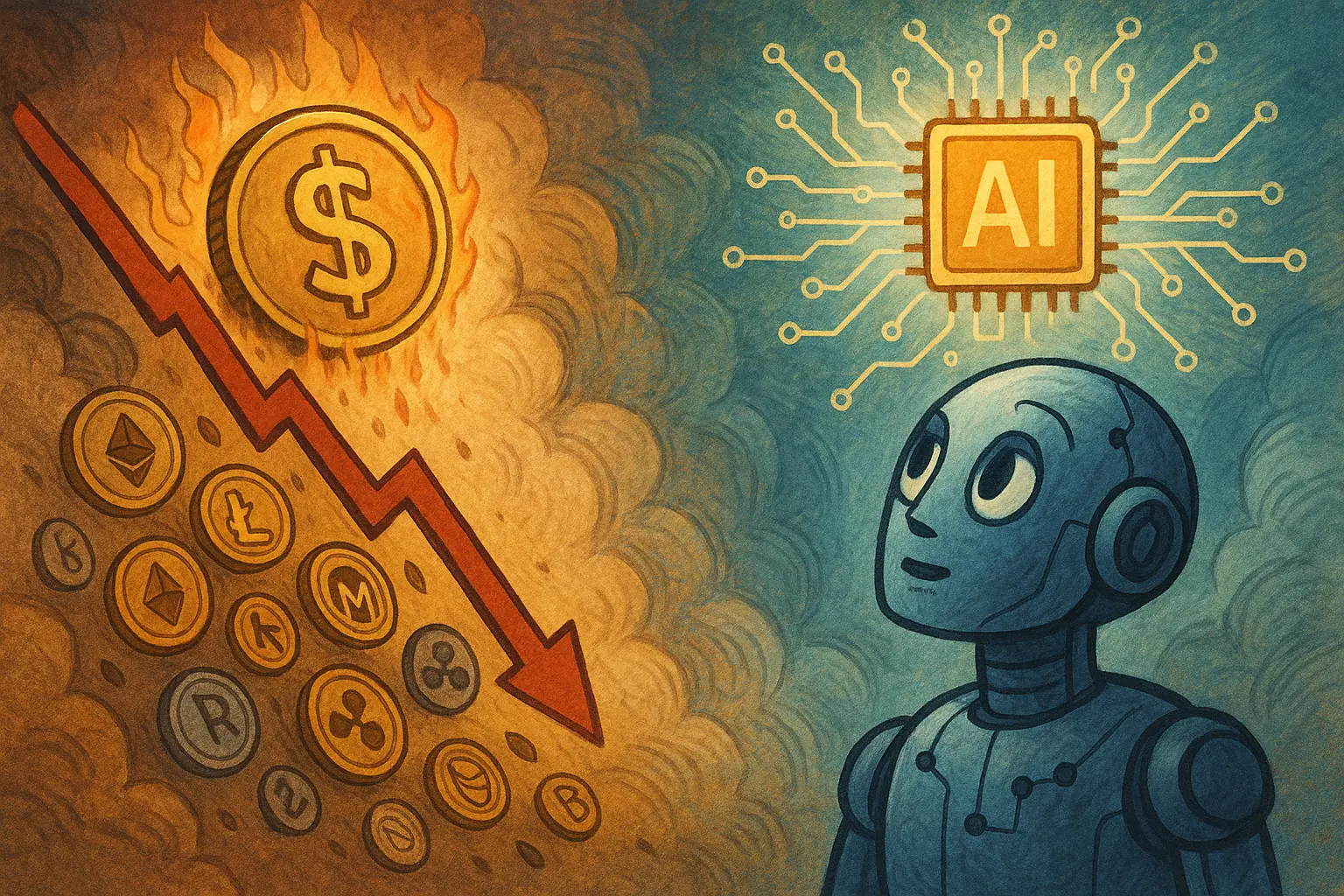
BlackRock Digital Asset Chief Robbie Mitchnick said at the New York Digital Asset Summit on Tuesday that institutional investors’ focus on cryptocurrencies is rapidly intensifying, with most tokens in circulation viewed as short-term assets lacking long-term value. He also pointed out that the natural symbiotic relationship between artificial intelligence (AI) and cryptocurrencies is the core driver shaping the next crypto bull market, far more important than any rotation effect from the proliferation of altcoins.
Institutional Perspective on Altcoins: Why Most Tokens Lack Long-Term Survival Space
Mitchnick described a clear market consolidation trend: the rankings of top tokens have seen fierce changes over the years, with only Bitcoin (BTC) maintaining the strongest historical durability, followed by Ethereum (ETH), which has also established a stable market position. However, many emerging tokens fail to sustain long-term value.
“Most of them are nonsense,” he straightforwardly stated, referring to the large number of tokens currently in circulation. This view is directly reflected in institutional behavior: BlackRock’s institutional clients tend to focus on a few high-confidence assets rather than building broad portfolios of altcoins. Bitcoin and Ethereum already dominate institutional digital asset allocations, and overall market interest in other tokens continues to decline.
The Symbiotic Theory of AI and Cryptocurrencies: Miner Transformation as the Most Direct Evidence
Mitchnick’s core framework repositions cryptocurrencies from speculative assets to infrastructure for the AI economy. His logic is: “AI agents are unlikely to use traditional payment systems like Fedwire and SWIFT. Cryptocurrencies are computer-native currencies, and AI is computer-native data and intelligence. Therefore, a natural symbiotic relationship exists between the two.”
This framework is being validated by the actual actions of Bitcoin miners:
Major Listed Miners Transitioning to AI Computing Business
Hut 8 (HUT): Actively transforming data centers to support AI and high-performance computing (HPC) hosting agreements.
Core Scientific (CORZ): Has signed multiple AI and HPC agreements, driving business diversification.
Iren (IREN): Simultaneously expanding AI infrastructure business, viewing stable AI revenue as a buffer against mining income volatility.
The motivation behind these miners’ transformations centers on two key points: AI workloads provide more stable income than crypto mining, and they meet the growing demand for computational capacity.
Bitcoin’s Dual Positioning: Infrastructure and Risk Diversification in the AI Era
Mitchnick further pointed out that Bitcoin has a dual appeal in the AI era. On one hand, as a computer-native currency, Bitcoin is naturally suited to serve as a transaction medium for AI agents and automation systems; on the other hand, as AI-driven technological revolutions reshape industries and introduce structural uncertainties, Bitcoin can also serve as a risk diversification tool during rapid transitions.
He emphasized that there is an “intersecting relevance” between cryptocurrencies and the AI economy, and in this new AI-driven era, “there are clear opportunities for their roles to play.” This suggests that the next narrative driver for cryptocurrencies may no longer be rotations among altcoins but rather the deep integration of AI and blockchain infrastructure.
Frequently Asked Questions
Why does BlackRock consider most altcoins to be “nonsense”?
Mitchnick’s argument is based on historical data: top crypto rankings have frequently changed over the long term, with only Bitcoin and Ethereum maintaining lasting market positions. Many emerging tokens cannot sustain long-term value. As a result, institutional clients prefer to concentrate on a few high-confidence assets rather than building broad altcoin portfolios.
How will AI drive the next crypto bull market?
Mitchnick’s symbiotic theory suggests that AI agents and automation systems are more likely to use cryptocurrencies—these computer-native currencies—when conducting transactions, rather than relying on traditional financial systems. This natural relationship could make cryptocurrencies foundational transaction media for the AI economy, driving long-term demand growth.
Why are Bitcoin miners shifting toward AI businesses?
AI workloads offer more stable and continuously growing revenue streams compared to crypto mining. Listed miners like Hut 8, Core Scientific, and Iren are actively transforming data centers or signing high-performance computing agreements, reflecting a structural shift in the industry’s business models.
Disclaimer: The information on this page may come from third parties and does not represent the views or opinions of Gate. The content displayed on this page is for reference only and does not constitute any financial, investment, or legal advice. Gate does not guarantee the accuracy or completeness of the information and shall not be liable for any losses arising from the use of this information. Virtual asset investments carry high risks and are subject to significant price volatility. You may lose all of your invested principal. Please fully understand the relevant risks and make prudent decisions based on your own financial situation and risk tolerance. For details, please refer to
Disclaimer.


