Betting on RWA has been successful, but the future use of the token is still unclear.
Written by: Husband How
RWA (Real World Assets) is known as the key to starting DeFi 2.0, but it seems to be relatively “distant” from most ordinary investors. After all, purchasing RWA products requires KYC and certain asset conditions, which are too high for most retail investors.
How to seize the investment opportunity and get a share of the “soup” before the RWA track has fully exploded? The first is to purchase tokens of RWA projects; the second is to purchase RWA products with lower condition thresholds.
The first method is that investors need to understand the fundamentals of the project, as well as the product design and risk control of the project. Most RWA products require an SPV (Special Purpose Entity) as a capital controller to achieve risk isolation. It is necessary to pay attention to whether the entity meets local laws to avoid unknown project risks. Purchasing tokens should be the main investment method for most crypto investors, and it is also the most profitable method relatively speaking.
The second method is that RWA products generally tokenize real assets, such as U.S. dollars and U.S. Treasury bonds. If investors meet the investment criteria, their returns are more stable and their risks are lower. However, there are currently few RWA products that can be participated in, and most of the KYC and asset standards are not suitable for crypto investors.
Combining the above two situations, Odaily Planet Daily found Ondo Finance that meets the conditions in the RWA track. This article will introduce the past history, products and tokens of Ondo Finance, hoping to provide readers with a suitable RWA investment target.
After 1 year, Ondo Finance successfully transformed
Ondo Finance was founded in 2021 and focused on the Laas (liquidity services) track in its early days. However, the market entered a bear market at any time, and the market value of DeFi and the liquidity on the chain shrank, causing the development of the project to encounter bottlenecks, and then it transitioned to the RWA track in January 2023, which took a year. As of now, according to Defillama data, Ondo Finance’s TVL ranks third in the RWA track, with a TVL of US$183 million.
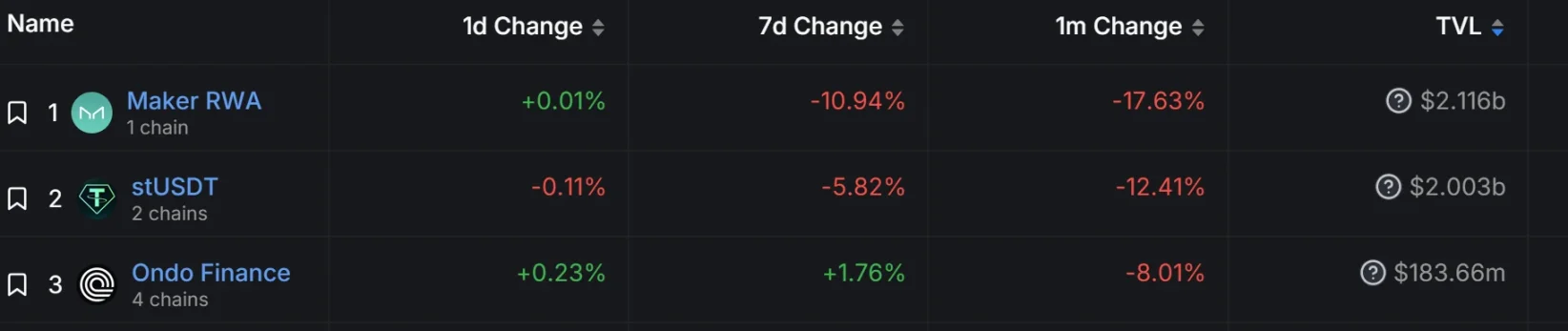
Ondo Finance’s TVL ranking in third place should be attributed to the design of its products. In essence, RWA products do not require special design. They themselves tokenize the underlying objects in traditional finance. This requires a closer and safer connection between reality and virtuality. This is the difficulty of RWA product design. Investors can purchase or redeem The security and standardization of RWA asset processes are the purpose of product design.
The three RWA products currently launched by Ondo Finance are OUSG, USDY and OMMF.
OUSG (U.S. Treasury Bond)
OUSG is the main contributing product to TVL in Ondo Finance, with a TVL of US$117 million. The vast majority of OUSG’s underlying assets come from BlackRock’s short-term U.S. bond ETF: iShares Short Treasury Bond ETF (NASDAQ: SHV), and a small part is USDC and USD as liquidity.
SHV ETF was established in 2007. It refers to short-term treasury bonds with an investment cycle of less than 1 year. It tracks the ICE U.S. Short-term Treasury Bond Index. According to Yahoo data, the current opening price of SHV ETF is 110.42 USD, with total assets of approximately 18.4 billion U.S. dollars. The annualized return is 5.17%, and it is rated AA by S&P.
The current price of OUSG is 104.66 USD, with an annualized rate of return of 4.69%. It supports purchases on Ethereum, Polygon and Solana chains. It is worth noting that Ondo I LP, as the fund manager, manages the SHV ETF shares of OUSG purchased by investors. As an SPV of OUSG, Ondo I LP is a US entity company, which is conducive to risk isolation for investors and helps users redeem their shares in emergencies (emergency situations include project bankruptcy and other reasons).
In terms of related fees, OUSG charges a 0.15% fund management fee, a maximum of 0.15% for payment of service providers such as fund managers and auditors, and a 0.15% ETF charge from BlackRock itself, the issuer of the ETF. management fee.
However, the purchase requirements of OUSG are relatively high, and KYC verification is a prerequisite. At the same time, the requirements for “Qualified Purchasers” must be met. This requirement requires investors to hold an investment portfolio of at least US$5 million and OUSG’s The minimum purchase amount is 100,000 USDT.
However, compared with the violent price fluctuations during the bear market stage, RWA products investing in short-term U.S. Treasury bond ETFs with annualized returns of about 5% are suitable targets. Therefore, in the past year, OUSG’s TVL has grown rapidly in scale and has become Ondo Finance’s main product.
USDY (USD interest rate)
USDY is a tokenized instrument backed by short-term U.S. Treasury securities and bank demand deposits. USDY is open to ordinary investors, with a purchase limit of more than $500, and can be minted and transferred on the chain 40-50 days after purchase. The current price of USDY is 1.02 USD, with an annualized return of 5.10% and a TVL of $66.2 million.
Compared with USDT and USDC stablecoins that are often used in the crypto world, USDY is more like an interest-bearing stablecoin, and can also be classified as an interest-bearing stablecoin sector. However, compared with other interest-bearing stablecoins, it The support behind it is a traditional bank, and according to its official website, the USDY complies with US regulatory requirements.
Since USDY can be minted and circulated on the chain after a certain period of time and operate as a stable currency, the structural design and risk control of USDY are particularly important. The following are the key points of USDY’s design and supervision methods.
- Structural design: USDY is issued by Ondo USDY LLC and serves as an SPV. Assets are managed separately from Ondo Finance and separate books and accounts are maintained. This structure ensures the separation of USDY collateral assets from the potential financial risks of Ondo Finance;
- Over-collateralization: USDY uses over-collateralization as a risk mitigation measure. The minimum 3% first loss level is used to mitigate short-term fluctuations in U.S. Treasury bond prices. USDY is currently over-collateralized by 4.64% of first-time losing positions;
- First priority: USDY investors have “first priority” in underlying bank deposits and government bonds. Ankura Trust acts as a collateral agent, overseeing the security interests of USDY holders. Established control agreements with the banks and custodians that hold the assets, giving Ankura Trust the legal rights and obligations to control the assets and repay Token holders in the event of certain defaults or when the loan is accelerated through USDY holder voting;
*Daily Transparency Report: Ankura Trust serves as the certifier and provides daily transparency reports reporting on reserve status. These reports detail asset holdings, ensuring transparency and accountability. Reports are independently verified, providing additional assurance of reliability;
- Asset allocation: USDY adopts a prudent investment strategy to maintain the safety and liquidity of funds. The asset allocation target is 65% bank deposits and 35% short-term U.S. Treasuries. This conservative investment approach focuses only on these safer and more liquid instruments, minimizing risk exposure;
- Asset custody: U.S. Treasury bonds supporting USDY are deposited in the “cash custody” accounts of Morgan Stanley and StoneX to ensure the safety of assets. These assets will not be re-hypothecated again. Ankura Trust verifies the existence of these deposits daily.
Through the above methods, USDY products isolate assets and crypto projects to reduce project RUG risks; the collateral is over-collateralized to buffer the risk of falling government bond interest rates; Ankura Trust serves as a regulatory agency to protect the safety of investors’ funds and income; The items are stored in a traditional bank’s cash custody account to ensure that the funds will not be reused.
The investment threshold of USDY is lower than other RWA products, and in addition to purchasing on the chain with USDC, you can also participate through wire transfer.
USDY has certain legal constraints to a certain extent, and has certain interest-earning advantages compared to other stable currencies. But the current usage rate of USDY is relatively low.
OMMF (U.S. Government Money Market Fund)
OMMF is a RWA token based on the U.S. Government Money Market Fund (MMF), which has not yet been officially released. Will be added after subsequent releases.
Flux Finance (lending platform)
In February 2023, Ondo Finance launched the Flux Finance lending platform. Its lending agreement is based on Compound V2. According to the official website disclosure, the fund utilization rate is currently above 85%.
Flux Finance, as one of the three channels for redeeming RWA products provided by the project party, provides a new liquidity method for the time cost issue of redemption through official channels. This is because redemption through official channels cannot be done directly on the chain. To redeem, you still need to wait for the SPV of the RWA product to sell the product before redeeming it. There is a time cost of 1-5 days.
However, Flux Finance currently supports OUSG’s product lending. As for USDY, it can be transferred through on-chain DEX after minting.
Betting on RWA track success, but the future use of tokens is still unclear
Before the transformation, Ondo Finance issued the token ONDO and sold it to the public on Coinlist. However, after the token was purchased, it was subject to a 1-year lock-up period and was subsequently released monthly. The token can be used as the governance voting quota of Flux Finance.
However, after on-chain community voting, the token ONDO was unlocked for circulation on January 18 this year. The current price of the ONDO token is 0.27 USDT, which is nearly 2.5 times higher than the token after the unlock.
At the same time, Coinbase added Ondo Finance (ONDO) to the asset listing roadmap. Because Coinbase is not only an investor in Ondo Finance, but also the only channel for USDC to be exchanged for US dollars in RWA products.
However, in the past two days, the address of the Ondo project team has transferred ONDO tokens to the exchange many times. This may be for market making or shipment, and investors need to be cautious.
According to the official article, ONDO token serves as the governance token of Ondo DAO and Flux Finance. Since it is not yet clear whether ONDO tokens can be related to RWA products, it cannot be ruled out that ONDO tokens will be used as an incentive for USDY and other RWA products in the future. After all, of the total number of tokens announced, only 16% are held by investors or Coinlist public sales, and the remaining 84% of tokens have not yet been clearly allocated.
If ONDO tokens can be combined with RWA products, using Flux Finance as a platform, and using ONDO tokens as an incentive to flow on the RWA product chain, it will undoubtedly push RWA products into the eyes of public crypto investors.


