Source: Golden Ten Data
On Friday, the latest reading of the Federal Reserve’s favorite inflation indicator will be released. According to market consensus, the December Personal Consumption Expenditures Price Index (PCE) report will show that core inflation continues to slow down, despite upward pressure from rising gasoline prices on overall PCE.
On the occasion of the latest PCE report, the Federal Reserve is entering a wait-and-see mode, and the market generally expects the Fed to maintain interest rate stability in the coming months.
Although the pressure on prices in the United States has steadily eased from its peak two years ago, investors are now grappling with a series of unresolved issues. These issues involve the impact of Trump’s policies, and the possibility that the Fed may maintain interest rates at a higher level for longer than initially expected.
According to FactSet’s broad estimate, economists believe that overall PCE in December rose by 0.3% on a monthly basis and by 2.6% year-on-year, both slightly higher than the previous value. They expect the month-on-month growth rate of core PCE inflation (excluding volatile food and energy prices) to accelerate by 0.2%, while the year-on-year growth rate remains at 2.8%.
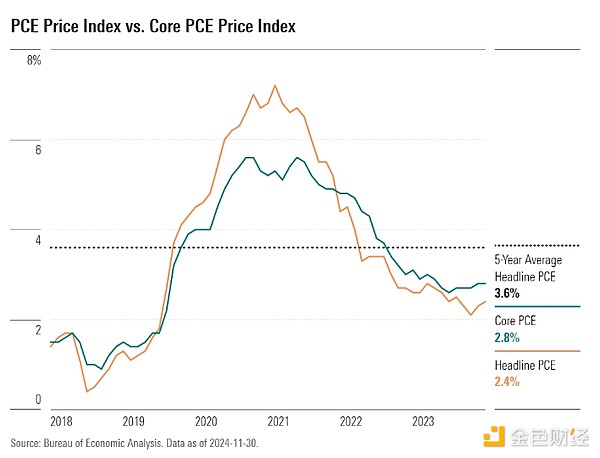
Although overall PCE in December may rise, Ameriprise Financial’s chief economist Russell Price said, “We continue to make progress on inflation”.
He expects overall PCE to increase by 0.3% month-on-month in December, with core PCE increasing by 0.2%, in line with the market’s general estimate. “We still expect both of these data to make further progress in the coming months and may approach (but not fully reach) the Fed’s target of around 2% by mid-year,” he said.
Many of the raw data of the PCE report are released in advance, such as the Consumer Price Index (CPI). This means that economists already have a good understanding of the PCE data on Friday.
The December CPI report shows that although overall inflation has risen slightly due to the increase in energy prices, the core inflation rate continues to slow. After the release of the report, the market was jubilant, easing investors’ concerns about a renewed increase in price pressures.
Prices are expected to not react the same way on Friday, even though the data may show the same situation. “There are already numbers indicating a moderation in inflation, and PCE should show similar information,” he said.
Economists generally expect that core PCE will continue to decline in the coming months, although sticky service prices still pose upward pressure on the index. Preston Caldwell, senior economist at Morningstar US, expects ‘If we no longer see soaring inflation, the year-on-year growth rate of core PCE in March will drop to a low of 2.2%, provided that inflation does not soar again, as we saw in the first quarter of 2024.’
When will the Federal Reserve cut interest rates?
The Federal Reserve kept interest rates steady at its first meeting of the year earlier this week, a move that was not surprising to the market. The policy committee stated in a statement that ‘inflation remains somewhat high.’ As the economy continues to grow and there are no signs of weakness in the labor market, officials have room to wait for more evidence of cooling price pressures before taking further interest rate cuts.
“Maintaining the pause is a very rational and reasonable view,” Praise said, quoting strong consumer spending, employment, and economic growth data. He expects the Federal Reserve to cut interest rates by 25 basis points at the June meeting.
Some strategists even suggested that after cutting interest rates by a full percentage point last fall, the Fed had ended its rate-cutting cycle. “The labor market is stabilizing and the inflation rate is slightly above target,” economists at Bank of America wrote to clients earlier this month.
Following this week’s Federal Reserve meeting, Nomura Securities now expects the Fed to stand pat in 2025, compared to the previous forecast of a rate cut. Meanwhile, Goldman Sachs reiterated their view that the Fed will cut rates twice, but less than the three cuts earlier this year. Barclays also lowered their expectations earlier this month, predicting only one rate cut by the Fed this year.
The gold bulls are in high spirits
On Thursday, spot gold soared to a record high, nearing the $2,800 mark, as US economic data showed slower-than-expected growth. In addition, Trump’s reiteration of imposing 25% tariffs on imports from Mexico and Canada also boosted the safe-haven demand for gold. Investors are now turning to PCE data for further clues on the interest rate trajectory.
IG market strategist Yeap Jun Rong said, "Repeated tariff threats have fueled safe-haven inflows into gold… Any unexpected downside in inflation data may indicate greater policy flexibility for the Fed, which could lead to earlier rate cut expectations and further support for gold.
KCM Trade’s chief market analyst Tim Waterer said that if the tariff threat transitions from a bargaining concept to an economic reality, gold may further rise.
As the gold recovery trend has been restored, the path to $2800 gold is already clear. Fxstreet analysts say the bulls may then challenge key psychological barriers such as $2850, $2900, and $3000. On the other hand, the bears must push the gold price below $2750 to have a chance to test $2700. Breaking below this level will open up more downward space, with the next key support at $2663, the convergence point of the 50-day and 100-day moving averages.
Disclaimer: The information on this page may come from third parties and does not represent the views or opinions of Gate. The content displayed on this page is for reference only and does not constitute any financial, investment, or legal advice. Gate does not guarantee the accuracy or completeness of the information and shall not be liable for any losses arising from the use of this information. Virtual asset investments carry high risks and are subject to significant price volatility. You may lose all of your invested principal. Please fully understand the relevant risks and make prudent decisions based on your own financial situation and risk tolerance. For details, please refer to
Disclaimer.


