Original Author: Pepper (X:@off_thetarget)
Tl’dr Conclusion
- “Foreign exchange” ( fools themselves on raydium LP)used their own chips - > their chips are obtained from the bonding curve, and the foreign exchange chips are severely undervalued.
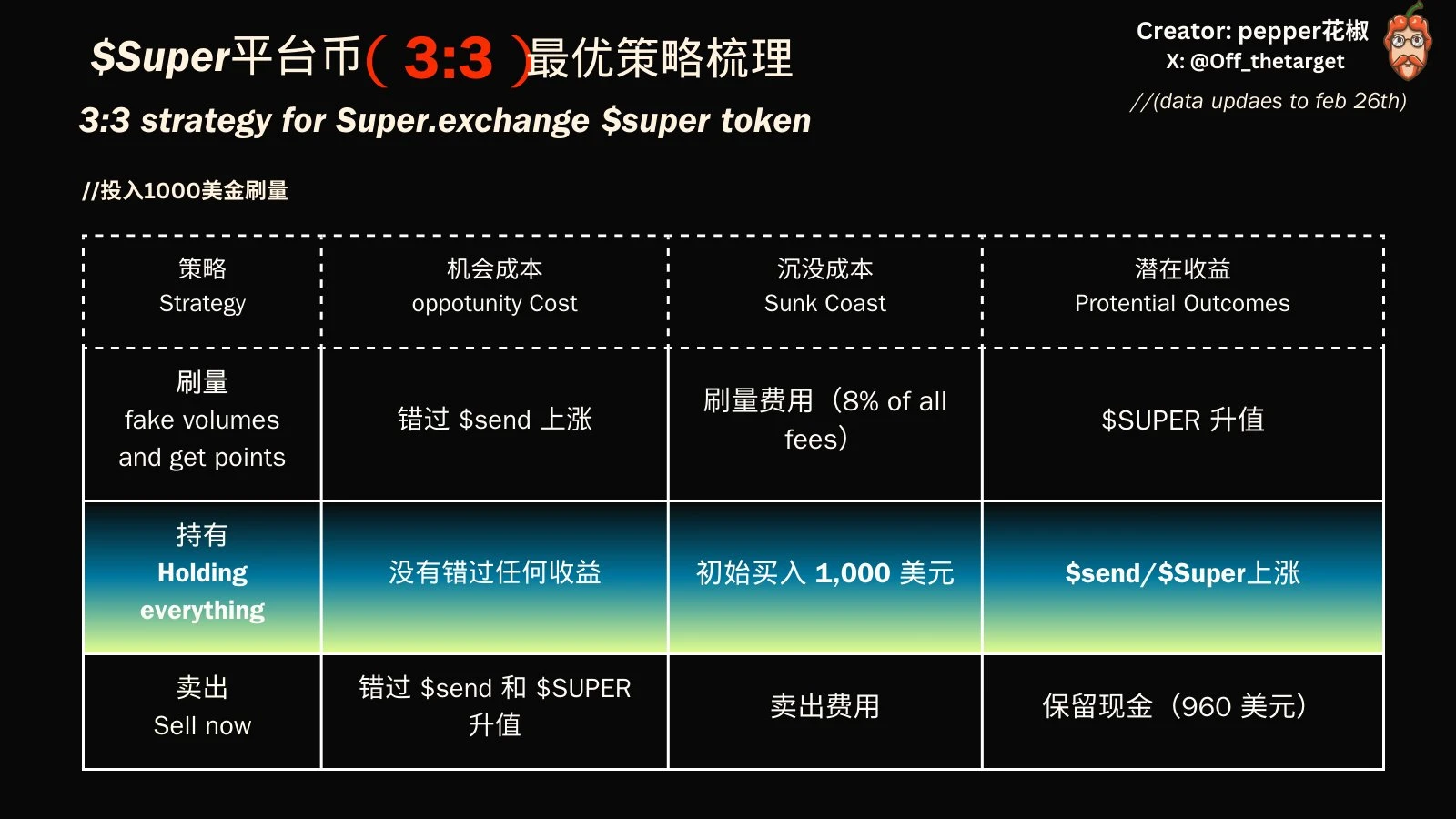
Optimal strategy: Buy $send, buy futures $super, do not brush
-
If the foreign market is higher than your cost price, then you can go to brush. The more you brush within the same time period ( 5 min), the fewer points you will get. Reduce high-frequency area operations, find the time when Asians are sleeping, and buy immediately after getting the points. Don’t wait for the price to go up later, brush as early as possible. The flywheel won’t stop.
-
The new model meme platform does not require platform tokens, but instead takes your expectations for platform tokens to exchange for a portion of your transaction fee income. The $super tokens that can be obtained through points will become fewer and fewer, and the price of $super will become higher and higher. Destruction is related to point redemption, and points are controlled by the function of trading volume + number of traders.
-
The $super of the “outer disk” is the expected value of the first batch of $super masturbators of the “inner disk”, which is also the cost line, when the gear starts to accelerate (n = 4-8), the “inner disk” MC takes off to exceed the value of the “outer disk”, which is seriously mismatched, because of insufficient liquidity, the “outer disk” is likely to be pulled away ( just need to remember that there are two bonding curves that are completely different: one is x * y =k, and the other is x^n *y =K) The formulas are different, the calculation methods are different, and the expectations are different
Detailed Analysis: Misconception of Market Value of ‘Internal and External Disk/Infinite Disk’
1. Let’s first take a look at the ordinary “external disk” under the AMM mechanism
**Most of the previous AMM mechanisms are x * y = K to calculate, that is, the value of K fluctuates with the value of x and the value of y, generally two pairs to group, where x and y represent the “inventory” of the two tokens respectively, k is the liquidity parameter, the inventory changes in the process of each transaction and k remains the same, and k corresponds to increase or decrease in the process of adding and removing each liquidity.
In short, liquidity decreases - > prices fall - > plates die. **
**Forced liquidity demand rises. **
But @_superexchange’s bonding curve is infinite, and there is no distinction between inner and outer disks.
2. Pumpfun’s Inner Disk vs Super Exchange Comparison
The bonding curve is different from the bonding curve of pumpfun, although it is also a reference AMM mode, but the joint curve of the virtual disk is different.
I referred to the previous analysis article:
The pricing system has a pre-virtual pool, the number of $Sol in the virtual pool is x 0, and the total amount of tokens is y 0. Through the data collection of the number of $SOL bought by platform users and the corresponding tokens, and fitted with the x*y=k formula, the pre-virtual pool is 30 $SOL and 1073000191 tokens, the initial k value is 32190005730, and the price of each token is 0.000000028 $SOL
Pumpfun Here, before we graduate, we divide into several regions, assuming 20-40% as one region, 40%-80% as one region, and 80%-100% (graduation) as one region.
20% - 40%: Then the price formula: y=k/x, early price liquidity change: dy/dx=−k/x, that is, when x is small, the price is sensitive to purchase, and the liquidity is low.
If x increases by 40% -80%, then the liquidity is still low, and small purchases lead to rapid price increases.
80% - Graduation: ∣dydx∣| increases, buying a small amount of ( x ) results in a dramatic drop in ( y ), unable to support large capital, the common manifestation is that when the internal disk is close to 80 K, the robots quickly dump the disk, which can be dumped to 20-30 K, showing the performance of the TAO pool.
Summary: Forced liquidity demand rises. **
So let’s take another look at super exchange.
The formula on his side is x^n * y = k, where n has 7 gears, n from 32 to 1.
When N = 32,
Here the change of liquidity is: the change of liquidity: dydx=−n⋅kxn+ 1, n = 32, ∣dydx∣ is very small, the price is insensitive to ( x ), and the liquidity is high.
Layman’s terms, x buys insensitive to price and continuously ‘increase’ liquidity.
When N = 8-4,
Liquidity changes: ∣dydx∣=n⋅kxn+ 1, n decreases, ∣dydx∣ increases but is inhibited by xn+ 1, and the market depth is stable.
Common understanding is to reduce n and increase x prices to start the bulldozer and stabilize the depth.
When N = 1,
Liquidity changes: Liquidity changes: ∣dydx∣=kx 2, ( x ) increases, ∣dydx∣
Decrease, market depth stable.
In layman’s terms, it means supporting larger capital inflows and outflows without particularly large impact on depth.
Summary: Forced liquidity demand rises. **
Original Text Link
Disclaimer: The information on this page may come from third parties and does not represent the views or opinions of Gate. The content displayed on this page is for reference only and does not constitute any financial, investment, or legal advice. Gate does not guarantee the accuracy or completeness of the information and shall not be liable for any losses arising from the use of this information. Virtual asset investments carry high risks and are subject to significant price volatility. You may lose all of your invested principal. Please fully understand the relevant risks and make prudent decisions based on your own financial situation and risk tolerance. For details, please refer to
Disclaimer.


