
Cryptocurrency development project submissions plummeted 75%, public blockchain developers are leaving in large numbers, yet crypto wallets are growing against the trend. With AI significantly boosting the productivity of existing developers, the crypto industry is entering the App era, and the developer landscape is changing.
Cryptocurrency development activity drops sharply, global developers turn to AI
As the cryptocurrency market remains sluggish and the AI wave surges, the crypto ecosystem is losing developers, while AI projects are leading GitHub’s growth.
According to CoinDesk, Artemis data shows that since early 2025, weekly code commits for crypto projects have decreased by about 75%, from 850,000 to 210,000, and active developers have decreased by 56%, down to approximately 4,600.
Since open-source repositories track developers’ coding activity, build tools, and new project launches, these data are considered some of the clearest indicators of software innovation trends. Current data indicate that AI projects now dominate GitHub’s growth momentum.
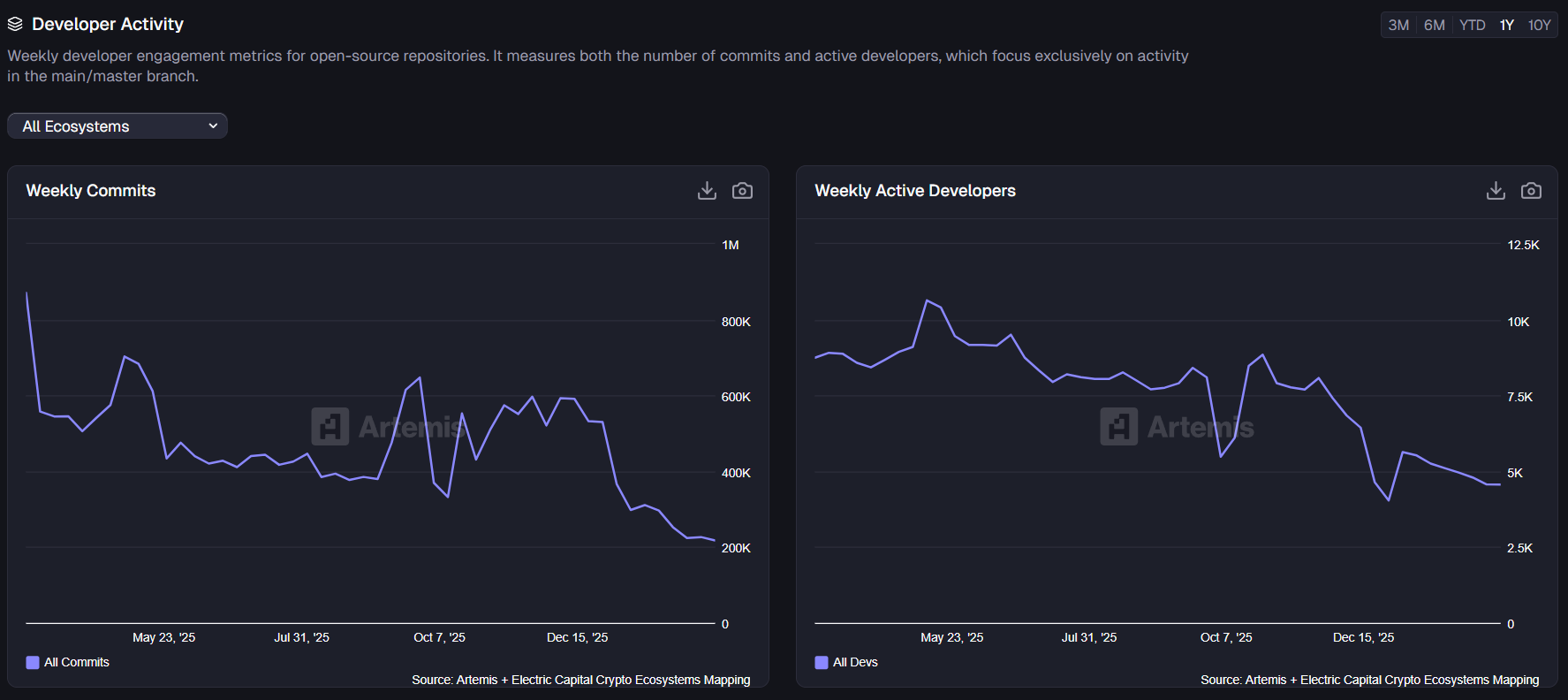
Image source: Artemis Since early 2025, weekly code commits for crypto projects on GitHub have dropped by about 75%
AI infrastructure grows rapidly, crypto sector shrinks
The latest GitHub Octoverse report shows that in 2025 alone, GitHub added about 36 million new developers, with global user numbers surpassing 180 million. The total code commits across the platform also grew by approximately 25% compared to the previous year.
This growth momentum is largely flowing into the AI field, with GitHub hosting over 4.3 million AI-related repositories.
Over the past year, repositories incorporating large language model (LLM) development kits surged by about 178%, totaling over 1.1 million, and generative AI projects attract over 1 million contributors monthly.
Additionally, repositories for Jupyter Notebooks used in machine learning experiments grew by about 75%; Dockerfile repositories for deploying AI apps increased by roughly 120%; and the programming language TypeScript, supporting many AI tools, gained over 1 million contributors in a year, becoming the most used language on GitHub.
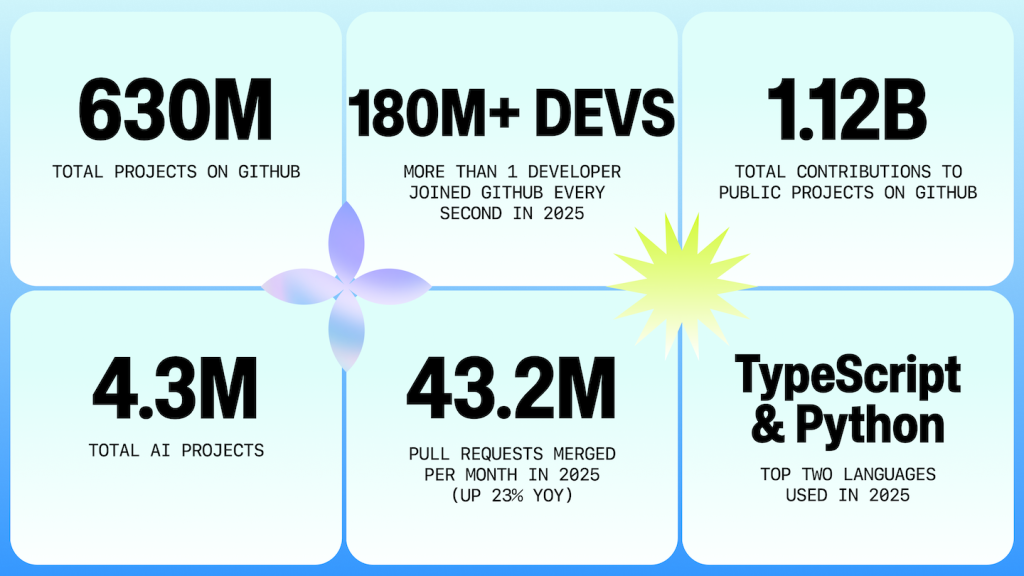
Image source: GitHub Currently, GitHub hosts over 4.3 million AI-related repositories
Major public chains face setbacks, crypto wallets grow against the trend
Compared to the exponential growth of AI developers, foundational public chain development activity in the crypto space has been heavily impacted.
Artemis statistics show that Ethereum’s weekly active developers decreased by 34% in three months to 2,811; Solana dropped 40% to 942; Base lost 52% to 378.
Emerging public chains that attracted significant funding last year were most affected, with Aptos losing about 60% of its developers, BNB Chain’s code submissions plummeting 85%, and Celo decreasing by 52%.
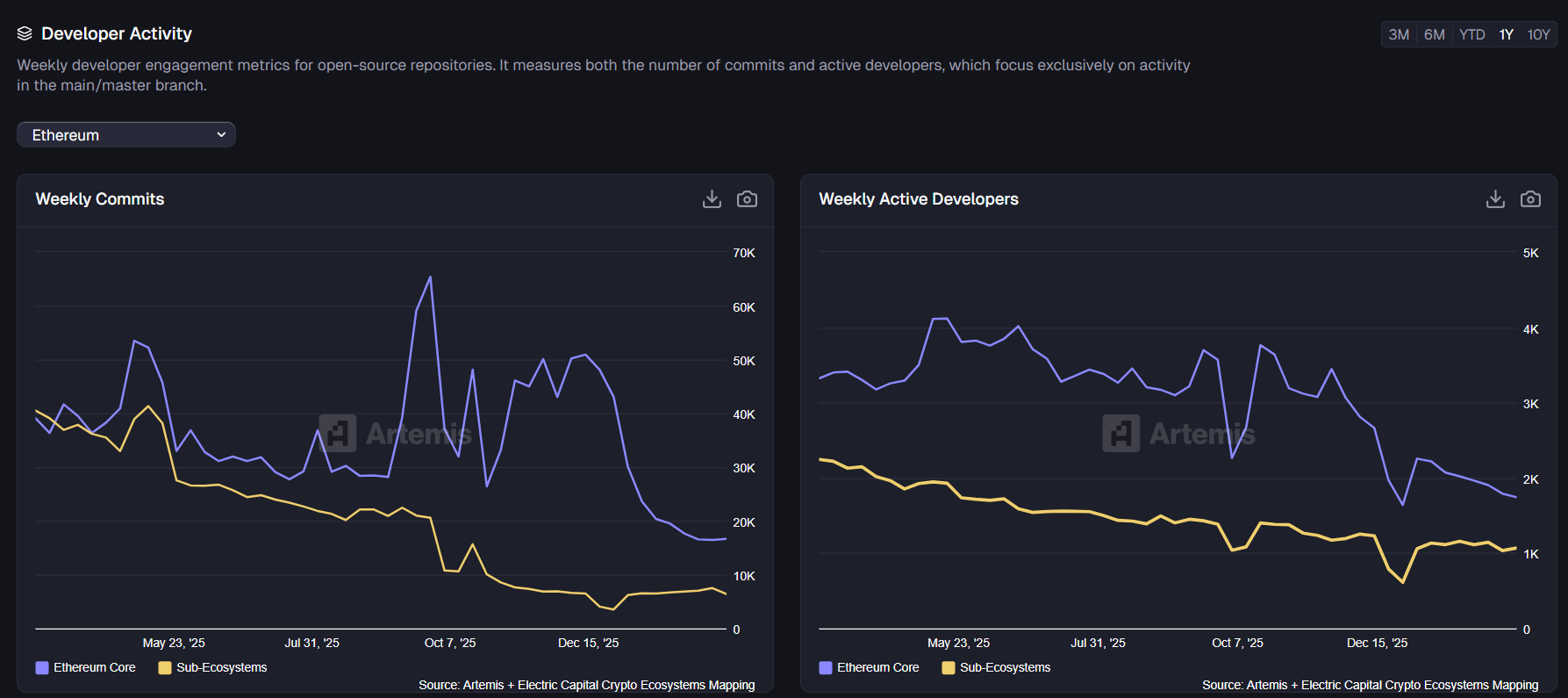
Image source: Artemis Ethereum’s weekly active developers decreased by 34% in three months to 2,811
The only area maintaining growth and scale is crypto wallet infrastructure, with weekly active developers slightly increasing by about 6% to 308.
The activity in wallets may be related to current industry focus on AI agent payments and cross-border stablecoin payments. On March 12, the Layer 1 blockchain Aleo announced that the era of AI agent payments integrated with cryptocurrency technology is coming, which could become a killer app for the industry.
Further reading:
What is the x402 protocol? Behind the x402 meme coin hype, you should understand the future payment revolution
Veterans join, newcomers leave, crypto developer landscape changing
At the same time, the structure of crypto development labor is changing. Developers with over two years of experience increased by about 27% compared to last year, contributing around 70% of code commits. The main loss of developers is among those with less than one year of experience, decreasing by 58%.
Although activity levels of crypto developers often fluctuate with market cycles, the AI sector now has strong funding and clear commercial needs. If a bull market returns, will these departed talents come back? That remains to be seen.
Crypto industry enters App era, open-source infrastructure no longer needs rebuilding
Behind the decline in crypto development activity are deeper technological and strategic shifts. BeInCrypto reports that AI coding assistants can quickly handle repetitive tasks, debug, and even generate complex code in a short time.
This reduces the number of public code commits, but significantly boosts individual developer productivity. Development teams can accomplish the same amount of work with fewer public records, explaining why surface activity data declines while some projects continue to progress smoothly.
Meanwhile, the crypto industry is entering the App era. Many new projects now choose to build directly as real applications on existing platforms or integrate infrastructure and applications from the start. This may explain why activity in purely infrastructure-focused open-source repositories is declining.
Further reading:
AI flood on GitHub! Some projects are pausing external contributions, turning Shitcode into a DDoS-like attack
Disclaimer: The information on this page may come from third parties and does not represent the views or opinions of Gate. The content displayed on this page is for reference only and does not constitute any financial, investment, or legal advice. Gate does not guarantee the accuracy or completeness of the information and shall not be liable for any losses arising from the use of this information. Virtual asset investments carry high risks and are subject to significant price volatility. You may lose all of your invested principal. Please fully understand the relevant risks and make prudent decisions based on your own financial situation and risk tolerance. For details, please refer to
Disclaimer.
Related Articles
JPMorgan ETF Trend Report: API-ification, Active Management at 83%, Tokenization Split into Two Paths—Synthetic and Native
JPMorgan Chase’s report highlights three major trends: 1) AP’s API automated trading accounts for about 50% of top-tier market traffic; 2) in 2025, actively managed ETFs make up 83% of new issuance, and are expected to become mainstream in 2026–27; 3) tokenization splits into two paths: synthetic (mirroring prices through derivatives) and native (issued on the blockchain). The report emphasizes improving transparency and governance with tools such as Athena, and monitors subsequent follow-through and the timeline toward formal productization.
ChainNewsAbmedia2h ago
a16z Report: Stablecoins Reach $4.5T in Q1 Transactions, Shift to Local Payments
Gate News message, April 25 — According to a new a16z report, stablecoins have evolved from crypto settlement tools into global financial infrastructure, with adoption accelerating across Asia, Brazil, and other emerging markets. The shift in focus has moved from cross-border to local payments as re
GateNews8h ago
Kelp DAO 漏洞救援:Mantle 擬貸 Aave 3 萬 ETH、DeFi 聯盟承諾逾 43,500 ETH
After the Kelp DAO cross-chain bridge was hacked, DeFi United mobilized agreements from protocols including Aave to commit 43,500 ETH (about $101 million) to provide relief for bad debts. Mantle proposed MIP-34, offering to lend up to 30,000 ETH to the Aave DAO and granting 130,000 AAVE voting rights; Stani Kulechov personally injected 5,000 ETH, and Lido and others also contributed. This move is seen as an experiment in “exchanging loans for governance rights” during a crisis, pending a vote.
ChainNewsAbmedia23h ago
Morgan Stanley launches its first GENIUS Act-compliant stablecoin reserve fund MSNXX: annual fee 0.15%, minimum $10,000,000
Morgan Stanley Investment Management today launches the MSNXX stablecoin reserve fund, providing asset management for stablecoin issuers. The assets are invested in cash, 93-day U.S. Treasury bills, and overnight repurchase agreements. The NAV is fixed at $1.00, with an annual fee of 0.15%, and a minimum threshold of $10 million. This fund complies with the GENIUS Act requirements, integrating stablecoin funding into the U.S. government money market fund framework, demonstrating that stablecoin infrastructure is aligning with traditional finance.
ChainNewsAbmedia23h ago
Algorand, Aptos Lead Quantum Security Race: Coinbase Report
Coinbase's Quantum Advisory Council has identified Algorand and Aptos as the Layer-1 networks best positioned to handle future quantum computing threats, according to a report cited on April 24, 2026. While large-scale quantum risks remain years away, the report emphasizes that preparation is
CryptoFrontier04-24 07:32
Taiwan’s 14 brokerage firms have launched virtual asset ETFs via omnibus authorization for cross-advisory (sub-advisory) arrangements, with cumulative trading exceeding NT$98.99 billion New Taiwan dollars
According to the latest statistics provided by the Securities and Futures Bureau of the Financial Supervisory Commission, as of the end of March 2026, a total of 14 securities firms in Taiwan have launched virtual asset ETF cross-border/overseas custody (futures commission) re-delegation business, with cumulative trading exceeding NT$9.9B. Huang Zhonghao, Deputy Director of the Securities and Futures Bureau of Taiwan, stated that the Financial Supervisory Commission (FSC) has required the securities firms’ association to submit an assessment report on the performance of the virtual asset ETF cross-border/overseas custody (futures commission) re-delegation business over the past year, and that the assessment will expand eligibility to retail investors.
MarketWhisper04-24 06:41


