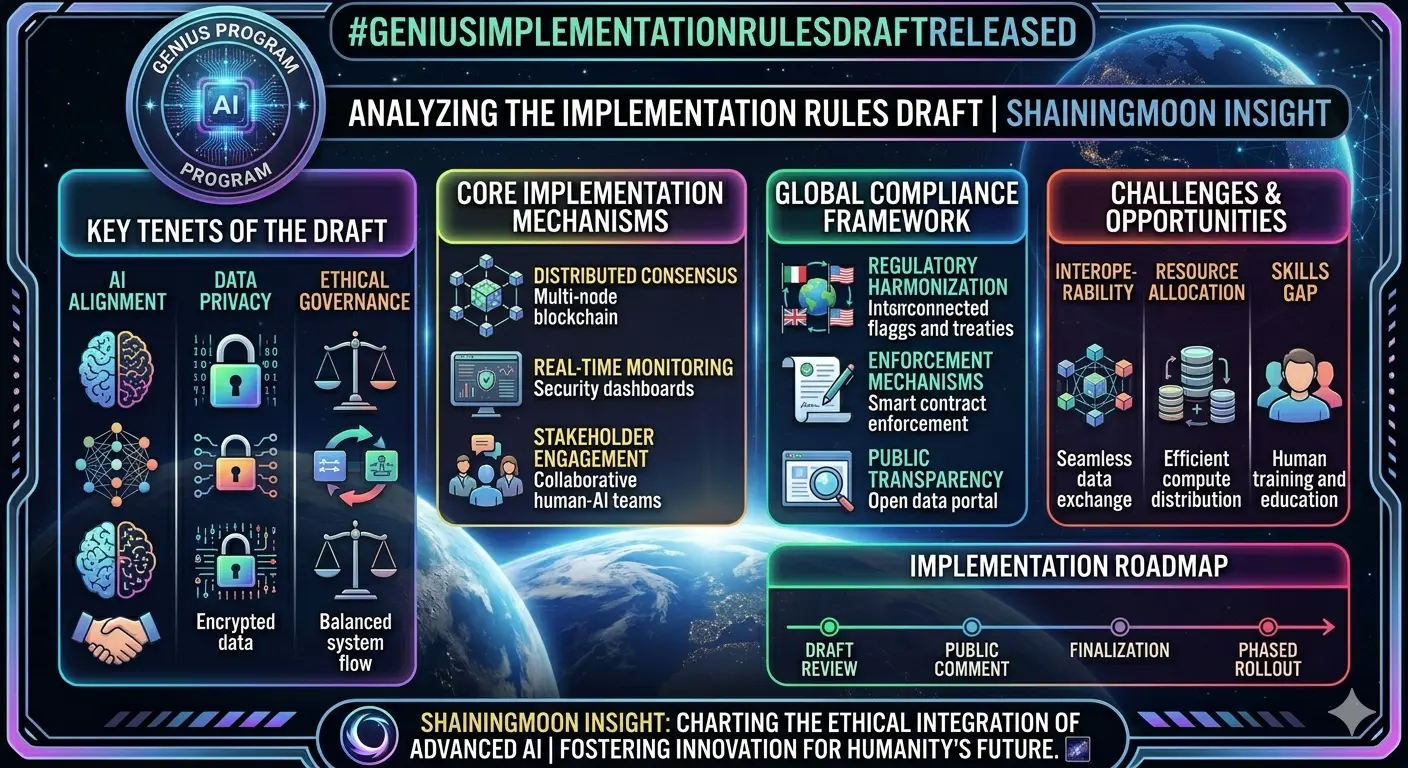
#GENIUSImplementationRulesDraftReleased
The Definitive Guide to GENIUS Act Rulemaking & Stablecoin Regulation (2026)
Updated with the latest regulatory developments as of April 2026.
Introduction: Why GENIUS Matters
The Guiding and Establishing National Innovation for U.S. Stablecoins Act (GENIUS Act) represents the first comprehensive federal law in the United States designed to regulate payment stablecoins — digital assets pegged to fiat currency that are used for payments, settlements, and broader financial activity. The law was signed into effect on July 18, 2025, marking a historic turning point in how digital currencies intersect with traditional financial regulation.
The GENIUS Act is not merely another policy paper — it is a framework that will shape how stablecoins are issued, managed, supervised, and integrated into the financial system. Over the course of 2025 and early 2026, federal agencies including the Treasury Department, Office of the Comptroller of the Currency (OCC), Federal Deposit Insurance Corporation (FDIC), and National Credit Union Administration (NCUA) have been engaged in drafting and proposing implementing rules — the actual regulations that will bring the law to life.
The recent release of the Draft Implementation Rules — referred to here as #GENIUSImplementationRulesDraftReleased — marks a crucial phase where the public, industry participants, and policymakers can see the practical interpretation of the law and provide feedback. In this post, we explain:
What the GENIUS Act requires
What the Draft Implementation Rules propose
Key regulatory and compliance provisions
Impact on stablecoin issuers and service providers
Industry reactions and controversies
Strategic implications for crypto businesses and financial institutions
1. Overview of the GENIUS Act
1.1 What the Law Is and What It Does
The GENIUS Act establishes a federal regulatory framework for payment stablecoins in the United States. Stablecoins are digital assets that are pegged to fiat currencies (e.g., the U.S. dollar) and are widely used in cryptocurrency markets for trading, payments, remittances, and DeFi protocols.
Key elements of the law include:
A prohibition on any person other than a “permitted payment stablecoin issuer” from issuing a payment stablecoin in the U.S.
A prohibition on digital asset service providers offering or selling stablecoins unless certain conditions are met (e.g., the issuer is approved or foreign issuers meet specific requirements)
A requirement that federal regulators issue implementing regulations within one year of enactment — i.e., by July 18, 2026
The law’s goal is to balance innovation in digital payments with consumer protection, financial stability, and anti-money-laundering (AML) safeguards.
2. The Regulatory Implementation Process
Passing the GENIUS Act was only the first step. The law mandates that multiple federal agencies issue regulations to interpret and enforce its provisions. This includes:
Treasury Department — for overarching guidance and coordination, especially state regulatory frameworks.
OCC (Office of the Comptroller of the Currency) — for federal stablecoin issuer regulation.
FDIC (Federal Deposit Insurance Corporation) — for draft rules on stablecoin applications tied to insured institutions.
NCUA (National Credit Union Administration) — for draft rules on stablecoin issuance by credit unions.
Each agency has been working through Notice of Proposed Rulemaking (NPRM) or draft regulations that lay out how the law will function in practice.
3. Treasury’s Draft Rules & Public Comment Period
One of the most recent developments is the Treasury Department’s notice of proposed rulemaking, which seeks public input on how to implement key aspects of the GENIUS Act.
3.1 State-Level Regulatory Regimes
The Treasury’s proposal focuses on establishing broad principles for determining whether a state-level regulatory regime is “substantially similar” to the federal framework. This is critical because:
Stablecoin issuers with less than $10 billion in outstanding issuance may opt for state regulation instead of full federal oversight — but only if the state regime is certified as substantially similar.
This creates a federal-state regulatory partnership model where states can regulate smaller issuers — but under principles set by the federal government.
3.2 Public Comment & Participation
The Treasury’s NPRM invites comments from all stakeholders, and the public comment period is open for 60 days after publication in the Federal Register. This means industry participants, academics, legal experts, and the general public can influence how stablecoin regulation is shaped.
4. OCC’s Proposed Rulemaking for Stablecoin Issuers
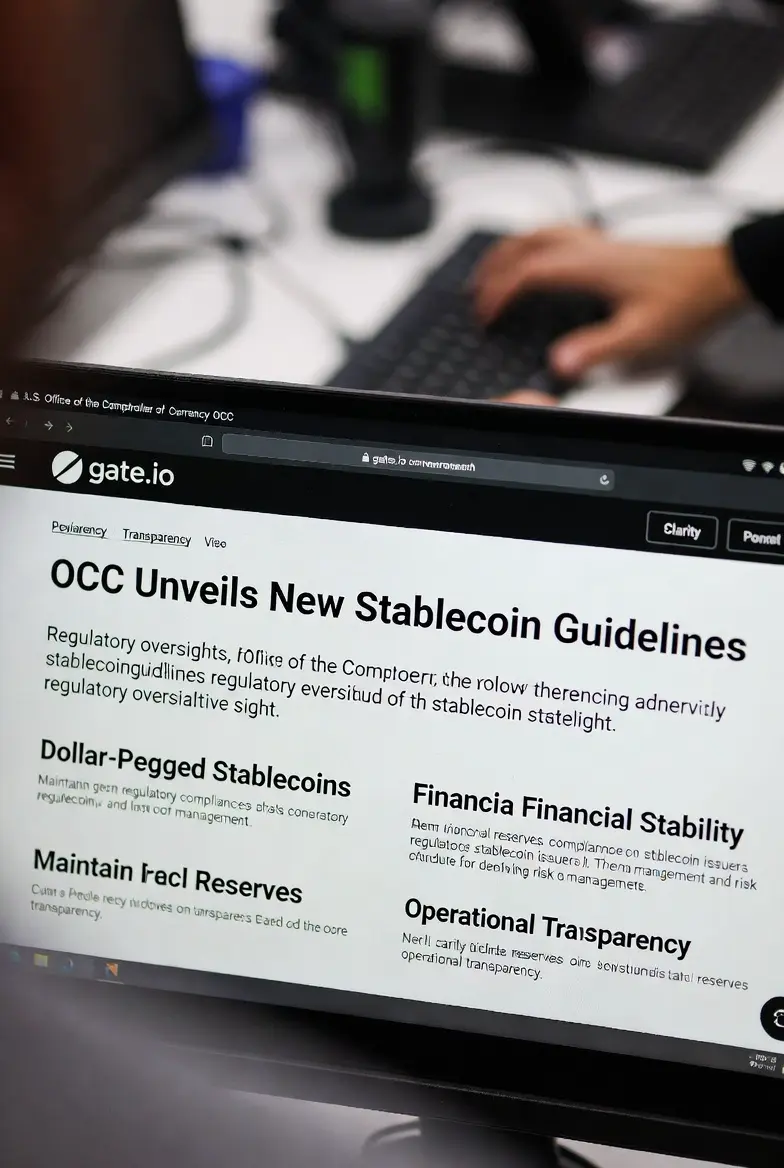
The OCC’s draft rule — a major piece of the implementation puzzle — was issued in early 2026. This proposed rule would:
Define what constitutes a permitted payment stablecoin issuer (PPSI) under federal law.
Clarify the types of entities that can be PPSIs (national banks, federal savings associations, foreign issuers meeting specific requirements, etc.).
Specify restrictions on custody, issuance, and operational activities related to stablecoins.
A key takeaway is that the rule generally limits stablecoin issuance to PPSIs — effectively eliminating unregulated issuance and placing stablecoin creation under the supervision of federal regulators.
5. FDIC & NCUA Draft Rules
In parallel with Treasury and OCC activity:
The FDIC released draft rules for stablecoin applications tied to insured institutions, providing guidance on how banks can participate in stablecoin issuance under GENIUS.
The NCUA unveiled draft rules for credit unions that seek to become stablecoin issuers, further expanding the regulated pathways.
These draft regulations signal that multiple regulatory paths are being developed — but all with strict compliance requirements.
6. Key Regulatory Themes in the Draft Rules
Across the draft regulations from Treasury, OCC, FDIC, and NCUA, several major themes emerge:
6.1 Permitted Payment Stablecoin Issuers (PPSIs)
A central concept is the designation of PPSIs — entities authorized to issue stablecoins. The draft rules propose clear criteria and supervision mechanisms for PPSIs, including capital, risk management, and compliance expectations.
6.2 Prohibitions on Unregulated Issuance
The draft rules reiterate that only PPSIs may issue payment stablecoins in the U.S., and digital asset service providers cannot offer or sell stablecoins unless certain conditions are met.
This has profound implications for exchanges, wallets, and DeFi platforms that currently facilitate stablecoin trading without issuer status.
6.3 Federal vs. State Oversight
The Treasury’s proposed principles for state regulation create a dual-track system where smaller issuers can choose state oversight — but only if the state framework meets federal standards.
6.4 AML, Consumer Protection, and Risk Management
Draft regulations emphasize:
Strong AML/CFT (Anti-Money Laundering/Counter-Terrorist Financing) controls
Consumer protection safeguards
Risk management and operational resilience
These requirements mirror traditional financial regulation but are tailored to digital asset risks.
7. Industry Reactions & Controversies
The regulatory proposals have sparked diverse reactions within the crypto community and broader financial industry.
7.1 Concerns About Innovation
Some stakeholders argue that stringent rules may stifle innovation, especially for nonbank and decentralized entities that have historically driven stablecoin development. Critics say that limiting issuance to PPSIs could centralize stablecoin creation among large financial institutions.
7.2 Yield-Bearing Stablecoins Debate
Another major controversy is the treatment of yield-bearing stablecoins — tokens that pay interest or rewards. The GENIUS Act did not explicitly address this category, leading to regulatory uncertainty and debate in Congress and among regulators.
8. Strategic Implications for Market Participants
The release of the draft implementation rules means that crypto firms, financial institutions, and technology providers must start preparing for compliance:
8.1 For Stablecoin Issuers
Entities that want to issue stablecoins in the U.S. will likely need to:
Apply for PPSI status
Build robust compliance programs
Align with federal or certified state regulatory frameworks
This may involve partnerships with banks or state regulators to meet requirements.
8.2 For Exchanges & Wallets
Platforms that list or facilitate stablecoin transactions will need to:
Verify issuer status
Ensure compliance with AML and consumer protection standards
Adjust product offerings to align with new regulations
9. What’s Next? Timeline & Expectations
The regulatory process is still unfolding:
Public comments on draft rules are ongoing through 2026.
Agencies are expected to finalize regulations by July 18, 2026, per the law’s timeline.
Implementation and compliance phases will continue into 2027 and beyond as enforcement mechanisms and supervisory structures are put in place.
10. Conclusion: A New Era for Stablecoin Regulation
The release of the #GENIUSImplementationRulesDraftReleased marks a watershed moment in digital asset regulation. For the first time, stablecoins — a cornerstone of modern cryptocurrency ecosystems — are being integrated into a comprehensive federal regulatory framework that aims to balance innovation with safety, transparency, and financial stability.
This regulatory evolution will shape how stablecoins operate, how businesses interact with them, and how consumers and institutions use digital assets in the years ahead. The draft rules reflect both the promise and complexity of bringing digital finance into the regulated financial system.
Stakeholders across the crypto and financial sectors should engage with the public comment process, assess compliance requirements, and prepare for a future where stablecoins are a regulated part of mainstream finance.
The Definitive Guide to GENIUS Act Rulemaking & Stablecoin Regulation (2026)
Updated with the latest regulatory developments as of April 2026.
Introduction: Why GENIUS Matters
The Guiding and Establishing National Innovation for U.S. Stablecoins Act (GENIUS Act) represents the first comprehensive federal law in the United States designed to regulate payment stablecoins — digital assets pegged to fiat currency that are used for payments, settlements, and broader financial activity. The law was signed into effect on July 18, 2025, marking a historic turning point in how digital currencies intersect with traditional financial regulation.
The GENIUS Act is not merely another policy paper — it is a framework that will shape how stablecoins are issued, managed, supervised, and integrated into the financial system. Over the course of 2025 and early 2026, federal agencies including the Treasury Department, Office of the Comptroller of the Currency (OCC), Federal Deposit Insurance Corporation (FDIC), and National Credit Union Administration (NCUA) have been engaged in drafting and proposing implementing rules — the actual regulations that will bring the law to life.
The recent release of the Draft Implementation Rules — referred to here as #GENIUSImplementationRulesDraftReleased — marks a crucial phase where the public, industry participants, and policymakers can see the practical interpretation of the law and provide feedback. In this post, we explain:
What the GENIUS Act requires
What the Draft Implementation Rules propose
Key regulatory and compliance provisions
Impact on stablecoin issuers and service providers
Industry reactions and controversies
Strategic implications for crypto businesses and financial institutions
1. Overview of the GENIUS Act
1.1 What the Law Is and What It Does
The GENIUS Act establishes a federal regulatory framework for payment stablecoins in the United States. Stablecoins are digital assets that are pegged to fiat currencies (e.g., the U.S. dollar) and are widely used in cryptocurrency markets for trading, payments, remittances, and DeFi protocols.
Key elements of the law include:
A prohibition on any person other than a “permitted payment stablecoin issuer” from issuing a payment stablecoin in the U.S.
A prohibition on digital asset service providers offering or selling stablecoins unless certain conditions are met (e.g., the issuer is approved or foreign issuers meet specific requirements)
A requirement that federal regulators issue implementing regulations within one year of enactment — i.e., by July 18, 2026
The law’s goal is to balance innovation in digital payments with consumer protection, financial stability, and anti-money-laundering (AML) safeguards.
2. The Regulatory Implementation Process
Passing the GENIUS Act was only the first step. The law mandates that multiple federal agencies issue regulations to interpret and enforce its provisions. This includes:
Treasury Department — for overarching guidance and coordination, especially state regulatory frameworks.
OCC (Office of the Comptroller of the Currency) — for federal stablecoin issuer regulation.
FDIC (Federal Deposit Insurance Corporation) — for draft rules on stablecoin applications tied to insured institutions.
NCUA (National Credit Union Administration) — for draft rules on stablecoin issuance by credit unions.
Each agency has been working through Notice of Proposed Rulemaking (NPRM) or draft regulations that lay out how the law will function in practice.
3. Treasury’s Draft Rules & Public Comment Period
One of the most recent developments is the Treasury Department’s notice of proposed rulemaking, which seeks public input on how to implement key aspects of the GENIUS Act.
3.1 State-Level Regulatory Regimes
The Treasury’s proposal focuses on establishing broad principles for determining whether a state-level regulatory regime is “substantially similar” to the federal framework. This is critical because:
Stablecoin issuers with less than $10 billion in outstanding issuance may opt for state regulation instead of full federal oversight — but only if the state regime is certified as substantially similar.
This creates a federal-state regulatory partnership model where states can regulate smaller issuers — but under principles set by the federal government.
3.2 Public Comment & Participation
The Treasury’s NPRM invites comments from all stakeholders, and the public comment period is open for 60 days after publication in the Federal Register. This means industry participants, academics, legal experts, and the general public can influence how stablecoin regulation is shaped.
4. OCC’s Proposed Rulemaking for Stablecoin Issuers
The OCC’s draft rule — a major piece of the implementation puzzle — was issued in early 2026. This proposed rule would:
Define what constitutes a permitted payment stablecoin issuer (PPSI) under federal law.
Clarify the types of entities that can be PPSIs (national banks, federal savings associations, foreign issuers meeting specific requirements, etc.).
Specify restrictions on custody, issuance, and operational activities related to stablecoins.
A key takeaway is that the rule generally limits stablecoin issuance to PPSIs — effectively eliminating unregulated issuance and placing stablecoin creation under the supervision of federal regulators.
5. FDIC & NCUA Draft Rules
In parallel with Treasury and OCC activity:
The FDIC released draft rules for stablecoin applications tied to insured institutions, providing guidance on how banks can participate in stablecoin issuance under GENIUS.
The NCUA unveiled draft rules for credit unions that seek to become stablecoin issuers, further expanding the regulated pathways.
These draft regulations signal that multiple regulatory paths are being developed — but all with strict compliance requirements.
6. Key Regulatory Themes in the Draft Rules
Across the draft regulations from Treasury, OCC, FDIC, and NCUA, several major themes emerge:
6.1 Permitted Payment Stablecoin Issuers (PPSIs)
A central concept is the designation of PPSIs — entities authorized to issue stablecoins. The draft rules propose clear criteria and supervision mechanisms for PPSIs, including capital, risk management, and compliance expectations.
6.2 Prohibitions on Unregulated Issuance
The draft rules reiterate that only PPSIs may issue payment stablecoins in the U.S., and digital asset service providers cannot offer or sell stablecoins unless certain conditions are met.
This has profound implications for exchanges, wallets, and DeFi platforms that currently facilitate stablecoin trading without issuer status.
6.3 Federal vs. State Oversight
The Treasury’s proposed principles for state regulation create a dual-track system where smaller issuers can choose state oversight — but only if the state framework meets federal standards.
6.4 AML, Consumer Protection, and Risk Management
Draft regulations emphasize:
Strong AML/CFT (Anti-Money Laundering/Counter-Terrorist Financing) controls
Consumer protection safeguards
Risk management and operational resilience
These requirements mirror traditional financial regulation but are tailored to digital asset risks.
7. Industry Reactions & Controversies
The regulatory proposals have sparked diverse reactions within the crypto community and broader financial industry.
7.1 Concerns About Innovation
Some stakeholders argue that stringent rules may stifle innovation, especially for nonbank and decentralized entities that have historically driven stablecoin development. Critics say that limiting issuance to PPSIs could centralize stablecoin creation among large financial institutions.
7.2 Yield-Bearing Stablecoins Debate
Another major controversy is the treatment of yield-bearing stablecoins — tokens that pay interest or rewards. The GENIUS Act did not explicitly address this category, leading to regulatory uncertainty and debate in Congress and among regulators.
8. Strategic Implications for Market Participants
The release of the draft implementation rules means that crypto firms, financial institutions, and technology providers must start preparing for compliance:
8.1 For Stablecoin Issuers
Entities that want to issue stablecoins in the U.S. will likely need to:
Apply for PPSI status
Build robust compliance programs
Align with federal or certified state regulatory frameworks
This may involve partnerships with banks or state regulators to meet requirements.
8.2 For Exchanges & Wallets
Platforms that list or facilitate stablecoin transactions will need to:
Verify issuer status
Ensure compliance with AML and consumer protection standards
Adjust product offerings to align with new regulations
9. What’s Next? Timeline & Expectations
The regulatory process is still unfolding:
Public comments on draft rules are ongoing through 2026.
Agencies are expected to finalize regulations by July 18, 2026, per the law’s timeline.
Implementation and compliance phases will continue into 2027 and beyond as enforcement mechanisms and supervisory structures are put in place.
10. Conclusion: A New Era for Stablecoin Regulation
The release of the #GENIUSImplementationRulesDraftReleased marks a watershed moment in digital asset regulation. For the first time, stablecoins — a cornerstone of modern cryptocurrency ecosystems — are being integrated into a comprehensive federal regulatory framework that aims to balance innovation with safety, transparency, and financial stability.
This regulatory evolution will shape how stablecoins operate, how businesses interact with them, and how consumers and institutions use digital assets in the years ahead. The draft rules reflect both the promise and complexity of bringing digital finance into the regulated financial system.
Stakeholders across the crypto and financial sectors should engage with the public comment process, assess compliance requirements, and prepare for a future where stablecoins are a regulated part of mainstream finance.