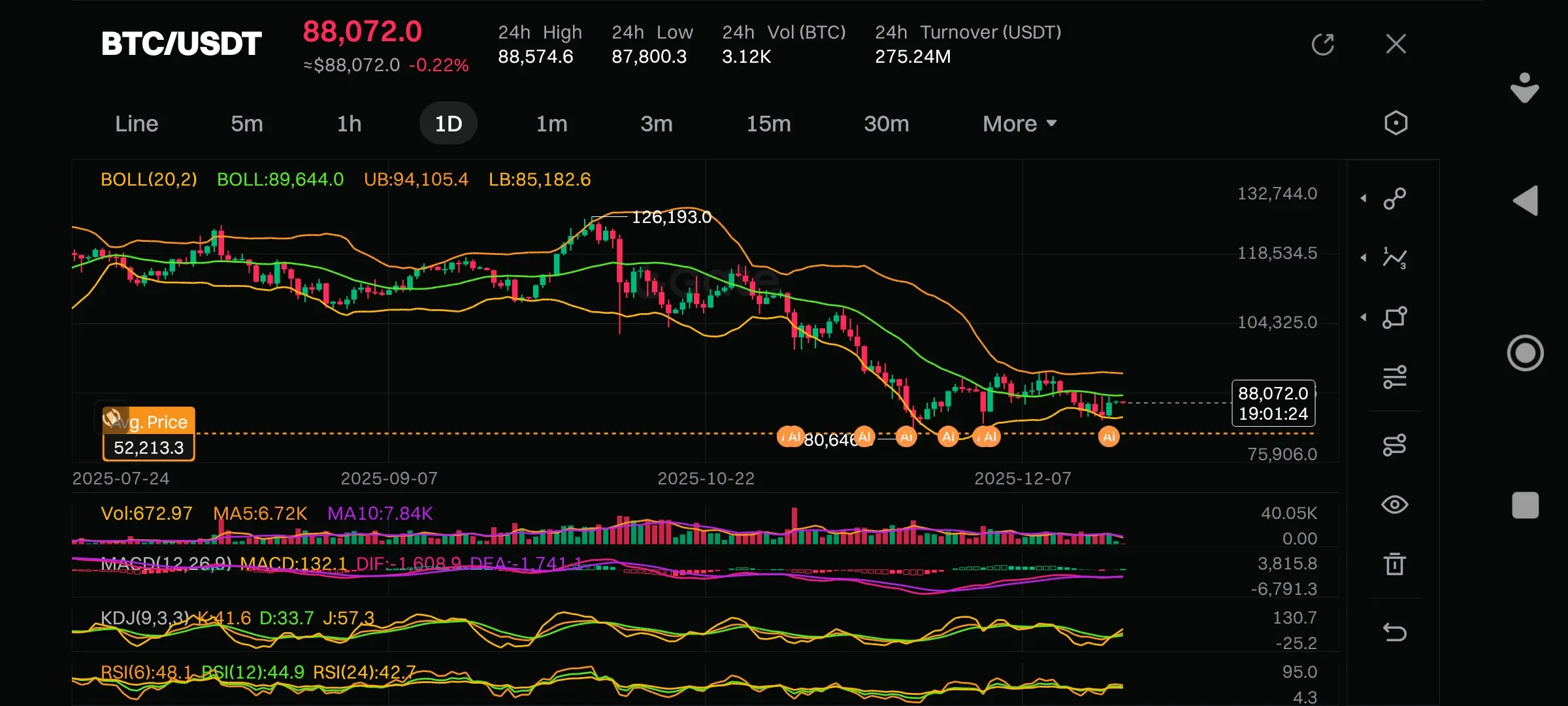
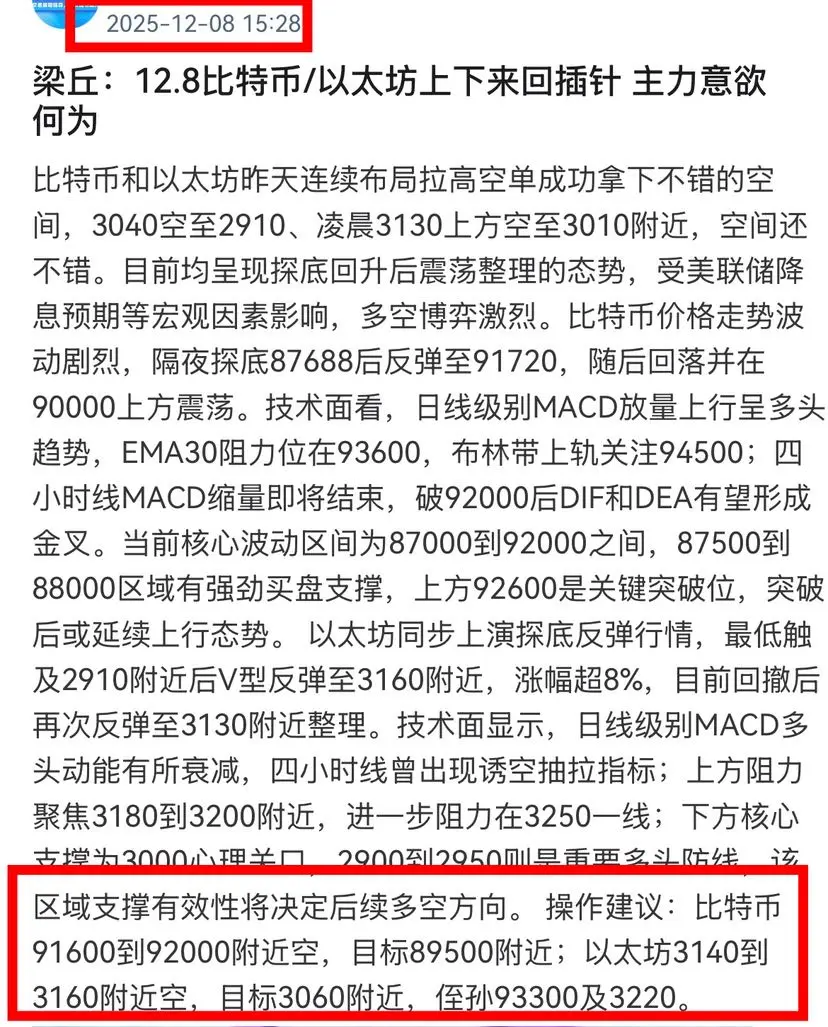
Today’s analysis using moving averages.
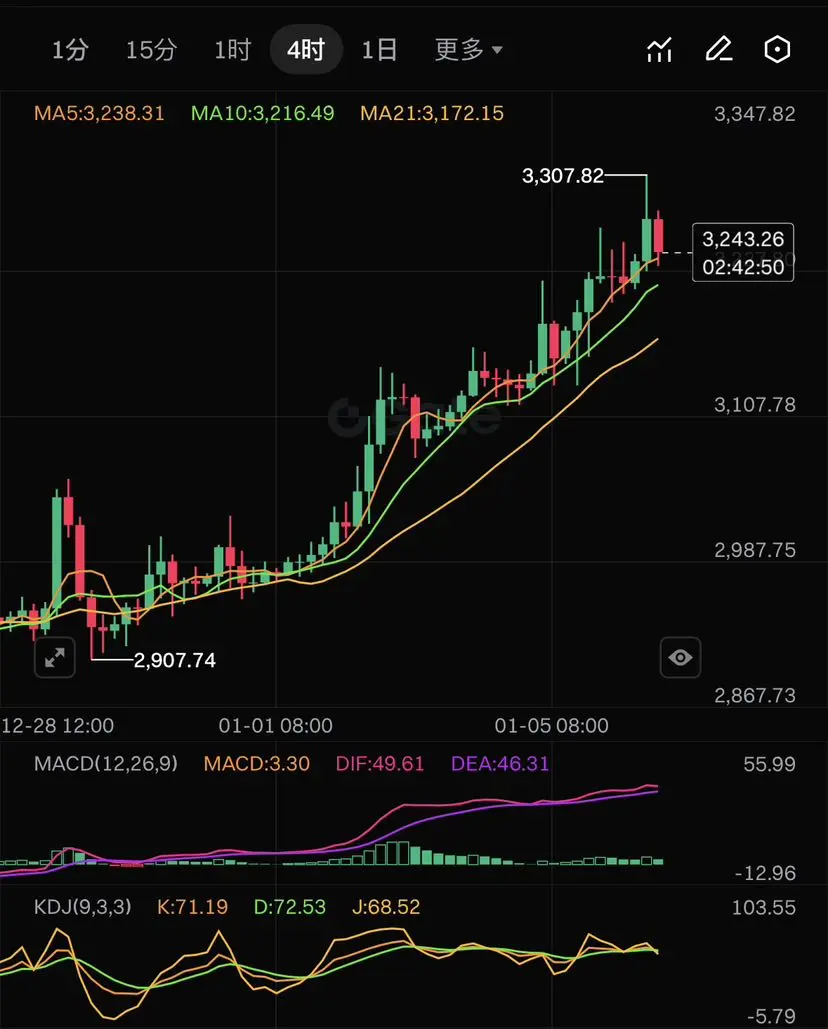
Since ETH has pulled back after approaching the $3,300 level, this is a typical “false breakout” or “pressure-triggered correction” from a technical perspective. Currently, the price has fallen back to around $3,240 - $3,250, and the entry point for short positions has entered the “confirmation stage.”
Combining the latest moving averages (MA) and KDJ trends
1. Market situation analysis: What does the rebound and fall mean?
1. Confirmation of resistance: The vicinity of $3,300 is not only a psychological barrier but also a major area for bulls to take profits and bears to hide. The rebound and fall indicate that selling pressure above is much heavier than buying pressure.
2. KDJ trend: At this time, the 1-hour and 4-hour KDJ indicators are highly likely to be forming a death cross from above 80 (or the J line is starting to turn sharply downward). This is a sign of waning momentum.
3. Moving average divergence: The price just surged too quickly, causing a significant deviation from the 5-day moving average (MA5, currently around $3,220). According to the mean reversion principle, the price has a strong tendency to move closer to MA5 or even MA10.
2. Adjustment of short entry points
Since the pullback has already occurred, the current entry logic shifts from “accumulation” to “confirmation of breakdown”:
Strategy 1: Aggressive (enter on rebound)
• Entry zone: $3,260 - $3,275
• Logic: After a rapid decline, the price often experiences a slight “second rebound.” If this rebound cannot recover $3,280, it indicates that bears have taken control.
• Stop loss: $3,280 (if the price breaks above the recent high again, exit the short position).
Strategy 2: Conservative (add on breakdown)
• Entry zone: Short when breaking below $3,220 (support at MA5).
• Logic: Once $3,220 is broken, it means the short-term upward trendline has been broken, and the death cross on KDJ will officially open downward, creating space.
• Stop loss: $3220
3. Target levels and risk management
• First target (short-term): $3,180 (upper edge of yesterday’s consolidation zone, with minor support).
• Second target (wave): $3,110 - $3,130 (support zone at MA10 on the daily chart).
• Key signal reminder: If the price returns to $3,250 and continues to oscillate for more than 4 hours without falling, be cautious of the risk of KDJ forcibly forming a “golden cross” near 50 and pushing the price higher again.
4. Summary and advice
“Rebound and fall” is the most favored scenario for shorting. *Watch KDJ: If the death cross on the 15-minute/1-hour chart has already closed downward, enter directly.
• Watch moving averages: As long as the price stays below $3,260 (hourly MA5), short positions can be held.
Since ETH has pulled back after approaching the $3,300 level, this is a typical “false breakout” or “pressure-triggered correction” from a technical perspective. Currently, the price has fallen back to around $3,240 - $3,250, and the entry point for short positions has entered the “confirmation stage.”
Combining the latest moving averages (MA) and KDJ trends
1. Market situation analysis: What does the rebound and fall mean?
1. Confirmation of resistance: The vicinity of $3,300 is not only a psychological barrier but also a major area for bulls to take profits and bears to hide. The rebound and fall indicate that selling pressure above is much heavier than buying pressure.
2. KDJ trend: At this time, the 1-hour and 4-hour KDJ indicators are highly likely to be forming a death cross from above 80 (or the J line is starting to turn sharply downward). This is a sign of waning momentum.
3. Moving average divergence: The price just surged too quickly, causing a significant deviation from the 5-day moving average (MA5, currently around $3,220). According to the mean reversion principle, the price has a strong tendency to move closer to MA5 or even MA10.
2. Adjustment of short entry points
Since the pullback has already occurred, the current entry logic shifts from “accumulation” to “confirmation of breakdown”:
Strategy 1: Aggressive (enter on rebound)
• Entry zone: $3,260 - $3,275
• Logic: After a rapid decline, the price often experiences a slight “second rebound.” If this rebound cannot recover $3,280, it indicates that bears have taken control.
• Stop loss: $3,280 (if the price breaks above the recent high again, exit the short position).
Strategy 2: Conservative (add on breakdown)
• Entry zone: Short when breaking below $3,220 (support at MA5).
• Logic: Once $3,220 is broken, it means the short-term upward trendline has been broken, and the death cross on KDJ will officially open downward, creating space.
• Stop loss: $3220
3. Target levels and risk management
• First target (short-term): $3,180 (upper edge of yesterday’s consolidation zone, with minor support).
• Second target (wave): $3,110 - $3,130 (support zone at MA10 on the daily chart).
• Key signal reminder: If the price returns to $3,250 and continues to oscillate for more than 4 hours without falling, be cautious of the risk of KDJ forcibly forming a “golden cross” near 50 and pushing the price higher again.
4. Summary and advice
“Rebound and fall” is the most favored scenario for shorting. *Watch KDJ: If the death cross on the 15-minute/1-hour chart has already closed downward, enter directly.
• Watch moving averages: As long as the price stays below $3,260 (hourly MA5), short positions can be held.

 :
: