BlackRiderCryptoLord

vip
Age 0.6 Yıl
Peak Tier 0
No content yet
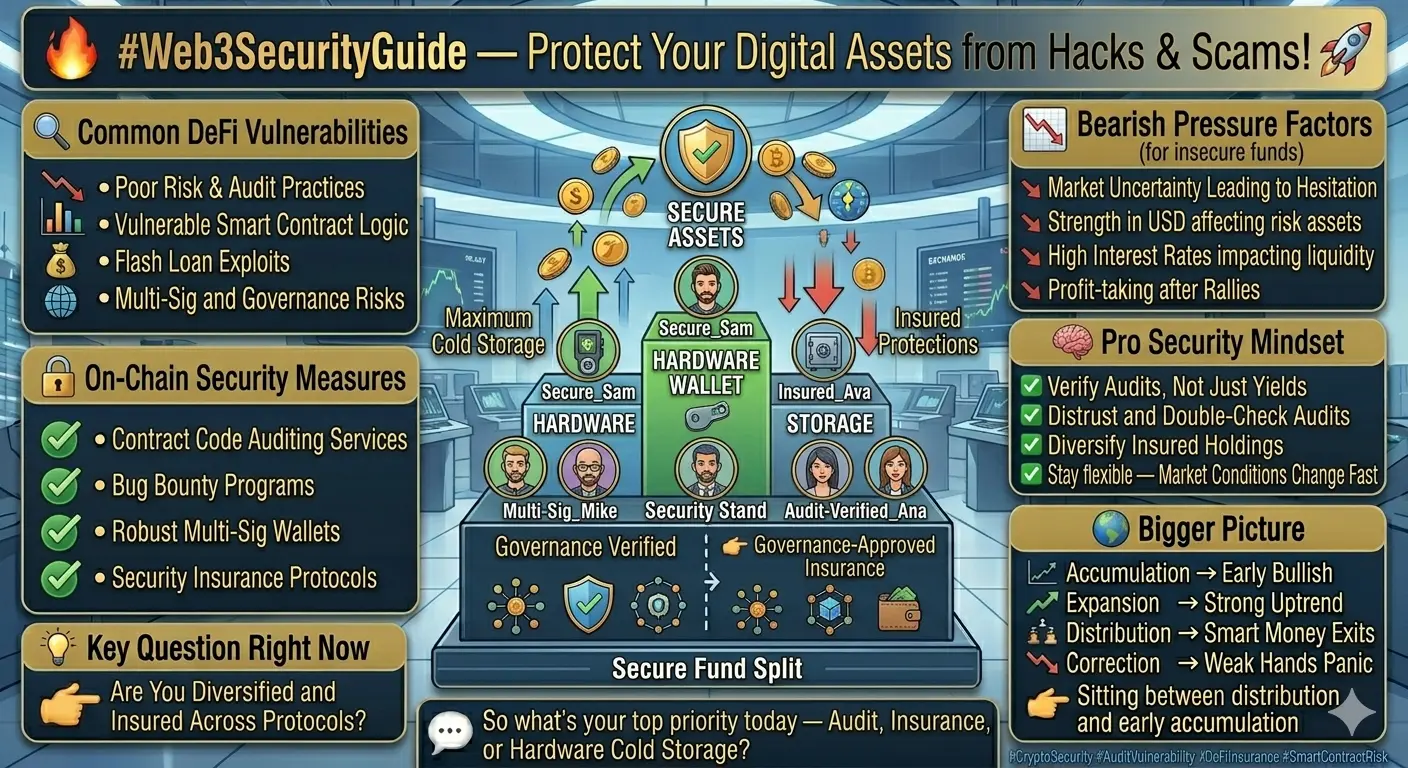
#Web3SecurityGuide
🛡️ Web3 Security in 2026: Survival of the Safest
[Introduction]
In April 2026, the crypto market is expanding rapidly, but attackers are evolving just as fast. Simply hiding your seed phrase is no longer enough—the real game is Operational Security (OpSec). Protecting your assets now requires constant awareness, smart tools, and disciplined habits.
[Key Statistics 📊]
$285M Lost: A recent exploit on the Drift Protocol on the Solana highlights how severe DeFi risks still are.
Security Gap: Studies show a large portion of users still rely on outdated storage methods, while o
DRIFT52,41%
SOL-0,36%
ENS-0,12%
post-image
post-image
  • Reward
  • Comment
  • Repost
  • Share
#AreYouBullishOrBearishToday?
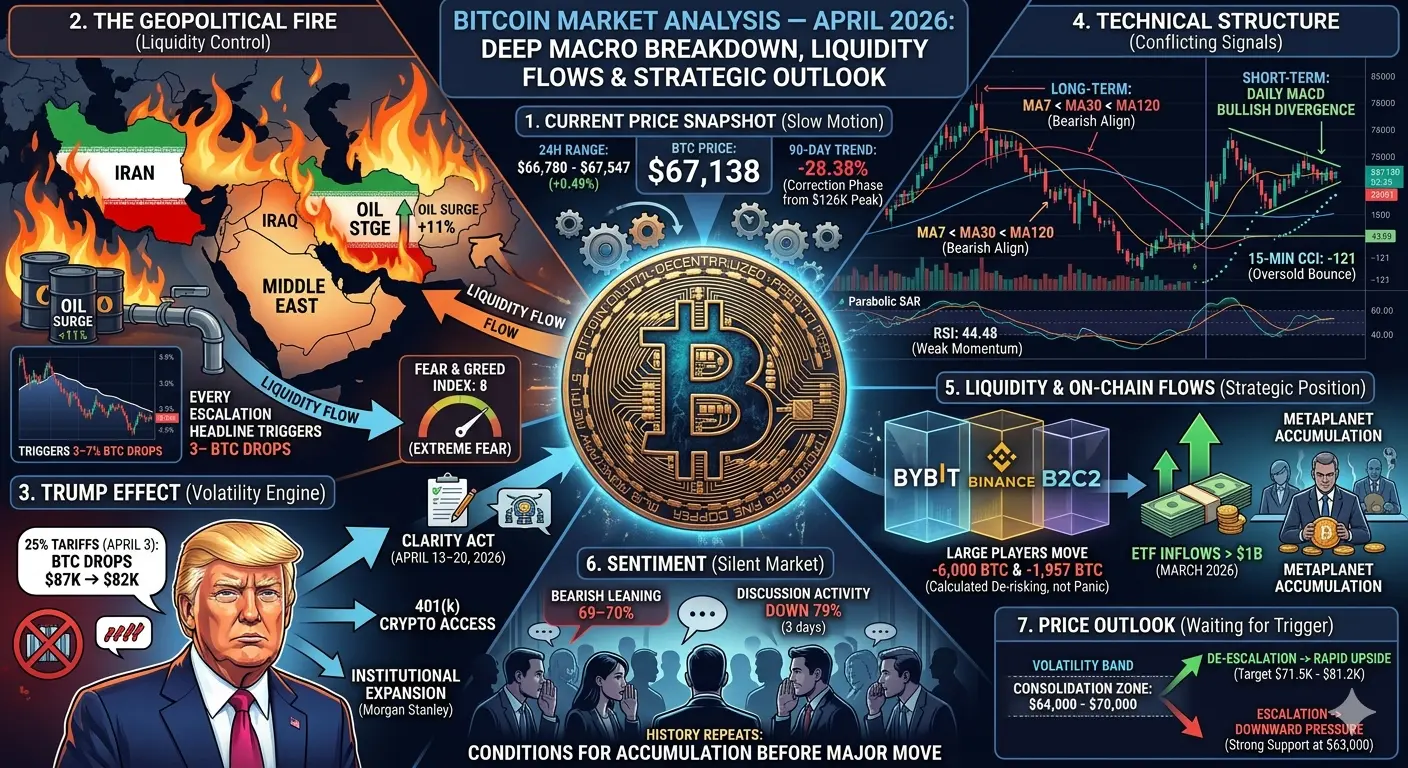
BULLISH or BEARISH? Full Market Breakdown — April 4, 2026
The Short Answer First
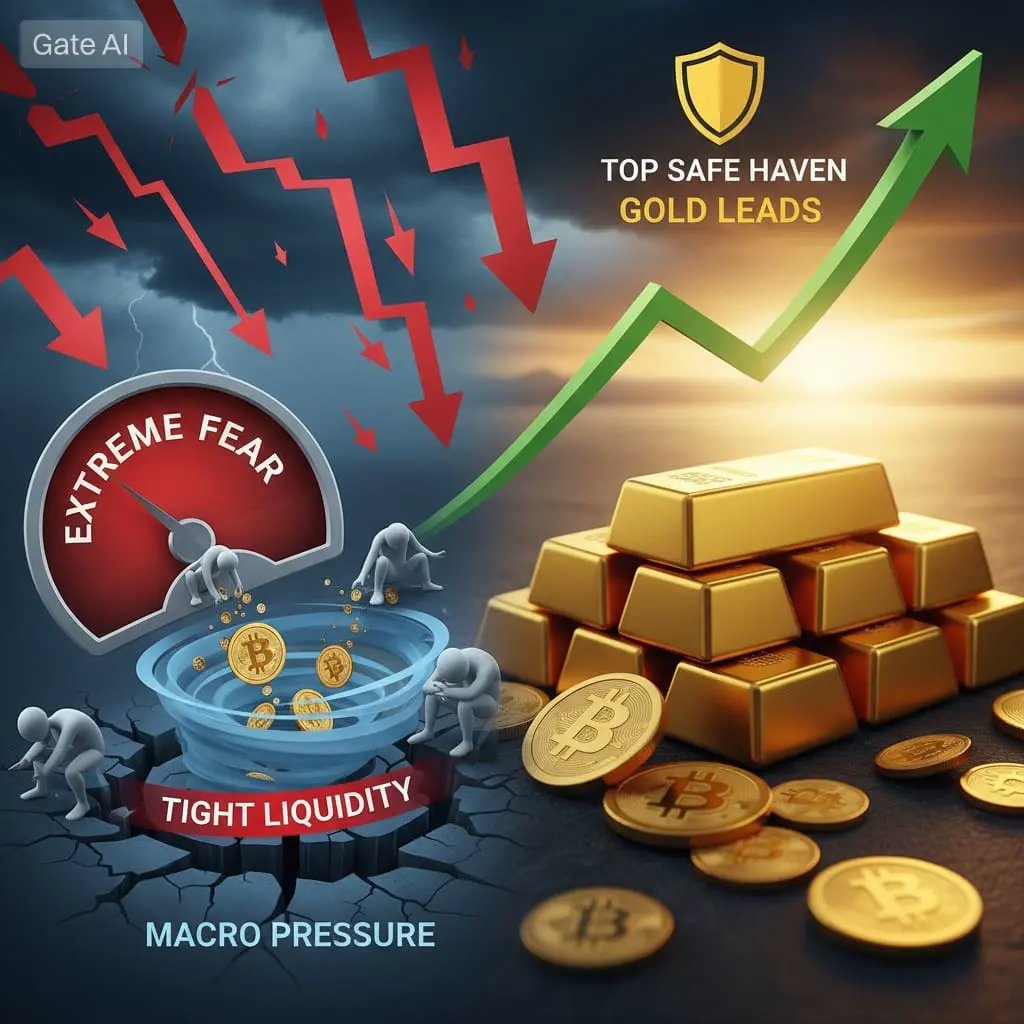
Currently BEARISH with selective safe-haven strength. The Fear & Greed Index is sitting at 11 out of 100 — Extreme Fear. That number alone tells you everything about the current market mood. Traders are scared, not greedy.
---
STEP 1 — The Big Picture: What Is Driving Markets Right Now?
Macro Environment (The Root Cause)
The single biggest factor crushing markets right now is Trump's sweeping tariff policy — essentially a modern version of the 1930 Smoot-Hawley tariffs that triggered
ETH-0,51%
HighAmbitionvip
#AreYouBullishOrBearishToday?
BULLISH or BEARISH? Full Market Breakdown — April 4, 2026
The Short Answer First
Currently BEARISH with selective safe-haven strength. The Fear & Greed Index is sitting at 11 out of 100 — Extreme Fear. That number alone tells you everything about the current market mood. Traders are scared, not greedy.
---
STEP 1 — The Big Picture: What Is Driving Markets Right Now?
Macro Environment (The Root Cause)
The single biggest factor crushing markets right now is Trump's sweeping tariff policy — essentially a modern version of the 1930 Smoot-Hawley tariffs that triggered the Great Depression. Here is what happened:
Trump announced massive tariffs on all major US trade partners
China immediately retaliated with counter-tariffs
This triggered a global risk-off sentiment — investors ran away from risk assets
Stock markets had their worst single-day drop since 2020
When stocks bleed, crypto usually bleeds harder. That is the current setup.
Liquidity Situation
The probability of a Fed rate cut in June dropped from 62% to 57% after tariff announcements
Less chance of rate cuts = tighter liquidity = less money flowing into risky assets like crypto
Oil prices are elevated (more on that below), which adds inflationary pressure and keeps the Fed cautious
---
STEP 2 — BTC Current Status
Metric Value
Current Price $67,006
24h High $67,352
24h Low $66,514
24h Change +0.3%
7-Day Change +1.5%
30-Day Change -1.6%
90-Day Change -28.6%
Reading this data honestly:
BTC is stuck in the $65,500 - $69,200 range — no strong breakout direction
The 90-day number of -28.6% tells you we are in a clear downtrend on the bigger timeframe
Short-term (7 days) shows +1.5% — just noise, not a trend reversal
Whales (1,000–10,000 BTC holders) have collectively sold 188,000 BTC over the past year — this is heavy bearish pressure from the top
Bitcoin miners like Riot Platforms are selling BTC to cover operational costs — miner capitulation is a classic late-bear-market signal
Michael Saylor's Strategy continues buying — but he is a long-term HODLer, not a signal for short-term direction
BTC Sentiment on X (Social Media):
Bullish authors: 78
Bearish authors: 31
Total discussing: 127
So Twitter/X is still roughly 2.5x more bullish than bearish on BTC — but social sentiment often lags price reality. Do not trade social media alone.
---
STEP 3 — ETH Current Status
Metric Value
Current Price $2,051
24h High $2,080
24h Low $2,041
24h Change -0.36%
7-Day Change +3.3%
30-Day Change +3.6%
90-Day Change -36.4%
ETH is underperforming BTC on the 90-day chart
The ETH/BTC pair is hovering near a critical macro support zone (around 0.0197 BTC) — this level previously marked macro bottoms in 2016 and 2019
Ethereum Foundation recently increased its staking to 70,000 ETH — showing confidence in the network
Schwab and BlackRock are planning to launch BTC and ETH spot trading in H1 2026 — this is a long-term bullish signal, not near-term
---
STEP 4 — METALS vs OIL vs BTC Comparison
This is the real comparison a trader needs to understand:
Gold (XAU/USD)
Fact Detail
Current Spot Price -$4,676 per ounce
Recent Performance +19.25% in past 3 months
Trend STRONGLY BULLISH
Gold is on an absolute monster run right now. Why? Because when there is geopolitical uncertainty, trade wars, and fear — money flows into gold as the ultimate safe haven. Institutions, governments, and retail traders are all piling into gold. Gold is doing its classic job perfectly.
Key message: Gold is the king of this current risk-off environment.
---
Crude Oil (WTI)
Fact Detail
Current WTI Price -$60–68 per barrel (near-term)
Trend BEARISH/WEAK
Key Driver Trade war fears crushing demand outlook
Oil is in a complicated spot:
Trade wars reduce global economic activity, which reduces oil demand
JP Morgan already cut its 2025 Brent forecast to $66/barrel (from $73)
OPEC+ supply decisions add further uncertainty
High oil prices hurt inflation → hurts crypto indirectly because the Fed stays hawkish
Oil is not a buy here for most traders — it is caught between supply pressure and weak demand outlook.
---
BTC vs Gold vs Oil — Who Wins in This Environment?
Asset Current Trend Safe Haven Status Short-Term
Gold Bullish Yes, classic Strong
Oil Weak/Bearish No Cautious
BTC Sideways/Bearish Partial (developing) Uncertain
BTC is trying to become a safe haven like gold, but it is not there yet. In a risk-off environment, gold wins. BTC still trades partly like a tech stock — when stocks fall, BTC falls with them. The 90-day -28.6% chart confirms this.
---
STEP 5 — Fear & Greed Index = 11 (Extreme Fear)
This is the most important single number right now.
What does 11/100 mean for a trader?
The market is oversold emotionally — people are panic-selling
Historically, extreme fear zones are buying opportunities, not selling zones — but timing matters
The legendary Warren Buffett principle: "Be greedy when others are fearful"
However: fear can stay at extreme levels for weeks or months before a reversal
Do NOT catch a falling knife just because fear is high
---
STEP 6 — TRADING TIPS for Trader Hazrat
If You Want to Trade RIGHT NOW — Here Is the Honest Advice:
Scenario A: You Want to Go LONG (Buy)
Wait for BTC to hold above $66,500 and show at least 2–3 daily closes above $68,000
Entry zone only if price breaks and holds above $70,000 — that would signal a real trend change
Use strict stop-loss below $65,000 — no exceptions
Position size should be maximum 20-30% of your trading capital — this is not the time for full size
Target: $72,000–$74,000 for a swing trade if breakout confirms
Scenario B: You Want to Go SHORT (Sell/Bearish Trade)
The trend on the 90-day chart is your friend
If BTC loses $65,000 support, short toward $60,000 is a valid thesis
Stop-loss above $68,500
Confirmation signal: BTC drops below $65,000 with high volume
Scenario C: You Are Unsure (Most Honest Answer for Current Market)
Stay in stablecoins (USDT) and wait for clarity
Use this time to set price alerts — if BTC breaks above $70,000, consider long; if it breaks below $65,000, consider short or wait
Capital preservation in extreme fear environments is a trade in itself
---
STEP 7 — Overall Verdict: Bullish or Bearish?
Timeframe Verdict Confidence
Right Now (hours) Neutral/Weak Bearish Medium
Short-term (1–2 weeks) Bearish High
Medium-term (1–3 months) Uncertain, watching $65K Medium
Long-term (6–12 months) Cautiously Bullish Medium
Bottom Line for the Trader
The market is in Extreme Fear with a bearish macro backdrop — trade wars, miner selling, whale distribution, and tight liquidity are all aligned against bulls right now. Gold is the clear winner in this environment. BTC is holding its ground but lacks the catalyst to break higher.
Do not FOMO into longs. Do not panic sell without a level. Have a plan, set alerts, protect your capital. The best trades in bear markets are often the ones you do NOT take.
> There will be clear opportunities — but right now, patience is the trade.
repost-content-media
  • Reward
  • Comment
  • Repost
  • Share
#WeekendCryptoHoldingGuide
Gate Square | #假期持币指南 — HighAmbition's Complete Holiday Trading Discussion
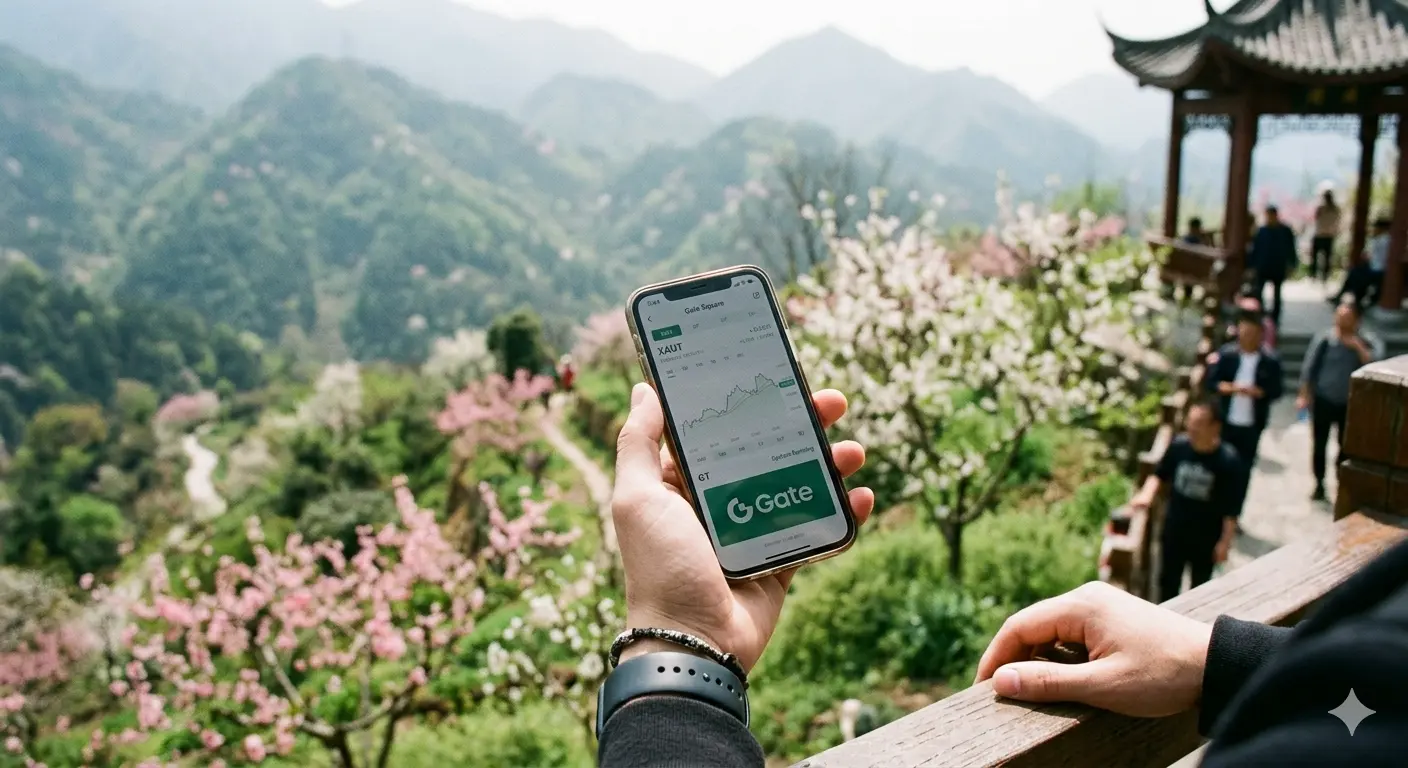
A full, honest, step-by-step breakdown of every question Gate asked — plus a deep analytical dive on my two favorite coins: XAUT and GT. Written for the Qingming Holiday 2026 activity.
Opening Thoughts
Spring is here. The mountains are calling. The K-line is also calling — louder, honestly. But here is what separates a serious trader from someone who just calls themselves a trader: the serious one builds a system that works whether they are watching or not. That is the entire philosophy behin
GT1,24%
HighAmbitionvip
#WeekendCryptoHoldingGuide
Gate Square | #假期持币指南 — HighAmbition's Complete Holiday Trading Discussion
A full, honest, step-by-step breakdown of every question Gate asked — plus a deep analytical dive on my two favorite coins: XAUT and GT. Written for the Qingming Holiday 2026 activity.
Opening Thoughts
Spring is here. The mountains are calling. The K-line is also calling — louder, honestly. But here is what separates a serious trader from someone who just calls themselves a trader: the serious one builds a system that works whether they are watching or not. That is the entire philosophy behind how I trade, how I hold through holidays, and why I chose XAUT and GT as my two core positions. Everything below is real — my actual approach, my actual reasoning, no fluff.
Holiday Mindset
My answer is neither extreme. Going completely offline during a holiday sounds peaceful, but crypto never sleeps. The Qingming holiday in China pauses traditional markets, but crypto continues running 24/7, reacting instantly to global macro triggers like oil shocks, Federal Reserve signals, geopolitical escalations, and tariff announcements. If you hold XAUT, which is tied directly to gold, ignoring the market completely is not an option because gold reacts immediately to these macro events.
On the other side, checking the market every 30 minutes is equally dangerous. It destroys mental clarity, ruins your holiday experience, and leads to emotional decisions. A red candle triggers panic selling, a green candle triggers impulsive buying, and both usually result in losses, especially during holidays when liquidity is thinner and spreads are wider.
My approach is structured awareness with pre-set automation. Before the holiday starts, I spend around 25 minutes setting price alerts for every asset I hold. For XAUT, alerts are placed at $4,620 on the downside and $4,660 on the upside. For GT, alerts are set at $6.20 and $6.70. Then I ensure every open position has a stop-loss in place, because risk control is non-negotiable.
I define two check windows only — one quick glance in the morning at 08:30 local time, and one structured review at 21:00 where I look at macro headlines and system performance. Outside of those windows, I disconnect completely and trust the system. That trust is the real edge.
Lazy Person’s Secret
The real advantage during holidays comes from automation. My system runs on three layers simultaneously, each designed to remove emotion and maintain efficiency.
The first layer is weekly DCA into GT. A fixed USDT amount buys GT every week regardless of price. GT has already declined around 39% over the past 90 days, so this strategy allows accumulation at lower average prices without trying to time the bottom. If GT trades at $6.50 one week and $6.20 the next, the average entry naturally improves. Over time, this creates a strong position built through consistency rather than prediction.
The second layer is a grid trading bot on XAUT/USDT. XAUT trades at $4,636, with a 24-hour range between $4,631.7 and $4,645.8. This tight movement creates ideal conditions for grid trading. By setting a range between $4,600 and $4,680 with 10 grid levels, the bot automatically buys on dips and sells on rises, capturing small profits repeatedly. Because XAUT follows gold, its movement is more structured and less chaotic than typical altcoins, making it ideal for this strategy.
The third layer is Simple Earn on idle USDT. Any unused capital is placed into flexible yield products, generating daily returns instead of sitting idle. Even during a short holiday period, this ensures that all capital remains productive.
All of this preparation takes about 25 minutes before the holiday begins. After that, the system runs independently while I focus on real life.
April Outlook
My focus remains on XAUT and GT, both chosen based on clear reasoning rather than speculation.
XAUT Deep Analysis
XAUT represents tokenized gold, backed 1:1 by physical reserves stored in Switzerland under LBMA standards. It is not a speculative asset but a digital representation of real gold, combining stability with blockchain flexibility.
Currently, XAUT is trading at $4,636 USDT, with a 24-hour range between $4,631.7 and $4,645.8. It has gained +2.88% over the last 7 days, declined -9.87% over 30 days, and still holds a +3.26% gain over 90 days. Its market cap stands at -$2.59 billion with a rank of #38, and social sentiment remains strongly positive at 83%.
From a technical perspective, the short-term structure shows recovery signs, while the medium-term trend remains cautious due to the prior correction. This creates a setup where short-term strength meets longer-term opportunity. A nearly 10% correction in a gold-backed asset during global instability is not weakness — it is positioning opportunity.
The macro case strengthens this view. Rising geopolitical tensions, particularly around the Strait of Hormuz, create inflation fears and drive capital into safe-haven assets like gold. At the same time, equity market weakness pushes institutional money toward defensive positions. If the dollar weakens due to potential monetary easing, gold benefits further.
Additionally, ecosystem expansion has increased XAUT utility, with new collateral options, trading pairs, and derivatives products being introduced. This increases accessibility and demand within the crypto ecosystem.
My strategy is to hold XAUT as a macro hedge while running a grid bot within the $4,600—$4,680 range. The upside target remains $4,700+, while risk is controlled with a stop-loss below $4,610.
GT Deep Analysis
GT functions as the native token of the Gate ecosystem, effectively acting as a form of platform equity. Its value is tied directly to platform growth, user expansion, and ecosystem development.
GT is currently trading at $6.50 USDT, with a 24-hour change of +0.61% and a range between $6.39 and $6.51. Volume has surged to -369,000 USDT compared to a 7-day average of -68,300 USDT, representing a 5.4x spike. Meanwhile, price has declined -0.76% over 7 days, -6.88% over 30 days, and -38.79% over 90 days, placing it at rank #89.
The most important observation is the volume spike. A 5.4x increase in volume with stable price movement indicates accumulation rather than selling. This suggests that larger players are positioning quietly.
Short-term technical structure shows bullish momentum, while higher timeframes still reflect prior bearish pressure. However, early signs of trend exhaustion are visible, especially with improving structure and strong volume support.
Fundamentally, GT benefits from continuous ecosystem growth, including trading fee discounts, Launchpool access, and participation in platform campaigns. The ongoing Gate x Red Bull F1 tournament is driving user engagement, increasing trading activity, and expanding brand exposure.
My strategy involves consistent DCA accumulation, fee optimization through GT holdings, and participation in ecosystem rewards. The upside target remains in the $7.50—$8.00 range, while risk is managed through proper position sizing.
Final Philosophy
Everything comes down to one principle: systems beat willpower. Emotional decisions destroy portfolios, while structured systems create consistency. By automating DCA, grid trading, and yield generation, I remove emotional interference and allow the system to operate efficiently.
During this Qingming holiday, my portfolio continues working through automated strategies while I step away. XAUT provides macro protection and stability, while GT offers growth potential tied to platform expansion.
The market continues moving regardless of holidays. The goal is not to control the market, but to build a system that works without constant attention.
The spring light is here. I am outside.
But the system is still running.
repost-content-media
  • Reward
  • Comment
  • Repost
  • Share
#GateSquareAprilPostingChallenge
1 — The Big Picture: Why These Three Assets Are Now One System
April 2026 is not a typical market environment. What we are witnessing is a macro convergence, where Bitcoin, Crude Oil, and Gold are no longer trading independently — they are reacting to the same global force:
Geopolitical instability.
The ongoing tensions involving United States–Iran conflict dynamics, disruptions in the Strait of Hormuz, and attacks in the Red Sea have created a chain reaction across all markets.
The Core Relationship:
Oil drives inflation
Gold reflects fear
Bitcoin reacts to l
HighAmbitionvip
#GateSquareAprilPostingChallenge
1 — The Big Picture: Why These Three Assets Are Now One System
April 2026 is not a typical market environment. What we are witnessing is a macro convergence, where Bitcoin, Crude Oil, and Gold are no longer trading independently — they are reacting to the same global force:
Geopolitical instability.
The ongoing tensions involving United States–Iran conflict dynamics, disruptions in the Strait of Hormuz, and attacks in the Red Sea have created a chain reaction across all markets.
The Core Relationship:
Oil drives inflation
Gold reflects fear
Bitcoin reacts to liquidity
Understanding today’s market means understanding how these three interact as a system, not as separate trades.
2 — Crude Oil (XTI): The Primary Driver of Everything
Right now, oil is the starting point of the entire macro chain.
With XTI trading around the $105 range, markets are pricing in serious supply disruption risk, mainly due to instability near the Strait of Hormuz — a route responsible for nearly 20% of global oil flows.
Step-by-Step Impact:
1. Supply Shock Risk
Any escalation involving Iran threatens global oil supply. Even the fear of disruption pushes prices higher.
2. Inflation Transmission
Higher oil prices increase:
Transport costs
Manufacturing costs
Energy bills globally
This directly pushes inflation higher, especially in economies like the United States.
3. Central Bank Constraint
When inflation rises, the Federal Reserve cannot ease policy easily.
Result: Interest rates stay high → liquidity tightens
4. Liquidity Shock to Risk Assets
When liquidity contracts:
Crypto markets weaken
Equities struggle
Investors move to safer assets
Scenario Mapping:
$105 Oil → Uncertainty, sideways crypto
$110–$120 Oil → Strong risk-off pressure
$120+ Oil → Panic environment, aggressive capital rotation into gold
👉 Key Insight:
Oil is not just another asset — it is the trigger variable controlling global liquidity in April 2026.
3 — Gold (XAUT): The Market’s Fear Gauge
Gold is currently behaving exactly as expected in a geopolitical crisis — strong, bid, and heavily accumulated.
With XAUT near $4,637 and bullish sentiment above 80%, the market is clearly positioning for continued instability.
Why Gold Is Rising:
1. Safe Haven Demand
During conflict, institutions reduce exposure to volatile assets and rotate into gold. This is a decades-proven behavior.
2. Currency Dynamics
If inflation rises but central banks hesitate to tighten further, the US dollar weakens — which boosts gold prices (since gold is USD-denominated).
3. Strategic Positioning
Large funds are not just hedging — they are positioning for prolonged uncertainty.
4. Structural Shift in Crypto Platforms
Platforms like Gate.io introducing XAUT and oil derivatives shows something deeper:
👉 Macro assets are becoming part of crypto-native trading ecosystems
Technical Insight:
Gold is currently in a short-term bullish structure within a broader consolidation phase:
Higher timeframe shows exhaustion after strong Q1 rally
Lower timeframes show continued buying pressure
Forward Outlook:
If tensions escalate → $5,000 becomes realistic
If tensions ease → expect sharp profit-taking
👉 Key Insight:
Gold is already pricing in risk that crypto has not fully reacted to yet.
4 — Bitcoin (BTC): Stuck Between Two Identities
Bitcoin is currently in a conflicted state.
It is trying to evolve into “digital gold” — but in reality, it still behaves like a high-risk tech asset.
What’s Happening:
1. Strong Correlation With Tech Markets
BTC maintains high correlation with equity indices like the Nasdaq-100, especially during macro shocks.
👉 When oil rises → inflation fears rise → tech sells off → BTC follows.
2. Liquidity Sensitivity
Bitcoin is extremely sensitive to global liquidity:
Tight liquidity → BTC drops
Easy liquidity → BTC rallies
3. De-Risking Behavior
In crisis moments:
Investors sell liquid assets first
BTC becomes a source of quick liquidity
4. Institutional Transition Phase
Despite short-term weakness, long-term fundamentals are improving:
Charles Schwab planning crypto trading
Corporate accumulation continues
Infrastructure is expanding
Technical Position:
Bearish structure on higher timeframe
Early reversal signals forming (divergence, SAR flips)
Key levels:
Support: $66,700
Resistance: $67,500–$68,000
👉 Key Insight:
BTC is not failing — it is reacting exactly as a liquidity-driven asset should in a macro tightening environment.
5 — The Transmission Mechanism (The Real Market Engine)
Everything connects through a simple but powerful chain:
Geopolitical Conflict

Oil Prices Rise (XTI)

Inflation Increases

Federal Reserve Stays Tight

Liquidity Contracts

Bitcoin Weakens (Short-Term)
Meanwhile:
Same Conflict

Safe Haven Demand

Gold (XAUT) Rises
6 — What Traders Must Watch (Critical Signals)
Focus on these real-time triggers:
Developments near the Strait of Hormuz
Federal Reserve policy tone
Oil breaking above key levels ($110, $120)
Gold momentum continuation or reversal
Correlation breakdown between BTC and equities
7 — Final Conclusion: The Real Insight for April 2026
This market is no longer about isolated charts — it is about macro reactions.
Oil controls inflation and liquidity
Gold reflects fear and capital preservation
Bitcoin reacts to liquidity cycles while building long-term strength
👉 The most important shift:
Crypto is now fully integrated into the global macro system.
Every headline involving Iran, every move by the Federal Reserve, and every spike in oil is directly influencing BTC price action.
Final Trading Insight
This is not a trend market — it is a reaction market.
Watch oil as your leading indicator
Use gold as your risk sentiment gauge
Treat BTC as a liquidity-sensitive instrument
repost-content-media
  • Reward
  • Comment
  • Repost
  • Share
#CryptoMarketSeesVolatility
What Is Crypto Market Volatility?
Volatility means the rapid and unpredictable movement of asset prices — up or down — within a short timeframe. In the crypto market, this is not a rare event. It is the defining characteristic. Understanding WHY it happens and HOW it affects Bitcoin and Ethereum specifically is the foundation of being a better-informed participant in this space.
---
Part 1 — The Fear & Greed Index: The Pulse of the Market
Before diving into individual coins, you must understand the overall market mood. Right now, the Crypto Fear & Greed Index sits
HighAmbitionvip
#CryptoMarketSeesVolatility
What Is Crypto Market Volatility?
Volatility means the rapid and unpredictable movement of asset prices — up or down — within a short timeframe. In the crypto market, this is not a rare event. It is the defining characteristic. Understanding WHY it happens and HOW it affects Bitcoin and Ethereum specifically is the foundation of being a better-informed participant in this space.
---
Part 1 — The Fear & Greed Index: The Pulse of the Market
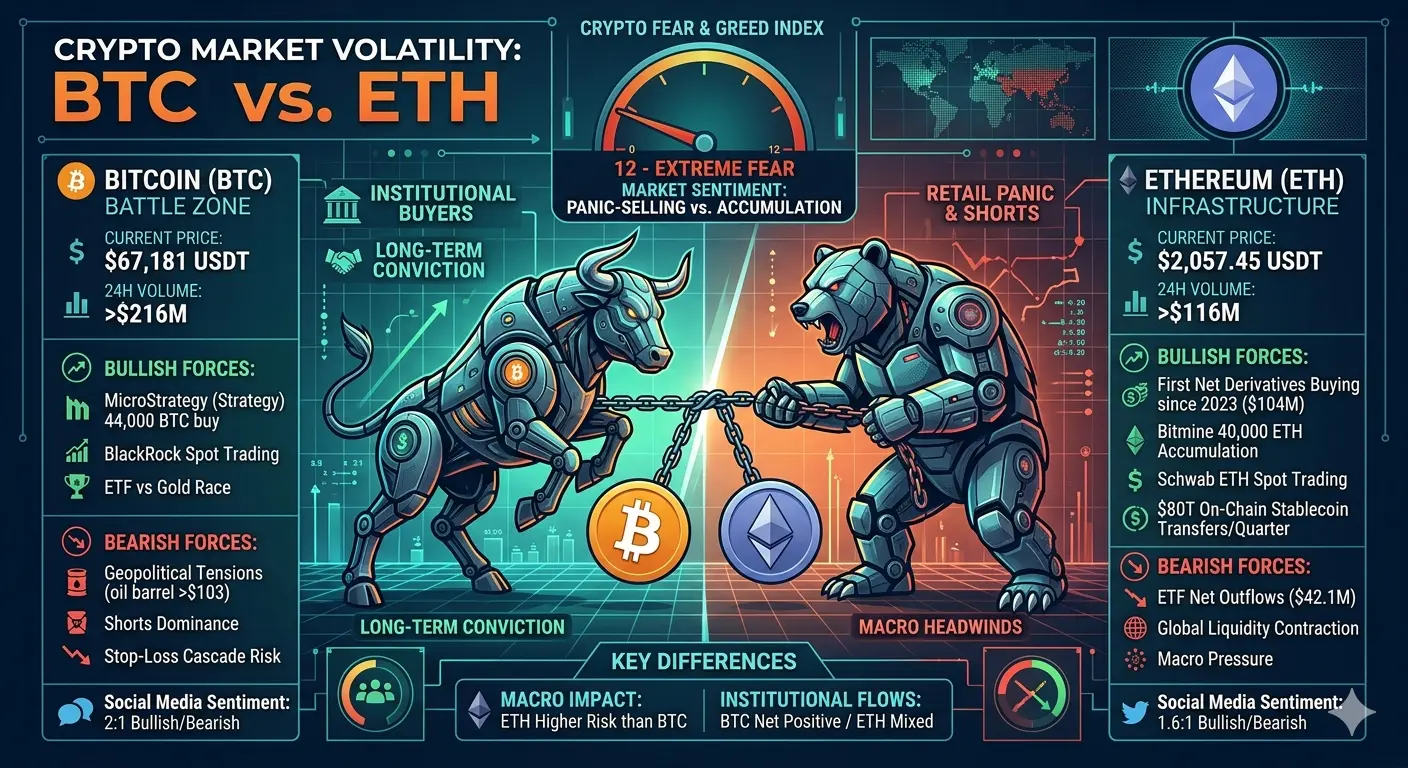
Before diving into individual coins, you must understand the overall market mood. Right now, the Crypto Fear & Greed Index sits at 12 out of 100, which is classified as Extreme Fear.
This single number tells a very important story:
When fear dominates, retail investors panic-sell
Weak hands exit positions, forcing prices lower
Institutional players often use these exact moments to accumulate
Historically, extreme fear has preceded major recovery phases
This is the environment BTC and ETH are currently operating in.
---
Part 2 — Bitcoin (BTC): The Institutional Battle Zone
Current Price: $67,181 USDT
24-Hour Range: $66,848 — $67,547
24-Hour Change: +0.48%
24-Hour Volume: Over $216 million
What Is Driving BTC Volatility Right Now?
Bullish Forces Pushing Price Up:
1. Institutional Accumulation at Scale — Strategy (formerly MicroStrategy) purchased 44,000 BTC through its preferred stock program. This is not a speculative trade. This is a long-term conviction bet worth billions of dollars.
2. BlackRock and Charles Schwab Entering Spot Trading — When trillion-dollar traditional finance giants build infrastructure for BTC spot trading, it permanently changes the demand structure of the asset. Supply stays capped at 21 million. Demand channels are multiplying.
3. Bitcoin ETF vs. Gold ETF Race — Bitcoin ETFs are approaching the asset size of Gold ETFs. This is a historic milestone. It signals that institutional allocation to BTC is no longer experimental — it is becoming standard portfolio practice.
4. Innovation Validating the Thesis — At the BOSS Summit, Mesh Radio demonstrated Bitcoin transactions with zero internet connectivity. This reinforces BTC's core identity as uncensorable, unseizable money — a narrative that attracts capital during periods of geopolitical uncertainty.
5. Jack Dorsey Reviving the Bitcoin Faucet — A symbolic but meaningful signal. Grassroots adoption efforts being revived by a high-profile figure keeps BTC in public conversation.
Bearish Forces Pushing Price Down:
1. Geopolitical Tensions — Global instability is pushing oil prices above $103 per barrel. When macro uncertainty rises, risk assets across all categories — stocks, crypto, commodities — face selling pressure as investors move toward perceived safe havens.
2. Derivatives Market Dominated by Short Sellers — In the futures and options market, short positions currently outnumber long positions. This creates downward price pressure and raises the risk of long liquidations if prices dip below key support levels.
3. Retail Stop-Loss Cascade Risk — Many retail traders set automatic stop-losses at round numbers like $65,000 or $64,000. If price touches those levels, automated selling triggers — amplifying the move downward dramatically.
BTC Market Sentiment on Social Media
Bullish voices: 83 unique accounts, 183 posts
Bearish voices: 41 unique accounts, 65 posts
Total engaged accounts: 144
The bullish-to-bearish ratio is roughly 2:1. Despite extreme fear in the overall index, BTC has a relatively resilient social sentiment — more people are defending the bull case than attacking it.
---
Part 3 — Ethereum (ETH): The Infrastructure Under Pressure
Current Price: $2,057.45 USDT
24-Hour Range: $2,044 — $2,083
24-Hour Change: +0.33%
24-Hour Volume: Over $116 million
What Is Driving ETH Volatility Right Now?
Bullish Forces:
1. First Net Buying in Derivatives Since 2023 — This is a technically significant signal. ETH derivatives markets recorded $104 million in net buying — the first positive net position since 2023. This suggests institutional and professional traders are beginning to build long exposure, which typically precedes a price recovery.
2. Bitmine Continuously Accumulating ETH — Bitmine has now added 40,000 ETH to its treasury, worth over $82 million. Sustained corporate buying reduces the circulating supply available on exchanges — a structurally bullish development.
3. Charles Schwab Launching ETH Spot Trading — Similar to what is happening with BTC, ETH is gaining new institutional on-ramps. When traditional brokerage accounts can hold ETH directly, a massive new pool of capital becomes accessible.
4. $80 Trillion in On-Chain Stablecoin Transfers Per Quarter — This number is the most underrated ETH metric. The Ethereum network processes $80 trillion in stablecoin value every quarter. This is the actual economic output of the network — and it is larger than the GDP of most countries. ETH as infrastructure is not theoretical. It is producing real economic utility at scale.
Bearish Forces:
1. ETF Net Outflows of $42.1 Million — While some institutions are buying directly (Bitmine), ETH ETFs saw $42.1 million in net outflows. This shows that institutional sentiment is divided — some are accumulating, others are reducing exposure. This split creates uncertainty and price instability.
2. Global Liquidity Contraction — When central banks tighten monetary policy and oil prices rise, the total amount of money flowing into risk assets shrinks. ETH, being a risk asset, suffers disproportionately compared to BTC, which has stronger "digital gold" narrative protection.
3. Macro Pressure Is Heavier on ETH Than BTC — In risk-off environments, capital tends to rotate from altcoins and smart contract platforms toward Bitcoin first. ETH typically underperforms BTC during periods of extreme fear — exactly the environment we are in right now.
ETH Market Sentiment on Social Media
Bullish voices: 26 unique accounts, 35 posts
Bearish voices: 16 unique accounts, 21 posts
Total engaged accounts: 60
ETH sentiment is noticeably quieter than BTC. Engagement volume is lower, and while bulls still outnumber bears, the margin is tighter. This reflects the current reality — ETH is in a consolidation phase with less conviction on either side.
---
Part 4 — The 5 Core Causes of Crypto Volatility (Applied to This Moment)
Cause How It Affects BTC Right Now How It Affects ETH Right Now
Macro Events Oil at $103 creates risk-off pressure Heavier impact — ETH seen as higher risk than BTC
Institutional Flows Net positive — Strategy, BlackRock building Mixed — Bitmine buying, ETF outflows offsetting
Derivatives & Leverage Shorts dominant, liquidation risk is real First net buying since 2023 — potential turning point
Regulatory Clarity ETF approvals building confidence ETF product expansion starting
Social Sentiment 2:1 bullish-to-bearish ratio Quieter, closer to neutral
---
Part 5 — What Does This All Mean Practically?
For BTC:
The market is caught between institutional buyers who see long-term value and short-term traders who are fearful. The $66,800 — $67,500 range is a short-term equilibrium zone. A break above $67,600 with volume could signal short-term momentum. A drop below $66,800 risks triggering stop-loss cascades.
For ETH:
The $2,044 support level has held so far. The first net derivatives buying since 2023 is a meaningful technical signal. However, macro headwinds and ETF outflows create a ceiling. Watch the $2,100 level — if ETH can reclaim and hold above it with volume, sentiment may shift.
For the Overall Market:
A Fear & Greed Index of 12 is historically uncommon. The last time this index was this low, it preceded significant recoveries — but timing the exact bottom is impossible. What it does tell you clearly is that the market is in capitulation territory, not euphoria territory. Risk-reward, from a long-term perspective, tends to favor buyers at extreme fear readings more than at extreme greed readings.
---
Final Summary
The hashtag #CryptoMarketSeesVolatility is not just a trending phrase. It captures a real, multi-layered moment where institutional money is moving in, macro fear is pushing retail out, and both BTC and ETH are caught in a tug-of-war between long-term structural strength and short-term macro pressure. Volatility is not the enemy — confusion about what is causing it is
repost-content-media
  • Reward
  • Comment
  • Repost
  • Share
#OilPricesRise .
Why Are Oil Prices Rising? The Full Story — And Where Things Are Headed
Current Price Reference: Brent Crude — $116/barrel | WTI (XTI) — $112/barrel | April 2026
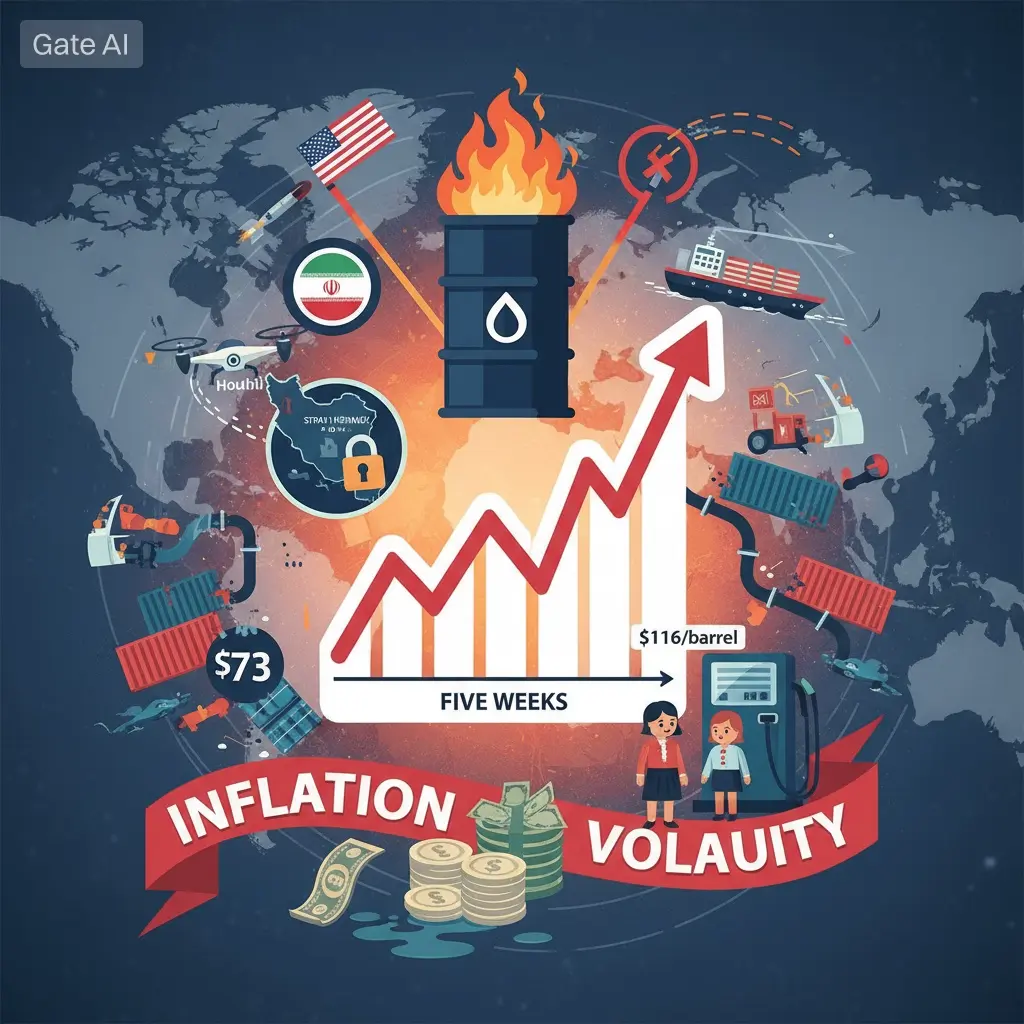
The global oil market is in a state of extreme volatility, the likes of which have not been seen in decades. In just over five weeks, Brent crude surged from $73 to $116 per barrel, while WTI (XTI) climbed from below $70 to $112. This is not merely a financial story; it is a geopolitical, economic, and structural shock playing out on a global scale. The speed, magnitude, and complexity of this crisis demand close atte
HighAmbitionvip
#OilPricesRise .
Why Are Oil Prices Rising? The Full Story — And Where Things Are Headed
Current Price Reference: Brent Crude — $116/barrel | WTI (XTI) — $112/barrel | April 2026
The global oil market is in a state of extreme volatility, the likes of which have not been seen in decades. In just over five weeks, Brent crude surged from $73 to $116 per barrel, while WTI (XTI) climbed from below $70 to $112. This is not merely a financial story; it is a geopolitical, economic, and structural shock playing out on a global scale. The speed, magnitude, and complexity of this crisis demand close attention from investors, traders, governments, and even ordinary consumers filling up at the pump.
The Spark: U.S.-Israel Military Action on Iran
The immediate trigger for the oil price surge was the joint U.S.-Israel military strike against Iran on February 28, 2026. This was a direct attack on critical Iranian energy infrastructure, signaling a significant escalation rather than a routine skirmish. Iran responded by closing the Strait of Hormuz, a chokepoint through which nearly 20 million barrels of oil flow daily — approximately 20% of global oil supply.
The physical disruption was immediate. Tankers attempting transit were attacked, shipping insurance rates spiked, and numerous vessels refused entry into the Gulf altogether. According to the International Energy Agency (IEA), over 12 million barrels/day of oil supply have already been lost, a level of disruption that exceeds historic crises including the 1973 oil embargo, the 1979 Iranian Revolution, and even the post-Ukraine Russian gas cutoff combined.
The Strategic Importance of the Strait of Hormuz
The Strait of Hormuz is only 33 kilometers wide, yet it is arguably the most strategically critical oil chokepoint in the world. Daily, it channels oil exports from major producers:
Saudi Arabia
Iraq
Kuwait
UAE
Qatar (the world’s largest LNG exporter)
Iran
While pipelines like Saudi Arabia’s East-West Pipeline (capacity ~5 million barrels/day) and UAE’s Abu Dhabi-Fujairah line (capacity ~1.5 million barrels/day) exist, together they only replace a small fraction of the supply normally moving through Hormuz. There is no alternative capable of replacing the strait quickly, making any closure a systemic shock to the global oil system.
Price Trajectory: The Surge From $73 to $116
The pace of this price increase is unprecedented:
Date
Brent Crude Price
Late February 2026
$73/barrel
Early March 2026
$88–95/barrel
Late March 2026
$104/barrel
April 3–5, 2026
$116/barrel
WTI (XTI), the U.S. benchmark, mirrors this surge, trading near $112/barrel. This represents a 58% increase in under 40 days, a rate of ascent faster than any comparable modern oil crisis, including the shock of 1979. Such a rapid rise reflects not just market speculation, but a real, structural supply shock that cannot be quickly resolved.
Key Drivers Behind the Oil Price Surge
1. Real, Physical Supply Shock
Unlike many historical price spikes driven primarily by market fear, the current surge is physically real. Tankers are being targeted, routes are blocked, and insurance costs have escalated dramatically. Unlike speculative shocks, these are tangible constraints with immediate impacts on supply.
2. Strategic Chokepoint With No Easy Alternatives
The global oil system is built around the Strait of Hormuz. Even with available pipelines, the scale of throughput needed cannot be met elsewhere. This bottleneck creates a supply deficit that is virtually impossible to fill quickly, directly pressuring prices upward.
3. Political Escalation and Uncertainty
Statements from President Donald Trump regarding seizing Iranian oil have added a substantial geopolitical risk premium. Even claims that the conflict might end in 2–3 weeks are treated cautiously by markets; traders discount optimistic political timelines when physical infrastructure and logistics realities suggest prolonged disruption.
4. Houthi Rebel Involvement
Complicating the situation, Yemen’s Houthi rebels have entered the conflict in support of Iran, targeting Red Sea shipping lanes. This extends the supply risk beyond Hormuz, creating the potential for disruption in multiple major maritime corridors simultaneously.
5. Speculative and Futures Market Pressure
Financial traders are actively taking long positions due to the possibility of extended disruption. Analysts, such as Macquarie Group, warn that if the Strait of Hormuz remains closed through June 2026, Brent crude could hit $200/barrel, translating to U.S. gasoline above $7/gallon. Even absent the extreme case, the market pricing reflects the risk of prolonged geopolitical turmoil.
Global Economic Impacts
Inflation
Rising oil prices have accelerated U.S. CPI, which rose from 2.4% in February to 3.4% in March 2026, with fuel prices the primary driver. Gasoline costs jumped 31% in one month, averaging $3.84 per gallon nationwide.
Food Prices
Fertilizer prices, particularly nitrogen-based urea, surged 30–40%, threatening agricultural stability and food security in developing nations. The UN FAO has warned of significant disruptions if the conflict continues for several weeks.
Recession Risk
Sustained $100+ oil exerts considerable pressure on global growth. IMF estimates indicate that even $85/barrel reduces global growth by 0.3–0.4 percentage points. Current prices are already well above that level, increasing the risk of stagflation.
Impact on Asian Economies
Countries like Japan, South Korea, India, and Southeast Asian nations are most exposed due to reliance on Hormuz for energy imports. Japan and France have convened joint summits to coordinate responses, while China has deployed reserves and raised fuel ceilings to absorb part of the shock domestically.
Why U.S. Oil Companies Aren’t Ramping Production
Despite $100+ oil, major U.S. shale producers are not significantly increasing output. Key reasons include:
Capital Discipline: Companies like ExxonMobil and Chevron prioritize shareholder returns over short-term drilling.
Operational Constraints: Labor, equipment, and logistics cannot scale production quickly.
Uncertainty About Conflict Duration: Rapid end of conflict would leave overproduced oil stranded, reducing profitability.
Citigroup estimates U.S. producers might add 100,000 barrels/day by 2027, far below the millions lost in the Gulf.
Government and IEA Response
G7 Nations: Committed to market stabilization measures.
IEA: Coordinating Strategic Petroleum Reserve (SPR) releases to alleviate short-term shortages.
U.S.: Offering naval escorts for tankers, echoing the 1980s “tanker war” strategies.
While helpful, these measures cannot fully offset a prolonged closure of Hormuz. SPR releases are short-term solutions, not substitutes for millions of barrels of lost daily supply.
Possible Future Scenarios
Scenario A — Quick Resolution (4–6 Weeks): Strait reopens, Brent retraces to $85–95, easing inflationary pressures.
Scenario B — Prolonged Stalemate (3–6 Months): Partial disruption persists; prices stay $100–130, creating stagflation risks and global economic uncertainty.
Scenario C — Extreme Escalation: Iran targets Saudi/UAE oil infrastructure; Brent may surge to $200/barrel, triggering a global recession worse than 2008.
Implications for Traders and Investors
XTI/USDT on Gate’s platform is highly sensitive. $5–10 intraday swings are possible on any diplomatic signal. The broader commodities market — oil, LNG, natural gas, fertilizers, and gold — has entered a period of heightened volatility, creating both opportunities and extreme risk for leveraged positions.
Final Take
The IEA calls this the worst energy supply disruption in modern history. From $73 to $116+ in five weeks, the market has signaled the disruption is real, large, and ongoing. Tracking the Strait of Hormuz, diplomatic developments, and SPR releases will be critical for understanding oil price direction, global inflation, and economic growth throughout 2026.
Data Sources: CNN, Reuters, Bloomberg, NPR, IEA, EY-Parthenon, Macquarie Group, Citigroup. Prices current as of April 5, 2026. Projections carry material uncertainty.
repost-content-media
  • Reward
  • Comment
  • Repost
  • Share
#GateSquareAprilPostingChallenge
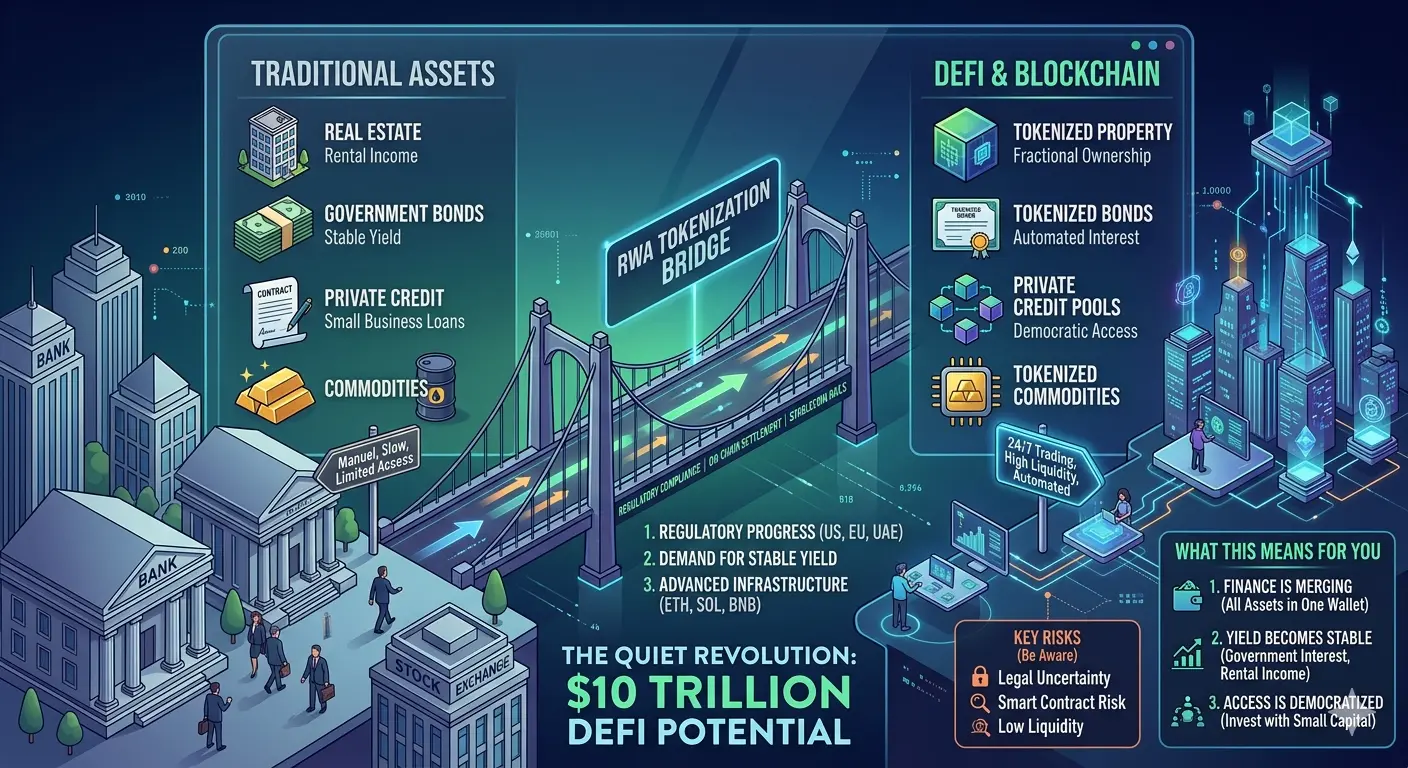
Real World Assets on Blockchain: The Quiet Revolution That Could Make DeFi Worth $10 Trillion
The Big Shift Most People Are Missing
While most of the market is focused on Bitcoin price movements and short-term speculation, a much bigger transformation is quietly unfolding.
Real World Assets (RWAs) — including real estate, government bonds, private credit, and commodities — are increasingly being brought on-chain.
This is not driven by hype or retail traders.
It is being led by institutions, asset managers, and regulated financial firms.
That alone changes ever
ETH-0,51%
SOL-0,36%
BNB0,54%
HighAmbitionvip
#GateSquareAprilPostingChallenge
Real World Assets on Blockchain: The Quiet Revolution That Could Make DeFi Worth $10 Trillion
The Big Shift Most People Are Missing
While most of the market is focused on Bitcoin price movements and short-term speculation, a much bigger transformation is quietly unfolding.
Real World Assets (RWAs) — including real estate, government bonds, private credit, and commodities — are increasingly being brought on-chain.
This is not driven by hype or retail traders.
It is being led by institutions, asset managers, and regulated financial firms.
That alone changes everything.
What Is RWA Tokenization (Simple Explanation)
RWA tokenization means turning ownership of real-world assets into blockchain-based tokens.
A tokenized bond = you receive real yield from government debt
A tokenized property = you earn rental income proportionally
A tokenized fund = access to investments that were previously restricted
Blockchain improves this system by enabling:
24/7 trading (no market hours)
Fractional ownership (invest with small capital)
Automated yield distribution (no manual payouts)
In short: it makes traditional finance faster, more accessible, and more liquid.
Why This Is Happening Now
This shift didn’t happen earlier because key pieces were missing. Now, they’ve aligned:
1. Regulatory Progress
Countries like the US, EU, UAE, and Singapore are building legal frameworks for tokenized securities.
Without legal backing, tokenization has no real value — now it does.
2. Demand for Yield
Investors want stable returns.
Tokenized bonds and private credit offer predictable income, unlike volatile crypto assets.
3. Better Blockchain Infrastructure
Networks like Ethereum, Solana, and BNB Chain now provide:
Faster transactions
Lower costs
Scalable systems for institutions
4. Stablecoin Payment Rails
Stablecoins like USDT make it easy to move money on-chain instantly and cheaply, removing friction from adoption.
Where the Smart Money Is Going
Even with a slight decline in total crypto funding, billions are still flowing into:
Payment infrastructure
Trading systems
On-chain financial products
Major firms like:
Sequoia Capital
Founders Fund
Bain Capital
Alibaba
are investing in long-term infrastructure, not speculation.
This is a clear signal:
the focus has shifted from hype to real utility.
The Ethereum Angle (Underrated Insight)
Despite recent price weakness, Ethereum remains the primary settlement layer for tokenized assets.
Key signals:
Large-scale ETH staking by institutions
Continued developer dominance
Strong integration with financial products
Important insight:
Price may fluctuate short term, but infrastructure dominance tends to win long term.
What This Means for You (Practical Impact)
1. Finance Is Merging
Crypto and traditional finance are no longer separate systems.
Soon, your wallet may hold:
BTC
ETH
Tokenized bonds
Tokenized real estate
All in one place.
2. Yield Becomes More Stable
Instead of relying only on:
Staking
Lending
Liquidity farming
You can earn yield from real-world income sources, like:
Government interest payments
Rental income
3. Access Becomes Democratized
Previously:
Private credit → $100K+ minimum
Real estate funds → limited access
Now:
Entry can be as low as a few hundred dollars
This is a major shift in financial inclusion.
The Risks (Honest View)
This is not risk-free. Key concerns include:
Legal uncertainty (varies by country)
Smart contract vulnerabilities
Low secondary market liquidity
Regulatory changes or restrictions
Also remember:
Tokenized assets still depend on real-world legal systems.
Final Takeaway
RWA tokenization is not a short-term trend.
It is a long-term structural transformation of finance.
The market may still be distracted by price action — but underneath, a new system is being built.
Those who understand it early will have a major advantage.
Closing Thought
In the future, the question won’t be:
“Crypto vs traditional finance?”
It will be:
“Which assets do I hold on-chain?”
repost-content-media
  • Reward
  • Comment
  • Repost
  • Share
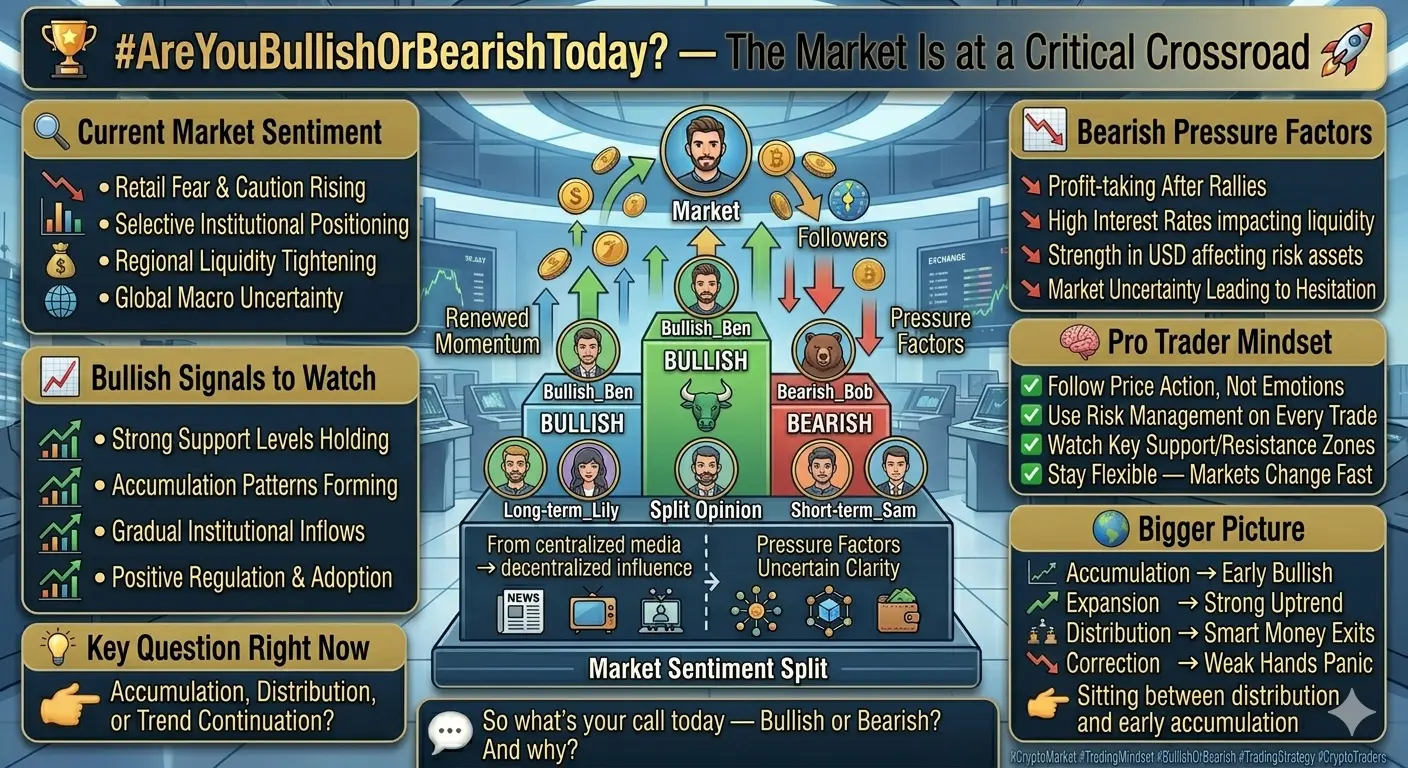
📊 #AreYouBullishOrBearishToday? — The Market Is at a Critical Crossroad
Every trading day brings a new question: Are we in a bullish continuation… or heading into deeper correction? Right now, the market is sending mixed signals — and smart traders are watching closely.
🔍 Current Market Sentiment
Sentiment is shifting rapidly due to macro and crypto-specific factors:
• 📉 Fear & caution rising among retail traders
• 📊 Institutional positioning remains selective
• 💰 Liquidity conditions tightening in some regions
• 🌐 Global macro uncertainty influencing risk appetite
👉 Markets are no long
post-image
post-image
post-image
  • Reward
  • 1
  • Repost
  • Share
HighAmbitionvip:
Just go for it 👊
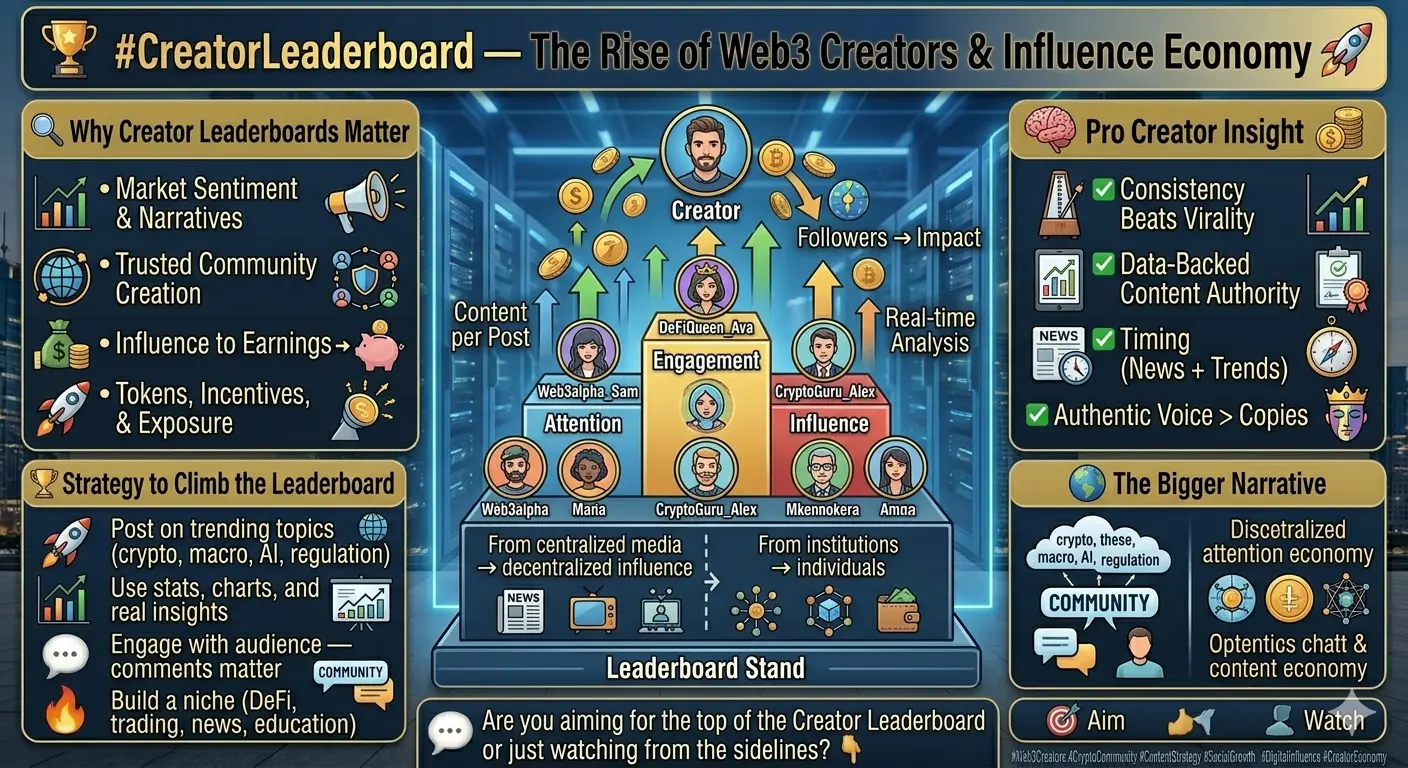
🏆 #CreatorLeaderboard — The Rise of Web3 Creators & Influence Economy 🚀
In the fast-evolving world of Web3, creators are no longer just content producers — they are becoming powerful economic engines. The latest Creator Leaderboard trends reveal who’s dominating attention, engagement, and influence across the crypto ecosystem.
🔥 Why Creator Leaderboards Matter
The game has changed. It’s no longer just about trading — it’s about visibility, value, and voice:
• 📊 Top creators are driving market sentiment & narratives
• 🌐 Communities are forming around trusted voices
• 💰 Influence is direct
DEFI5,56%
MEME-1,75%
post-image
post-image
  • Reward
  • 2
  • Repost
  • Share
dragon_fly2vip:
LFG 🔥
View More
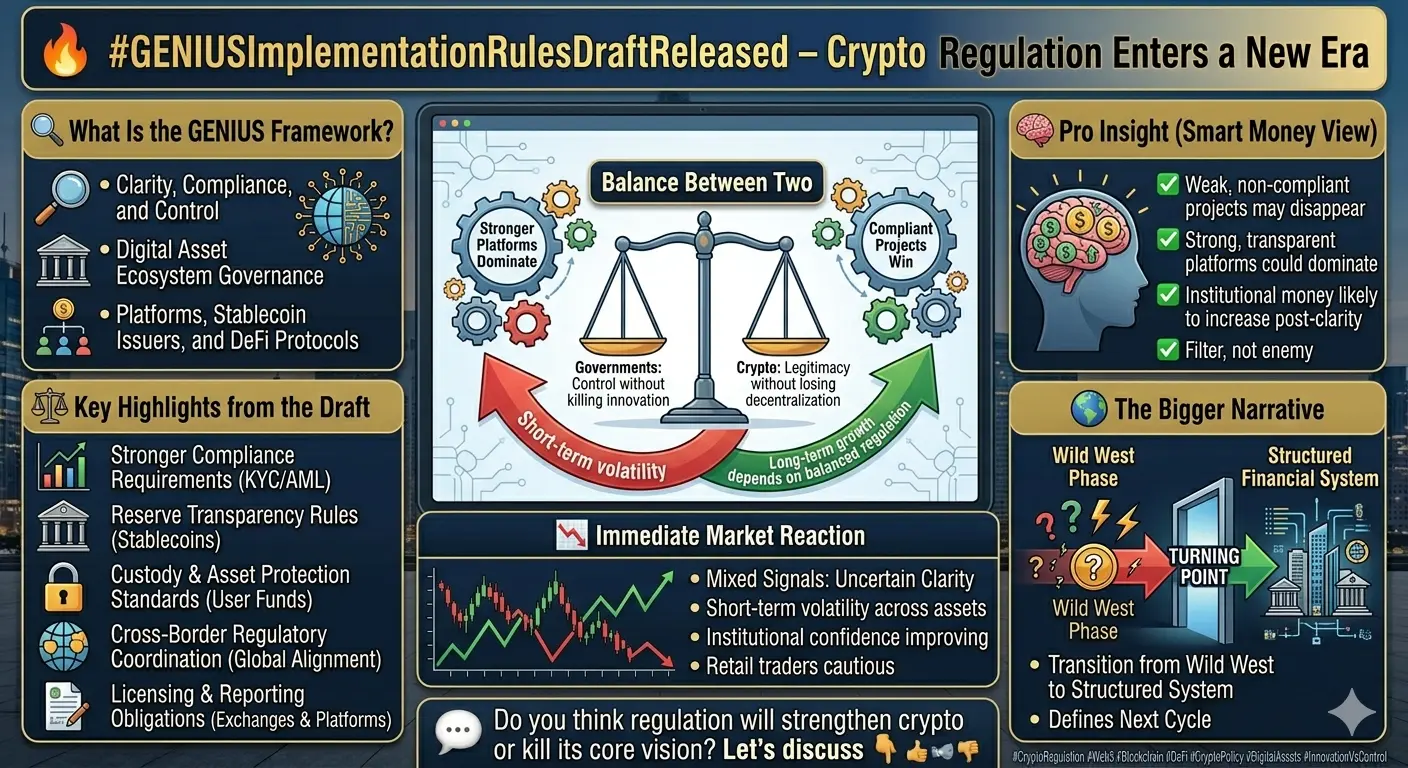
📜 #GENIUSImplementationRulesDraftReleased — Crypto Regulation Enters a New Era
The release of the GENIUS Implementation Rules Draft marks a major milestone in the evolution of crypto regulation. Governments and regulatory bodies are now moving beyond discussions — stepping into structured frameworks that could redefine how digital assets operate globally.
🔍 What Is the GENIUS Framework?
The GENIUS rules are designed to bring clarity, compliance, and control to the rapidly growing digital asset ecosystem. The draft outlines how crypto platforms, stablecoin issuers, and DeFi protocols may be g
post-image
post-image
post-image
  • Reward
  • Comment
  • Repost
  • Share
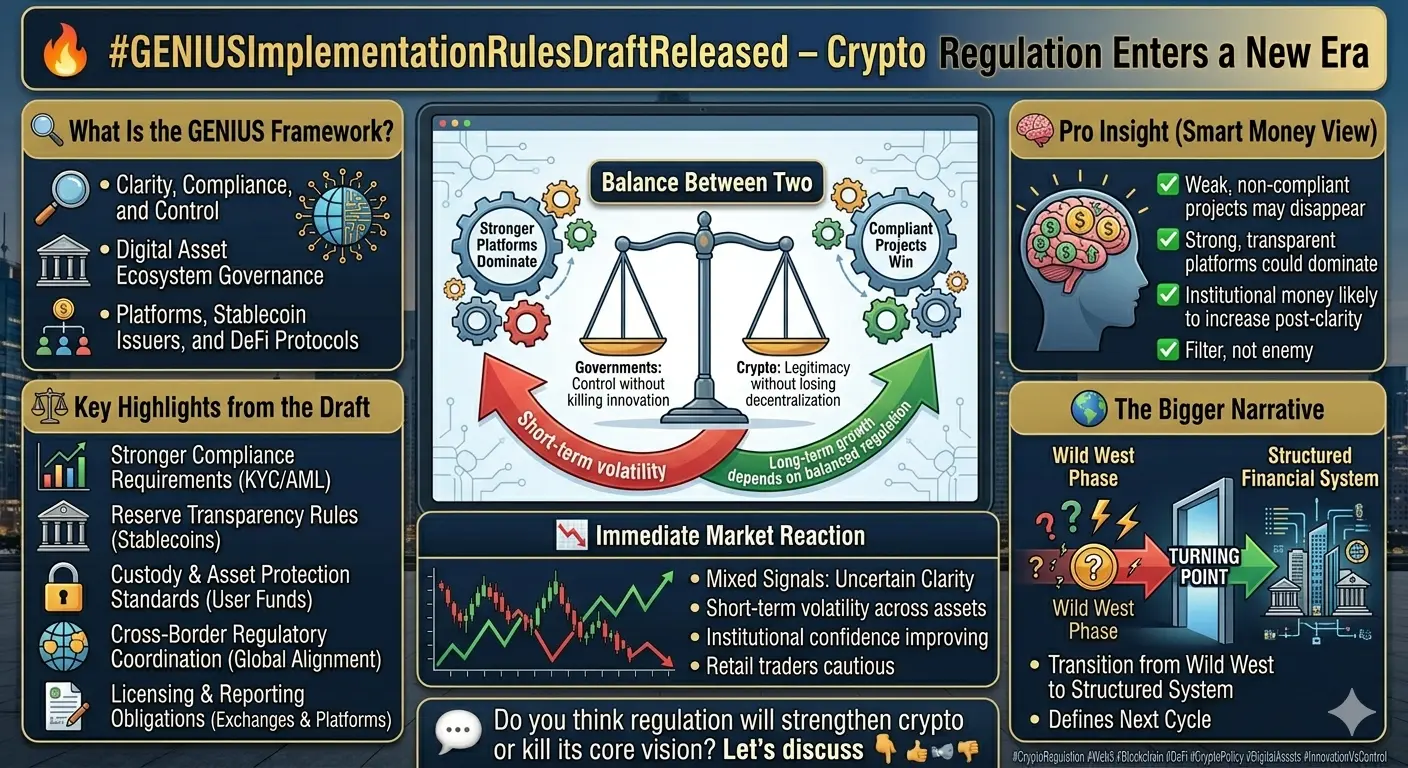
📜 #GENIUSImplementationRulesDraftReleased — Crypto Regulation Enters a New Era
The release of the GENIUS Implementation Rules Draft marks a major milestone in the evolution of crypto regulation. Governments and regulatory bodies are now moving beyond discussions — stepping into structured frameworks that could redefine how digital assets operate globally.
🔍 What Is the GENIUS Framework?
The GENIUS rules are designed to bring clarity, compliance, and control to the rapidly growing digital asset ecosystem. The draft outlines how crypto platforms, stablecoin issuers, and DeFi protocols may be g
post-image
post-image
post-image
  • Reward
  • Comment
  • Repost
  • Share
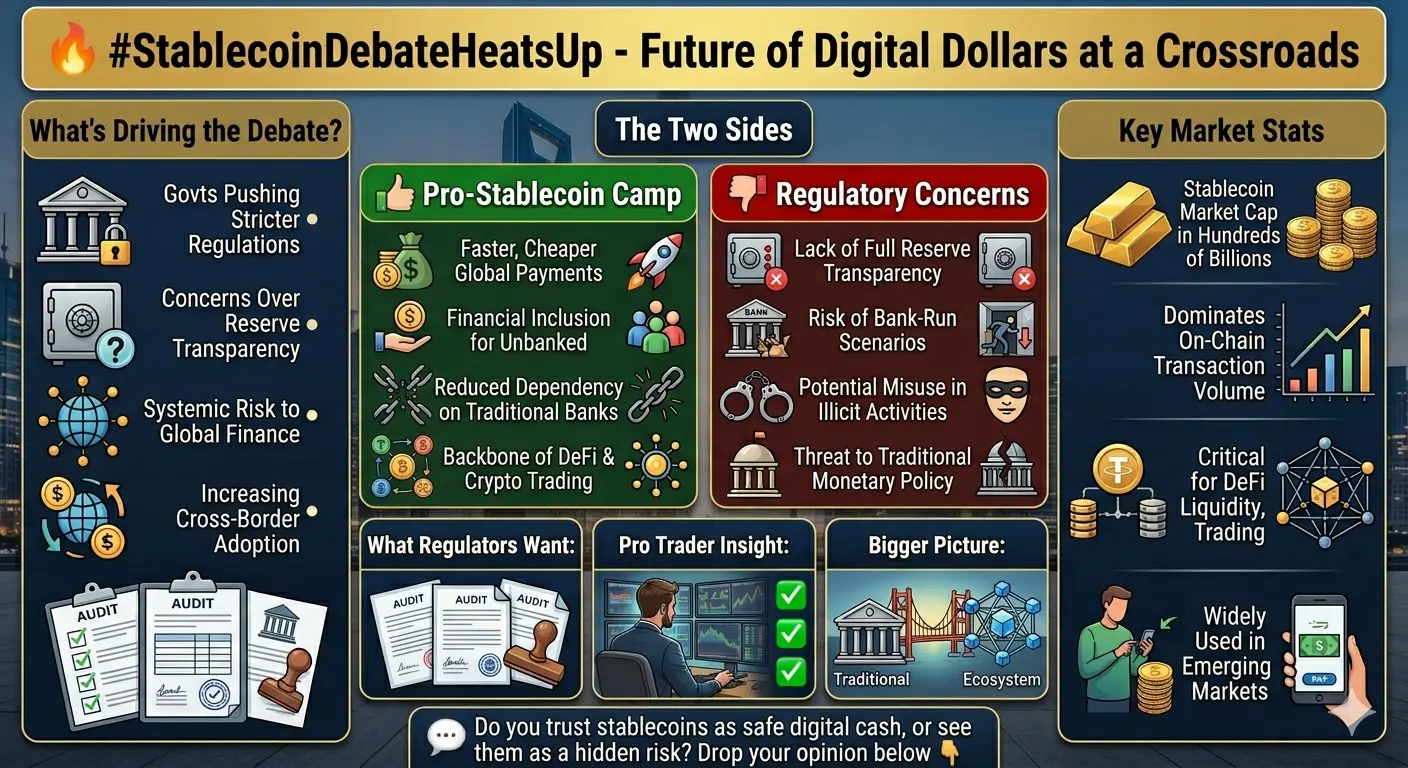
🔥 #StablecoinDebateHeatsUp — The Future of Digital Dollars at a Crossroads
The global financial system is witnessing a major turning point as the debate around stablecoins intensifies. Regulators, institutions, and crypto giants are all stepping into the arena — and the outcome could reshape the entire Web3 economy.
🧠 What’s Fueling the Debate?
Stablecoins, designed to maintain a 1:1 peg with fiat currencies like the US Dollar, have become the backbone of crypto liquidity. But with rapid growth comes rising scrutiny:
• 🏦 Governments pushing for stricter regulations
• 💰 Concerns over reserv
DEFI5,56%
post-image
post-image
post-image
  • Reward
  • Comment
  • Repost
  • Share
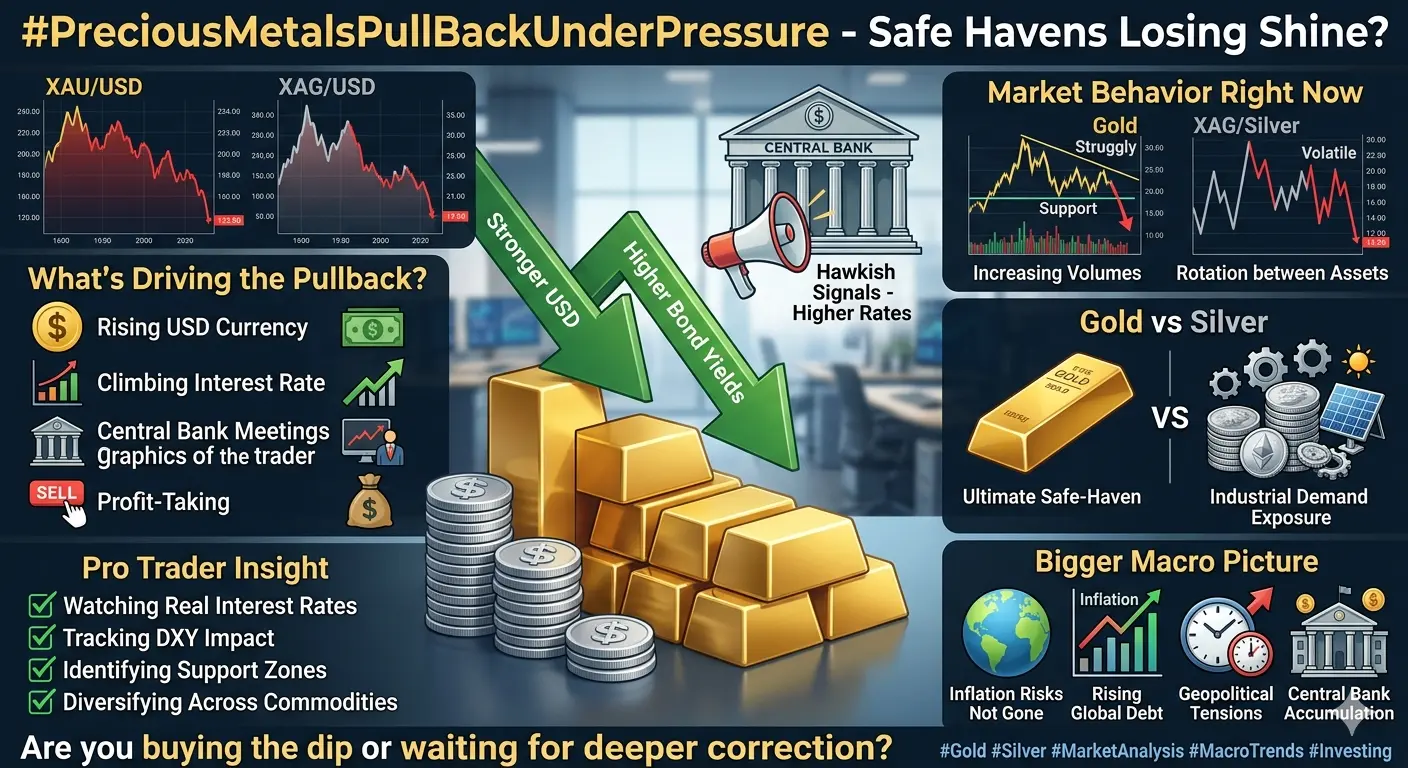
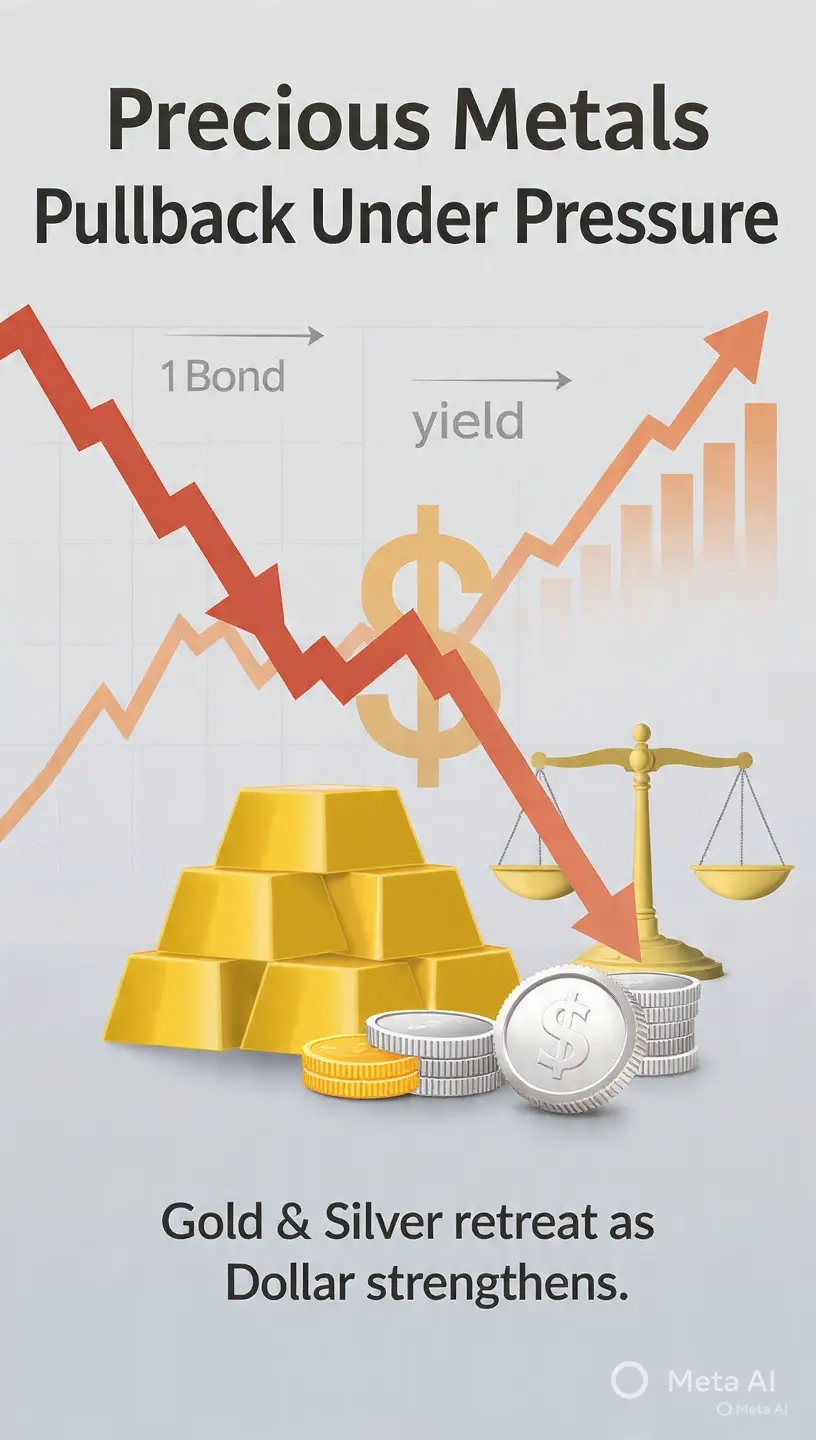
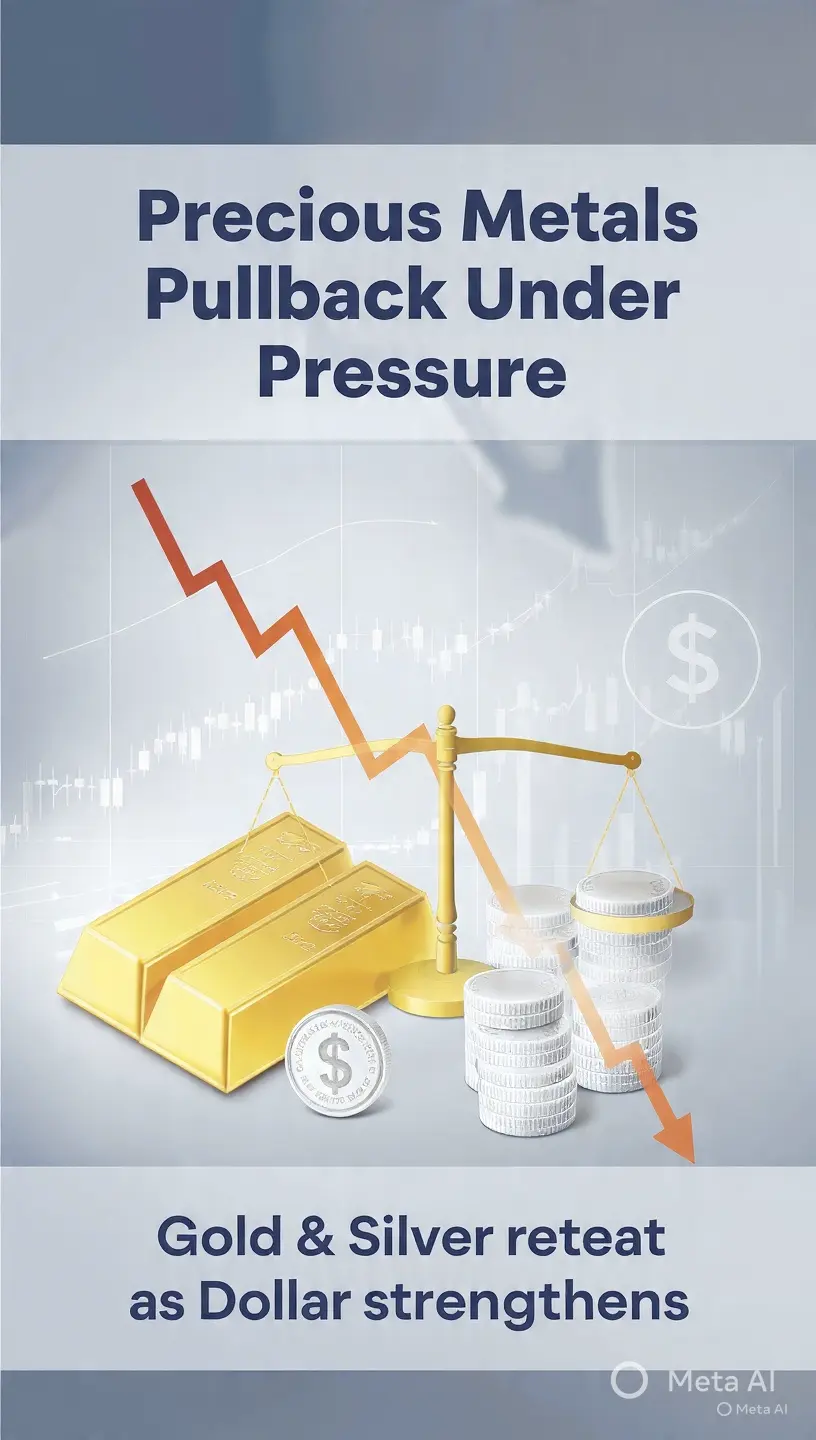
📉 #PreciousMetalsPullBackUnderPressure — Safe Havens Losing Shine?
The precious metals market is facing renewed pressure as gold and silver retreat from recent highs. After a strong bullish run fueled by macro uncertainty, inflation fears, and geopolitical tensions, the latest pullback is forcing investors to reassess their positions.
🔍 What’s Driving the Pullback?
Several macro factors are currently weighing on precious metals:
• 📊 Stronger Dollar Momentum — A rising USD is making gold and silver more expensive for global buyers
• 📈 Higher Bond Yields — Increasing yields reduce the appeal
post-image
post-image
post-image
  • Reward
  • Comment
  • Repost
  • Share
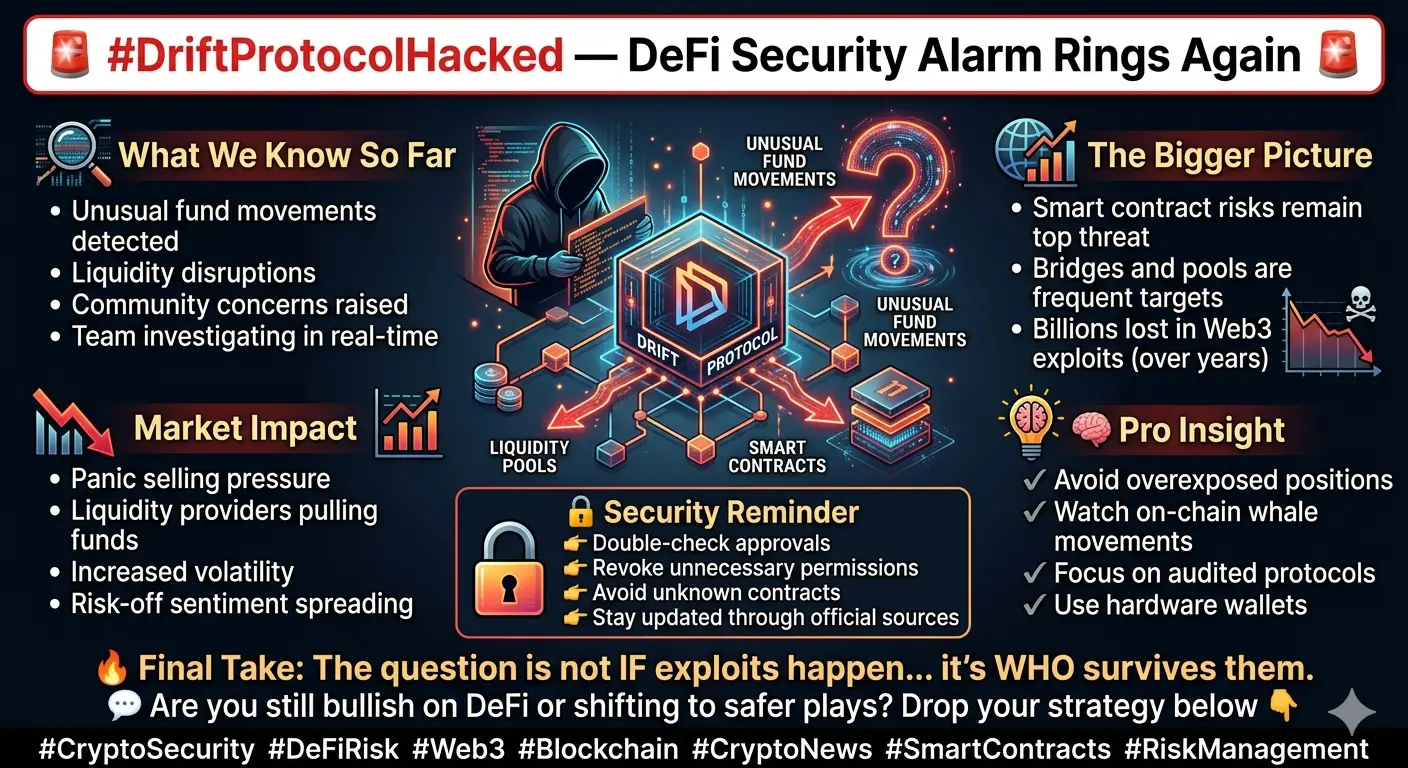
🚨 #DriftProtocolHacked — DeFi Security Alarm Rings Again 🚨
The decentralized finance (DeFi) space is once again under pressure as reports of a potential exploit involving Drift Protocol surface. While investigations are still unfolding, early signals suggest suspicious activity tied to liquidity pools and smart contract vulnerabilities.
🔍 What We Know So Far
• Unusual fund movements detected across Drift Protocol wallets
• Liquidity disruptions impacting trading pairs
• Community raising concerns over possible exploit vectors
• Team reportedly investigating & monitoring in real time
📊 The
post-image
post-image
post-image
  • Reward
  • Comment
  • Repost
  • Share
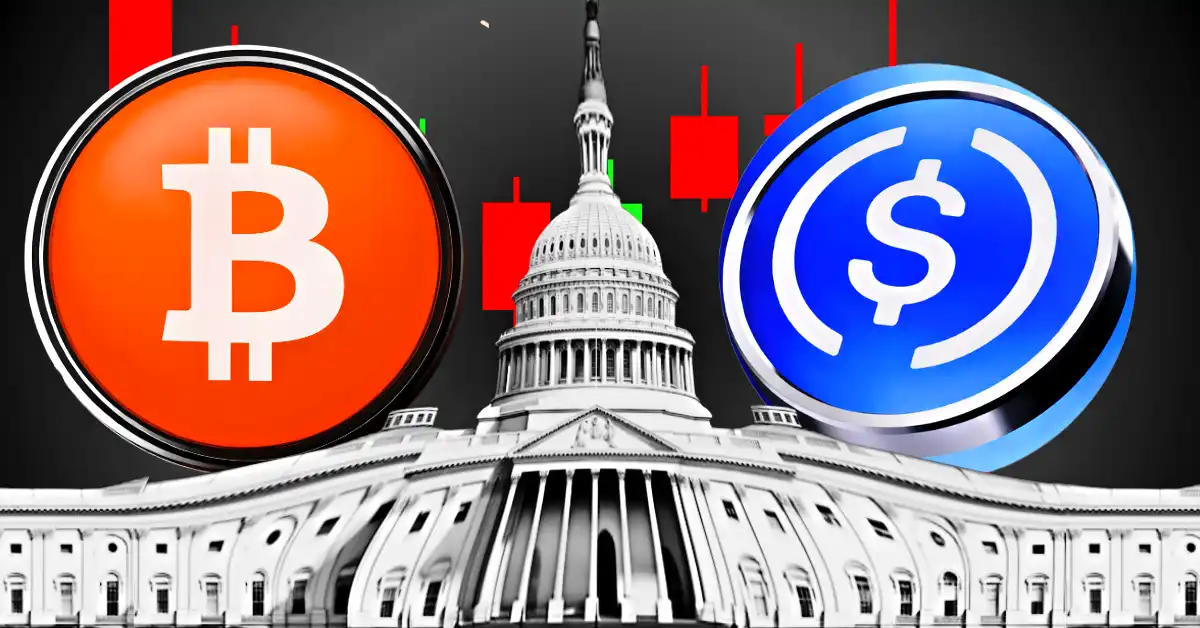
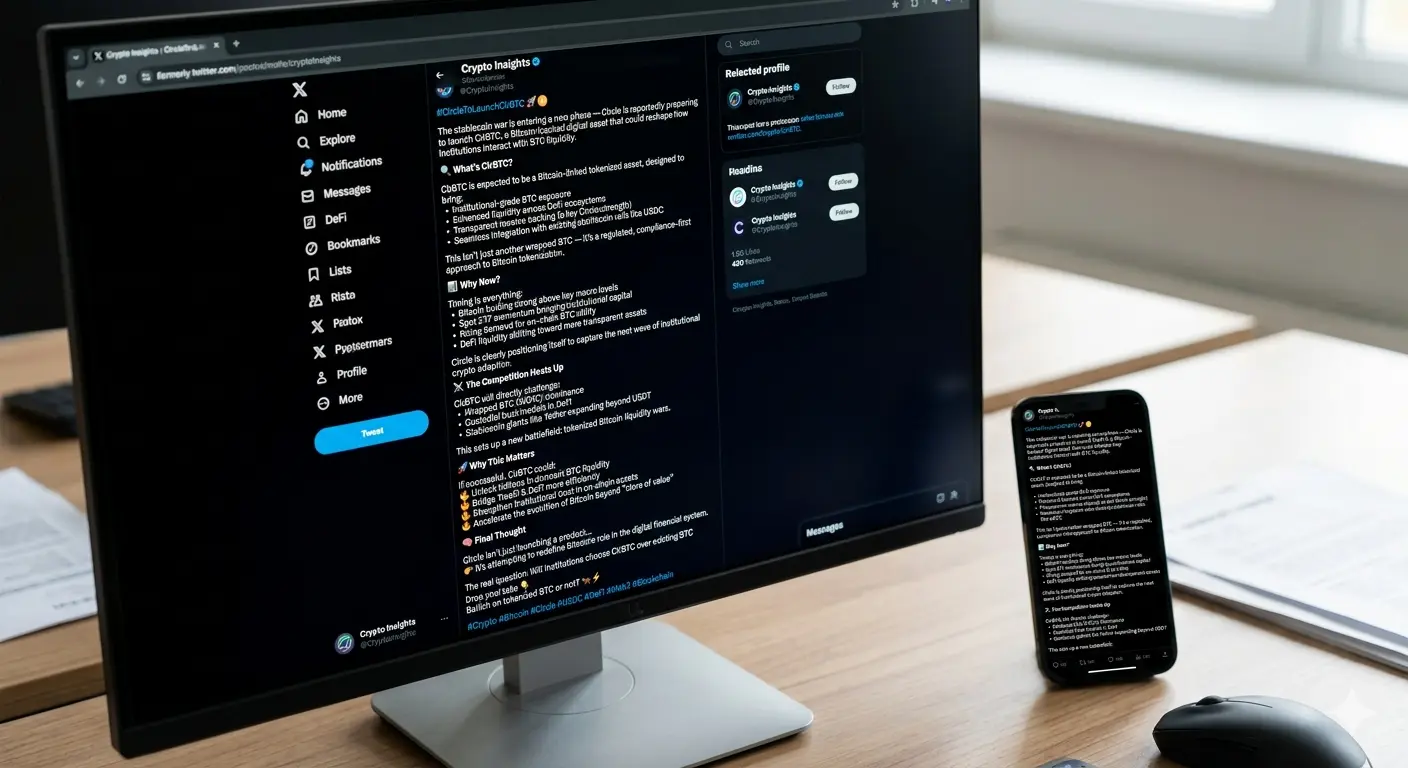
#CircleToLaunchCirBTC 🚀🪙
The stablecoin war is entering a new phase — Circle is reportedly preparing to launch CirBTC, a Bitcoin-backed digital asset that could reshape how institutions interact with BTC liquidity.
🔍 What’s CirBTC?
CirBTC is expected to be a Bitcoin-linked tokenized asset, designed to bring: • Institutional-grade BTC exposure
• Enhanced liquidity across DeFi ecosystems
• Transparent reserve backing (a key Circle strength)
• Seamless integration with existing stablecoin rails like USDC
This isn’t just another wrapped BTC — it’s a regulated, compliance-first approach to Bitco
USDC0,01%
WBTC-0,12%
post-image
post-image
  • Reward
  • Comment
  • Repost
  • Share
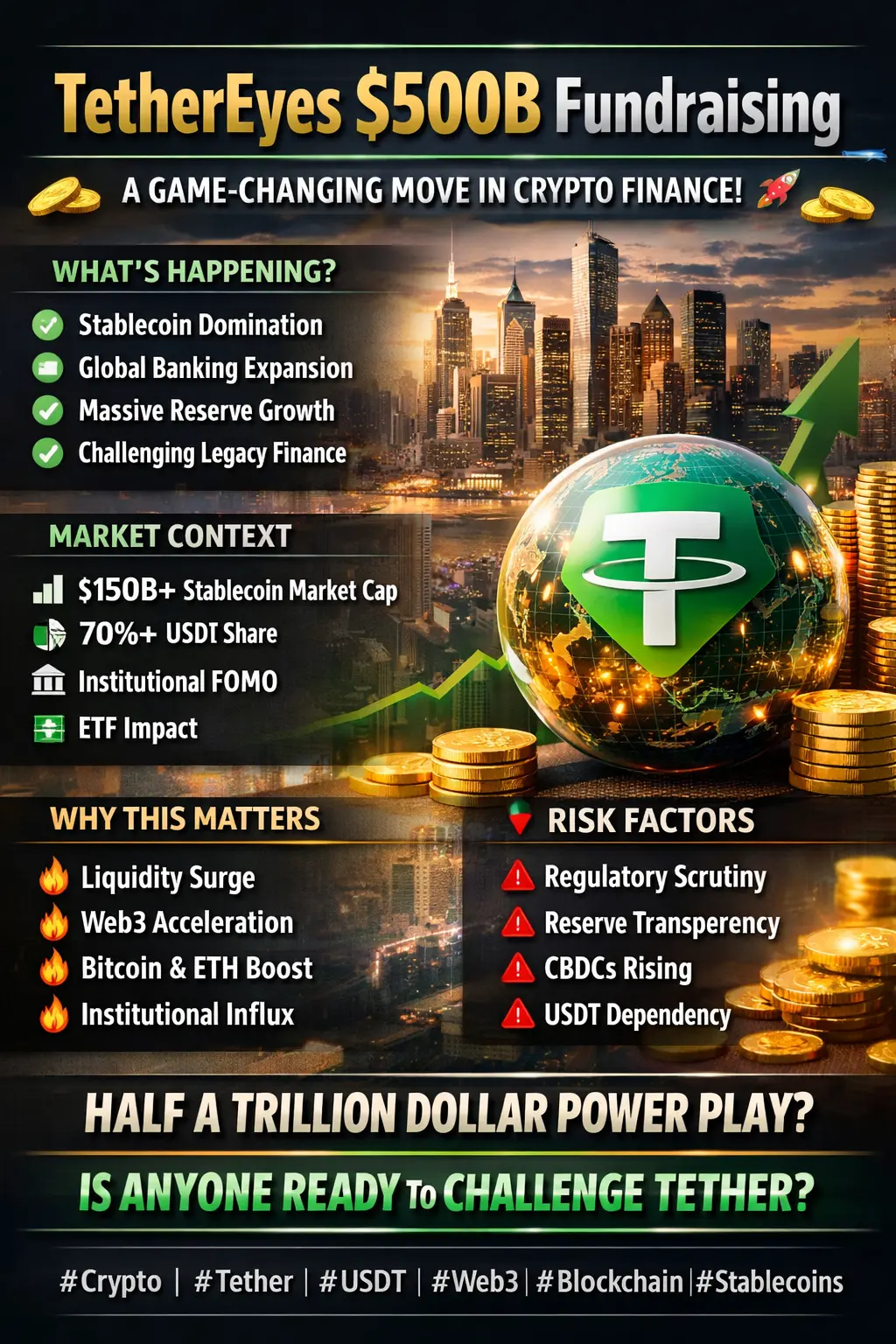
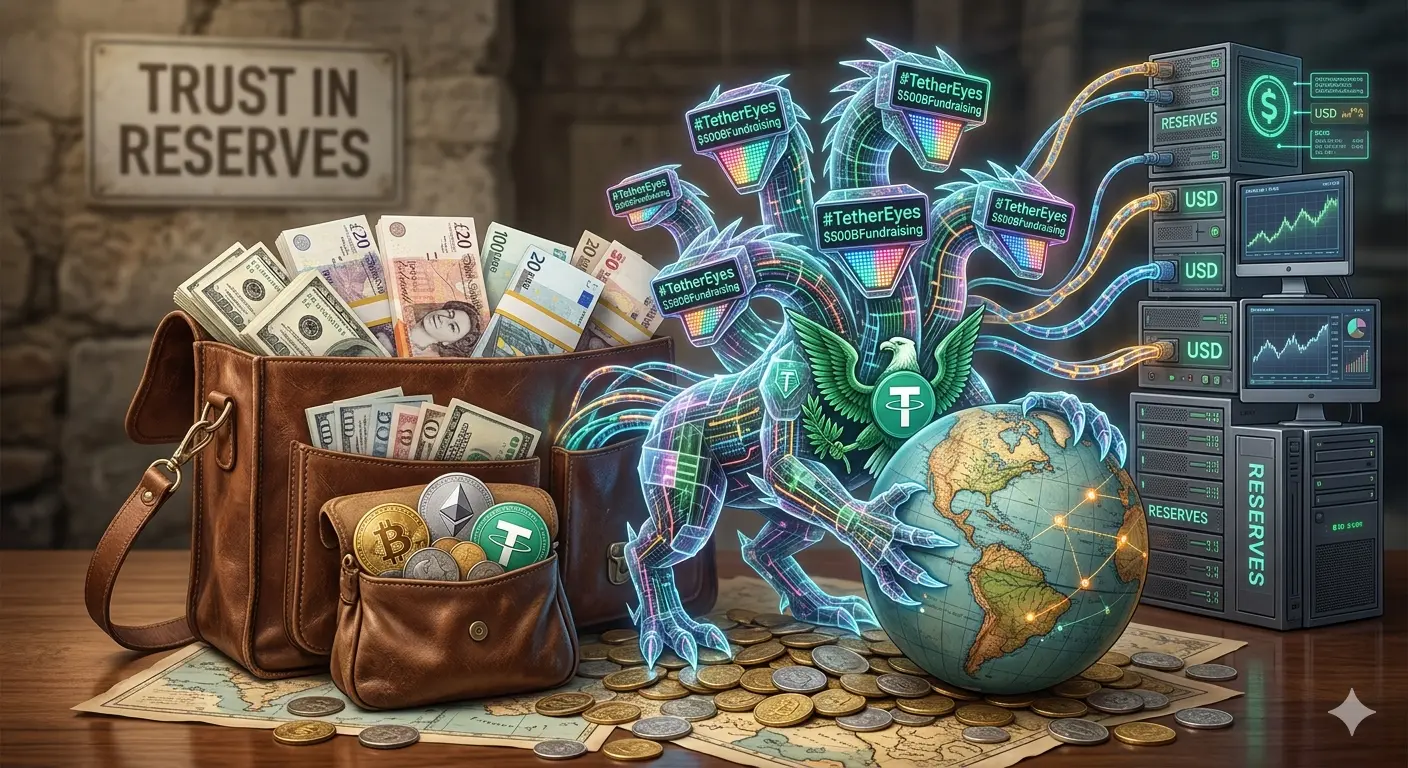
#TetherEyes$500BFundraising
🚨💰
The crypto market is buzzing with a massive development — Tether is reportedly exploring a $500 BILLION fundraising vision, signaling one of the most ambitious capital expansion strategies in financial history.
🔍 What’s Happening?
Tether, the issuer behind the world’s largest stablecoin USDT, is no longer just a liquidity provider — it’s evolving into a global financial powerhouse.
If this $500B fundraising narrative materializes, it could: • Redefine stablecoin dominance
• Expand into global banking & fintech infrastructure
• Strengthen reserves beyond tradi
ETH-0,51%
USDC0,01%
post-image
post-image
post-image
  • Reward
  • Comment
  • Repost
  • Share
#BitcoinMiningIndustryUpdates
The Silent Engine Powering the Crypto Economy
The Big Picture
The Bitcoin mining industry is undergoing one of its most transformative phases ever. With rising hash rate, post-halving pressure, energy debates, and institutional expansion, mining is no longer a niche activity—it’s now a multi-billion-dollar global infrastructure layer.
As we move deeper into 2026, miners are navigating a complex environment of shrinking rewards, rising costs, and increasing competition.
Hashrate Hits New Highs
The Bitcoin network continues to demonstrate unprecedented security an
post-image
post-image
  • Reward
  • Comment
  • Repost
  • Share
#SpaceXIPOTargets$2TValuation
The Most Anticipated IPO in History?
The Headline That’s Shaking Markets
Rumors and insider discussions suggest that SpaceX could be positioning itself for a future IPO targeting a staggering $1.5T–$2T valuation.
If realized, this would not only make it one of the largest IPOs ever—but potentially redefine the valuation ceiling for private tech companies globally.
Why a $2 Trillion Valuation Isn’t Crazy
At first glance, $2T sounds extreme. But when you break down SpaceX’s ecosystem, the numbers start to make sense.
1. Starlink — The Real Cash Machine
Starlink is
post-image
post-image
  • Reward
  • Comment
  • Repost
  • Share
#OilPricesRise
Global Energy Markets Enter a Critical Phase
The Big Picture
Oil markets are once again heating up, and this isn’t just another short-term spike. The recent surge in crude prices is being driven by a powerful mix of geopolitical tensions, supply constraints, and resilient global demand—creating a high-stakes environment for economies, investors, and policymakers worldwide.
Brent crude has pushed back above key resistance zones, while WTI is showing strong upward momentum, signaling that the market is entering a structural tightening phase rather than a temporary rally.
Key Driv
post-image
post-image
  • Reward
  • Comment
  • Repost
  • Share
#CryptoMarketSeesVolatility
The crypto market is once again riding a wave of intense volatility — and this isn’t just random price action, it’s a reflection of deeper macro and structural shifts shaping the entire digital asset landscape.
📉 Market Snapshot: What’s Happening?
Over the past few sessions, we’ve seen: • Sharp intraday swings across BTC and ETH
• Liquidity thinning in key trading hours
• Increased liquidation cascades in derivatives markets
• Fear sentiment dominating retail positioning
The Fear & Greed Index hovering in Extreme Fear territory signals one thing clearly: uncertain
ETH-0,51%
post-image
post-image
  • Reward
  • 1
  • Repost
  • Share
  • Pin