SheenCrypto

vip
Age 0.7 Yıl
Peak Tier 5
No content yet
Pin
market analysis
1.588 views
2026-04-02 14:33
  • Reward
  • 13
  • Repost
  • Share
EagleEyevip:
good work
View More
Bitcoin large transfer
live-cover
50 reminders set
2026-04-04 15:00
  • Reward
  • Comment
  • Repost
  • Share
#GENIUSImplementationRulesDraftReleased #GENIUSImplementationRulesDraftReleased
April 2026 — The US Treasury Department has officially released its first proposed rule under the GENIUS Act, marking a critical milestone in implementing America's first comprehensive federal stablecoin framework. This 87-page Notice of Proposed Rulemaking (NPRM), published on April 1, 2026, establishes principles for determining whether state-level stablecoin regulatory regimes are "substantially similar" to federal standards . Here is your complete professional analysis of what this means for the stablecoin ind
post-image
post-image
  • Reward
  • 4
  • Repost
  • Share
MoonGirlvip:
Ape In 🚀
View More
#BitcoinMiningIndustryUpdates |
April 2026 — The Bitcoin mining industry is undergoing its most fundamental transformation since its inception. What was once a straightforward business of securing the Bitcoin network and accumulating BTC has now become a high-stakes race toward artificial intelligence infrastructure. Here's your complete professional analysis of the latest developments.
Current Industry Snapshot
Metric Value Trend
Bitcoin Price ~$66,700 - $70,300 Down
Mining Cost (Avg.) ~$79,995 - $87,000 per BTC Up
Profit/Loss per BTC -$17,000 to -$19,000 Loss
Network Hashrate ~920 - 986
BTC-0,07%
post-image
post-image
post-image
  • Reward
  • 5
  • Repost
  • Share
MoonGirlvip:
Ape In 🚀
View More
#OilPricesRise
April 2026, worldwide oil (crude oil) prices are soaring to the sky. But the real question isn't how high prices have gone — the real question is:
Which force will win? Will oil $120 break through, or will recession hit and end this rally?
This article will tell you that in this competition (competition), two giants are facing off — and how you can understand this competition.
First, Know the Current Scene (Data)
Benchmark Price (USD/barrel) 1-Week Change
Brent Crude ~$107.50 +9.2%
WTI Crude ~$111.30 +11.4%
Alert: WTI has become more expensive than Brent — which is unusual. T
TRUMP0,21%
View Original
post-image
post-image
  • Reward
  • 4
  • Repost
  • Share
MoonGirlvip:
To The Moon 🌕
View More
#OilPricesRise 🌍 Global Oil Prices Surge: A Professional Analysis of the 2026 Energy Crisis
#OilPricesRise #EnergyMarkets #GeopoliticalRisk
Global crude oil markets are experiencing unprecedented volatility in April 2026, with prices surging past $106 per barrel following escalating geopolitical tensions in West Asia. This article provides a comprehensive, data-driven analysis of the multifaceted forces driving this rally.
Current Market Snapshot (as of April 3, 2026)
Benchmark Price (USD/barrel) Key Driver
Brent Crude (Global) ~$107.57 Geopolitical risk premium
WTI Crude (US) ~$111.29 Secur
HNT-4,57%
post-image
post-image
  • Reward
  • 3
  • Repost
  • Share
MoonGirlvip:
Ape In 🚀
View More
#GateSquareAprilPostingChallenge Beyond the Hype: A Professional’s Guide to Spotting Utility vs. Speculation in April’s Market
#GateSquareAprilPostingChallenge #CryptoAnalysis #AltcoinSeason
As we dive deeper into Q2, the April market is sending mixed signals. Volatility is high, but so is the opportunity for those who do their homework.
Today, let’s break down $GOF (GoFundMe Token) — not as financial advice, but as a case study in fundamental tokenomics.
The Current Landscape
April has historically been a bullish month for alts, but 2026 requires a scalpel, not a sledgehammer. Liquidity is r
BTC-0,07%
post-image
post-image
  • Reward
  • 3
  • Repost
  • Share
MoonGirlvip:
To The Moon 🌕
View More
#CreatorLeaderboard: The Web3 Creator’s “Algorithm Battle” Where Attention Gets Tokenized
Silence isn’t gold in Web3. It’s the biggest opportunity cost.
By 2026, the global creator economy has ballooned to over $323 billion, growing at a CAGR of more than 26%. While TikTok and YouTube remain traffic giants, the era of pure vanity metrics is fading. Creators face a harsh reality: You create content on legacy platforms, but the platform owns your data, throttles your reach, and takes the lion’s share of your revenue.
This is precisely why matters. It’s no longer just a popularity contest. In the
ON-10,33%
DEEP-1,64%
TRUST1,08%
post-image
post-image
post-image
  • Reward
  • 7
  • Repost
  • Share
MoonGirlvip:
Ape In 🚀
View More
very good
DragonFlyOfficialvip
#GateSquareAprilPostingChallenge
🌟 GateSquare April Posting Challenge is Live!
April starts with a calm but confident market tone, and BTC is still holding the $65,000 support zone. Market liquidity remains stable across major assets, which makes this month a strong opportunity for creators to share clear and valuable insights.
April is shaping up to be a high-engagement month. Global macro events are active, market volatility is expected to increase, and posting consistently right now gives creators the best visibility. The April Challenge on GateSquare rewards those who show up daily, deliver value, and build their voice in the community.
This is the moment to post smarter and stronger.
Create, engage, and grow — April is yours to win.
repost-content-media
  • Reward
  • 5
  • Repost
  • Share
EagleEyevip:
good work
View More
very nice
CryptoChampionvip
#CreatorLeaderboard
Signal vs Noise: The New Era of Ranked Influence
April 2026 didn’t just introduce a leaderboard—it introduced accountability at scale. What we’re witnessing now isn’t a content competition; it’s a live audit of influence. In a landscape flooded with AI-generated noise, the Creator Leaderboard has become a compression tool, separating engineered engagement from earned authority.
This is no longer about visibility—it’s about validation.
The creators climbing the ranks aren’t louder; they’re sharper. Every post is now a position. Every insight carries weight. The system doesn’t reward activity—it rewards accuracy, timing, and conviction. And with the integration of performance-based metrics like short-term prediction tracking, the gap between “creator” and “analyst” is disappearing fast.
We’ve entered the age of quantified reputation.
What makes this shift powerful is the death of passive influence. Followers don’t matter if they don’t act. Impressions don’t matter if they don’t convert. The leaderboard is filtering for one thing only: impact. If your content doesn’t move sentiment, shift positioning, or trigger capital flow—it’s invisible.
And the structure is ruthless.
A small percentage of creators are absorbing the majority of attention, tips, and trust. Not because of favoritism—but because the system now mirrors markets: efficient, selective, and unforgiving. The middle layer is collapsing, and only those who evolve beyond surface-level commentary will survive.
But here’s where it gets strategic.
Winning creators are no longer thinking in posts—they’re thinking in narratives. They build context, not just content. They anticipate sentiment shifts before they show up in price. And most importantly, they understand that consistency without edge is useless.
This is where the real game is played:
Depth over frequency
Precision over virality
Insight over opinion
The leaderboard isn’t just ranking creators—it’s mapping influence in real time. It tells you who the market is listening to before the move happens.
So the question isn’t “How do I get views?”
The real question is:
Can your ideas survive exposure to real capital?
repost-content-media
  • Reward
  • 4
  • Repost
  • Share
EagleEyevip:
good work
View More
good post
BeautifulDayvip
#StablecoinDebateHeatsUp
The stablecoin debate is no longer about “if.” It is about control.
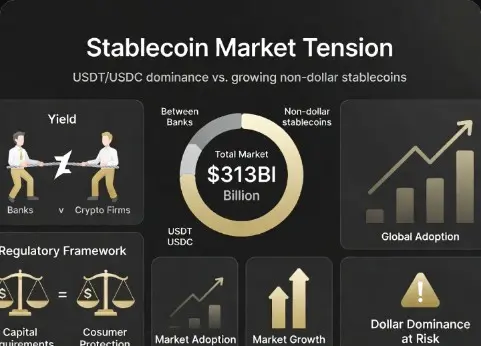
Banks want to restrict yield on stablecoin holdings. Crypto firms want open competition. Regulators are building the framework while both sides are still fighting over what the system should become.
The GENIUS Act pushed federal oversight forward, but the real questions remain unresolved: capital requirements, reserve composition, and consumer protections are still being defined in real time.
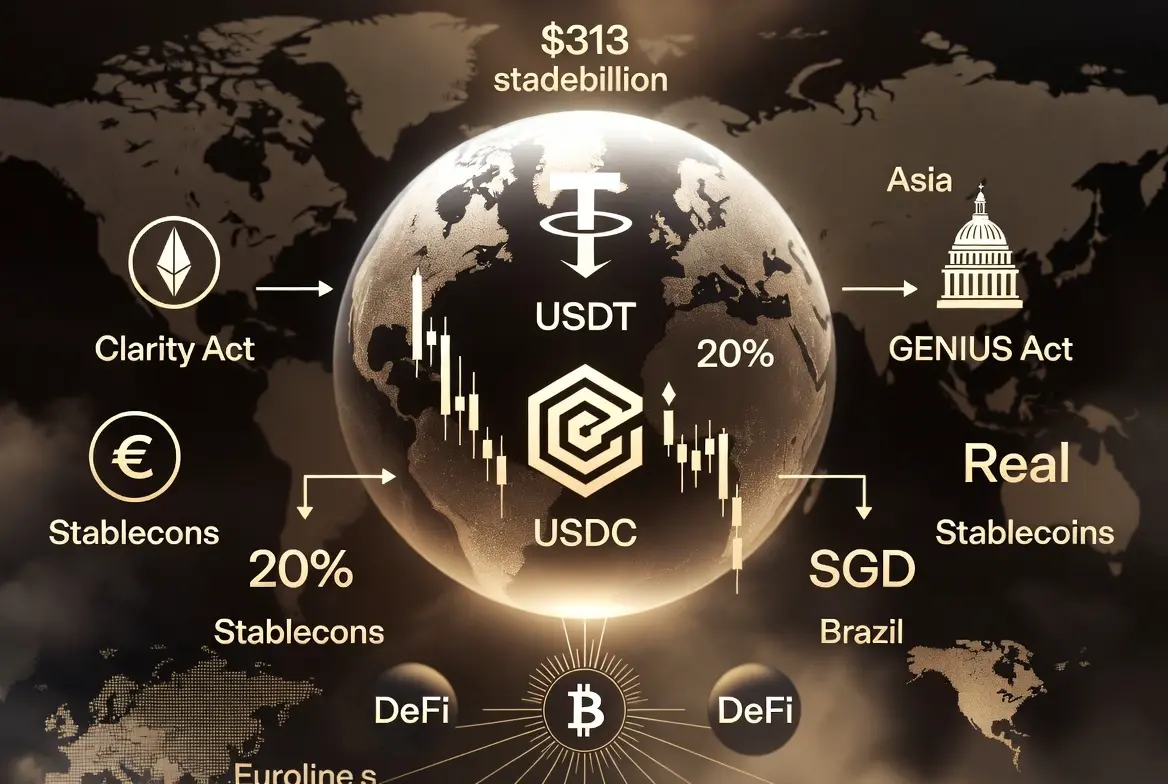
Meanwhile, the market is not waiting. Stablecoin supply has crossed $313 billion, and growth is no longer purely dollar-centric. Non-dollar stablecoins are expanding across Europe and Southeast Asia — in many cases accelerated by the very regulations designed to contain them.
The underlying tension is simple but powerful.
If banks win the yield debate, they protect their margins but risk weakening the global reach of dollar-based stablecoins.
If they lose, a new class of financial institution takes shape — one that behaves like a bank, earns like a bank, but operates under a fundamentally different rulebook.
That asymmetry is the real story.
repost-content-media
  • Reward
  • 7
  • Repost
  • Share
EagleEyevip:
good work
View More
good post
xxx40xxxvip
#StablecoinDebateHeatsUp
The most trusted stablecoin wasn't the one with the audit.
It was the one that didn't need one — until now.
That just changed. And the entire stablecoin industry is recalibrating in real time.
———
The $313 Billion Market That Nobody Fully Understands
As of March 2026, the total stablecoin market has hit a record $313 billion. That's not a crypto statistic — that's a macro number. It's larger than the GDP of many countries. It moves through DeFi protocols, cross-border payments, payroll systems in emerging markets, and institutional treasury operations.
And almost all of it is pegged to one currency: the U.S. dollar.
At the center of this market sit two competitors who couldn't be more different in how they've operated — and whose rivalry just entered a completely new phase.
———
USDT vs. USDC: A 12-Year Power Struggle
Tether's USDT was created in 2014. For years, it was the only stablecoin. It became the backbone of global crypto trading — $184 billion in market cap, over 550 million users worldwide.
But there was always one problem: nobody could fully verify what was backing it.
Tether issued quarterly attestations — not audits. The difference matters enormously. An attestation is a snapshot. An audit is a full investigation. For 12 years, Tether promised an audit and never delivered one. S&P Global rated USDT as "weak." Critics called it a $184 billion question mark. Some argued that if Tether's reserves didn't match its token supply, it could trigger a black swan collapse across the entire crypto market.
Meanwhile, Circle's USDC built its identity on exactly what Tether lacked: full annual audits by Deloitte, monthly attestations, and U.S. regulatory compliance. When Circle went public last year in a successful IPO, it was riding the wave of institutional demand for a "clean" stablecoin. USDC was positioned as the institutional-grade alternative.
Then Tether made its move.
———
The Audit That Broke Circle's Stock
On March 24, 2026, Tether announced it had signed a formal engagement with KPMG — one of the Big Four accounting firms — to conduct its first full independent financial statement audit.
The reaction was immediate and brutal — for Circle.
Circle's stock fell nearly 20% in a single session, marking its worst day on record. Coinbase dropped 8%. The market's message was clear: if Tether gets a clean audit, USDC's core competitive advantage — trustworthiness — is no longer exclusive.
But that wasn't the only pressure hitting Circle that day.
———
The Clarity Act: When Congress Joins the Fight
Simultaneously, the U.S. Senate was debating a revised draft of the Digital Asset Market Clarity Act. And the language being discussed sent shockwaves through the industry.
The draft raised the possibility of banning yield payments on stablecoins.
Read that again: a law that could make it illegal to earn interest simply by holding a stablecoin.
The GENIUS Act — which passed the Senate in June 2025 by a 68-30 vote — had already prohibited stablecoin yields on parked funds. The Clarity Act's new draft threatened to extend those restrictions further. Mizuho analyst Dan Dolev summarized the impact directly: a yield ban could reduce near-term use cases for Circle and make holding USDC on platforms like Coinbase significantly less attractive long-term.
For retail users and institutions who hold USDC precisely because it generates yield — this is not an abstract regulatory debate. This is a direct hit to returns.
———
The Paradox Nobody Saw Coming
Here's what makes this moment genuinely strange:
The regulatory push for transparency is supposed to protect users. More audits, clearer reserves, stricter oversight — these are good things. And they are good things.
But the immediate market effect has been to punish the company that was already doing the right things (Circle, which has been fully audited for years), while potentially rewarding the company that is only now beginning to comply (Tether).
Meanwhile, USDC's velocity is actually rising. A new report from Standard Chartered credits USDC's growing role in agentic AI use cases — automated systems that use stablecoins for micro-transactions — as a driver of increased circulation speed. The fundamentals are strong. The regulatory environment is hostile.
This is the stablecoin paradox of 2026: the market is growing faster than the rules being written to govern it.
———
The Dollar Isn't the Only Game in Town Anymore
One more development that isn't getting enough attention:
Non-dollar stablecoins just hit $1.2 billion in combined market cap. That sounds small against $313 billion — but the trajectory matters.
In Europe, monthly euro stablecoin volume surged from $383 million to $3.83 billion in the year after MiCA regulations took effect. In Brazil, the real-pegged BRLA stablecoin saw transfer volume increase eightfold year-over-year. In Singapore, StraitsX processed over $18 billion in combined on-chain volume through its XSGD and XUSD tokens.
Non-dollar stablecoins aren't speculative instruments. They're being used for payroll, treasury settlement, and cross-border business payments. And their growth pattern — consistent weekday volume, weekend drops — looks nothing like crypto trading. It looks like a global payment infrastructure quietly being built in parallel with the existing financial system.
The stablecoin debate isn't just about USDT versus USDC anymore. It's about which currencies get to exist in the digital economy.
———
What This Means for You
If you hold USDC for yield: watch the Clarity Act closely. A yield ban would fundamentally change the value proposition of holding it over USDT or other alternatives.
If you hold USDT: the KPMG audit is bullish long-term. If the reserves are confirmed clean, the decade-long question mark disappears — and institutional doors open.
If you're watching this from the outside: the stablecoin market is no longer a crypto-native story. It's a dollar dominance story, a regulatory power story, and a global payments infrastructure story — all happening simultaneously.
The debate is heating up. The $313 billion is already moving.
The only question is who gets to control where it goes next.
———
This article is for informational purposes only and does not constitute financial or investment advice. All data reflects publicly available information at the time of writing. Always do your own research before making any investment decisions.
$BTC $GT $ETH
#GateSquare #创作者冲榜 #内容挖矿 #Gate广场
repost-content-media
  • Reward
  • 7
  • Repost
  • Share
EagleEyevip:
good work
View More
#CircleToLaunchCirBTC Circle Reinforces Commitment to Ecosystem Security, Freezes 16 Hot Wallets in Proactive Compliance Action
[SAN FRANCISCO, CA] – [Date] – Circle, a global leader in digital financial technology and the issuer of USD Coin (USDC), today announced it has taken decisive action to freeze 16 hot wallets identified as being associated with suspicious or potentially illicit activity. This move underscores Circle’s unwavering commitment to maintaining the highest standards of security, regulatory compliance, and trust within the digital asset ecosystem.
The freeze, which renders th
post-image
post-image
post-image
post-image
discoveryvip
#CircleFreezes16HotWallets The cryptocurrency industry has once again been shaken by a major development: the freezing of 16 hot wallets by Circle. This decisive action has ignited intense debate across the digital asset ecosystem, raising critical questions about decentralization, regulatory compliance, and the future of financial sovereignty in blockchain networks.
As one of the leading issuers of stablecoins—particularly USD Coin (USDC)—Circle’s actions carry significant weight. The freezing of wallets is not just a technical move; it is a powerful signal about how centralized control mechanisms are being applied within a supposedly decentralized financial system.
What Happened: The Freezing of 16 Hot Wallets
Circle confirmed that it had frozen 16 hot wallets linked to suspicious or potentially illicit activity. Hot wallets, which are connected to the internet and used for frequent transactions, are inherently more vulnerable to hacks, exploits, and unauthorized access.
The freeze effectively rendered the funds in these wallets inaccessible, preventing any further transfers or withdrawals. While Circle did not disclose all operational details, such actions are typically taken in response to:
Regulatory requests
Law enforcement investigations
Detection of suspicious transaction patterns
Links to hacks, fraud, or sanctions violations
This move highlights the increasing role of centralized oversight in crypto infrastructure.
Understanding Hot Wallet Risks
Hot wallets play a crucial role in crypto liquidity and accessibility, but they come with inherent risks:
Exposure to cyberattacks: Being online makes them prime targets for hackers
Private key vulnerabilities: Compromised keys can lead to instant fund loss
Operational weaknesses: Exchanges and custodial services often rely on hot wallets for daily transactions
By freezing these wallets, Circle likely aimed to contain risk and prevent further damage, especially if the wallets were tied to an ongoing exploit or breach.
The Role of USDC in the Global Crypto Economy
USD Coin is one of the most widely used stablecoins in the world, pegged to the US dollar and backed by reserves. It is heavily utilized in:
Decentralized finance (DeFi) protocols
Centralized exchanges
Cross-border payments
Trading pairs across crypto markets
Because of its scale and trust, any action involving USDC—especially wallet freezes—has ripple effects across the entire ecosystem.
Centralization vs Decentralization: The Core Debate
This incident has reignited one of the oldest debates in crypto:
Is Crypto Truly Decentralized?
On one hand, blockchain technology promises censorship resistance and user control. On the other, assets like USDC are issued and managed by centralized entities like Circle.
The ability to freeze wallets demonstrates that:
Stablecoins can be controlled at the issuer level
Transactions can be restricted despite blockchain transparency
Users do not have absolute control over their funds
For some, this is a necessary compromise for security and regulatory compliance. For others, it represents a fundamental contradiction of crypto principles.
Regulatory Pressure and Compliance
Circle operates within a regulated financial framework, particularly in the United States. This means it must comply with:
Anti-Money Laundering (AML) laws
Know Your Customer (KYC) regulations
Sanctions enforcement
Law enforcement directives
The wallet freeze likely reflects increasing global pressure on crypto firms to align with traditional financial regulations.
Governments and regulators are paying closer attention to stablecoins due to their growing role in global finance. Actions like this may become more common as oversight intensifies.
Market Reaction and Investor Sentiment
Events like wallet freezes can have mixed effects on the market:
Positive Reactions
Increased trust in compliance and security
Confidence among institutional investors
Reduced risk of illicit activity
Negative Reactions
Fear of centralized control
Concerns over asset censorship
Potential loss of user autonomy
For traders and investors, this creates a complex landscape where security and freedom are constantly being balanced.
Security Implications for Crypto Users
This incident serves as a strong reminder for users to rethink their security strategies:
Avoid keeping large funds in hot wallets
Use cold storage for long-term holdings
Diversify across multiple wallets
Stay informed about platform policies
Even though blockchain transactions are immutable, access to funds can still be restricted under certain conditions.
The Bigger Picture: A Maturing Industry
The freezing of 16 wallets is not just an isolated event—it is part of a broader trend toward the institutionalization of crypto.
We are witnessing a shift where:
Compliance is becoming standard
Security measures are tightening
Centralized entities are gaining influence
Governments are actively shaping the ecosystem
This evolution suggests that crypto is moving closer to traditional finance, rather than operating entirely outside of it.
Future Outlook
Looking ahead, several key developments are likely:
1. Increased Transparency
Companies may provide clearer explanations for enforcement actions to maintain user trust.
2. Hybrid Models
The industry may adopt systems that balance decentralization with regulatory compliance.
3. Rise of Decentralized Alternatives
Users concerned about control may shift toward fully decentralized stablecoins and platforms.
4. Stronger Security Standards
Wallet management practices will continue to evolve, reducing risks associated with hot wallets.
Final Thoughts
The decision by Circle to freeze 16 hot wallets marks a critical moment in the evolution of cryptocurrency. It underscores a reality that many investors are beginning to accept:
Crypto is no longer just about decentralization—it is about navigating the intersection of technology, security, and regulation.
While the ideals of financial freedom remain central to the crypto vision, practical considerations are shaping how that vision is implemented in the real world.
For users, investors, and institutions alike, the message is clear:
understanding the balance between control and compliance will be essential in the next phase of the digital asset revolution.
  • Reward
  • 6
  • Repost
  • Share
SheenCryptovip:

LFG 🔥
View More
#TetherEyes$500BFundraising Tether Intensifies $500 Billion Fundraising Push as Investor Deadline Looms
In a high-stakes move to cement its dominance in the digital assets space, stablecoin issuer Tether is making a renewed bid to close a funding round at a staggering $500 billion valuation. With a two-week deadline for investor commitments, the company is leveraging its first full audit and the launch of a regulated US stablecoin to overcome market skepticism.
The Valuation Debate: $500 Billion Ambition Meets Investor Caution
Tether, the company behind the world’s largest stablecoin USDT ($18
USAT0,04%
post-image
post-image
post-image
  • Reward
  • 6
  • Repost
  • Share
dragon_fly2vip:
great job
View More
#BitcoinMiningIndustryUpdates Bitcoin Mining Faces Crossroads: Record AI Pivot and Capitulation Waves Reshape the Sector
As hash prices hit five-year lows and energy costs soar, 2026 marks a defining moment for the Bitcoin mining industry. Publicly traded miners are pivoting to Artificial Intelligence (AI) to survive, leading to significant sell-offs and a transformation of the global hashrate landscape.
The Profitability Squeeze Intensifies
The first quarter of 2026 has proven to be one of the most challenging periods for Bitcoin miners since the April 2024 halving. According to the latest da
BTC-0,07%
post-image
post-image
post-image
  • Reward
  • 3
  • Repost
  • Share
discoveryvip:
To The Moon 🌕
View More
#SpaceXIPOTargets$2TValuation SpaceX Files for Blockbuster IPO Targeting Historic $2 Trillion Valuation
Cape Canaveral, FL – In a move poised to become the defining financial event of the decade, SpaceX has officially ignited the engines for what could be the largest initial public offering in history. According to reports from Bloomberg and Reuters, the aerospace giant has confidentially filed paperwork with the U.S. Securities and Exchange Commission (SEC), targeting a valuation north of $2 trillion** and aiming to raise a staggering **$75 billion .
If successful, the offering would not only
XAI-1,05%
GROK-1,6%
post-image
post-image
  • Reward
  • 7
  • Repost
  • Share
SheenCryptovip:
LFG 🔥
View More
#OilPricesRise Global Supply Concerns and Geopolitical Tensions Drive
Dateline: April 4, 2026
By [ sheen crypto]
Crude oil futures extended their upward trajectory in early Asian trading today, pushing benchmark prices to their highest levels in several weeks. The hashtag has been trending as investors react to a confluence of tightening supply fundamentals and renewed geopolitical uncertainty.
Key Drivers Behind the Rally
Several critical factors are contributing to the current price surge:
1. OPEC+ Supply Discipline: Preliminary indications suggest the OPEC+ alliance (Organization of the Pe
post-image
post-image
post-image
  • Reward
  • 7
  • Repost
  • Share
SheenCryptovip:
LFG 🔥
View More
#CryptoMarketSeesVolatility #CryptoMarketSeesVolatility – 5 Professional Moves to Make When Others Panic
Introduction
Volatility is not the enemy. In crypto, volatility is the transfer window—wealth moves from the impatient to the prepared. Right now, is trending because leveraged positions are liquidating, and fear is rising.
But here is the truth: professionals don't fear volatility. They plan for it.
Let's break down exactly what is happening and how to respond like a pro.
1. First, Diagnose the Type of Volatility
Not all volatility is created equal. Ask three questions before taking any ac
BTC-0,07%
post-image
post-image
post-image
  • Reward
  • 7
  • Repost
  • Share
SheenCryptovip:
LFG 🔥
View More
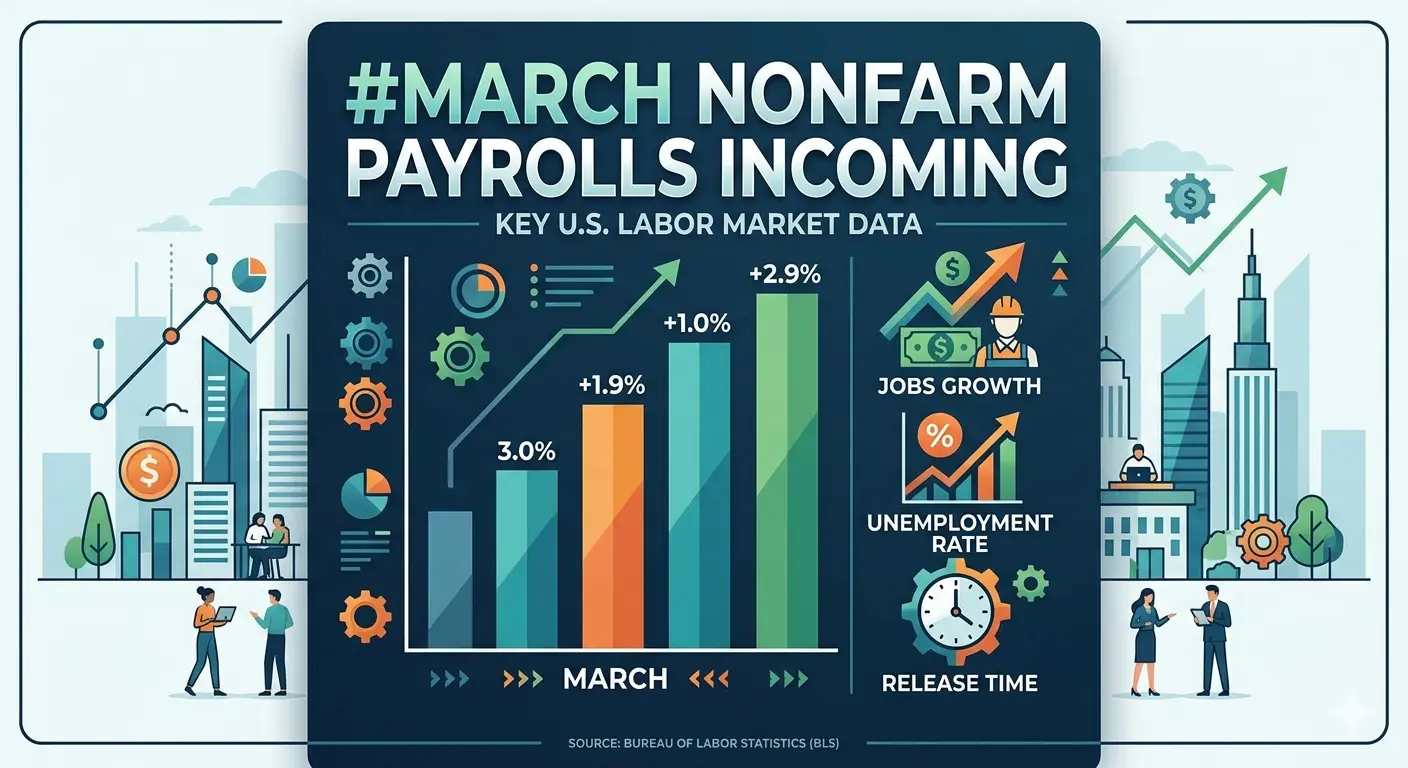
#MarchNonfarmPayrollsIncoming March Nonfarm Payrolls Incoming: Why This Jobs Report Could Trigger the Next Crypto Volatility Spike
Introduction
The first Friday of the month is here. s trending, and for good reason. While crypo prides itself on being "macro free," the reality is clear: a hot or cold NFP print moves the dollar (DXY), bond yields, and rate hike expectations—directly impacting Bitcoin dominance and altcoin liquidity.
Here is your professional playbook for interpreting today’s data.
1. The Current Market Context (Pre-NFP)
Going into March’s report, the consensus forecast sits near
BTC-0,07%
ETH-0,54%
NFP-0,48%
RWA1,26%
post-image
post-image
  • Reward
  • 7
  • Repost
  • Share
SheenCryptovip:
LFG 🔥
View More
#GateSquareAprilPostingChallenge #GateSquareAprilPostingChallenge
Introduction
The crypto market never sleeps, and neither should your strategy. The isn't just about posting daily—it's about building a professional edge. Whether you are a trader, analyst, or enthusiast, going "pro" means moving from guesswork to data-backed decisions.
Here is how to level up your content this April.
1. Master the Art of On-Chain Analysis (Not Just Price)
Professional traders don't just watch the chart; they watch the flow. Before making a prediction post, check:
· Exchange Netflows: Are large amounts of BTC/ET
BTC-0,07%
ETH-0,54%
post-image
post-image
post-image
  • Reward
  • 7
  • Repost
  • Share
SheenCryptovip:
LFG 🔥
View More
  • Pin