


Xiaominweb3

vip
Age 0 Yıl
Peak Tier 5
No content yet
On the surface, @0xMiden uses a mature ZK toolchain,
but its true barrier is not in cryptography itself.
What is difficult to replicate is the path it has taken from the very beginning, centered around "provable execution"
reverse designing virtual machines, instruction sets, and account models.
This means it is not simply "plugging in ZK" onto an existing execution model,
but rather making ZK a prerequisite for the execution model.
Once this choice is made, it is difficult to adjust midway,
which also explains why this route seems to progress slowly but has a complete structure.
View Original
post-image
  • Reward
  • Comment
  • Repost
  • Share
Most blockchain systems make very simple assumptions about users:
Users are only responsible for submitting transactions; execution and proof are handled at the system layer.
@0xMiden's assumptions about users are clearly more advanced.
In its model, users are not passive request initiators,
but the primary responsible party for execution.
Logic runs locally on the user,
proofs are generated on the user side,
and the chain is only responsible for verifying whether the state is reasonable.
This means the system does not aim to "reduce all complexity,"
but rather hands the complexity back to the
View Original
post-image
  • Reward
  • Comment
  • Repost
  • Share
Happy Friday! The weekend is just around the corner.
After a busy week, my mind is actually more easily attracted to some truly interesting things.
Recently, what made me stop and think seriously is a core idea from @0xMiden:
It doesn't insist on a TPS number race, but instead chooses to return to a more fundamental question—where should computation actually happen?
Through local execution, on-chain verification, and the "proof as the result" design, it shifts the source of scalability from simply node performance to user-side computational power.
The changes brought about by this approach are
View Original
post-image
  • Reward
  • Comment
  • Repost
  • Share
Privacy is not about "hiding data," but:
Others can verify that you are correct, but cannot see what you have done.
@0xMiden's local execution + zero-knowledge proof model naturally supports this.
The logic runs on your device, and the proof is verified on the chain.
It's not about adding privacy as an afterthought, but making privacy the default and optional.
View Original
post-image
  • Reward
  • Comment
  • Repost
  • Share
Early on in my contract trading, I took many detours.
Position control and risk awareness were not up to par. When the market moved against me, I faced direct liquidation during retracements. After being whipped for a long time,
I realized that for retail investors, the market never sleeps and is never short of opportunities. Staying in the market is the only way to seize those opportunities.
Recently, I’ve been using Gate’s leveraged ETFs, which come with 3x and 5x leverage. Unlike futures contracts, there’s no liquidation line.
Market volatility is reflected in the net asset value’s ups and
View Original
post-image
  • Reward
  • Comment
  • Repost
  • Share
Many blockchain projects compete to be faster and have higher TPS.
But @0xMiden chose a more fundamental question:
Why must all transactions be executed on the chain?
In @0xMiden, execution happens locally on the user's device,
The chain is only responsible for verifying whether the results are correct.
What does this mean?
It means that computational load, privacy risks, and costs are no longer entirely borne by the chain.
It’s not about "speeding up" the blockchain,
But about redistributing power:
Returning verification to the chain and giving users true execution authority.
This is also why
View Original
post-image
  • Reward
  • Comment
  • Repost
  • Share
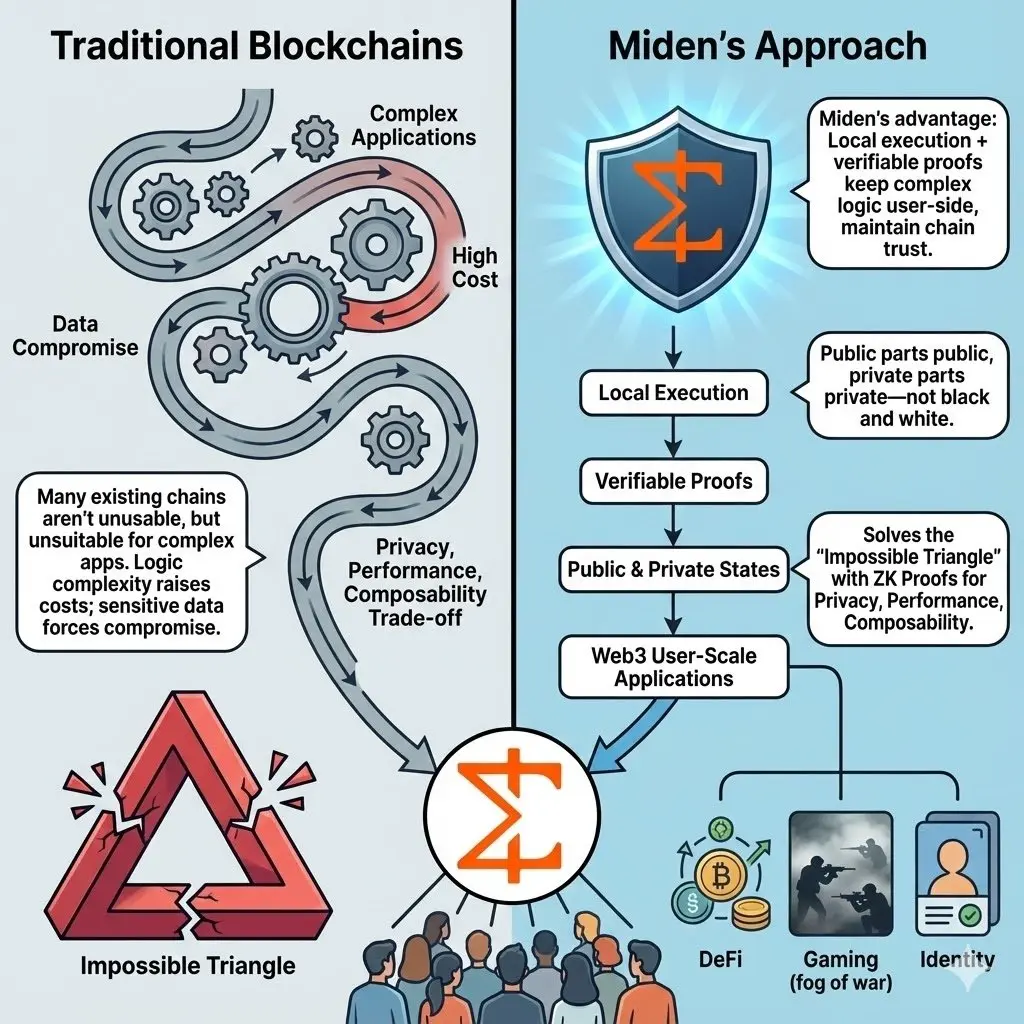
The true limitations to the development of Web3 applications are often not "not enough chains," but the difficulty in balancing privacy, performance, and composability.
Many blockchains, in pursuit of one or two of these features, have to sacrifice the others—either sacrificing privacy for speed and transparency, or impacting scalability or interactivity to protect privacy.
@0xMiden's attempt is like a framework that tries to incorporate all three into a single design blueprint.
It does not pursue short-term popularity but focuses on underlying infrastructure capable of supporting long-term ec
View Original
post-image
  • Reward
  • Comment
  • Repost
  • Share
MemeMax chose to build its own MemeCore chain from scratch rather than directly using an existing public chain. The key reason is to pursue a better trading experience and true fairness.
On general public chains, Meme Coin transactions are often accompanied by high concurrency and strong market sentiment, which can easily lead to network congestion, skyrocketing Gas fees, and also provide ample arbitrage opportunities for front-running bots.
A dedicated chain is like a "high-speed highway" specifically paved for such high-frequency, emotional trading. It can significantly reduce latency and ef

View Original
  • Reward
  • Comment
  • Repost
  • Share
Playing Meme Coins is the most headache-inducing, nothing more than these few issues:
High slippage that feels like a mugging, transactions constantly snatched by scientists and bots, and once the hype dies down, the pool dries up...
These are all old problems.
@MemeMax_Fi is an interesting project—it almost directly targets these pain points.
Not only has it built a dedicated chain @MemeCore_M optimized for Meme trading, maximizing transaction speed, but it also has an anti-bot attack mechanism built in, aiming to give ordinary players a fairer playground.
More importantly, it introduces a tw
View Original
post-image
  • Reward
  • Comment
  • Repost
  • Share
NFT platforms don't have to rely on waves of hype to stay alive, do they?
@spaace_io offers a different answer — it cares more about whether you "truly participate," rather than just how much you trade.
Here, gamified progress and leaderboards allow every small action to accumulate value.
Smarter still, the platform system can sense market rhythms:
Helping you focus during the hype, inspiring discovery during quiet times, just like a trading-savvy friend by your side, rather than facing cold, impersonal machines.
This also proves that a stable, active community is far more resilient than occas
View Original
post-image
  • Reward
  • Comment
  • Repost
  • Share
Many people simply understand @MemeMax_Fi as a "meme-based exchange," but it actually has a deeper intention.
It's not just about packaging trading with memes, but trying to make that contagious community sentiment directly part of financial interactions—meme is shifting from "atmosphere group" to "infrastructure."
Interestingly, I found that the performance of @MemeMax_Fi is quite different from most projects in the market.
Others tend to desperately create noise and hype expectations as they approach a new phase, but it instead appears very calm, with composed and restrained actions.
That's
View Original
post-image
  • Reward
  • Comment
  • Repost
  • Share
  • Pin

Trade Crypto Anywhere Anytime
qrCode
Scan to download Gate App
Community
  • 简体中文
  • English
  • Tiếng Việt
  • 繁體中文
  • Español
  • Русский
  • Français (Afrique)
  • Português (Portugal)
  • Bahasa Indonesia
  • 日本語
  • بالعربية
  • Українська
  • Português (Brasil)