Autor: Santiago Roel Santos Quelle: Retrospectively Übersetzung: Shan Ouba, Jinse Caijing
Preis - Anwendungsparadoxon
Der Fortschritt bei der Umsetzung von Anwendungen wird nicht aufhören, aber die Kurse könnten noch lange Zeit schwer wieder anziehen.
Der Widerspruch zwischen der beschleunigten Verbreitung praktischer Anwendungen und der schwachen Marktpreisentwicklung ist kein „Fehler“ der Branche, sondern ein zentrales Merkmal der aktuellen Entwicklung der Kryptoindustrie.
Wenn du eine langfristige Perspektive von zehn Jahren auf die Kryptoindustrie hast, erscheint die aktuelle Positionierung durchaus vielversprechend. Doch um diese langfristige Strategie durchzuhalten, muss man enorme psychische Belastungen aushalten. Du solltest bereit sein: Während sich Anwendungsszenarien ständig erweitern, stagnieren oder fallen die Kurse; während andere in den aktuellen Trendfeldern Künstliche Intelligenz, Aktien usw. viel verdienen, scheint die Krypto-Branche vom Markt vollständig vergessen zu sein.
Diese Diskrepanz kann ungerecht erscheinen und den Weg vorwärts als lang und beschwerlich erscheinen lassen. Aber die Kurse sind ohnehin verzögert – schließlich waren die Bewertungen vieler Krypto-Assets von Anfang an überhöht und nicht gerechtfertigt.
Der Markt ignoriert die positiven Nachrichten über die praktische Umsetzung von Anwendungen… bis zu dem Tag, an dem er plötzlich wieder in Euphorie verfällt.
Anwendung oder Bewertungsblase?
Kurzfristig könnte die tatsächliche Umsetzung von Anwendungen die Branche sogar noch verschlechtern.
Mit dem Eintritt in die groß angelegte Nutzung der Krypto-Infrastruktur wird der Markt immer klarer erkennen: Wie viel Kapital ist bereits vor der tatsächlichen, nachhaltigen Nachfrage in diesen Sektor geflossen? Die Umsetzung von Anwendungen ist keine Validierung des Geschäftsmodells, sondern ein harter Belastungstest. Manche Projekte werden scheitern, andere überleben, aber ihre Bewertungen werden deutlich sinken und weit unter den Höchstständen liegen, die in den früheren Narrativen beschrieben wurden.
Die Kryptoindustrie wandelt sich vom Publikumsliebling zu einer unsichtbaren Infrastruktur im Alltag; vom aufregenden Neuland zu einer unspektakulären Realität.
Und genau das ist eine gute Entwicklung.
Dieses Entwicklungsmuster ist nicht neu. Während der Dotcom-Blase brach der Nasdaq um etwa 78 % ein, gleichzeitig explodierte die Nutzerzahl im Internet – die globale Nutzerbasis verdreifachte sich, der Ausbau der Breitbandinfrastruktur wurde massiv vorangetrieben. Es dauerte Jahre, bis der Markt sich erholte, aber das Internet veränderte in dieser Zeit die Welt grundlegend. Während Investoren noch ihre Wunden lecken, begann die Softwarebranche bereits, die globale Wirtschaft zu erobern.
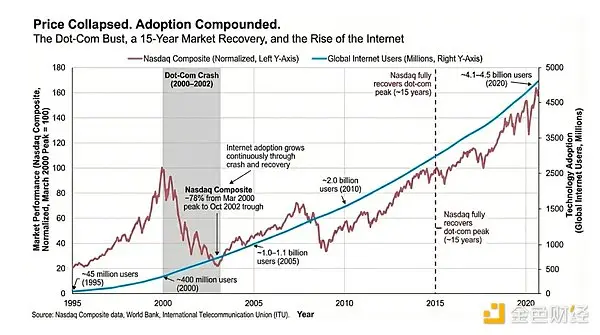
Die Entwicklung grundlegender Technologien wird niemals jene belohnen, die keine Geduld haben.
Infrastrukturverbreitung – Wer profitiert?
Für viele Branchenakteure wird diese Transformation schmerzhaft sein.
Entwickler, die jahrelang an Open-Source-Codebasen gearbeitet haben, werden zusehen müssen, wie Unternehmen ihre Ergebnisse kopieren und den Großteil der wirtschaftlichen Vorteile einstreichen; lokale Risikokapitalgeber, die frühzeitig in Krypto-Infrastruktur investiert haben, werden feststellen, dass die traditionellen Risikokapitalgeber in Silicon Valley mehr Wert abgreifen; Kleinanleger, die Token statt Aktien gekauft haben, fühlen sich isoliert, wenn Unternehmen mit Krypto-Netzwerken Gewinne erzielen, aber kaum an die Token-Inhaber zurückgeben.
Diese Situation ist teilweise auf strukturelle Probleme der Branche zurückzuführen, teilweise auf die eigenen Folgen des Branchenwachstums.
Doch die Kryptoindustrie passt sich aktiv an. Die Evolution offener Systeme ist stets rasant, Anreizmechanismen werden kontinuierlich verbessert, Wertschöpfungsketten zunehmend optimiert. Doch leider werden nicht alle Geschäftsmodelle die Früchte dieser Entwicklung ernten können.
Der Fortschritt bei der Anwendung ist bereits im Gange, auch wenn der Markt derzeit kaum darauf achtet. Vielleicht braucht es noch Jahre, bis die Branche die Logik neu ordnet und Krypto-Technologien als Kernbetriebssystem betrachtet, nicht nur als spekulative Assetklasse.
Preis- und Anwendungszyklen sind nicht synchron
Preise werden durch Marktstimmung und Liquidität getrieben, Anwendungen durch technische Praktikabilität und Infrastrukturentwicklung.
Obwohl sie verbunden sind, sind sie nicht im gleichen Takt. Historisch gesehen hat die Kryptoindustrie immer die Preise vor den Anwendungen geführt – das ist in frühen Phasen technologischer Revolutionen üblich. Doch jetzt hat sich die Richtung geändert: Die Anwendung setzt den Ton an, die Preise hinken weit hinterher.
Derzeit richten sich die neuen Käufer von Krypto-Assets auf andere Bereiche, Kapital strömt in den KI-Sektor. Dieser Trend könnte noch lange anhalten oder sich bald umkehren – und das liegt außerhalb unserer Kontrolle.
Was wir klar sehen können: Es ist kaum vorstellbar, eine Welt ohne Stablecoins, transparente Finanzkanäle und Echtzeit-Globalabwicklungssysteme zu haben.
Die tiefste Lektion aus den Zyklen der Kryptoindustrie ist, einen Fakt zu akzeptieren: Die Diskrepanz zwischen Anwendung und Preisentwicklung kann viel länger andauern, als vernünftig erscheint; und um den Wert zu vervielfachen, muss man in Zeiten, in denen die Geduld der Mehrheit erschöpft ist, ruhig und rational bleiben.
Dabei ist zu betonen, dass dies kein Aufruf zum „Blindhalten“ ist.
Viele Krypto-Projekte werden es nie wieder schaffen, aufzustehen. Manche haben von Anfang an fatale Schwächen, andere fehlen die Wettbewerbsvorteile, wieder andere wurden längst von den Entwicklern aufgegeben. In Zukunft werden neue Gewinner entstehen, alte Stars verblassen – nur wenige Projekte werden eine echte Trendwende schaffen.
Zurück zur Normalität – der gesunde Weg
Wir treten in eine neue regulatorische und wirtschaftliche Ära ein, die genau die Chance bietet, alte Probleme zu lösen – etwa schwache Wertschöpfung, unzureichende Transparenz, Missverhältnis zwischen Aktien- und Token-Struktur, intransparente Anreizmechanismen.
Wenn die Kryptoindustrie so werden will, wie sie es sich erträumt, muss sie sich an den Standards einer reifen Branche messen lassen.
Ich betrachte die Dinge mit einer Wahrscheinlichkeits-Perspektive. Meine sicherste Einschätzung ist: In den nächsten 15 Jahren werden die meisten Unternehmen Krypto-Technologien aktiv einsetzen, um wettbewerbsfähig zu bleiben. Wenn dieser Punkt erreicht ist, wird die Marktkapitalisierung der Kryptoindustrie 10 Billionen US-Dollar übersteigen. Stablecoins, Asset-Tokenisierung, Nutzerzahlen und On-Chain-Aktivitäten werden exponentiell wachsen. Gleichzeitig wird das Bewertungsmodell der Branche neu kalibriert, alteingesessene Unternehmen könnten scheitern, und Geschäftsmodelle, die von Anfang an keinen Sinn ergaben, werden entlarvt.
Dies ist der unvermeidliche Weg zu einer gesunden Branche, ein unvermeidlicher Prozess.
Krypto-Technologie sollte „unsichtbar“ werden. Je mehr eine Firma sie nur als Marketing-Gag nutzt, desto fragiler ist ihr Geschäftsmodell. Die wahren Gewinner werden Krypto-Technologie in Geschäftsprozesse, Zahlungssysteme und Bilanzen integrieren. Nutzer merken kaum, dass sie Krypto-Technologie verwenden, profitieren aber von schnelleren Abrechnungen, niedrigeren Betriebskosten und weniger Zwischenstellen.
Die Kryptoindustrie sollte im Alltag unsichtbar werden.
Mit zunehmender Kapitalverknappung, Airdrops, Bedarfssubventionen, ausgeprägten Incentives und Überfinanzierung wird diese Phase enden – das ist ein unvermeidlicher Teil der Geschichte.
Meine Grundüberzeugung ist einfach: Die Beschleunigung bei der Anwendung, die Neubewertung der Kurse, die Rückkehr zu normalen Bewertungen. Die Kryptoindustrie ist eine Langstreckenbahn, aber das bedeutet nicht, dass die gehaltenen Token im Wert steigen.
Wem gehört letztlich der Wert?
Die ersten Vorteile grundlegender Technologien kommen den Verbrauchern zugute – durch niedrigere Preise und bessere Nutzererfahrungen. Die sekundären Nutznießer sind Unternehmen, die durch Upgrades ihrer Betriebssysteme, den Einsatz günstigerer, effizienterer und programmierbarer Infrastruktur Kosten senken und Gewinne steigern.
Diese Logik wirft eine Reihe unangenehmer, aber unvermeidlicher Fragen auf: Visa oder Circle? Stripe oder Ethereum? Robinhood oder Coinbase? In öffentliche Blockchains investieren oder auf Plattformen für Nutzerverkehr setzen? In dezentrale Finanzanwendungen investieren oder in traditionelle Finanzaktien? In dezentrale Infrastrukturprojekte oder in zentrale Infrastrukturaktien? In DeFi-Anwendungen investieren oder in klassische Finanzunternehmen? Oder in dezentrale Infrastrukturprojekte?
Das ist keine Entweder-oder-Entscheidung, sondern es können alle Wege gemeinsam Erfolg haben. Entscheidend ist der relative Wert und die relative Überrendite – wer kann den Wertüberschuss der Blockchain-Technologie wirklich erfassen?
Mein Ansatz ist: Die Unternehmen, die offene Abwicklungssysteme integrieren, um Kosten zu senken und Gewinne zu steigern. Erfahrung zeigt, dass solche Unternehmen oft mehr profitieren als die Infrastrukturprovider selbst.
Natürlich gibt es Ausnahmen.
Was ich glaube – und was nicht
Ich bin überzeugt, dass Netzwerke mit echten Bedürfnissen letztlich kommerziell erfolgreich sein werden. Die Entwicklung des Internets hat das längst bewiesen – Facebook hat Jahre gebraucht, um kommerziell zu werden.
Ich bin überzeugt, dass einige öffentliche Blockchains auf eine Bewertung kommen, die ihrer Größe entspricht; aber ich glaube auch, dass die meisten öffentlichen Blockchains kaum genug Nutzer anziehen werden, um ihre Existenz zu rechtfertigen.
Ich bin sicher, dass die Kluft zwischen Arm und Reich in der Branche weiter wachsen wird. Transparenz wird entscheidend sein, und Kanäle, Marktdurchdringung, Nutzerbindung und wirtschaftliche Effizienz werden viel wichtiger sein als der erste Vorteil.
Ein fataler Irrtum der Branche ist, den Einfluss früher technischer Überlegenheit zu überschätzen und alle anderen Faktoren zu unterschätzen.
Realistisch bleiben, die richtige Position finden
In den nächsten Jahren werde ich keine allzu hohen Erwartungen an die Preisentwicklung von Krypto-Assets haben. Die praktische Umsetzung wird weiter voranschreiten, aber die Kurse könnten weiter fallen – falls die Aktienmärkte insgesamt eine Rückkehr zum Mittelwert vollziehen oder die KI-Hype-Blase platzt, könnte die Lage für Kryptowährungen noch verschärft werden.
Geduld ist die größte Stärke.
Mein Investment-Standpunkt ist klar:
- Bullish für Krypto-als-Service
- Bullish für Krypto-gestützte Unternehmen
- Bearish für überfinanzierte Projekte
- Bearish für Projekte mit schlechter wirtschaftlicher Effizienz
- Bearish für Infrastrukturprojekte, die vor der tatsächlichen Nachfrage entstehen
Kapitalschutz ist essenziell. Der Wert von Bargeld wird stark unterschätzt – er liegt nicht in der Rendite, sondern im psychologischen Schutz, den es bietet. Wenn andere durch Liquiditätsengpässe gezwungen sind, auszusteigen, haben diejenigen mit Bargeld die Chance, strategisch zu agieren.
Der Markt verändert sich immer schneller, die Investoren werden immer ungeduldiger. Schon allein eine längere Perspektive als die meisten Marktteilnehmer zu haben, ist ein echter Vorteil. Professionelle Fondsmanager müssen ständig Positionen anpassen, um ihre Existenz zu rechtfertigen; Privatanleger verlieren sich zunehmend in der Jagd nach Markttrends in einer verschärften Liquiditätskrise; Institutionelle Investoren werden erneut behaupten, die Krypto-Branche sei endgültig tot.
Gleichzeitig werden immer mehr Unternehmen still und leise Krypto-Systeme integrieren, mehr Bilanzen werden an das 7×24-Stunden-Finanznetzwerk angebunden.
Eines Tages, wenn wir auf diese Zeit zurückblicken, werden wir erkennen, dass alles vorhersehbar war, die Signale überall vorhanden waren. Doch erst wenn die Kurse steigen, wird der Glaube unerschütterlich.
Bis dahin gilt: Geduld haben – auf den Höhepunkt der Panik warten, die Panikverkäufe abschließen, die Glaubenskrieger ihre Verteidigungslinien brechen lassen. Und jetzt ist noch nicht der Moment.
Du musst nicht hasten. Die Kurse schwanken, das Leben geht weiter. Schaffe etwas Wertvolles, verbringe mehr Zeit mit den Menschen, die dir wichtig sind. Lass dein Portfolio nicht dein ganzes Leben bestimmen.
Egal, ob der Markt es bemerkt oder nicht: Die Krypto-Technologie wird sich weiterentwickeln. Viel Glück.


