

Trade
Basic
Futures
Futures
Hundreds of contracts settled in USDT or BTC
Options
HOT
Trade European-style vanilla options
Unified Account
Maximize your capital efficiency
Demo Trading
Futures Kickoff
Get prepared for your futures trading
Futures Events
Participate in events to win generous rewards
Demo Trading
Use virtual funds to experience risk-free trading
Earn
Launch
CandyDrop
Collect candies to earn airdrops
Launchpool
Quick staking, earn potential new tokens
HODLer Airdrop
Hold GT and get massive airdrops for free
Launchpad
Be early to the next big token project
Alpha Points
NEW
Trade on-chain assets and enjoy airdrop rewards!
Futures Points
NEW
Earn futures points and claim airdrop rewards
Investment
Simple Earn
Earn interests with idle tokens
Auto-Invest
Auto-invest on a regular basis
Dual Investment
Buy low and sell high to take profits from price fluctuations
Soft Staking
Earn rewards with flexible staking
Crypto Loan
0 Fees
Pledge one crypto to borrow another
Lending Center
One-stop lending hub
VIP Wealth Hub
Customized wealth management empowers your assets growth
Private Wealth Management
Customized asset management to grow your digital assets
Quant Fund
Top asset management team helps you profit without hassle
Staking
Stake cryptos to earn in PoS products
Smart Leverage
NEW
No forced liquidation before maturity, worry-free leveraged gains
GUSD Minting
Use USDT/USDC to mint GUSD for treasury-level yields

More

Here’s Why Hyperliquid (HYPE) Needs Derivatives Before Wall Street Can Touch It
3h ago
Monero (XMR) Is Back on Top, and the Chart Explains Why
5h ago
Trending Topics
View More9.88K Popularity
14.49K Popularity
29.25K Popularity
12.47K Popularity
153.01K Popularity
Hot Gate Fun
View More- MC:$3.53KHolders:10.00%
- MC:$3.54KHolders:10.00%
- MC:$3.54KHolders:10.00%
- MC:$5.18KHolders:37.91%
- MC:$3.57KHolders:20.04%





Pin
Gate Square New & Returning Creator Rewards are ongoing!
Your ideas may be more valuable than you think!
Make your first post or come back post to share a $20,000 monthly prize pool!
Post with #MyFirstPostOnSquare to receive a $50 Position Voucher each
Monthly Top Posters and Top Engagers will each earn an extra $50 reward
Your crypto insights could inspire many—start creating today!
👉 https://www.gate.com/postGate Square “Creator Certification Incentive Program” — Recruiting Outstanding Creators!
Join now, share quality content, and compete for over $10,000 in monthly rewards.
How to Apply:
1️⃣ Open the App → Tap [Square] at the bottom → Click your [avatar] in the top right.
2️⃣ Tap [Get Certified], submit your application, and wait for approval.
Apply Now: https://www.gate.com/questionnaire/7159
Token rewards, exclusive Gate merch, and traffic exposure await you!
Details: https://www.gate.com/announcements/article/47889Your First Words Matter!
Share your first post on and split $10,000 in New Year rewards.
Post with #My2026FirstPost to share your New Year wish
2026U Position Voucher, Gate New Year boxes, F1 Red Bull merch await you!
Ends on Jan 15, 2026, 16:00 UTC
2026 starts with this post!Gate 2025 Year-End Gala Square TOP50 List Announced!
The final ranking phase is now live.
Earn Votes by watching live streams and posting.
30 Votes = 1 chance — support your favorite creators now!
👉 https://www.gate.com/activities/community-vote-2025
iPhone 17 Pro Max, JD gift cards, Mi Band, Gate merch await you!
Creators are welcome to rally fans to climb the rankings and win rewards!
Voting ends: Jan 20, 02:00 UTC
Details: https://www.gate.com/announcements/article/48693
XRP Rich List: Why Owning 1,000 XRP Is Becoming Out of Reach for Many
What the XRP Rich List Data Shows According to the table shared, XRP ownership remains heavily concentrated in smaller wallets by count, but not by value. Wallets holding between 0 and 500 XRP make up the overwhelming majority of addresses on the network. However, they collectively control only a small fraction of total supply. In contrast, a relatively small number of wallets holding millions or even billions of XRP account for a significant share of the total balance. For example, just 26 wallets hold more than 500 million XRP, while fewer than 100 wallets control balances above 100 million XRP. This type of distribution is not unique to XRP, but the widening gap between wallet counts and wallet value is becoming more visible as prices climb. The discussion is less about manipulation and more about math.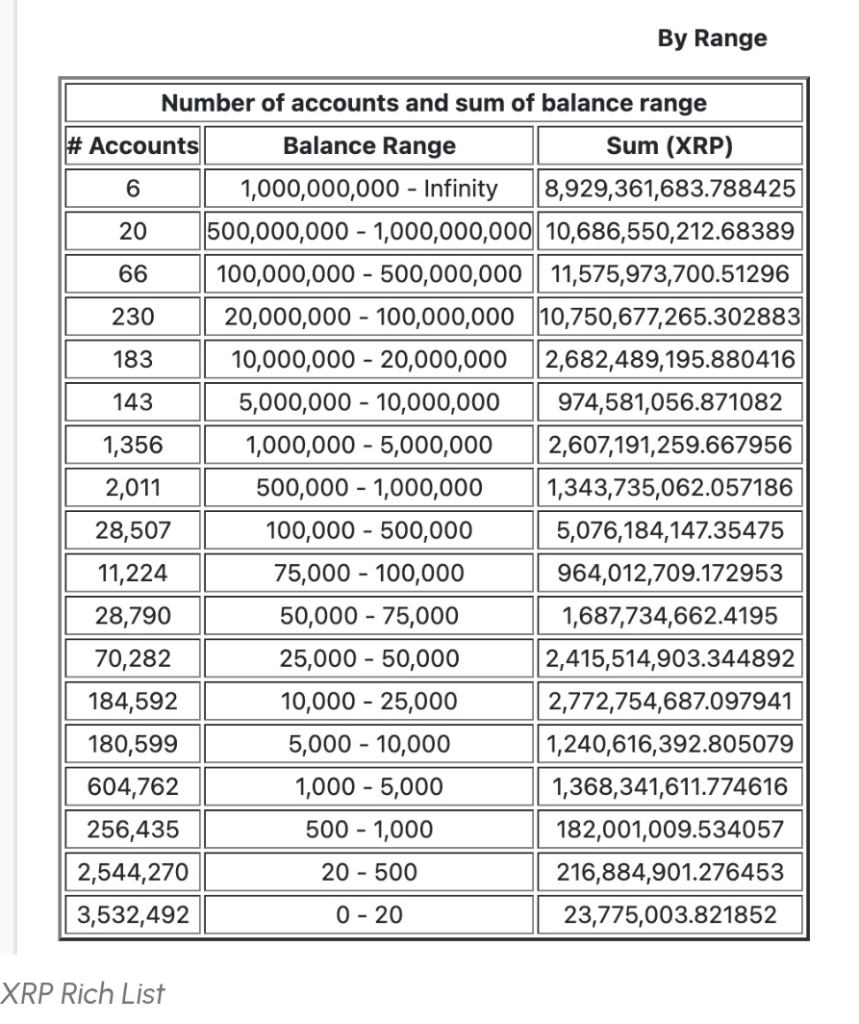
Source: X/@ChartNerdTA
As XRP’s price increases, the number of tokens a new participant can realistically accumulate with the same amount of capital naturally declines. A year ago, $1,000 could buy around 2,000 XRP. Today, that same amount buys closer to 550 XRP. This does not mean retail interest has disappeared, but it does change behavior. Smaller holders may focus on maintaining positions rather than expanding them, while newer entrants may settle for lower XRP targets than those who entered earlier. Is Retail Really Being “Pushed Out”? Some community members argue that retail is being priced out. Others see it differently. From a market structure perspective, rising prices typically favor early adopters and long-term holders. This pattern has played out across Bitcoin, Ethereum, and other large-cap crypto assets. XRP appears to be entering a similar phase, where accumulation becomes harder, but existing holders benefit from appreciation rather than expansion. Importantly, the data does not show mass retail exits. Instead, it suggests slower accumulation at higher price levels, which is a normal shift as assets mature. Read also: XRP Price Drop Raises Questions as Large Exchange Flows Hit Thin Liquidity Bigger Picture for XRP Holders The XRP rich list data highlights a transition phase rather than a breaking point. Retail still dominates in terms of wallet count, while larger holders continue to control supply. As XRP adoption narratives focus more on payments, liquidity, and institutional use cases, ownership distribution may continue to skew this way. For smaller holders, the focus may shift from chasing round numbers like 10,000 XRP to simply holding a position that aligns with their risk tolerance. For larger holders, the data reinforces XRP’s role as a long-term asset rather than a short-term accumulation play. In that sense, the rich list is less a warning sign and more a snapshot of a network growing into its next stage.