Ethereum Domain Name Service ENS cancels Layer-2 Namechain plan, opting to deploy ENSv2 directly on the mainnet. Lead developer nick.eth stated that gas costs have decreased by 99% over the past year, and Fusaka upgrade has raised the gas cap to 60 million, with a target of 200 million by 2026. ENS will focus resources on architectural improvements while maintaining L2 interoperability.
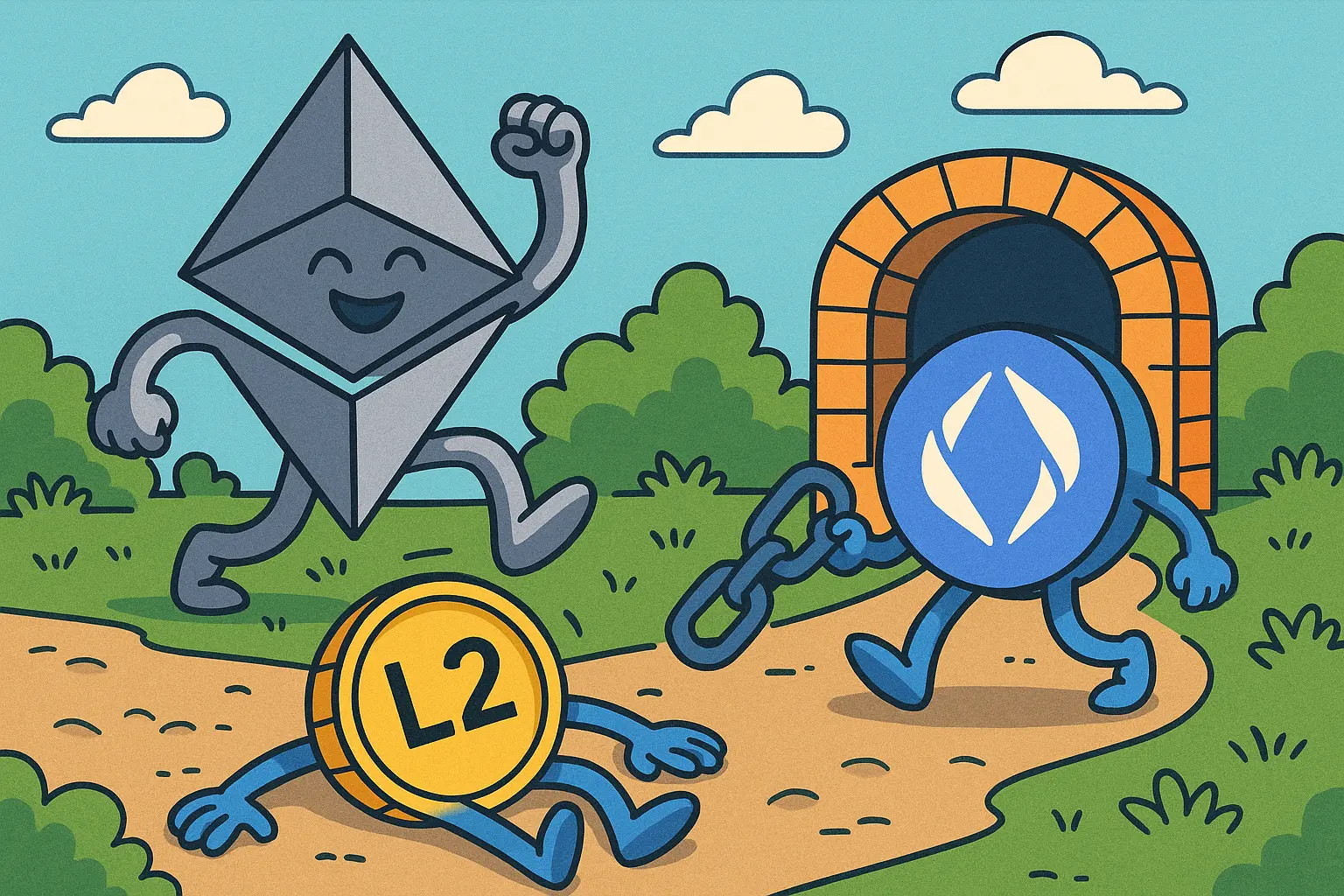
ENS abandons L2 plan as Ethereum scaling exceeds expectations
(Source: ENS)
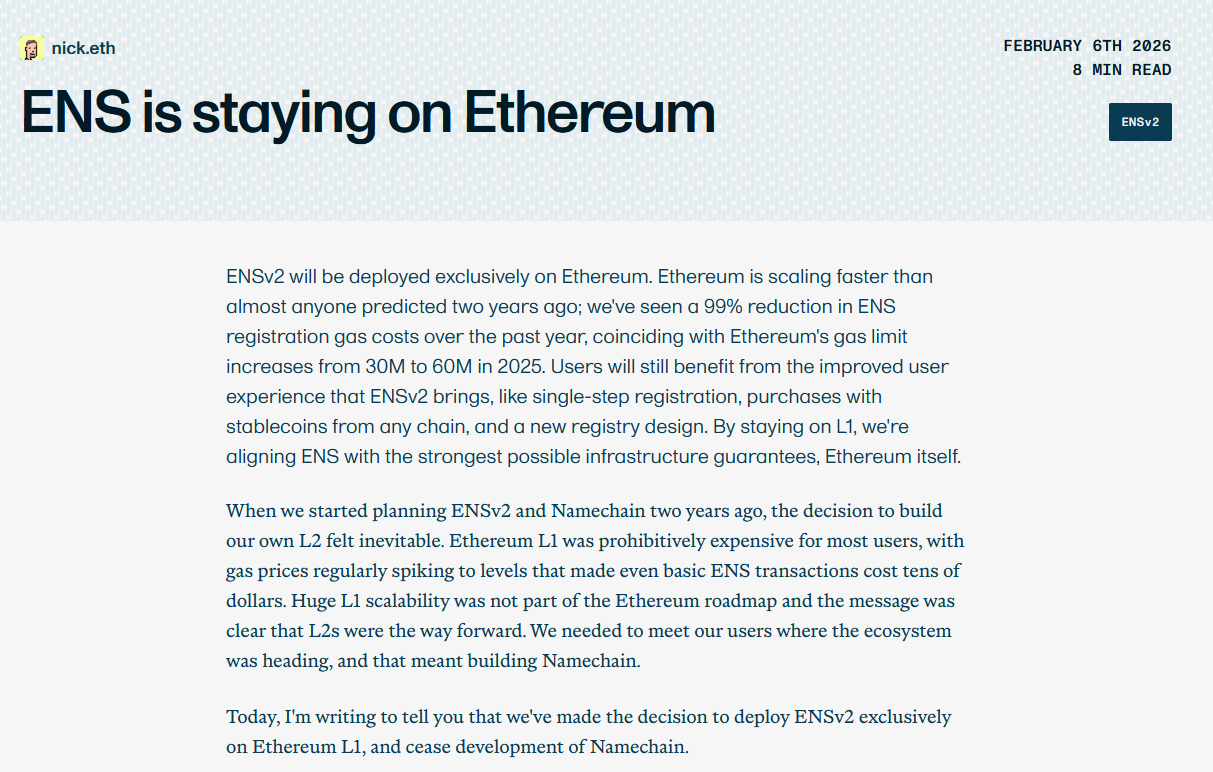
In a Friday blog post, ENS lead developer nick.eth explained that this decision was partly due to a series of significant upgrades to the Ethereum network, which resulted in “a 99% reduction in ENS registration gas costs over the past year.” This dramatic cost reduction has fundamentally changed the technical roadmap decisions for ENS. When the main appeal of Layer-2 solutions is to reduce transaction costs, if Layer-1 costs are already low enough, building and maintaining an additional layer (L2) becomes less justifiable.
“In short: Ethereum L1 is scaling, and the speed of scaling is almost faster than anyone predicted two years ago. The recent Fusaka upgrade increased the gas cap to 60 million, doubling the early 2025 target,” said nick.eth, adding, “Now, Ethereum core developers aim to raise the gas cap to 200 million by 2026, tripling the current limit, and this is before any ZK upgrades are launched.”
Fusaka is one of Ethereum’s recent upgrades, launched in early December 2025. It significantly expanded the capacity of both L1 and L2 ecosystems, reducing gas fees. The upgrade includes multiple technical improvements, such as increasing the gas limit, optimizing execution layer efficiency, and enhancing data availability. The cumulative effect of these improvements has greatly lowered transaction costs on the Ethereum mainnet.
Initially, ENS announced the launch of L2 Namechain in November 2024, stating it would enable users to register domains via aggregated registrations, making domain registration cheaper and easier. At that time, high Ethereum gas fees meant registering and updating ENS domains could cost dozens or even hundreds of dollars. Under those circumstances, building a dedicated L2 for domain operations was a reasonable technical choice.
Nick.eth emphasized that the situation has changed dramatically; now, it can be built directly on L1 instead of choosing a full L2 to reduce costs. “Ethereum’s roadmap does not include large-scale L1 layer expansion, and it’s clear that L2 is the future. We need to meet user demands and follow ecosystem development trends, which means building Namechain,” he reflected on the initial decision logic.
However, Ethereum’s actual development trajectory has exceeded expectations. The substantial increase in gas cap and the effects of various optimizations have made L1 costs and performance sufficient for ENS’s needs. Continuing to push for Namechain now would only add unnecessary complexity and security risks.
With the cancellation of the Namechain plan, ENS will reallocate engineering resources toward core improvements of ENSv2 itself. “Most of our engineering effort is now focused on ENSv2: new registration management architecture, improved ownership models, better expiration handling, and providing flexibility for each name’s independent registration management,” said nick.eth.
The new ENSv2 architecture will bring several key improvements. The new registration management system allows more flexible domain management, enabling developers to define different registration rules and pricing strategies for various domain types. The refined ownership model offers more granular permission controls, allowing domain owners to allocate management, resolution, and transfer rights to different addresses—providing better tools for enterprise applications and DAO governance.
Enhanced expiration handling addresses long-standing pain points. Currently, expired domains have a grace period before entering a public auction, which is not very user-friendly and often results in valuable domains being snatched due to neglect. ENSv2 will introduce more reasonable renewal reminders and grace period mechanisms while maintaining market efficiency.
Providing each name with independent registration management is one of the most revolutionary improvements. This means top-level domains (like .eth, .dao, etc.) can have entirely different registration logic and business models. This flexibility opens the door for diverse ENS ecosystem development and could spawn specialized domain services.
Nick.eth emphasized: “Deciding to continue using L1 does not mean we are abandoning L2 entirely. The flexibility of ENSv2’s architecture makes L2 domains more interoperable. Our new registration process simplifies cross-chain transactions.” This statement indicates that ENS does not dismiss the value of L2 but believes that, given current technical conditions, deploying on L1 is a better choice while maintaining compatibility with L2 ecosystems.
Key improvements of ENSv2
Flexible registration architecture: Different domain types can define varied rules and pricing
Granular ownership model: Management, resolution, and transfer rights can be separated
Improved expiration handling: More user-friendly renewal and grace period mechanisms
Independent registration management: Each top-level domain can have its own business model
L2 interoperability: Simplifies cross-chain domain resolution and registration processes
ENS’s decision shift reflects profound changes in Ethereum’s scaling roadmap. Two years ago, almost everyone believed Ethereum L1 had limited scaling potential, and future growth would depend on L2 solutions. This perception drove rapid development of L2s like Arbitrum, Optimism, and Base, and many projects planned migrations or launched dedicated chains.
However, Ethereum core developers, through a series of technical breakthroughs, have significantly improved L1 performance. Fusaka’s upgrade doubled the gas cap from about 30 million to 60 million. More aggressively, developers aim to raise the gas cap to 200 million by 2026, over three times the current limit. If achieved, Ethereum L1 throughput would reach unprecedented levels.
This acceleration in L1 scaling has deep implications for the entire Ethereum ecosystem. If L1 becomes sufficiently cheap and fast, many applications that planned to migrate to L2 might reconsider staying on L1. This poses a potential challenge to L2 projects, which need to offer value beyond mere cost savings—such as specialized execution environments, privacy features, or deep integration with specific ecosystems.
Recently, Vitalik Buterin questioned the L2 layer model, prompting responses from Arbitrum, Optimism, and Base, each trying to redefine L2’s value. They emphasize that L2 is not just a cost optimization tool but also provides specific functionalities and an independent community. This debate highlights the ongoing philosophical collision in Ethereum’s scaling approach.
Ecological insights from ENS’s decision
ENS’s shift offers important lessons for other Ethereum projects. For projects considering launching or migrating to L2, it’s crucial to reassess the actual costs and performance of L1. If the main motivation is to reduce gas fees, and L1 is already cheap enough, then L2 might not be necessary. This can save significant development and maintenance resources and avoid cross-chain complexity and security risks.
That said, L2 still retains value for applications requiring extremely high throughput, privacy, or deep ecosystem integration. ENS’s case shows that for relatively low-frequency operations like domain registration, L1 is already sufficient.
From a broader perspective, ENS’s decision reflects the maturity and confidence of the Ethereum ecosystem. When L1 scaling succeeds, the ecosystem does not need to sacrifice security and decentralization to lower costs. This “return to L1” trend may appear in other areas, especially for applications with high security and finality requirements.
This page may contain third-party content, which is provided for information purposes only (not representations/warranties) and should not be considered as an endorsement of its views by Gate, nor as financial or professional advice. See Disclaimer for details.
Ethereum scalability wins over Layer 2? ENS abandons Namechain and directly deploys on the mainnet.
Ethereum Domain Name Service ENS cancels Layer-2 Namechain plan, opting to deploy ENSv2 directly on the mainnet. Lead developer nick.eth stated that gas costs have decreased by 99% over the past year, and Fusaka upgrade has raised the gas cap to 60 million, with a target of 200 million by 2026. ENS will focus resources on architectural improvements while maintaining L2 interoperability.
ENS abandons L2 plan as Ethereum scaling exceeds expectations
(Source: ENS)
In a Friday blog post, ENS lead developer nick.eth explained that this decision was partly due to a series of significant upgrades to the Ethereum network, which resulted in “a 99% reduction in ENS registration gas costs over the past year.” This dramatic cost reduction has fundamentally changed the technical roadmap decisions for ENS. When the main appeal of Layer-2 solutions is to reduce transaction costs, if Layer-1 costs are already low enough, building and maintaining an additional layer (L2) becomes less justifiable.
“In short: Ethereum L1 is scaling, and the speed of scaling is almost faster than anyone predicted two years ago. The recent Fusaka upgrade increased the gas cap to 60 million, doubling the early 2025 target,” said nick.eth, adding, “Now, Ethereum core developers aim to raise the gas cap to 200 million by 2026, tripling the current limit, and this is before any ZK upgrades are launched.”
Fusaka is one of Ethereum’s recent upgrades, launched in early December 2025. It significantly expanded the capacity of both L1 and L2 ecosystems, reducing gas fees. The upgrade includes multiple technical improvements, such as increasing the gas limit, optimizing execution layer efficiency, and enhancing data availability. The cumulative effect of these improvements has greatly lowered transaction costs on the Ethereum mainnet.
Initially, ENS announced the launch of L2 Namechain in November 2024, stating it would enable users to register domains via aggregated registrations, making domain registration cheaper and easier. At that time, high Ethereum gas fees meant registering and updating ENS domains could cost dozens or even hundreds of dollars. Under those circumstances, building a dedicated L2 for domain operations was a reasonable technical choice.
Nick.eth emphasized that the situation has changed dramatically; now, it can be built directly on L1 instead of choosing a full L2 to reduce costs. “Ethereum’s roadmap does not include large-scale L1 layer expansion, and it’s clear that L2 is the future. We need to meet user demands and follow ecosystem development trends, which means building Namechain,” he reflected on the initial decision logic.
However, Ethereum’s actual development trajectory has exceeded expectations. The substantial increase in gas cap and the effects of various optimizations have made L1 costs and performance sufficient for ENS’s needs. Continuing to push for Namechain now would only add unnecessary complexity and security risks.
ENSv2 architecture upgrade becomes focus, L2 interoperability retained
With the cancellation of the Namechain plan, ENS will reallocate engineering resources toward core improvements of ENSv2 itself. “Most of our engineering effort is now focused on ENSv2: new registration management architecture, improved ownership models, better expiration handling, and providing flexibility for each name’s independent registration management,” said nick.eth.
The new ENSv2 architecture will bring several key improvements. The new registration management system allows more flexible domain management, enabling developers to define different registration rules and pricing strategies for various domain types. The refined ownership model offers more granular permission controls, allowing domain owners to allocate management, resolution, and transfer rights to different addresses—providing better tools for enterprise applications and DAO governance.
Enhanced expiration handling addresses long-standing pain points. Currently, expired domains have a grace period before entering a public auction, which is not very user-friendly and often results in valuable domains being snatched due to neglect. ENSv2 will introduce more reasonable renewal reminders and grace period mechanisms while maintaining market efficiency.
Providing each name with independent registration management is one of the most revolutionary improvements. This means top-level domains (like .eth, .dao, etc.) can have entirely different registration logic and business models. This flexibility opens the door for diverse ENS ecosystem development and could spawn specialized domain services.
Nick.eth emphasized: “Deciding to continue using L1 does not mean we are abandoning L2 entirely. The flexibility of ENSv2’s architecture makes L2 domains more interoperable. Our new registration process simplifies cross-chain transactions.” This statement indicates that ENS does not dismiss the value of L2 but believes that, given current technical conditions, deploying on L1 is a better choice while maintaining compatibility with L2 ecosystems.
Key improvements of ENSv2
Flexible registration architecture: Different domain types can define varied rules and pricing
Granular ownership model: Management, resolution, and transfer rights can be separated
Improved expiration handling: More user-friendly renewal and grace period mechanisms
Independent registration management: Each top-level domain can have its own business model
L2 interoperability: Simplifies cross-chain domain resolution and registration processes
Ethereum scaling roadmap rewritten, L2 narrative challenged
ENS’s decision shift reflects profound changes in Ethereum’s scaling roadmap. Two years ago, almost everyone believed Ethereum L1 had limited scaling potential, and future growth would depend on L2 solutions. This perception drove rapid development of L2s like Arbitrum, Optimism, and Base, and many projects planned migrations or launched dedicated chains.
However, Ethereum core developers, through a series of technical breakthroughs, have significantly improved L1 performance. Fusaka’s upgrade doubled the gas cap from about 30 million to 60 million. More aggressively, developers aim to raise the gas cap to 200 million by 2026, over three times the current limit. If achieved, Ethereum L1 throughput would reach unprecedented levels.
This acceleration in L1 scaling has deep implications for the entire Ethereum ecosystem. If L1 becomes sufficiently cheap and fast, many applications that planned to migrate to L2 might reconsider staying on L1. This poses a potential challenge to L2 projects, which need to offer value beyond mere cost savings—such as specialized execution environments, privacy features, or deep integration with specific ecosystems.
Recently, Vitalik Buterin questioned the L2 layer model, prompting responses from Arbitrum, Optimism, and Base, each trying to redefine L2’s value. They emphasize that L2 is not just a cost optimization tool but also provides specific functionalities and an independent community. This debate highlights the ongoing philosophical collision in Ethereum’s scaling approach.
Ecological insights from ENS’s decision
ENS’s shift offers important lessons for other Ethereum projects. For projects considering launching or migrating to L2, it’s crucial to reassess the actual costs and performance of L1. If the main motivation is to reduce gas fees, and L1 is already cheap enough, then L2 might not be necessary. This can save significant development and maintenance resources and avoid cross-chain complexity and security risks.
That said, L2 still retains value for applications requiring extremely high throughput, privacy, or deep ecosystem integration. ENS’s case shows that for relatively low-frequency operations like domain registration, L1 is already sufficient.
From a broader perspective, ENS’s decision reflects the maturity and confidence of the Ethereum ecosystem. When L1 scaling succeeds, the ecosystem does not need to sacrifice security and decentralization to lower costs. This “return to L1” trend may appear in other areas, especially for applications with high security and finality requirements.