


#MARAReports1.3BQ1NetLoss
𝐌𝐀𝐑𝐀 𝐑𝐄𝐏𝐎𝐑𝐓𝐒 𝐐𝟏 𝐍𝐄𝐓 𝐋𝐎𝐒𝐒 𝐎𝐅 $𝟏.𝟑𝐁 𝐀𝐒 𝐁𝐈𝐓𝐂𝐎𝐈𝐍 𝐌𝐈𝐍𝐈𝐍𝐆 𝐒𝐇𝐈𝐅𝐓𝐒 𝐈𝐍𝐓𝐎 𝐀𝐍 𝐄𝐍𝐄𝐑𝐆𝐘 𝐀𝐍𝐃 𝐀𝐈 𝐄𝐑𝐀
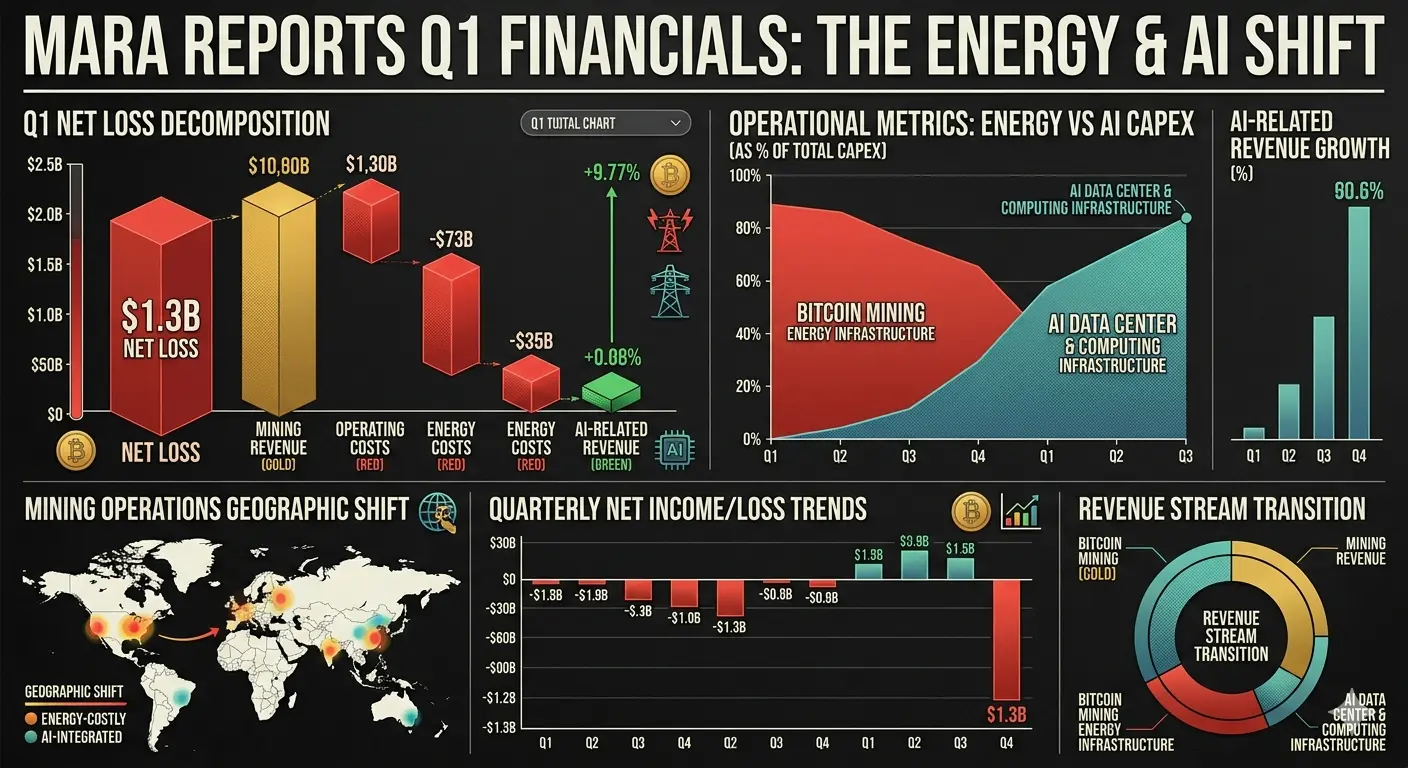
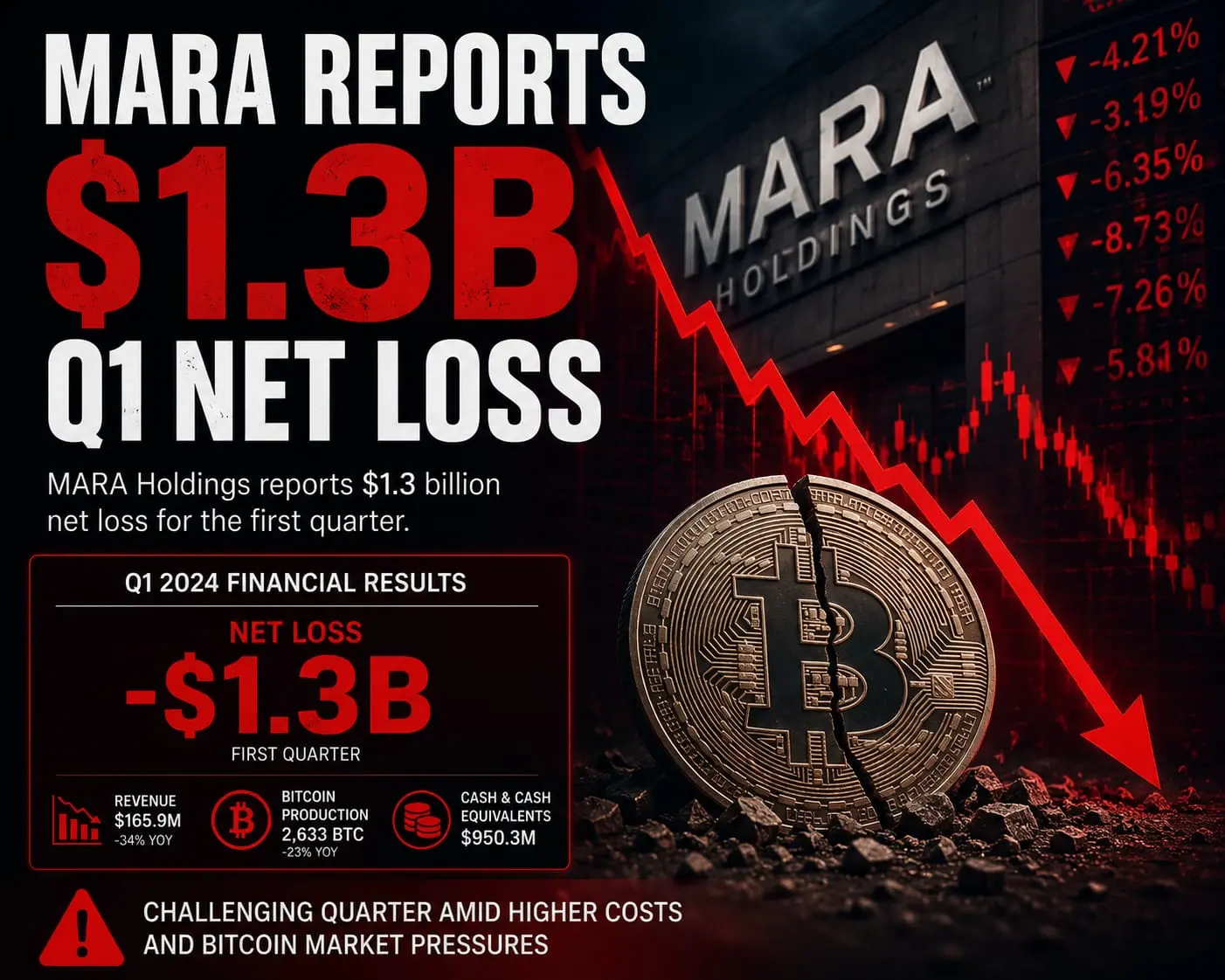
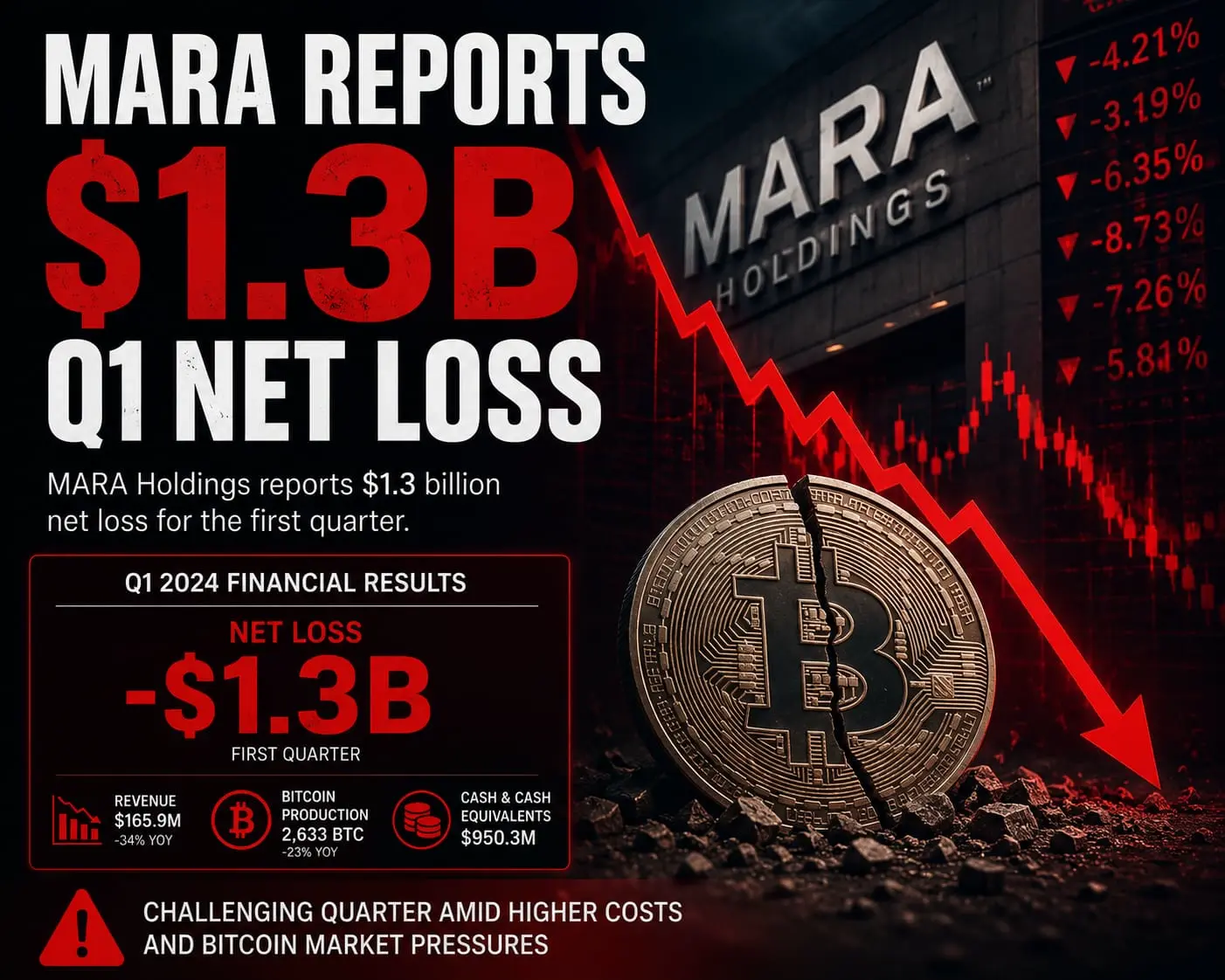
MARA’s latest Q1 financial report reflects one of the most volatile and structurally important quarters ever seen in the Bitcoin mining sector, highlighting both the fragility and transformation of large-scale mining operations in a rapidly changing macro and crypto environment. The company reported revenue of 174.6 million US dollars, but at the same time recorded a staggering net loss of 1.3 billion US dollars, a dramatic widening compared to the 533.4 million US dollar loss in the same period last year. This divergence between operational revenue and net profitability underscores how heavily mining firms are exposed not only to mining economics but also to Bitcoin price volatility and balance sheet accounting effects.
A major contributor to the massive quarterly loss was a 1 billion US dollar fair value reduction on digital assets, driven by Bitcoin’s approximate 22 percent decline during the quarter. Because MARA holds a large amount of Bitcoin on its balance sheet, changes in BTC price directly affect reported financial performance. When Bitcoin drops, the value of holdings is marked down, creating large paper losses even if the underlying coins are not sold. This accounting structure makes mining companies extremely sensitive to macro-driven crypto cycles, especially during correction phases.
On the operational side, MARA mined 2,247 BTC during the quarter, but at an average production cost of approximately 76,288 US dollars per Bitcoin, which is notably high relative to market prices during weaker phases. This cost structure reflects increasing mining difficulty, rising energy prices in certain regions, hardware depreciation, and competition within the global hash rate network. When production cost approaches or exceeds market price, margins compress sharply, forcing miners to rely more heavily on treasury reserves or asset sales to maintain liquidity.
During the same period, MARA also sold 20,880 BTC at an average price of 70,137 US dollars, indicating active balance sheet management and liquidity strategy adjustments. The decision to sell a significant portion of holdings at prices below production cost suggests the company was managing operational expenses, debt obligations, or strategic capital allocation rather than purely holding for long-term appreciation. This type of behavior is common during volatile or bearish phases, where miners must stabilize cash flow even if it means realizing losses on Bitcoin sales.
Despite these challenges, MARA still maintains a substantial Bitcoin treasury of approximately 35,303 BTC, valued at around 2.4 billion US dollars at current market levels. This reserve remains a critical asset for the company, providing both long-term exposure to Bitcoin price upside and a liquidity buffer during periods of operational stress. However, it also introduces significant balance sheet volatility, as changes in Bitcoin price directly impact reported asset value.
-1300 + 174.6 = -1125.4
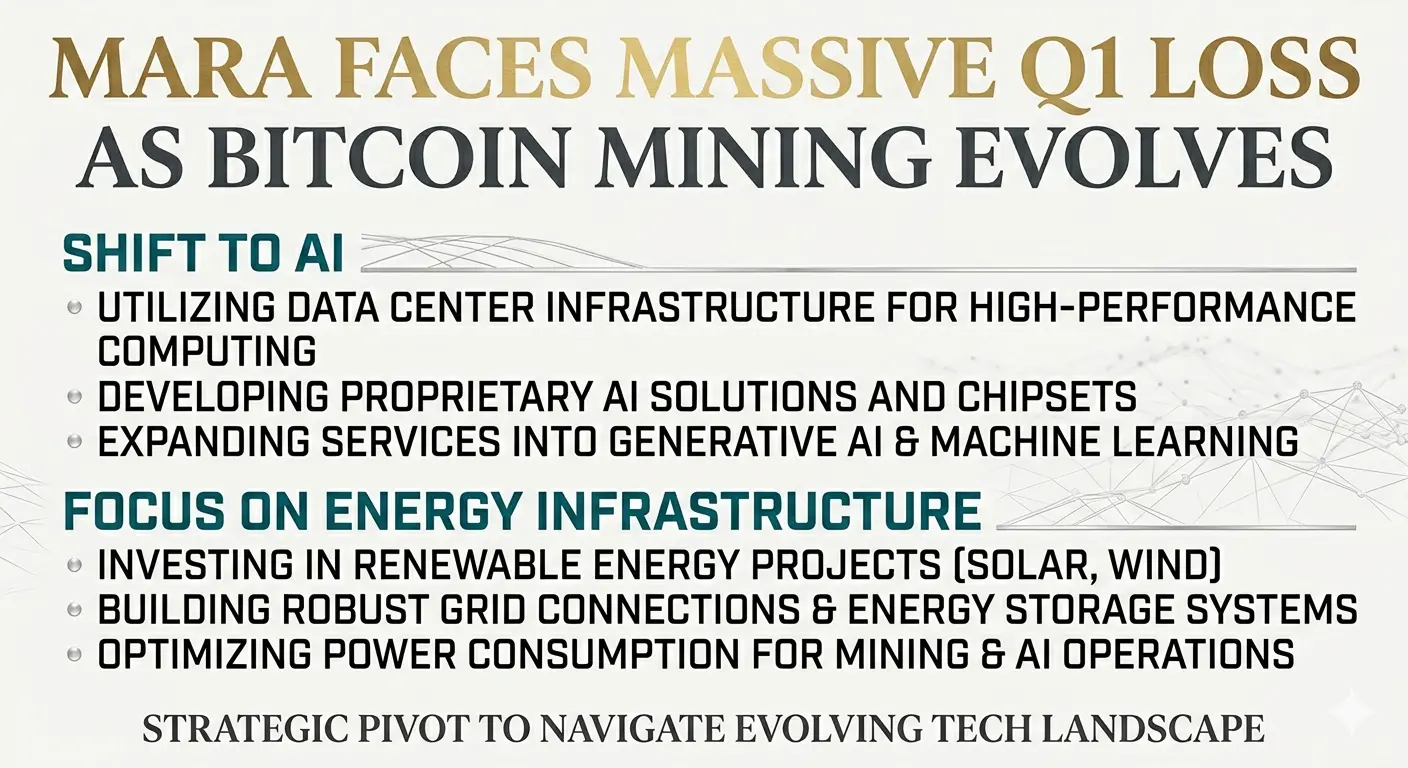
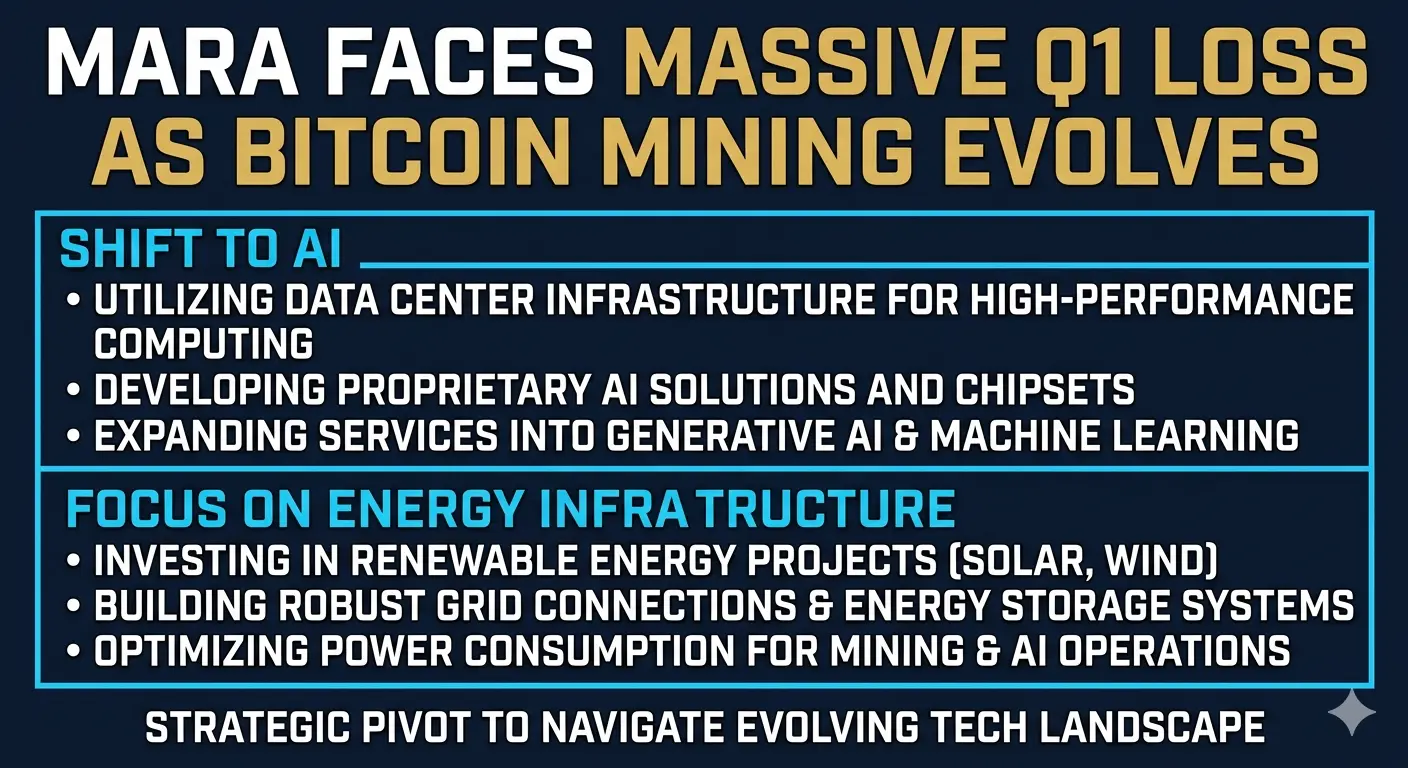
Beyond financial performance, the most important strategic signal from MARA’s report is its explicit shift toward an “energy monetization” model, as highlighted by CEO Frederick Thiel. This represents a fundamental evolution in how mining companies define their business identity. Instead of viewing themselves purely as Bitcoin production entities, companies like MARA are increasingly repositioning as energy infrastructure operators that can flexibly allocate power between crypto mining, AI computing, and industrial data services.
A key component of this transformation is MARA’s acquisition of the Long Ridge power plant, which provides direct control over energy generation and supply. By owning energy infrastructure, the company can reduce reliance on external electricity markets and potentially stabilize long-term operating costs. This move also allows MARA to treat electricity as a monetizable asset rather than just an operational expense, opening the door to diversified revenue streams.
In parallel, MARA is expanding into AI data center infrastructure, aligning itself with one of the fastest-growing sectors in global technology. Artificial intelligence workloads require massive computing power, high-density data centers, and stable energy supply—all areas where large Bitcoin mining operations already have strong infrastructure overlap. This makes mining companies natural candidates for AI infrastructure conversion or hybrid operation models.
The broader implication of this shift is that Bitcoin mining is no longer just a standalone industry. It is increasingly merging with global compute infrastructure, where energy, hardware, and data center capacity become interchangeable resources depending on market demand. This convergence is being driven by two major forces: Bitcoin’s cyclical volatility and the explosive growth in AI compute demand.
From a financial perspective, MARA’s results also highlight how mining companies operate in a high-leverage environment. Small changes in Bitcoin price can lead to outsized impacts on profitability due to fixed operational costs and large asset holdings. When Bitcoin declines, revenue drops while asset impairments increase simultaneously, creating a double pressure effect on earnings.
Another important dimension is the structural challenge of mining cost inflation. As Bitcoin network difficulty rises over time and block rewards continue to halve, miners must continuously upgrade hardware, secure cheaper energy, or improve efficiency just to maintain profitability. Companies that fail to adapt risk falling into unprofitable territory during extended market downturns.
MARA’s pivot toward energy infrastructure and AI computing is therefore not just a growth strategy—it is a defensive survival strategy. By diversifying revenue away from Bitcoin price dependency, the company aims to stabilize cash flow and reduce exposure to crypto market cycles. This is increasingly becoming a common trend among large mining firms globally.
At the same time, holding a large Bitcoin treasury remains a double-edged sword. While it provides upside exposure during bull markets, it also introduces significant volatility in reported earnings during downturns. This forces companies like MARA to constantly balance between accumulation, liquidation, and operational funding requirements.
Overall, MARA’s Q1 report serves as a clear case study of the Bitcoin mining industry’s transformation phase. The sector is evolving from pure hash-rate competition into a broader energy and compute infrastructure ecosystem that includes AI data centers, power plant ownership, and hybrid digital-physical asset monetization.
This transition marks a major structural shift in how mining companies operate, moving them closer to traditional energy and technology infrastructure firms rather than pure crypto-native entities. The success of this transition will likely determine which mining companies survive and thrive in the next cycle of the digital asset economy.
#GateSquareMayTradingShare
𝐌𝐀𝐑𝐀 𝐑𝐄𝐏𝐎𝐑𝐓𝐒 𝐐𝟏 𝐍𝐄𝐓 𝐋𝐎𝐒𝐒 𝐎𝐅 $𝟏.𝟑𝐁 𝐀𝐒 𝐁𝐈𝐓𝐂𝐎𝐈𝐍 𝐌𝐈𝐍𝐈𝐍𝐆 𝐒𝐇𝐈𝐅𝐓𝐒 𝐈𝐍𝐓𝐎 𝐀𝐍 𝐄𝐍𝐄𝐑𝐆𝐘 𝐀𝐍𝐃 𝐀𝐈 𝐄𝐑𝐀
MARA’s latest Q1 financial report reflects one of the most volatile and structurally important quarters ever seen in the Bitcoin mining sector, highlighting both the fragility and transformation of large-scale mining operations in a rapidly changing macro and crypto environment. The company reported revenue of 174.6 million US dollars, but at the same time recorded a staggering net loss of 1.3 billion US dollars, a dramatic widening compared to the 533.4 million US dollar loss in the same period last year. This divergence between operational revenue and net profitability underscores how heavily mining firms are exposed not only to mining economics but also to Bitcoin price volatility and balance sheet accounting effects.
A major contributor to the massive quarterly loss was a 1 billion US dollar fair value reduction on digital assets, driven by Bitcoin’s approximate 22 percent decline during the quarter. Because MARA holds a large amount of Bitcoin on its balance sheet, changes in BTC price directly affect reported financial performance. When Bitcoin drops, the value of holdings is marked down, creating large paper losses even if the underlying coins are not sold. This accounting structure makes mining companies extremely sensitive to macro-driven crypto cycles, especially during correction phases.
On the operational side, MARA mined 2,247 BTC during the quarter, but at an average production cost of approximately 76,288 US dollars per Bitcoin, which is notably high relative to market prices during weaker phases. This cost structure reflects increasing mining difficulty, rising energy prices in certain regions, hardware depreciation, and competition within the global hash rate network. When production cost approaches or exceeds market price, margins compress sharply, forcing miners to rely more heavily on treasury reserves or asset sales to maintain liquidity.
During the same period, MARA also sold 20,880 BTC at an average price of 70,137 US dollars, indicating active balance sheet management and liquidity strategy adjustments. The decision to sell a significant portion of holdings at prices below production cost suggests the company was managing operational expenses, debt obligations, or strategic capital allocation rather than purely holding for long-term appreciation. This type of behavior is common during volatile or bearish phases, where miners must stabilize cash flow even if it means realizing losses on Bitcoin sales.
Despite these challenges, MARA still maintains a substantial Bitcoin treasury of approximately 35,303 BTC, valued at around 2.4 billion US dollars at current market levels. This reserve remains a critical asset for the company, providing both long-term exposure to Bitcoin price upside and a liquidity buffer during periods of operational stress. However, it also introduces significant balance sheet volatility, as changes in Bitcoin price directly impact reported asset value.
-1300 + 174.6 = -1125.4
Beyond financial performance, the most important strategic signal from MARA’s report is its explicit shift toward an “energy monetization” model, as highlighted by CEO Frederick Thiel. This represents a fundamental evolution in how mining companies define their business identity. Instead of viewing themselves purely as Bitcoin production entities, companies like MARA are increasingly repositioning as energy infrastructure operators that can flexibly allocate power between crypto mining, AI computing, and industrial data services.
A key component of this transformation is MARA’s acquisition of the Long Ridge power plant, which provides direct control over energy generation and supply. By owning energy infrastructure, the company can reduce reliance on external electricity markets and potentially stabilize long-term operating costs. This move also allows MARA to treat electricity as a monetizable asset rather than just an operational expense, opening the door to diversified revenue streams.
In parallel, MARA is expanding into AI data center infrastructure, aligning itself with one of the fastest-growing sectors in global technology. Artificial intelligence workloads require massive computing power, high-density data centers, and stable energy supply—all areas where large Bitcoin mining operations already have strong infrastructure overlap. This makes mining companies natural candidates for AI infrastructure conversion or hybrid operation models.
The broader implication of this shift is that Bitcoin mining is no longer just a standalone industry. It is increasingly merging with global compute infrastructure, where energy, hardware, and data center capacity become interchangeable resources depending on market demand. This convergence is being driven by two major forces: Bitcoin’s cyclical volatility and the explosive growth in AI compute demand.
From a financial perspective, MARA’s results also highlight how mining companies operate in a high-leverage environment. Small changes in Bitcoin price can lead to outsized impacts on profitability due to fixed operational costs and large asset holdings. When Bitcoin declines, revenue drops while asset impairments increase simultaneously, creating a double pressure effect on earnings.
Another important dimension is the structural challenge of mining cost inflation. As Bitcoin network difficulty rises over time and block rewards continue to halve, miners must continuously upgrade hardware, secure cheaper energy, or improve efficiency just to maintain profitability. Companies that fail to adapt risk falling into unprofitable territory during extended market downturns.
MARA’s pivot toward energy infrastructure and AI computing is therefore not just a growth strategy—it is a defensive survival strategy. By diversifying revenue away from Bitcoin price dependency, the company aims to stabilize cash flow and reduce exposure to crypto market cycles. This is increasingly becoming a common trend among large mining firms globally.
At the same time, holding a large Bitcoin treasury remains a double-edged sword. While it provides upside exposure during bull markets, it also introduces significant volatility in reported earnings during downturns. This forces companies like MARA to constantly balance between accumulation, liquidation, and operational funding requirements.
Overall, MARA’s Q1 report serves as a clear case study of the Bitcoin mining industry’s transformation phase. The sector is evolving from pure hash-rate competition into a broader energy and compute infrastructure ecosystem that includes AI data centers, power plant ownership, and hybrid digital-physical asset monetization.
This transition marks a major structural shift in how mining companies operate, moving them closer to traditional energy and technology infrastructure firms rather than pure crypto-native entities. The success of this transition will likely determine which mining companies survive and thrive in the next cycle of the digital asset economy.
#GateSquareMayTradingShare