Ethereum staking withdrawal queue has surged to a historic third-high, with 2.44 million ETH (worth 1.05 billion USD) locked for 42 days before being unlocked. Analysts warn that this is a systemic flaw, and the risk of stETH depeg could trigger a bank run in DeFi, threatening the 13 billion USD liquid staking market. Vitalik insists this is a secure design; who is right and who is wrong? This article provides an in-depth analysis of the Ethereum staking crisis and the associated risks in DeFi.
Ethereum withdrawal queue hits new high: 2.44 million ETH awaiting unlock
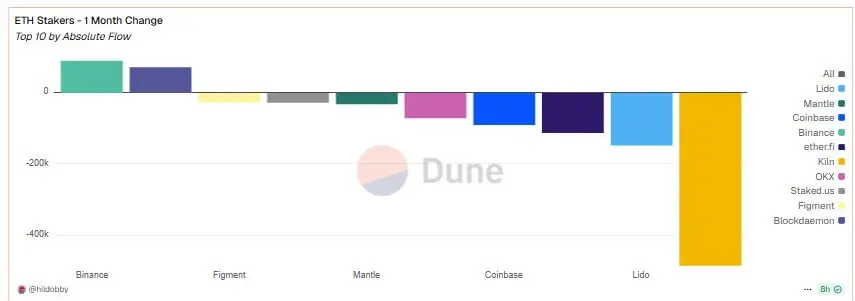
(Source: Dune Analytics)
According to Dune Analytics data, as of October 8, there are over 2.44 million ETH waiting to be withdrawn on the Ethereum network, with a total value exceeding 1.05 billion USD, making it the third highest record this month.
This figure is only second to the peak of 2.6 million ETH on September 11 and 2.48 million ETH on October 5, indicating a sustained high demand for validators to exit. More concerning is that ETH stakers are now facing an average withdrawal delay of 42 days and 9 hours, a phenomenon that has continued to worsen since CryptoSlate first discovered it in July.
Withdrawal Data Overview
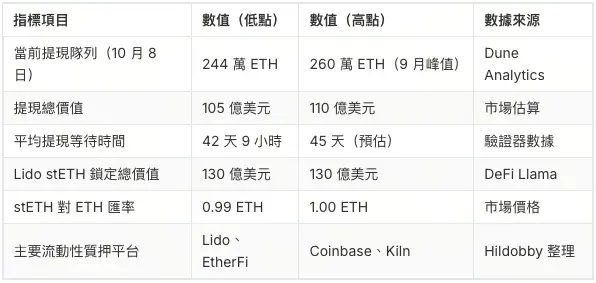
The withdrawal demand is mainly concentrated on leading liquid staking token (LST) platforms, including Lido, EtherFi, Kiln, etc. These services allow users to stake ETH while maintaining liquidity through derivative tokens such as stETH, thus becoming the main source of withdrawal pressure.
Vitalik vs Community: Design Flaw or Security Guarantee?
In response to the community's doubts about the withdrawal delays, Ethereum co-founder Vitalik Buterin made it clear that this is an intentional security mechanism.
Vitalik likens staking to a disciplined form of network service, believing that delayed exits can:
Suppress short-term speculation: prevent validators from frequently entering and exiting, maintaining network stability.
Ensure long-term commitment: Validators must continuously be responsible for the security of the chain.
Enhance system stability: Avoid sudden large-scale exits impacting the network
However, anonymous ecosystem analyst Robdog strongly opposed this, calling the situation a potential “time bomb”. He pointed out that longer exit times would amplify the duration risk for participants in the liquid staking market, which could trigger a vicious cycle.
Systemic Risks in DeFi Emerge: stETH Depeg May Trigger a Chain Reaction
Robdog warns that the withdrawal queue extension could have a huge systemic impact on DeFi, the lending market, and the use of LST as collateral.
stETH and other tokens typically trade at a price slightly lower than ETH, reflecting redemption delays and protocol risks. However, as the validator queue grows, these discounts will further widen:
· Price depeg mechanism:
Normal situation (45 days waiting period): stETH trading price 0.99 ETH, arbitrage annualized yield approximately 8%
Delay intensifies (90-day waiting period): Purchase motivation drops to 4%, peg gap widens.
Liquidity shock: Large-scale deleveraging events may force rapid unwinding of leverage, driving up borrowing rates.
· DeFi Chain Risk:
Collateral Crisis: stETH is widely used as collateral in protocols like Aave, and price deviations can affect the entire ecosystem.
Leveraged Cycle Collapse: Lido stETH locks up $13 billion, most of which is linked to leveraged positions.
Bank run risk: If an event similar to Terra/Luna or FTX occurs, a large demand for ETH withdrawals will encounter a limited amount available for withdrawal.
“If the exit period for an asset is extended from 1 day to 45 days, it is no longer the same asset,” Robdog emphasizes.
Solutions and Risk Management Recommendations
Analysts proposed the following countermeasures:
-
Upgrade and exit queue throughput: Even if the throughput is increased by 100%, there is still enough collateral to ensure network security
-
Strengthen the risk management framework: The treasury and lending markets need to address the growing duration risk.
-
Pricing considerations for term discounts: Developers should incorporate exit time costs when pricing collateral.
-
Monitor liquidity indicators: Closely track the exchange rate of stETH to ETH and changes in borrowing rates.
Disclaimer: The information on this page may come from third parties and does not represent the views or opinions of Gate. The content displayed on this page is for reference only and does not constitute any financial, investment, or legal advice. Gate does not guarantee the accuracy or completeness of the information and shall not be liable for any losses arising from the use of this information. Virtual asset investments carry high risks and are subject to significant price volatility. You may lose all of your invested principal. Please fully understand the relevant risks and make prudent decisions based on your own financial situation and risk tolerance. For details, please refer to
Disclaimer.
Related Articles
Still complaining about high on-chain fees? Ethereum Gas drops to $0.01, hitting an all-time low
Recently, Ethereum's average Gas price has dropped to approximately 0.045 Gwei, with transaction fees significantly reduced. With the growth of Layer2 scaling technology and multiple upgrades driving improvements, Ethereum's transaction fees have declined over 90% from their peak. Despite ongoing market price pressure, activity in the Ethereum ecosystem remains undiminished, with usage demand still strong, pushing overall transaction costs below traditional bank transfers.
区块客19m ago
In the past 24 hours, liquidations across the network reached $392 million, with short position liquidations accounting for over 60%.
Gate News, on March 17th, according to CoinAnk data, the entire network liquidated $392 million in the past 24 hours. Among these, long positions liquidated approximately $144 million, short positions liquidated approximately $248 million, with short position liquidations accounting for 63% of the total. By cryptocurrency, Bitcoin liquidations were approximately $147 million, and Ethereum liquidations were approximately $115 million.
GateNews19m ago
Ethereum Repeats Historic Pattern: Could Cycle Three Trigger Another Massive Rally?
Ethereum cycles repeat: consolidation, trendline retest, then major expansion phases.
The current cycle shows smaller returns, reflecting Ethereum’s growing market maturity.
$2K support remains critical for confirming continuation of the third cycle.
Ethereum’s ETH is printing a
CryptoNewsLand47m ago
An institution-linked whale increased its long position by 6,000 ETH near $2,300 for ETH.
A certain crypto financial institution increased its ETH long position by 6,000 ETH when the price pulled back near $2,300, bringing the total position value to $82.95 million with floating profits of approximately $9.4 million, yielding a return rate of 169%. The institution is the largest ETH bull on-chain, with affiliated addresses also holding substantial amounts of ETH.
GateNews1h ago
Bitcoin Spot ETF Saw $760 Million in Inflows Last Week! But Whether the Rally Continues Requires Monitoring 3 Key Factors
US cryptocurrency spot ETFs showed a significant rebound last week, with Bitcoin and Ethereum recording net inflows of approximately $763.4 million and $160.9 million respectively, with prices bouncing back accordingly. Although the market is showing incremental buying signals, it still faces variables from central bank policies and geopolitical risks in the future. The market will continue to monitor ETF capital inflows and macroeconomic impacts.
CryptoCity1h ago


