Author: Haonan
Article compiled by: Block Unicorn
Introduction
The global unsecured consumer credit market users are like fat sheep of modern finance—slow to act, lacking judgment, and lacking mathematical ability.
When unsecured consumer credit shifts to the stablecoin track, its operational mechanism will change, and new participants will have the opportunity to share the pie.
Market Size
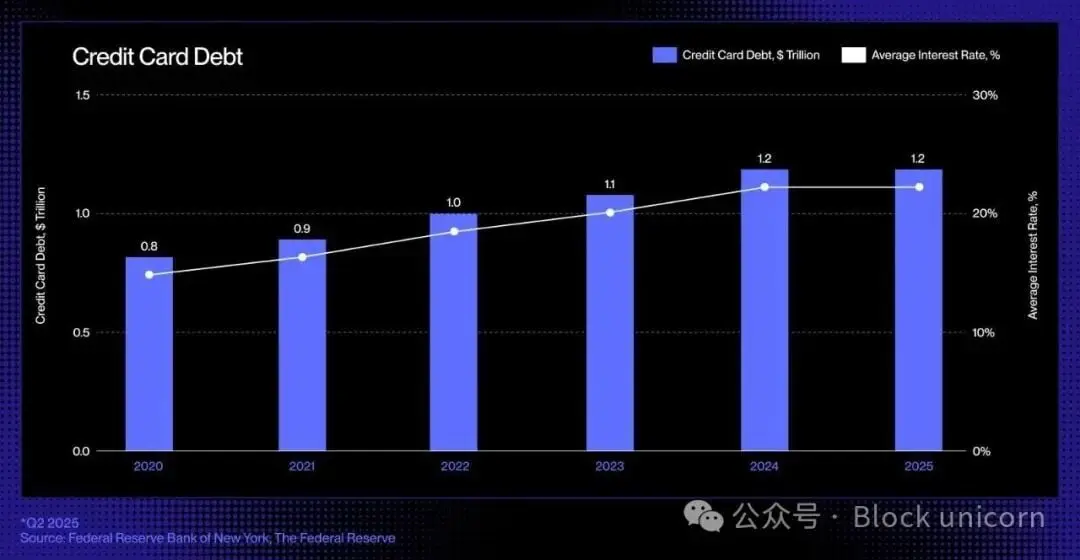
In the United States, the primary form of unsecured lending is credit cards: this ubiquitous, highly liquid, and instant credit tool allows consumers to borrow without providing collateral during shopping. Unpaid credit card debt continues to grow, currently reaching approximately $1.21 trillion.
Outdated Technology
The last major transformation in the credit card lending field occurred in the 1990s when Capital One introduced risk-based pricing, a breakthrough that reshaped consumer credit. Since then, despite the emergence of new banks and fintech companies, the structure of the credit card industry has remained largely unchanged.
However, the emergence of stablecoins and on-chain credit protocols has provided a new foundation: programmable currency, transparent markets, and real-time funds. They are expected to ultimately break this cycle, redefining how credit is generated, financed, and repaid in a digital, borderless economy.
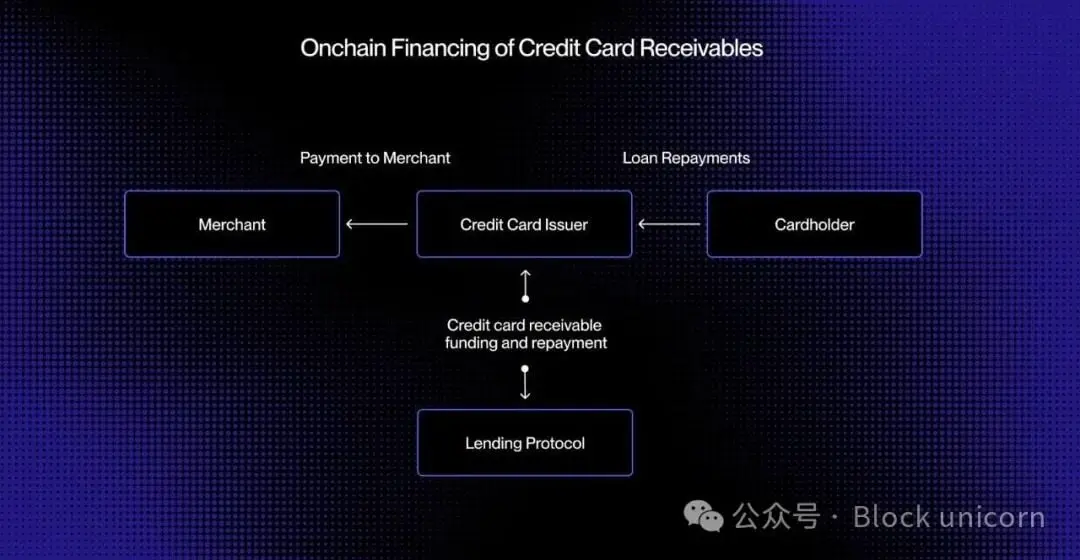
- In today’s card payment systems, there is a time gap between approval (transaction approval) and settlement (the card issuer transferring funds to the merchant via the card network). By moving the funds processing to the blockchain, these receivables can be tokenized and financed in real time.
- Imagine a consumer purchasing a $5,000 item. The transaction is immediately approved. Before settlement with Visa or Mastercard, the card issuer tokenizes the receivables on-chain and receives $5,000 USDC from a decentralized credit pool. After settlement, the issuer sends these funds to the merchant.
- Later, when the borrower repays, the repayment amount is automatically returned to the on-chain lender via smart contracts. Similarly, the entire process is conducted in real time.
This approach enables real-time liquidity, transparent funding sources, and automatic repayments, reducing counterparty risk and eliminating many manual processes still present in today’s consumer credit.
From Securitization to Funding Pools
For decades, the consumer credit market has relied on deposits and securitization to enable large-scale lending. Banks and credit card issuers bundle thousands of receivables into asset-backed securities (ABS) and sell them to institutional investors. This structure provides ample liquidity but also introduces complexity and opacity.
Lending platforms like Affirm and Afterpay have demonstrated the evolution of credit approval processes. They no longer offer universal credit limits but instead review each transaction at the point of sale, differentiating between a $10,000 sofa and a $200 pair of sneakers.
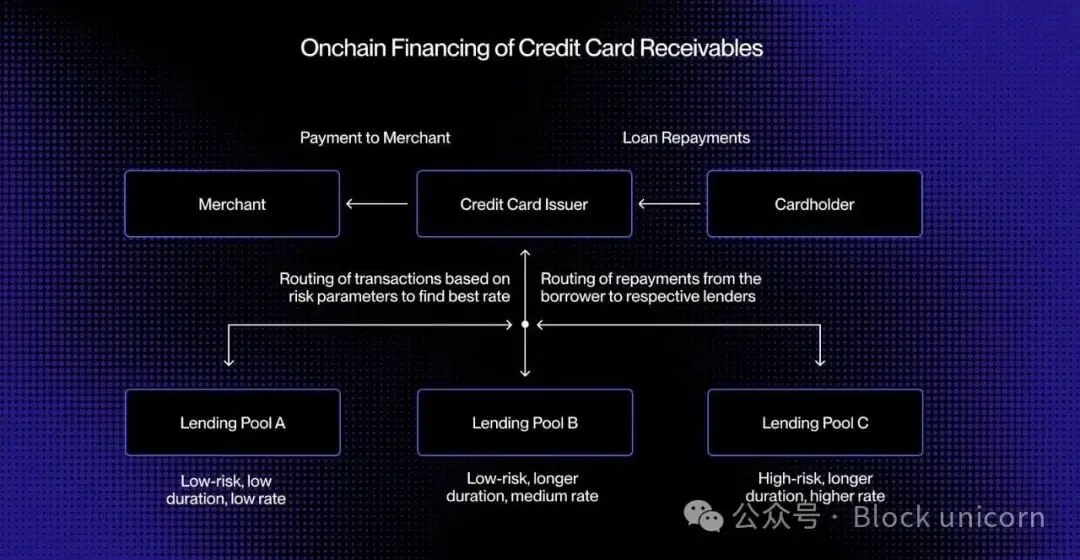
- This transaction-level risk control produces standardized, divisible receivables, each with clear borrower, term, and risk profile, making them ideal for real-time matching through on-chain lending pools.
- On-chain lending can further expand this concept by creating dedicated credit pools around specific borrower groups or purchase categories. For example, one credit pool could fund small transactions for high-quality borrowers, while another could serve subprime consumers with travel installment plans.
- Over time, these funding pools could evolve into targeted credit markets, enabling dynamic pricing and providing transparent performance metrics for all participants.
This programmability opens the door to more capital-efficient allocation, better interest rates for consumers, and the creation of an open, transparent, and instantly auditable global unsecured consumer credit market.
Emerging On-Chain Credit Stack
Reimagining unsecured lending for the on-chain era is not just about transplanting credit products onto blockchain but fundamentally rebuilding the entire credit infrastructure. Beyond issuers and processors, the traditional lending ecosystem relies on a complex network of intermediaries:
- We need new credit scoring methods. Traditional credit scoring systems, such as FICO and VantageScore, could be adapted for blockchain, but decentralized identification and reputation systems might play a larger role.
- Lending institutions will also require credibility assessments, akin to ratings by S&P, Moody’s, or Fitch, to evaluate approval quality and repayment performance.
- Finally, the less conspicuous but crucial aspects of debt collection also need improvement. Debt denominated in stablecoins still requires enforcement mechanisms and recovery processes, combining on-chain automation with off-chain legal frameworks.
Stablecoin cards have bridged the gap between fiat and on-chain consumer spending. Lending protocols and tokenized money market funds are redefining savings and returns. Introducing unsecured credit onto the chain completes this triangle, enabling seamless borrowing and lending for consumers, transparent funding for investors, all driven by open financial infrastructure.
Disclaimer: The information on this page may come from third parties and does not represent the views or opinions of Gate. The content displayed on this page is for reference only and does not constitute any financial, investment, or legal advice. Gate does not guarantee the accuracy or completeness of the information and shall not be liable for any losses arising from the use of this information. Virtual asset investments carry high risks and are subject to significant price volatility. You may lose all of your invested principal. Please fully understand the relevant risks and make prudent decisions based on your own financial situation and risk tolerance. For details, please refer to
Disclaimer.
Related Articles
Circle Moves $68M in USDC to Speed Treasury Settlements
Circle processed $68M in intercompany transfers using USDC across 11 transactions involving eight global entities.
USDC settlements confirmed in under 30 minutes, replacing traditional bank wires that could take up to three days.
Faster settlement reduced cash-in-transit exposure and
CryptoFrontNews2h ago
CRCL Stock Rises as Oil Spike and USDC Activity Lift Circle Shares
Key Insights
Rising oil prices and inflation concerns lifted Treasury yields, increasing revenue potential for Circle as USDC reserves remain invested in U.S. Treasury securities.
USDC transaction activity surged during market volatility, surpassing USDT in monthly volume and highlighting
CryptoFrontNews4h ago
$USDT and $USDC Dominate Top Stablecoins By Market Capitalization
The essay discusses the market capitalization of stablecoins, highlighting Tether ($USDT) as the dominant player with a market cap of $183.9B, representing 58.58% of the total stablecoin market. It lists other significant stablecoins and their market positions, noting the total stable market cap is $320.06B.
BlockChainReporter6h ago
The USDC Treasury has minted a total of 500 million USDC twice on the Solana chain.
Gate News Report, on March 10, at 23:36 and 23:41 Beijing time, according to Whale Alert monitoring, USDC issuer USDC Treasury minted an additional 250 million USDC on the Solana chain, totaling 500 million USDC minted in two transactions (worth approximately $500 million).
GateNews7h ago
Bernstein is optimistic about Circle with a 70% increase! The target price is set at $190, with a positive outlook on stablecoins as AI and payment infrastructure.
Wall Street investment firm Bernstein's latest report is bullish on USDC issuer Circle, with a target price of $190 and an expected potential increase of 70%. As stablecoins become more widespread in cross-border payments and future AI applications, Circle is poised to become a key infrastructure for the next generation of online finance. The adoption of stablecoins shows strong growth, especially in the payments sector.
動區BlockTempo10h ago
Bernstein maintains Circle's outperform rating with a target price of $190, indicating a 70% upside potential.
Analyst Bernstein maintains a bullish outlook on stablecoin issuer Circle, with a target price of $190, expecting a 70% increase. The analysis points out that stablecoins are gradually decoupling from the crypto market, with USDC supply rebounding to approximately $78 billion, and the total stablecoin supply reaching $184 billion.
GateNews11h ago


