For many years, the common assumption in both the crypto and traditional finance communities has been simple: as the adoption of financial institutions matures, Ethereum will be the blockchain chosen by Wall Street.
This is not too surprising, as Ethereum is currently the largest smart contract network, the default environment for developers, and it is also the ecosystem that shapes the concept of programmable finance today.
However, as efforts to tokenize institutional assets accelerate, a new question arises in mainstream discussions: what will happen if the chain that organizations ultimately rely on is not Ethereum, but Solana?
This scenario is still speculative, but its consideration reflects a change in the way the current market infrastructure is assessed.
The image of Solana is transforming
In the early days, Solana (SOL) was closely associated with retail speculation. Low fees, high processing speed, and ease of deployment made it an ideal place for memecoins, fast trading, and experimental products. For most of its existence, this chaotic environment shaped the cultural brand of the network.
However, those very characteristics – near-instant processing speed, transaction fees close to 0, and high performance – which once fueled the speculative frenzy, are now being reshaped into the foundation for institutional-level transactions.
According to data from Solscan, Solana can process over 3,000 transactions per second at an average cost of less than half a cent, while Ethereum is still limited at the base layer and has to rely on rollups to increase throughput and manage costs.
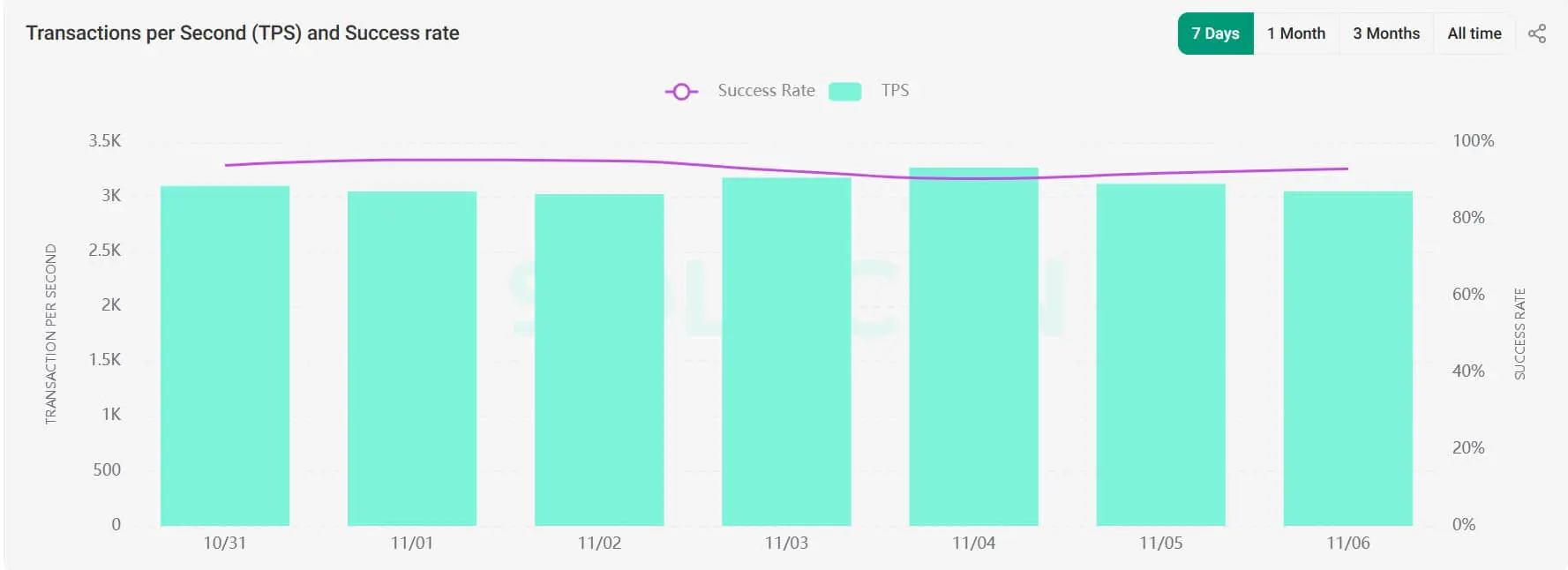 *Solana transactions per second (Source: Solscan)*This performance has attracted the attention of analysts tracking the intersection between blockchain and traditional capital markets.
Matt Hougan, CIO of Bitwise, recently described Solana as the “new Wall Street,” arguing that Solana's low-latency execution model aligns better with institutional processes compared to other multifunctional options. At the same time, stablecoin issuers and tokenization companies are developing increasingly sophisticated products on this network, further reinforcing that argument.
The reality is still far from ambition
Currently, Solana only performs an average of about 284 “transactions” per second in the sense of value transfer orders initiated by users, which is much lower than the theoretical number. Meanwhile, Nasdaq executes about 2,920 transactions per second and handles approximately $463 billion in daily volume, compared to about $6 billion for Solana.
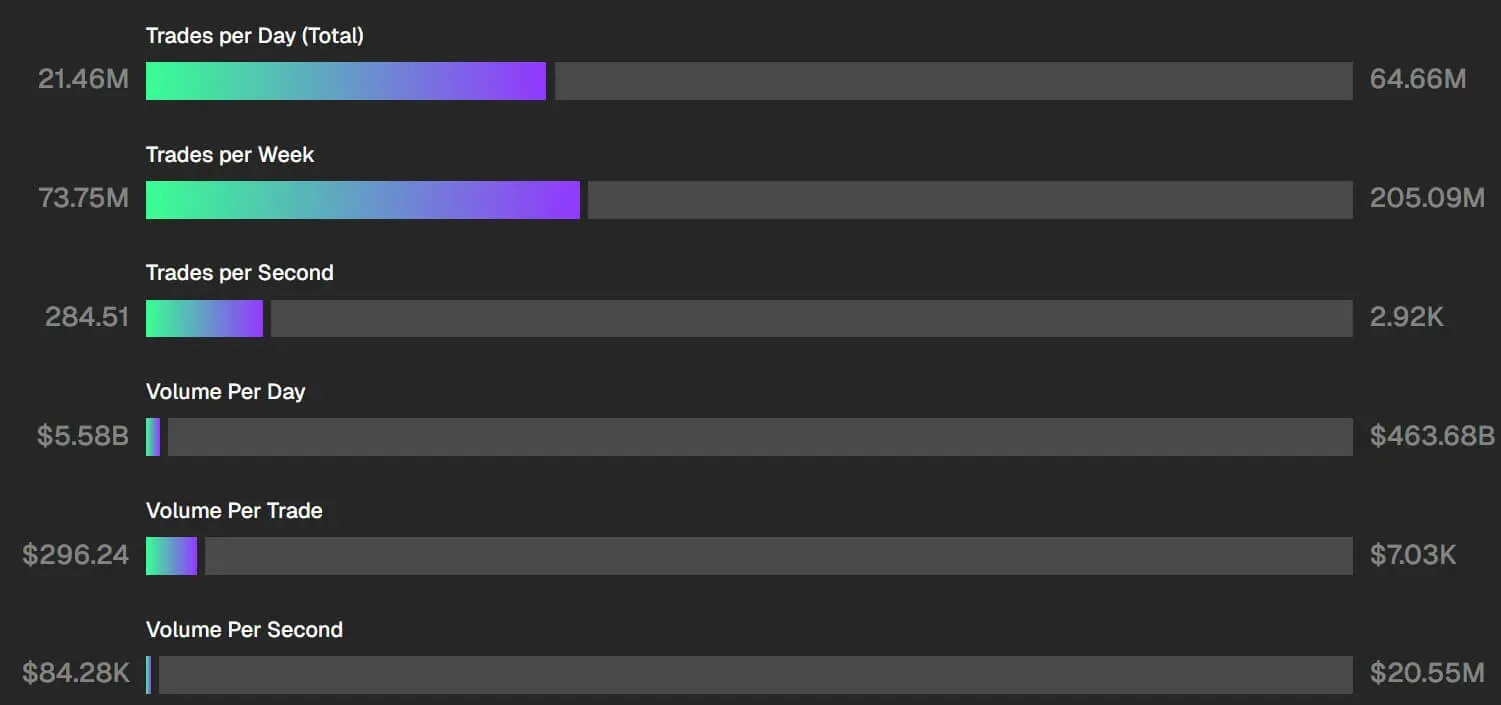 *Compare the key indicators of Solana and Nasdaq. (Source: FliptheNasdaq)*The gap in economic density between the two platforms is still very large.
However, Solana developers stated that the upcoming upgrades will optimize validator performance, improve scheduling, and reduce block conflicts – advancements that could bring the network closer to the reliability required by market infrastructure. While it is uncertain whether this will be achievable, this ambition reflects a clear strategy: Solana not only wants to be a fast blockchain but also aims to become a powerful “execution engine” capable of supporting regulated financial activities on a large scale.
Galaxy Research states:
“Solana is moving towards a unified vision of the 'Internet Capital Market', a system capable of supporting the entire digital financial activity, from retail speculation and consumer applications to enterprise infrastructure and tokenized real assets.”
The potential value of Solana if Wall Street places its trust
The question about the value of Solana if Wall Street widely adopts it has driven the development of new pricing models.
Jon Ma, CEO of Artemis, recently announced a model suggesting that when traditional assets are brought onto the blockchain, chains will be evaluated more like infrastructure than speculative stocks. According to this model, the valuation factors include throughput, cost efficiency, ability to charge fees, and the capability to support large-volume financial flows with low latency. The strength of the narrative and brand recognition becomes less important.
He predicts that the global tokenized market will reach between 10 to 16 trillion USD by 2030. In a scenario where Solana captures only 5% of this market share, the network's market capitalization could approach around 880 billion USD.
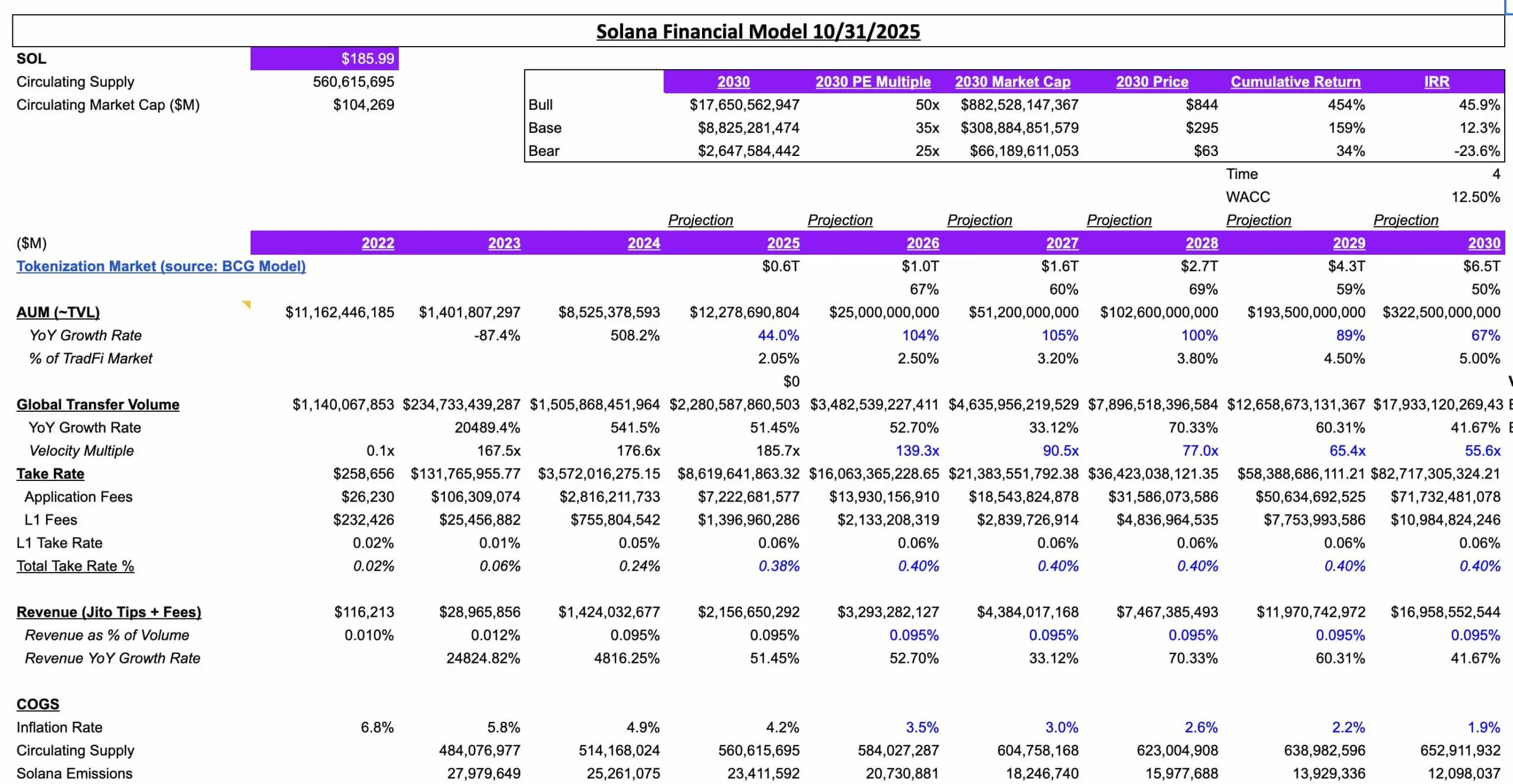 *Solana Financial Model (Source: John Ma)*Tokenized real assets now reach about 35.8 billion USD, nearly double compared to the end of 2024. As this number increases, performance and execution costs become central factors. In this context, Solana's appeal comes from the characteristics that have shaped its retail culture: speed, low fees, and scalability without relying on external execution layers.
Ethereum still maintains an advantage in security, development tools, and familiarity with regulations, becoming the default choice for organizations. However, the trend of tokenization forces the market to evaluate blockchain chains through a new lens: execution capability and efficiency in a large-scale digital asset environment.
Vương Tiễn
Disclaimer: The information on this page may come from third parties and does not represent the views or opinions of Gate. The content displayed on this page is for reference only and does not constitute any financial, investment, or legal advice. Gate does not guarantee the accuracy or completeness of the information and shall not be liable for any losses arising from the use of this information. Virtual asset investments carry high risks and are subject to significant price volatility. You may lose all of your invested principal. Please fully understand the relevant risks and make prudent decisions based on your own financial situation and risk tolerance. For details, please refer to
Disclaimer.


