“Rich Dad Poor Dad” author Robert Kiyosaki warned of an upcoming recession on X (formerly Twitter) but stated he is preparing by accumulating gold, silver, Bitcoin, and Ethereum. Kiyosaki set ambitious targets: gold at $27,000, silver at $100, Bitcoin at $250,000 by 2026.
Buying During the Crash: Kiyosaki’s Contrarian Investment Logic
“An impending crash: why I am buying rather than selling,” Kiyosaki wrote on X, setting bold goals: gold at $27,000, silver at $100, and Bitcoin at $250,000 by 2026. This contrarian approach is at the core of Kiyosaki’s repeated emphasis in “Rich Dad Poor Dad”—when the masses panic, smart money accumulates assets.
Kiyosaki’s gold forecast isn’t baseless; it stems from economist Jim Rickards. An expert on currency wars and financial crises, Rickards has accurately predicted multiple market collapses. His $27,000 gold target is based on analysis of global debt crises and currency system breakdowns. Currently, gold trades around $3,700, so reaching $27,000 implies about a 630% increase. While aggressive, considering gold’s historical performance during currency crises, this isn’t entirely impossible.
The $250,000 Bitcoin target aligns with Kiyosaki’s long-standing view of Bitcoin as a hedge against the Fed’s “fake money.” From the current roughly $106,000, this represents about a 136% increase. Kiyosaki sees Bitcoin as “real money,” alongside gold and silver, while viewing fiat currencies like the dollar as “fake money.” This perspective is rooted in his strong criticism of the Fed’s unlimited money printing.
Kiyosaki states his confidence in these assets is based on two economic principles. First is Gresham’s Law, which states that bad money drives out good. As governments keep printing money, diluting its value, people tend to hold scarce assets like gold and Bitcoin and use depreciating fiat for daily transactions. Second is Metcalfe’s Law, which links network value to the number of users. As Bitcoin adoption increases, its network effect will grow exponentially, driving its value higher.
Kiyosaki’s Core Rationale for Favoring Hard Assets
- US Debt Crisis: The US is the “largest debtor in history,” with debt exceeding $36 trillion and continuing to grow.
- Federal Reserve Money Printing: Criticizes the US Treasury and Fed for “printing money” to cover debt.
- Gresham’s Law: Bad money drives out good, and fiat devaluation boosts demand for hard assets.
- Metcalfe’s Law: Exponential growth in network users propels Bitcoin’s value upward.
Kiyosaki’s Strategic Shift Toward Ethereum
Kiyosaki is also turning bullish on Ethereum, marking an important shift in his investment strategy. Inspired by Fundstrat’s Tom Lee, Kiyosaki believes Ethereum’s role as a blockchain for stablecoins gives it a unique advantage in the global financial arena. Tom Lee, a well-known crypto bull on Wall Street, holds significant influence in traditional finance.
Ethereum’s position as a backbone for stablecoins cannot be ignored. Currently, the two largest stablecoins, USDT and USDC, have a large portion of their circulation on the Ethereum network. Stablecoins serve as a bridge between traditional finance and crypto, forming the foundation of DeFi ecosystems. As stablecoin usage continues to grow, Ethereum’s role as the main settlement layer will benefit from network effects and value accumulation.
Kiyosaki’s optimism about Ethereum also relates to its smart contract capabilities and rich ecosystem. Unlike Bitcoin, primarily a store of value, Ethereum supports extensive DeFi, NFTs, and dApps. This multifunctionality gives Ethereum a unique investment appeal among crypto assets. If Ethereum becomes the standard infrastructure for global stablecoins, its potential value could far exceed current market expectations.
Claiming to own gold and silver mines, Kiyosaki criticizes US Treasury and Fed for “printing money” to hide debt, calling the US “the biggest debtor in history.” He reiterates his famous phrase “Cash is trash,” urging investors to buy tangible assets even during market downturns. This view resonates especially in the current high-inflation environment, where bank deposits’ real purchasing power is eroding.
On-Chain Data and Institutional Views Support Rebound Expectations
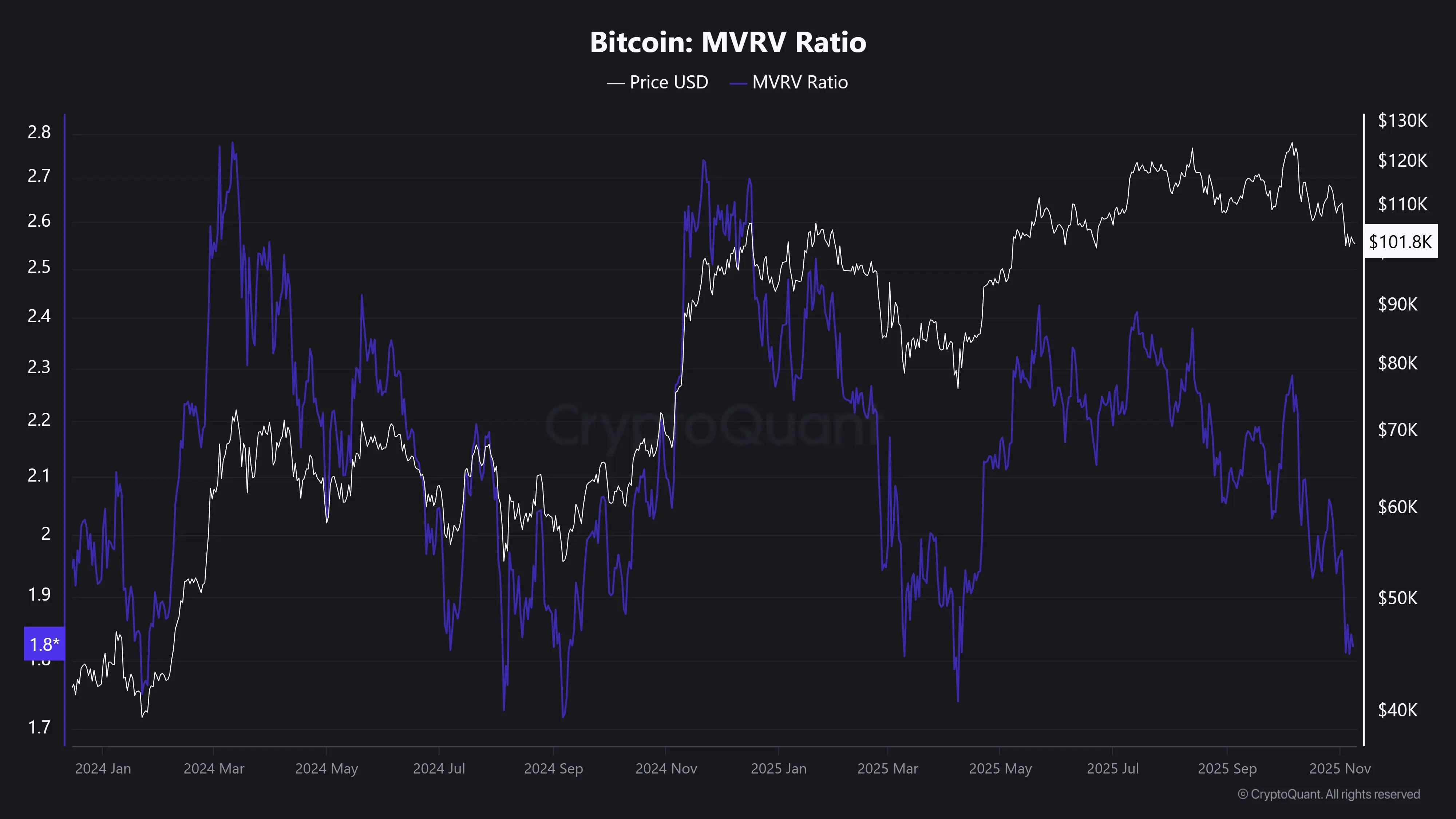
(Source: CryptoQuant)
On-chain data appears to support a potential Bitcoin rebound. Market analysis platform Crypto Crib notes that the Bitcoin Market Value to Realized Value (MVRV)—a key valuation indicator—has fallen to 1.8, a level historically signaling a 30% to 50% rebound.
The MVRV ratio compares Bitcoin’s market cap (current price times circulating supply) with its realized cap (based on the last price each Bitcoin moved at). When the MVRV is low, it suggests the market price is close to the average cost basis of holders, indicating limited downside. Historically, MVRV ratios between 1.5 and 2.0 have been good buy zones.
If Bitcoin rebounds 30% to 50% from current levels, prices could reach between $138,000 and $159,000. This range aligns with short-term analyst targets and paves the way for Kiyosaki’s long-term goal of $250,000. The support from on-chain data makes Kiyosaki’s predictions not just personal opinions but well-founded estimates backed by technical and fundamental analysis.
Legendary trader Arthur Hayes stated last week that, with US government debt soaring, the Fed will be forced to implement some form of “hidden QE.” He suggests the Fed might inject liquidity into the financial system via its repo operations to help roll over debt, without officially calling it QE. Hayes argues this stealth balance sheet expansion will “benefit dollar liquidity,” ultimately boosting asset prices, especially Bitcoin and other cryptocurrencies.
Hayes’s view aligns closely with Kiyosaki’s thesis. When the Fed prints money to address debt crises, fiat’s purchasing power declines, and scarce assets like gold and Bitcoin become primary beneficiaries. This macro perspective underpins Kiyosaki’s forecasts of $250,000 for Bitcoin and $27,000 for gold.
Cash Is Trash: Why Holding Cash Is No Longer Safe
Kiyosaki reiterates his famous phrase “Cash is trash,” a point especially relevant in today’s economic environment. In normal times, bank deposits offer safety and liquidity, with low but secure returns. However, in high inflation and negative real interest rate environments, the actual purchasing power of cash assets is rapidly shrinking.
For example, in the US, although official inflation has fallen from a peak of 9.1% in 2022 to around 3%, this is still above most savings account interest rates. This means cash holders are losing about 1% to 2% of purchasing power annually. More critically, if Rickards and Kiyosaki’s predictions of a severe debt crisis materialize, inflation could accelerate again, causing even greater losses for cash holdings.
Kiyosaki urges investors to buy tangible assets even during market corrections. The core idea is to see market volatility as an opportunity to buy rather than a reason to panic. When Bitcoin drops from $126,000 to $106,000, most retail investors panic and sell, but long-term investors like Kiyosaki see it as a chance to accumulate at lower prices.
Hard assets like gold and Bitcoin share a common trait: limited supply. Gold’s mining rate is far below demand growth, and Bitcoin’s cap of 21 million coins makes it inherently scarce. In a world of unlimited fiat supply, this scarcity will continue to drive their value higher. This is the fundamental logic behind Kiyosaki’s contrarian buying during “imminent collapse.”


