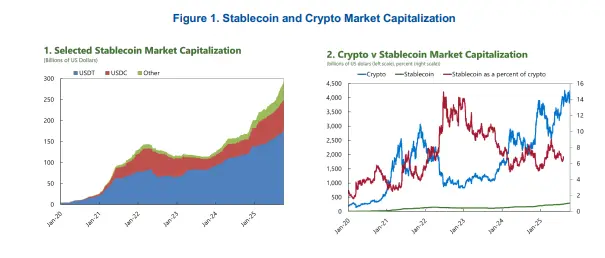
The International Monetary Fund (IMF) has released a report titled “Understanding Stablecoins,” warning that the fragmentation of regulatory frameworks across countries is creating structural “barriers,” threatening financial stability, weakening regulation, and slowing the development of cross-border payments. The global stablecoin market capitalization has surpassed $300 billion, with Tether’s USDT and Circle’s USDC accounting for the majority of the supply.
Regulatory Free-for-All in a $300 Billion Market
(Source: IMF)
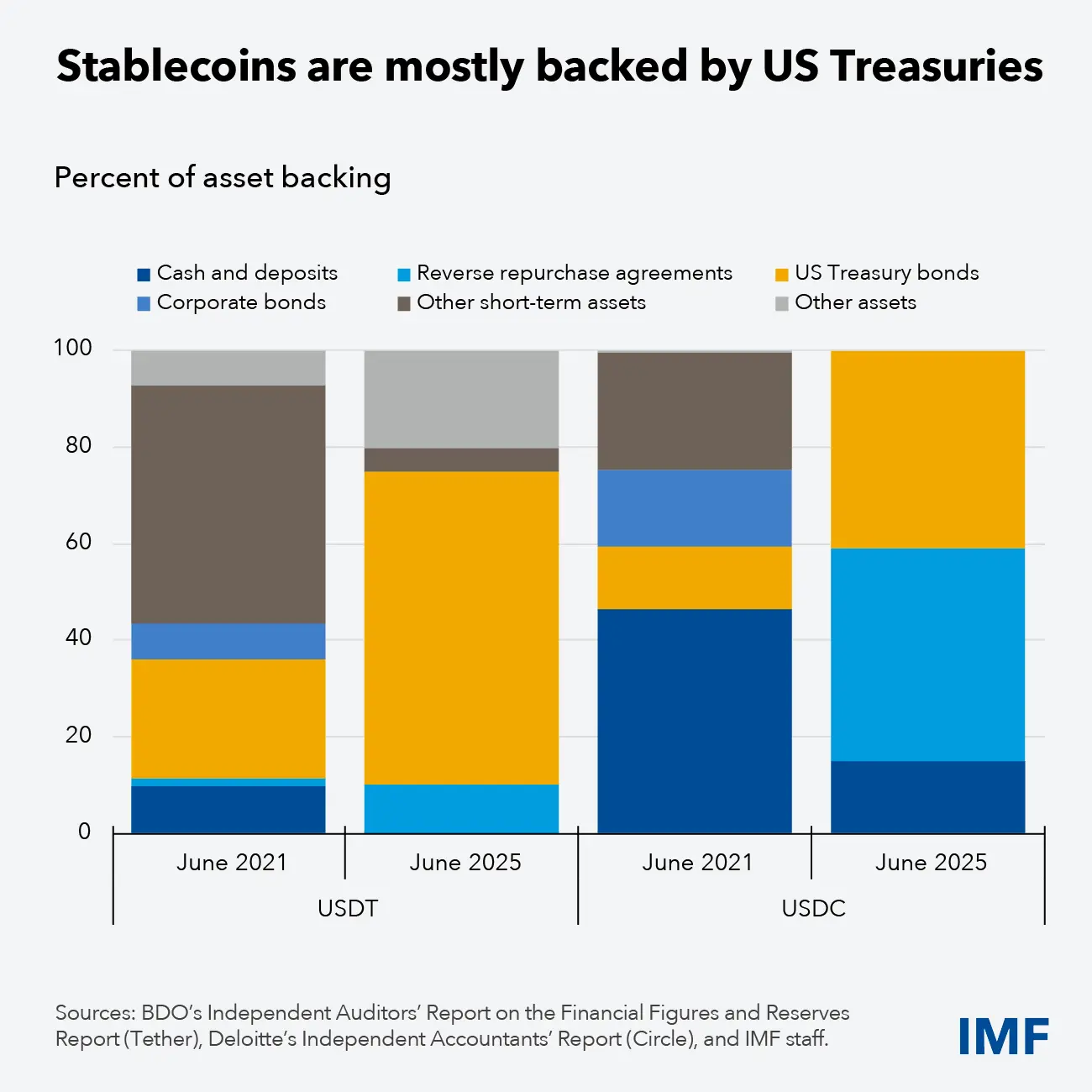
The global stablecoin market capitalization has surpassed $300 billion, a scale larger than the GDP of many small countries, pushing stablecoins from the fringes into the category of systemically important assets. Tether’s USDT and Circle’s USDC make up over 85% of the market share combined. About 40% of USDC’s reserves are held in short-term U.S. Treasuries, while USDT holds about 75% in short-term U.S. Treasuries and another 5% in Bitcoin.
The concentration of reserves in government debt markets directly links stablecoins to the traditional financial system. This connection is a double-edged sword: on one hand, it provides stablecoins with relatively reliable value backing; on the other, it makes stablecoins major buyers in the U.S. Treasury market. When about 60% of the $300 billion in stablecoins is invested in U.S. Treasuries, that equates to roughly $180 billion in demand for Treasuries. This scale makes stablecoin issuers systemically important participants in the Treasury market.
The IMF reviewed how major economies—including the U.S., U.K., EU, and Japan—regulate stablecoins and found significant differences in approaches. In the U.S., the regulatory status of stablecoins has long been ambiguous; the SEC has tried to treat some stablecoins as securities, while the Commodity Futures Trading Commission (CFTC) may view them as commodities. In the EU, the MiCA (Markets in Crypto-Assets Regulation) framework provides relatively clear guidelines for stablecoins, requiring issuers to hold an EU license and meet reserve requirements.
Japan regulates stablecoins under its Payment Services Act, allowing only licensed financial institutions to issue them. The U.K. is developing its own stablecoin regulatory framework, tending to treat them as payment instruments rather than securities. This global regulatory fragmentation is the core issue highlighted by the IMF.
Four Models of Global Stablecoin Regulation
Securities Model (Some U.S. Regulators): Treated as investment contracts, subject to securities laws
Payment Instrument Model (Japan, U.K.): Regulated as electronic money, with restrictions on issuers
Specialized Legislation Model (EU MiCA): Establishes a dedicated crypto-asset regulatory framework
Regulatory Vacuum Model (Some Offshore Jurisdictions): Lacks clear regulation or is deliberately lax
The practical result of this fragmentation is that stablecoin issuers can register in lax jurisdictions (such as the Cayman Islands or Bermuda) while serving users in stricter markets. This limits regulators’ ability to oversee reserves, redemption, liquidity management, and anti-money laundering controls.
The Real Pathway of Regulatory Arbitrage Threatening Financial Stability
(Source: IMF)
The IMF states that stablecoin issuers can operate in lax jurisdictions while serving users in more strictly regulated markets, and this regulatory arbitrage undermines global regulatory effectiveness. The fund warns that this creates regulatory arbitrage, weakening global oversight. Issuers can register in the least demanding locations, but their tokens circulate globally, making it difficult for any single regulator to supervise effectively.
Beyond regulatory arbitrage, the report also points to the problem of technological fragmentation. Stablecoins increasingly operate across different blockchains and exchanges, which are not always interoperable. USDT is currently issued on more than 15 different blockchains, including Ethereum, Tron, Solana, and Avalanche. Each chain’s USDT is technically a separate token; while they can theoretically be exchanged 1:1, cross-chain transfers require bridging services, adding complexity and risk.
The IMF believes this lack of coordination increases transaction costs, slows market development, and hinders efficient global payments. Differences in national regulatory approaches further complicate cross-border use and settlement. For example, a European company wanting to use stablecoins to pay a U.S. supplier must ensure the stablecoin complies with both the EU’s MiCA and relevant U.S. laws, but differing requirements drive up compliance costs substantially.
Even more serious financial stability risks arise from large-scale redemption scenarios. The IMF warns that mass redemptions could force rapid sales of Treasuries and repo assets, potentially disrupting short-term funding markets critical to monetary policy transmission. If market confidence collapses, leading to $100 billion in stablecoins being redeemed in a short period, issuers would be forced to sell about $70 billion in Treasuries. Such large-scale sales would raise Treasury yields, impact mortgage rates and corporate financing costs, and transmit crypto market turmoil into the real economy.
IMF’s Five Core Requirements in New Guidelines
To address these risks, the IMF has issued new global policy guidelines aimed at reducing fragmentation. The core of the guidelines is to establish unified regulatory standards so that stablecoins follow the same basic rules regardless of jurisdiction.
The Five Pillars of the IMF Stablecoin Regulatory Guidelines
Unified Definition: Adopting a consistent global definition of stablecoins to eliminate classification confusion
Reserve Asset Rules: Only allow high-quality liquid assets such as short-term government bonds, strictly limiting risk assets
1:1 Redemption Guarantee: Issuers must always guarantee full face-value redemption on demand
Cross-Border Supervision Framework: Establish information-sharing mechanisms for coordinated supervision among regulators
Same Activity, Same Regulation: Regardless of the issuer (bank, fintech company, or crypto platform), the same rules apply
The fund states that whether the issuer is a bank, fintech company, or crypto platform, the “same activity, same risk, same regulation” principle should be followed. This principle aims to eliminate regulatory arbitrage and ensure that all stablecoin issuers face the same compliance costs and supervisory standards.
The IMF also states that stablecoins should be backed only by high-quality liquid assets, such as short-term government bonds, and strictly limit holdings of risk assets. This requirement specifically targets Tether’s practice of holding 5% of reserves in Bitcoin. The IMF believes that as payment instruments, stablecoins should prioritize stability and liquidity rather than investment returns. Holding volatile assets such as Bitcoin and gold may increase long-term returns but raises the risk of insufficient funds during redemption.
The new guidelines also include enhanced international coordination in anti-money laundering enforcement, licensing, and supervision of large global stablecoin arrangements. AML is a key challenge in stablecoin regulation because their anonymity and cross-border convenience make them susceptible to illicit fund transfers. The IMF calls on countries to establish real-time information-sharing mechanisms to track suspicious large stablecoin transfers.
The Ultimate Showdown Between Digital Dollarization and Monetary Sovereignty
Widespread use of foreign-currency stablecoins can weaken domestic currency controls, reduce demand for the local currency, and accelerate digital dollarization. This is a major concern for many emerging markets. In high-inflation countries like Argentina, Turkey, and Venezuela, people are using USDT as a store of value, effectively creating a “shadow circulation” of the dollar. Stablecoins also make it easier to bypass capital controls via non-custodial wallets and offshore platforms.
In China, the central bank has described stablecoins as a threat to financial stability and monetary sovereignty. China’s strict capital controls limit citizens’ ability to convert RMB into foreign currencies, but stablecoins provide a channel to circumvent these restrictions. Users in China can buy crypto with RMB, exchange it for USDT, and then convert it to dollars overseas. This capital outflow channel is a main reason why China is cracking down on stablecoins.
The IMF also notes that the increasingly close links between stablecoin issuers, banks, custodians, crypto exchanges, and funds increase the risk that digital market shocks could spread to the broader financial system. This interconnectedness means that turmoil in the crypto market could be transmitted to the traditional financial system via stablecoin channels.
The IMF’s warning comes as global regulatory pressure continues to mount. In Europe, the European Central Bank recently warned that although stablecoins have a small market share in the euro area, their growing links to the U.S. Treasury market now pose spillover risks. The European Systemic Risk Board has also called for urgent safeguards against cross-border stablecoin structures operating under the EU MiCA framework.
The IMF concludes that without consistent global regulation, stablecoins could bypass national safeguards, undermine fragile economies, and transmit financial shocks across borders at high speed. This warning is not alarmist but based on a deep understanding of global financial history. Historically, unregulated cross-border financial innovation has often been the trigger for financial crises.


