On December 18, Bitcoin plummeted to around $85,000, after briefly rising to $90,000 overnight. The much-anticipated Santa Claus rally has been shattered, and this wave of sharp decline triggered a $155 million liquidation event in derivatives. Bitcoin ETFs saw outflows of $634 million this week, the US unemployment rate rose to its highest level since 2021, and the shadow of the Federal Reserve’s expected rate hikes in Japan on Friday has traders preparing for a deeper correction.
ETF Capital Outflows and Institutional Confidence Collapse
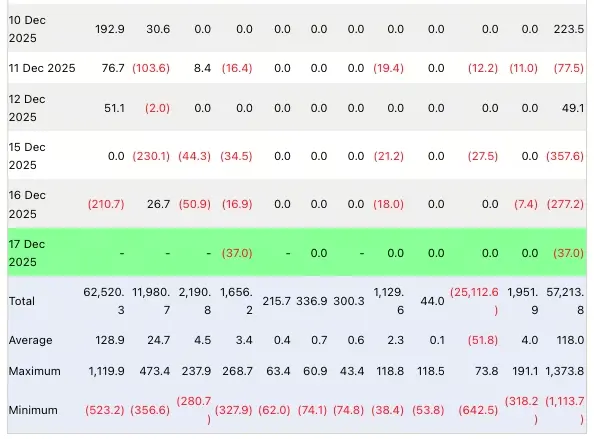
(Source: Farside Investor)
The primary reason for the demise of the Santa Claus rally is the continuous withdrawal of institutional funds. According to data from Farside Investors, Bitcoin ETFs have lost $634 million this week, with net outflows occurring for two consecutive days. This pattern of capital outflow is especially deadly during the holiday season, as December is traditionally a key window for institutions to position for the coming year. Capital outflows indicate a lack of confidence among institutional investors regarding the short-term outlook.
Behind the ETF outflows are multiple resonating factors. First, the employment data released by the US Bureau of Labor Statistics shows the unemployment rate has risen to its highest level since 2021. Although job creation exceeded expectations, the unemployment rate jumped from 4.4% to 4.6%, surpassing the market forecast of 4.4% and exceeding the Federal Reserve officials’ previous projection of 4.5% by year-end. This signals a weakening labor market, prompting institutional investors to reassess risk asset allocations.
Second, changes in the macro liquidity environment. Although the Federal Reserve announced a third consecutive 25 bps rate cut last week, market expectations for rate cuts in 2026 are cooling. Investors are currently betting on two 25 bps rate cuts in 2026, but Atlanta Fed President Bostic recently stated that rate cuts next year are unlikely. This policy uncertainty causes institutional funds to adopt a wait-and-see stance.
Triple Drivers Behind ETF Capital Outflows
Weak Employment Signals: Unemployment rises to 4.6%, hitting a new high since 2021, shaking expectations of a soft landing
Diminishing Rate Cut Expectations: Internal hawkish voices within the Fed are rising, and rate cuts in 2026 may be fewer than market expectations
Year-End Effect Amplification: Institutions enter risk control mode, reducing high-volatility asset allocations, seasonal liquidity depletion
Third, the year-end effect. During the last two weeks of December each year, institutional investors typically reduce trading activity, lock in annual gains, and avoid unnecessary risk exposure. This seasonal liquidity depletion makes markets more susceptible to shocks from unexpected events. When ETF outflows coincide with low liquidity environments at year-end, price volatility is significantly amplified.
Wave of Derivatives Liquidations and Technical Breakdowns
Data from blockchain analytics platform CoinGlass shows that over the past day, $155 million worth of Bitcoin derivatives contracts were liquidated. While this scale of liquidation is not an all-time high, in a low liquidity environment, it is enough to cause sharp price swings. The chain reaction of liquidations is the direct cause of Bitcoin’s price dropping rapidly from $90,000 to $85,000.
On the technical side, $90,000 has been an important psychological barrier. When Bitcoin briefly touched this level, it triggered a large number of stop-loss and profit-taking orders. Many traders set their defensive lines at $90,000, believing that as long as this level held, the Santa Claus rally could continue. However, buying pressure was insufficient to sustain this level, and as the price quickly fell back, long stop-loss orders were triggered in succession, creating a waterfall decline.
From the weekly chart perspective, Bitcoin has formed a clear head-and-shoulders pattern after multiple failed attempts to break above $100,000. The current price is below key moving averages, which have started to turn downward and are hovering around the $103,000 to $108,000 zone, acting as dynamic resistance. The MACD indicator continues to show a bearish trend, with the negative histogram expanding, indicating that downward momentum remains dominant.
Ethereum’s performance is even more brutal. The price has fallen 4%, recently trading at $2,824, after quickly retreating from a break above $3,000. Over the past week, Ethereum has declined by 16%, the largest drop among the top ten cryptocurrencies by market cap. This excessive decline demonstrates that when market confidence collapses, less liquid assets tend to suffer deeper losses.
Bank of Japan Rate Hike Becomes the Final Straw
Bitcoin traders are closely watching the Bank of Japan’s potential rate hike on Friday. If the BOJ raises rates, it could reverse the lucrative yen arbitrage trades, which are a significant source of global liquidity and have historically driven risk asset prices like Bitcoin higher. Typically, liquidity shortages lead to reduced dollar inflows into risk assets such as Bitcoin and stocks.
Matt Hougan, Chief Investment Officer at Bitwise, told Decrypt earlier Wednesday that this rate hike is unlikely to cause significant volatility, adding that it is fully priced in by the market. “That said, it remains a concerning headline—Japan’s interest rates are at a 30-year high!—and in the current market environment, investor reactions to this headline could lead to short-term downward pressure.”
The demise of the Santa Claus rally is essentially a resonance of multiple negative factors in a low liquidity environment. ETF outflows reflect a lack of institutional confidence, derivatives liquidations trigger technical breakdowns, and the expected rate hike by the Bank of Japan becomes the final straw. In the Myriad market forecast, users indicate that the probability of Bitcoin rebounding during Christmas is less than 4%, showing extreme pessimism about the short-term outlook.
For traders, the most critical support level is the true market average price (TMMP) at $81,500. Holding this level could allow the bull trend to continue. But if the weekly close falls below, the next support is at $74,000. Although the Santa Claus rally has been broken, the market’s self-healing ability should not be underestimated, and the key lies in when liquidity will flow back.
Disclaimer: The information on this page may come from third parties and does not represent the views or opinions of Gate. The content displayed on this page is for reference only and does not constitute any financial, investment, or legal advice. Gate does not guarantee the accuracy or completeness of the information and shall not be liable for any losses arising from the use of this information. Virtual asset investments carry high risks and are subject to significant price volatility. You may lose all of your invested principal. Please fully understand the relevant risks and make prudent decisions based on your own financial situation and risk tolerance. For details, please refer to
Disclaimer.
Related Articles
Bitcoin Spot ETF Saw $760 Million in Inflows Last Week! But Whether the Rally Continues Requires Monitoring 3 Key Factors
US cryptocurrency spot ETFs showed a significant rebound last week, with Bitcoin and Ethereum recording net inflows of approximately $763.4 million and $160.9 million respectively, with prices bouncing back accordingly. Although the market is showing incremental buying signals, it still faces variables from central bank policies and geopolitical risks in the future. The market will continue to monitor ETF capital inflows and macroeconomic impacts.
CryptoCity8m ago
Market rally continues! Bitcoin returns to $75,000 level, ETF inflows persist
Bitcoin broke through $74,000 on March 16 as institutional capital flowed back into the market, with ETF net inflows reaching $1 billion, shifting market sentiment to bullish. Analysts predict Bitcoin could reach $80,000, but it is currently in a consolidation phase. $75,000 is a key resistance level; a breakout could lead to a test of $90,000, otherwise it risks a pullback.
区块客15m ago
MICA Daily | BTC Stable Above 30-Day Moving Average, Continues to Show Bullish Outlook
According to Binance data, Bitcoin's moving average convergence divergence indicator shows significant improvement in its price trend structure, with current trading price around $73,000, and moving averages in a divergent state, reflecting a market transition phase. Technical analysis indicates that the 30-day moving average is of high importance; if the price maintains above this moving average, it indicates buying support, otherwise it may enter a correction phase. Investors will judge the trend based on changes in moving averages.
区块客19m ago
Bitcoin Surges Toward $75,000: $600 Million Short Liquidations Drive Rally, ETF Inflows Emerge as Key Variable
On March 17, Bitcoin tested the 75,000 US dollar level driven by short liquidations, briefly reaching 75,653 US dollars before retreating. This rally was accompanied by massive liquidations totaling approximately 609 million US dollars in 24 hours, with shorts accounting for a significant proportion. Market sentiment has recovered somewhat, with capital inflows into spot demand and ETF support driving Bitcoin's rally. Future price movements will be influenced by sustained capital inflows and macroeconomic data.
GateNews55m ago
Matrixport: ETH Cumulative Pullback of 63% This Round, Options Gamma Hedging as Main Driver of Recent Rebound
Ethereum has declined 63% cumulatively in this cycle, reaching a low of $1,837, and is currently testing technical resistance levels. Price recovery is driven by options flow and gamma hedging, while fundamentals have not shown significant changes. ETF demand is recovering, but derivatives positioning continues to influence price action. Ethereum's movement has decoupled from traditional assets.
GateNews1h ago


