
Will crypto be good in 2026?
A re-pricing of “true and false value” is quietly happening…
This time, why is it different?
In the last few months of 2025, the sentiment in the crypto market is undergoing a subtle yet real shift. Over 70% of people believe: the market has entered a bear phase! Bitcoin has retreated from its all-time high of $126,700, and the net inflow of ETFs has begun to stall periodically; altcoins are showing clear divergence, and Meme coins, which once ignited the most enthusiasm, are gradually falling out of favor. It all seems to be entering a: winter.
Strangely, this time there hasn’t been a sudden “hammer-like regulation” like at the end of 2021, nor a systemic collapse like FTX in 2022.
Apart from the sharp drop on 10·11, the market can even be described as “calm waters.” But everyone can feel that: something is off. If we had to summarize the current state in one sentence, it might be—markets are not dead, but faith is beginning to stratify.
2025 may not be just a simple bull-bear switch, but more like a recalibration of true and false value. So, a question that everyone faces is: Will crypto be good in 2026?
This article attempts to give an honest, long-term oriented answer.
01 The macro trend is warming up, but Bitcoin’s “identity” has changed
Over the past year, Bitcoin’s price performance and market positioning have undergone crucial changes.
After reaching a new high of $126,700, Bitcoin entered a high-level consolidation zone, volatility increased, and market sentiment gradually cooled. But unlike previous cycles, the core driving force behind this round of market movement is not retail investors, but institutional funds behind ETFs.
1. Bitcoin is becoming a “high-volatility institutional asset”
According to analysis by CryptoQuant analyst Axel Adler Jr., the average holding cost of US spot Bitcoin ETFs in the US is around $79,000. This data is increasingly viewed by institutions as an important medium- to long-term support zone.
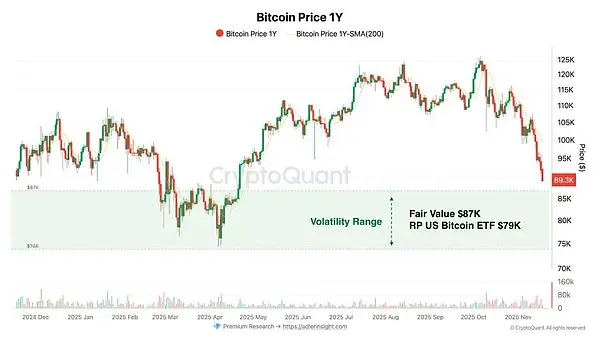
What does this mean? It means that Bitcoin’s trading logic is shifting from being a “sentiment asset” to something more akin to a hybrid of gold + tech stocks:
On one hand, it has a long-term narrative of anti-inflation and hedging fiat currency credit.
On the other hand, it will be strongly influenced by macro liquidity, risk appetite, and interest rate expectations, similar to tech stocks, with Bitcoin’s β attribute being amplified.
2. Macro environment: liquidity expectations are indeed improving
From a broader macro perspective, 2025 is a year of significant recovery for risk assets worldwide. AI has become the main narrative in global capital markets; US stocks continue to hit new highs; the Federal Reserve confirmed three rate cuts within the year in December.
The latest FOMC economic forecast raised the 2026 US GDP growth expectation from 1.8% to 2.2%–2.5%. Market consensus for 2026 is leaning toward “**mild easing.”
For Bitcoin, this is certainly a positive environment. But it’s also necessary to be cautious: if the economy unexpectedly weakens in 2026, or inflation rises again, risk assets could face significant corrections.
Bitcoin is no longer an “independent market ignoring macro.”
02 Regulatory turning point: no longer vague, but “officially entering”
If price determines short-term sentiment, then regulation determines long-term boundaries.
And in 2025, the crypto industry experienced a crucial change in regulation—ambiguity is being systematically cleared.
US: From confrontation to structured regulation
In 2025, the US enacted two milestone laws:
First, the “Genius Act” (Stablecoin Act)
Defines the legal attributes of stablecoins; establishes reserve and audit requirements; provides a clear path for compliant issuers. This law was signed into law in July 2025, and will take effect 18 months later or 120 days after regulatory rules are issued.
Second, the “Clarity Act” (Crypto Asset Market Structure Act)
Clarifies the regulatory boundaries between “security tokens” and “commodity tokens”; delineates SEC and CFTC jurisdictions; introduces a tiered regulatory framework. The bill is expected to be submitted to the Senate for review in early 2026. Meanwhile, the SEC is clearly accelerating approval of crypto ETFs, opening more compliant channels for institutional funds.
Hong Kong: A “model” for crypto finance regulation
In Asia, Hong Kong’s moves are also noteworthy. In 2025, the HKMA officially launched a stablecoin issuer regulation system; all Hong Kong-based stablecoins must be licensed; HashKey successfully IPO’d on the Hong Kong Stock Exchange, becoming the first compliant platform with crypto trading as its core business.
This means that crypto businesses are entering the Asian financial system for the first time in a form that is “priced by mainstream capital markets.” Overall, the regulatory logic in the US and Hong Kong is highly aligned: reducing gray areas and opening up compliant channels.
03 The three clearest main lines in 2026: not concepts, but ongoing developments
After countless narratives rise and fall, only a few truly show a “certain growth curve.”
Stablecoins: The most underestimated infrastructure in crypto
As of December 20, 2025, the total global stablecoin issuance exceeded $300 billion, with USDT and USDC accounting for over 80%. Stablecoins are no longer just “tools in the crypto circle,” but are actually supporting: cross-border payments, merchant settlements, remittances, and hedging. Giants like Visa, Stripe, and PayPal are already using stablecoins for settlement. Stripe even supports merchants using stablecoins for subscriptions.
Stablecoins are becoming the new generation of global payment protocols.
Key changes to watch in 2026 include: debt-backed stablecoins (backed by high-quality assets); regional stablecoins (Japan, EU, etc.); integration of banking ledgers with stablecoins.
Prediction markets: From “betting” to “pricing tools”
Prediction markets are undergoing an identity upgrade. Kalshi has obtained CFTC futures licenses, with a valuation of $11 billion; Polymarket leverages US elections and sports events to become a sentiment indicator. The essence of prediction markets is no longer just about winning or losing bets, but about using real funds to express the probability of a certain outcome.
In 2026, they could become: media sentiment references, macro risk pricing tools, and AI-automated probability markets. When AI can automatically analyze data, place bets, and generate odds, the reaction speed and information density of prediction markets will far surpass traditional survey systems.
On-chain US stocks: a key step in bringing real assets onto the chain
RWA (Real-World Assets) is not a new concept, but on-chain stocks could be a qualitative breakthrough. Amidst domestic crackdowns, companies like Securitize are pushing fully compliant on-chain stock trading platforms: tokens represent real stocks, with voting rights and dividends, settled on-chain, with off-chain custody. Recently, on-chain US stocks have become an undeniable fact.
This is not “shadow assets,” but a migration of financial infrastructure.
04 Four “marginal narratives” that may explode in 2026
The four most worth following trends are:
1. The identity issue of AI Agents (KYA)
When AI starts trading, signing contracts, and calling smart contracts, who are they? What can they do? How is responsibility assigned? KYA (Know Your Agent) may become the basic threshold for on-chain AI.
2. x402 and micro-payment protocols
AI collaboration requires automatic settlement and payment systems without human confirmation. x402 is working to solve this.
3. Privacy chains returning to the main stage
Not to evade regulation, but for business compliance. Corporate data, trading strategies, user information—all must be protected. Privacy is becoming a new moat.
4. Staked Media
Opinions are no longer just “talk,” but interest-aligned expressions. Predictions, comments, positions all require costs. This could reshape trust mechanisms in the content industry.
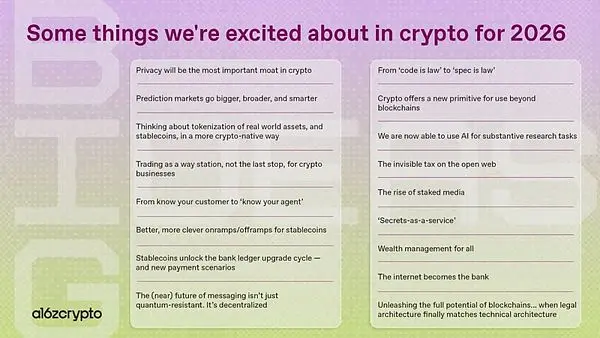
05 Crypto is moving out of “internal circulation”
The truly important change is: crypto is beginning to be used by “non-crypto users.”
Lagos vendors accepting USDT; users in high-inflation countries holding USDC for hedging; the Philippines using USDC for low-cost remittances.
They don’t care about chains or narratives, only: is it good and easy to use.
From crypto ETFs to stablecoin payments, from on-chain government bonds to prediction markets, from on-chain Agents to decentralized AI, all these indicate one thing: the crypto industry may be starting to land in the more real-world context, and perhaps increasingly resemble a parallel financial system alongside the traditional one, resonating with stock markets, macro liquidity, policy expectations, and AI cycles.
Crypto is moving from a casino to infrastructure.
From emotion to efficiency. From closed circles to the real world. This path won’t be fast, but it may be long enough.
And the real opportunity often arises when disappointment is not yet over, and certainty has just begun to appear.


