The Christmas bells of 2025 have already rung, but for cryptocurrency investors, this year’s Santa’s gift bag seems to contain something different. In stark contrast to the traditional stock market (S&P 500), which has seen strong year-end rallies and new highs, Bitcoin (BTC) has shown noticeable weakness and divergence during the 2025 Christmas period.
As the world’s largest cryptocurrency by market cap, Bitcoin closed at around $87,800 on Christmas Day 2025. Against the backdrop of light trading volume and overall market caution, it only rose slightly by 0.75%. Bitcoin’s price fluctuated within a narrow range of $85,000 to $90,000, reflecting low market volatility. Investors reduced risk before the year-end, with spot Bitcoin and Ethereum ETFs experiencing hundreds of millions of dollars in outflows on December 24 alone.
This performance marks the end of a challenging year for Bitcoin. Although the price once surged to a record high of $126,198 in October, it has since fallen by about 7% from the nearly $92,000 level on January 1.
While Bitcoin’s price remains high compared to its cycle lows, the “Santa Rally” has not materialized as expected. Instead, the market is digesting a correction after reaching a historic high of around $120,000 in October. As of December 25, Bitcoin’s trading price hovered between $87,000 and $96,000, slightly down from last year’s same period (Christmas 2024 at $99,000), marking a rare “cooling period” in the market.
2025 Christmas Market Analysis: From “Euphoria” to “Pragmatism”
The 2025 crypto market exhibits an extreme “binary opposition” structure, especially evident during Christmas:
- Bitcoin’s “Year-End Fatigue”: Bitcoin briefly broke through the $120,000 mark in October, sparking a short-lived celebration. However, the subsequent “October Flash Crash” and liquidity tightening at year-end pushed the price back below $90,000. Compared to Christmas 2024 at $98,000–$99,000, the 2025 Christmas price is actually down YoY. This breaks the stereotype that “the second year after halving must be a bull market.”
- Infrastructure and Tokens Parting Ways: Despite the sluggish price, mining stocks combined with AI (such as IREN, Cipher, BitMine) strengthened against the trend at year-end. Market funds are voting with their feet: investors prefer cash-flow-generating “shovel stocks” over purely speculative “tokens.”
Historical Christmas: Where does 2025 stand?
Bitcoin’s performance on Christmas Day has historically been mixed, often influenced by year-end tax planning, declining liquidity, and post-halving cycles. Historical data shows no consistent “Christmas rally” pattern. Although in the past ten years, Bitcoin has risen around Christmas in eight of those years, with gains ranging from 0.33% to 10.86%, overall, there has been no clear “Christmas rally.” However, Bitcoin’s performance often foreshadows the tone of the following year. The trend in 2025 bears a striking resemblance to 2017 and 2021. Christmas 2025 is not a crash but a “high-level consolidation.” Unlike 2017 and 2021, there was no panic selling this time; instead, institutions are adjusting their balance sheets at year-end, shifting funds from high-volatility crypto assets to AI and US tech giants.
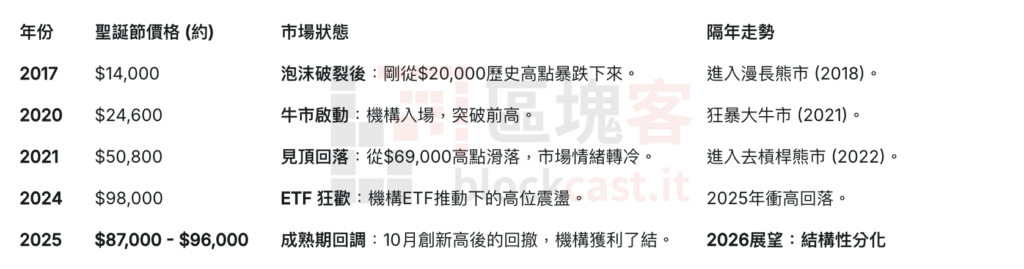 It is worth noting that halving years (2016, 2020, 2024) often predict strong Christmas rallies. With the rise of mining reward halving and scarcity concepts, Bitcoin’s average annual increase exceeds 100%. In contrast, 2025 is the worst Q4 performance in seven years for Bitcoin, with a 22.54% decline in December alone. This year, Bitcoin’s price has fallen 12% from the $99,299 high at Christmas 2024, highlighting a cooling cycle, and the Fear & Greed Index has reached 27, indicating retail investors are in “extreme panic.”
The “Facepalm” Moment: Industry Predictions vs. Reality
From late 2024 to early 2025, industry leaders, Wall Street analysts, and crypto KOLs made highly optimistic predictions for Bitcoin’s price by the end of 2025, relying on regulatory tailwinds like SEC reforms, Fed rate cuts, and institutional inflows.
However, Bitcoin ultimately closed near $87,000, making most predictions overly optimistic and highlighting the risks of extrapolating in a volatile market. Current market conditions show most forecasts missed the mark; analysts generally underestimated the “siphon effect.” In 2025, breakthroughs in AI technology diverted hot money that would have gone into blockchain. When NVIDIA and AI infrastructure stocks can deliver annual returns of 50%-100%, Bitcoin’s appeal as a “high beta tech stock” diminishes significantly.
Christmas 2025 did not see Bitcoin reach $200,000 as many bullish enthusiasts hoped, nor did it crash to zero as bears predicted. We are in an awkward but real “middle ground”: around $90,000. A figure that reassures conservatives but disappoints enthusiasts.
Extreme optimists like venture capital pioneer Tim Draper, PlanB (S2F), Tom Lee, Robert Kiyosaki, Cathie Wood, Bernstein, and Geoff Kendrick (Head of Digital Asset Research at Standard Chartered) have all predicted Bitcoin could surpass $150,000 in 2025, but they collectively missed the mark, indicating overly high expectations. They assumed ETF inflows and halving effects would linearly compound, but they underestimated the siphon effect of AI capital and macroeconomic stagflation pressures.
Why did most people get it wrong? Perhaps because “Wall Street uses old maps to find new continents.” Most prediction models (like S2F, Gold Market Cap Ratio) are based on the assumption that “Bitcoin is the only savings pool.” However, the reality of 2025 is that AI is the new savings pool. Funds haven’t disappeared; they have shifted from “virtual currencies” to “physical computing power.”
What should we expect in 2026?
The calm trend during Christmas 2025 sends a clear signal: the “narrative era” of cryptocurrencies is ending, and the “fundamental” era has arrived.
It is worth noting that halving years (2016, 2020, 2024) often predict strong Christmas rallies. With the rise of mining reward halving and scarcity concepts, Bitcoin’s average annual increase exceeds 100%. In contrast, 2025 is the worst Q4 performance in seven years for Bitcoin, with a 22.54% decline in December alone. This year, Bitcoin’s price has fallen 12% from the $99,299 high at Christmas 2024, highlighting a cooling cycle, and the Fear & Greed Index has reached 27, indicating retail investors are in “extreme panic.”
The “Facepalm” Moment: Industry Predictions vs. Reality
From late 2024 to early 2025, industry leaders, Wall Street analysts, and crypto KOLs made highly optimistic predictions for Bitcoin’s price by the end of 2025, relying on regulatory tailwinds like SEC reforms, Fed rate cuts, and institutional inflows.
However, Bitcoin ultimately closed near $87,000, making most predictions overly optimistic and highlighting the risks of extrapolating in a volatile market. Current market conditions show most forecasts missed the mark; analysts generally underestimated the “siphon effect.” In 2025, breakthroughs in AI technology diverted hot money that would have gone into blockchain. When NVIDIA and AI infrastructure stocks can deliver annual returns of 50%-100%, Bitcoin’s appeal as a “high beta tech stock” diminishes significantly.
Christmas 2025 did not see Bitcoin reach $200,000 as many bullish enthusiasts hoped, nor did it crash to zero as bears predicted. We are in an awkward but real “middle ground”: around $90,000. A figure that reassures conservatives but disappoints enthusiasts.
Extreme optimists like venture capital pioneer Tim Draper, PlanB (S2F), Tom Lee, Robert Kiyosaki, Cathie Wood, Bernstein, and Geoff Kendrick (Head of Digital Asset Research at Standard Chartered) have all predicted Bitcoin could surpass $150,000 in 2025, but they collectively missed the mark, indicating overly high expectations. They assumed ETF inflows and halving effects would linearly compound, but they underestimated the siphon effect of AI capital and macroeconomic stagflation pressures.
Why did most people get it wrong? Perhaps because “Wall Street uses old maps to find new continents.” Most prediction models (like S2F, Gold Market Cap Ratio) are based on the assumption that “Bitcoin is the only savings pool.” However, the reality of 2025 is that AI is the new savings pool. Funds haven’t disappeared; they have shifted from “virtual currencies” to “physical computing power.”
What should we expect in 2026?
The calm trend during Christmas 2025 sends a clear signal: the “narrative era” of cryptocurrencies is ending, and the “fundamental” era has arrived.
- Diminishing returns: Bitcoin is no longer the asset that can easily multiply tenfold. It is becoming a mature “digital gold” linked to macroeconomics. This means reduced volatility and lower excess returns.
- ETFs are a double-edged sword: While spot ETFs bring in capital, they also lock Bitcoin’s price to Wall Street trading hours and macro logic. During Christmas, when US stock markets are closed or thinly traded, Bitcoin also loses the independence of its own market.
- Seeking new growth points: The winners in 2025 are not hoarders but builders. Stocks of companies transforming into AI computing power, like BitMine and IREN, soared, proving that the market craves “computing power” rather than just “hash rate.”
This Christmas, Bitcoin did not bring investors a surprising red envelope but instead offered a cool health check report. For 2026, should investors abandon the linear wealth fantasies of the “S2F model” and focus on real-world applications that deeply integrate blockchain technology with AI and energy industries? Bitcoin remains king, but the king’s pace has become steady—甚至有些缓慢。
Disclaimer: The information on this page may come from third parties and does not represent the views or opinions of Gate. The content displayed on this page is for reference only and does not constitute any financial, investment, or legal advice. Gate does not guarantee the accuracy or completeness of the information and shall not be liable for any losses arising from the use of this information. Virtual asset investments carry high risks and are subject to significant price volatility. You may lose all of your invested principal. Please fully understand the relevant risks and make prudent decisions based on your own financial situation and risk tolerance. For details, please refer to
Disclaimer.
Related Articles
BTC 15-minute pump 0.55%: Large on-chain funds inflows and options positioning resonate to lift spot prices
2026-04-09 17:00 to 2026-04-09 17:15 (UTC), the BTC spot market saw a rapid spike with a +0.55% return. The price range was 72,063.9 to 72,518.5 USDT, and the full-period amplitude reached 0.63%. This upswing coincided with rising market attention; volatility clearly intensified, drawing funds into short-term trading in a mix of cautious sentiment and localized increased volume.
The main driving force behind this move was concentrated inflows to exchanges from on-chain large transfers, which pushed up spot market buy orders in a short time. Data shows that, in the past 24 hours, on-chain BTC transfers
GateNews16m ago
Mainstream CEX and DEX funding-rate displays suggest an increasingly bearish market sentiment
On April 10, the Bitcoin price broke through $72k again. According to Coinglass data, the funding rates on major trading platforms show that the market’s bearish sentiment is strengthening. Funding rates are used to balance the contract price with the asset price; a rate below 0.005% indicates that the market is broadly bearish.
GateNews57m ago
Over the past 1 hour, forced liquidations across the entire market totaled $101 million, including $80.39 million in BTC liquidations.
Gate News message, on April 9, CoinGlass data shows that over the past 1 hour, liquidations across the entire network totaled $101 million, including $97.07 million from short liquidations and $3.54 million from long liquidations. In addition, the liquidation amount for BTC reached $80.39 million, while the liquidation amount for ETH reached $11.79 million.
GateNews1h ago
CME Group BTC futures liquidity falls to a 14-month low, with basis trading failures triggering institutional capital outflows
The Chicago Mercantile Exchange’s Bitcoin futures market has continued to weaken. In March 2026, the daily average open interest fell to $7.2 billion, hitting a new low since February 2024, and has been declining for five straight months. The main reason is the large-scale unwinding of basis trades, which eliminated the arbitrage spread and caused leveraged capital to exit.
GateNews1h ago
BTC 15-minute pump of 1.03%: integer-level breakout and macro risk-hedging resonance amplifying the move
From 2026-04-09 15:30 to 15:45 (UTC), the BTC return rate recorded +1.03%, with the price ranging from 71,291.5 to 72,226.9 USDT, and the amplitude reaching 1.31%. During the abnormal move, market attention rose rapidly, volatility noticeably intensified, and prompted investors to closely watch short-term trends.
The main driver behind this abnormal move was BTC breaking through the 72,000 USDT integer level at 15:34, which directly activated some algorithmic trading and drew short-term funds in. The rapid breakout above this key price level boosted spot and derivatives trading volumes in the short term
GateNews1h ago
Bitcoin wallet Nunchuk releases open-source tools, enabling AI agents to interact with the wallet
Bitcoin Wallet Nunchuk released an open-source tool on April 9 that supports interactions with AI agents. It includes the Nunchuk CLI command-line tool and the Agent Skills code repository, providing a variety of wallet management features.
GateNews1h ago


