Pi Network price drops to $0.2025, down over 93% from its all-time high, with 134 million tokens worth $27 million set to unlock in January 2025. Even more critically, liquidity has almost dried up, with daily trading volume falling to $10 million, a disastrous figure for a token with a market cap exceeding $1.6 billion.
Pi Network 13.4 Million Tokens Unlock Sparks Deadly Liquidity Crisis
Pi Network will unlock 134 million tokens in January 2025. Although this is less than the 190 million tokens unlocked in December, indicating a slowdown in unlocking pace, in the context of current liquidity exhaustion, this number still poses a huge threat. A daily trading volume of only $10 million means the market can only absorb about $5 to $7 million in net selling pressure per day (assuming equal buy and sell sides), with 134 million tokens valued at $0.20 each totaling $26.8 million.
Simple math reveals a brutal reality: if all the unlocked tokens are sold within a week, the market would need 4 to 5 days of continuous buy-side pressure to fully absorb it. This is nearly impossible in a market with such low liquidity. A more likely scenario is that large sell-offs will overwhelm the weak buy support within hours, triggering a price waterfall.
The root cause of liquidity exhaustion is investor confidence collapse. After dropping 93% from its all-time high, most early holders have exited or are deeply trapped, and new buying interest is severely lacking. With a market cap of $1.6 billion and only $10 million daily trading volume, the turnover rate is just 0.625%, far below the healthy 5% to 10%. This low turnover indicates a “zombie” market; once large unlocks trigger selling, prices will lack buffers to stabilize.
Even more concerning is that the January unlock of 134 million tokens is just the beginning. Although the Pi Network team claims the unlocking pace will slow further in the first half of 2025, reducing inflation, the cumulative effect cannot be ignored. Even unlocking just 100 million tokens per month over six months amounts to 600 million tokens, which at current prices could exert a potential selling pressure of $120 million. Without liquidity improvements, this ongoing supply pressure will continue to push prices downward.
Can Ecosystem Development Offset Unlocking Sell Pressure?
From a timeline perspective, Pi Network’s ecosystem development measures cannot short-term offset the sell pressure from the January unlock. An investment of $100 million in the ecosystem fund will take several quarters or even years to show returns. The DEX mainnet is planned for 2026, and hackathon projects are still far from commercialization. The market is concerned about who will absorb the 134 million tokens’ sell-off in the next 30 days, and the answer seems to be “no one.”
Deeper still is the fundamental flaw in Pi Network’s token economic model. The total supply is reportedly hundreds of billions (exact figures never fully disclosed), with only a small portion in circulation. This enormous ceiling makes any short-term positive news insufficient to reverse investor fears of long-term dilution. Ecosystem development might boost token value in 2026 or beyond, but it cannot change the fact that a continuous unlocking schedule in the first half of 2025 is already set.
Pi Network’s Three Major Rescue Plans
$100 Million Ecosystem Fund Investment: Pi Network launched a $100 million ecosystem fund in May 2025, investing in CiDi Games (gaming sector) and OpenMind (app development). These investments aim to establish real-world applications and enhance Pi token utility, but no significant user growth or trading volume increase has been observed yet.
Decentralized Exchange and AMM Trial Operation: The team is testing a decentralized exchange and automated market maker tools, with the mainnet scheduled for 2026. This infrastructure aims to improve liquidity issues, but with over a year until launch, it’s too distant to address immediate needs.
Hackathon Application Ecosystem: Recent hackathon winners, Blind Lounge (privacy social dating platform) and Starmax (Pi token loyalty app), demonstrate innovative potential. However, these applications are still in conceptual stages, far from large-scale commercialization.
Technical Warning: Support at $0.1514 Under Immediate Test
(Source: Trading View)
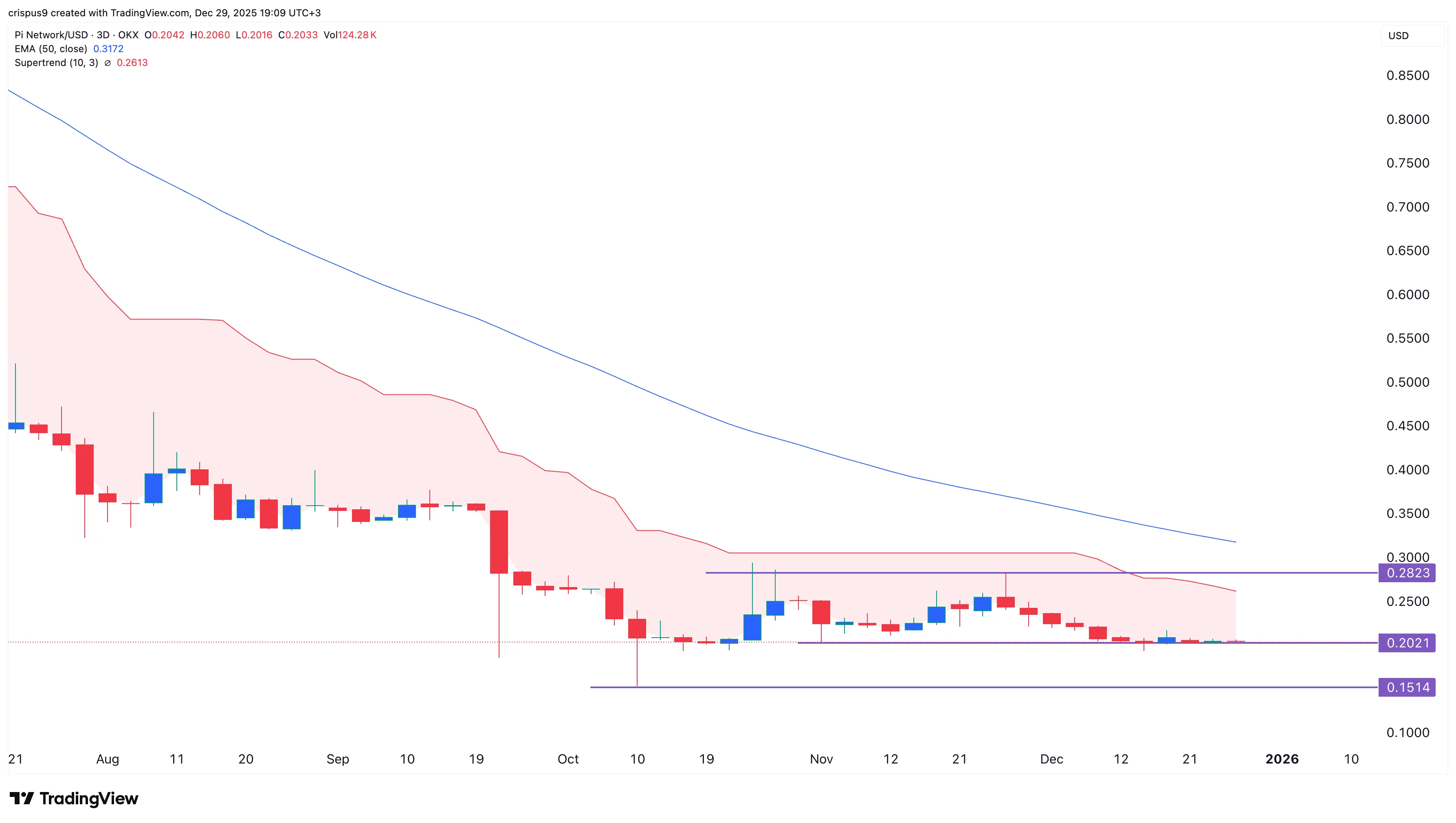
From a technical analysis perspective, Pi Network is in an extremely fragile state. The price is currently hovering around $0.2025, which is the lowest point since November 3, and also below the double top neckline at $0.2823. The double top pattern is a classic bearish reversal signal; once the neckline is broken, the price typically continues to decline by roughly the height of the head.
Worse still, Pi Network’s price has been below the 50-day exponential moving average (EMA), and the Super Trend indicator has turned red. The synchronized bearish signals from these two indicators suggest a clear medium-term downtrend. Without any obvious catalysts, the momentum from technicals will likely push the price lower.
The next key support level is at $0.1514, the October low and the all-time low. A drop from $0.2025 to $0.1514 represents a 25% decline. If this support fails, a vacuum zone will open below, lacking historical trading clusters to provide support. In this scenario, the price could spiral out of control, falling until new buyers step in at a lower level.
For Pi Network holders, the current choice is extremely difficult. Holding means enduring the sell pressure from the January unlock, risking further 25% or more losses. Selling early would add extra selling pressure in an already liquidity-starved market, accelerating the decline. This dilemma is a typical feature of a liquidity crisis and a core reason why Pi Network’s price could deepen from a 93% drop into an abyss.
Disclaimer: The information on this page may come from third parties and does not represent the views or opinions of Gate. The content displayed on this page is for reference only and does not constitute any financial, investment, or legal advice. Gate does not guarantee the accuracy or completeness of the information and shall not be liable for any losses arising from the use of this information. Virtual asset investments carry high risks and are subject to significant price volatility. You may lose all of your invested principal. Please fully understand the relevant risks and make prudent decisions based on your own financial situation and risk tolerance. For details, please refer to
Disclaimer.
Related Articles
Pi Network Explores AI Training With Over 421K Nodes in New Proof-of-Concept
Pi Network has over 421,000 Nodes, representing more than 1 million CPUs, that could support opt-in AI computing tasks.
In the OpenMind pilot, 7 Pi Node operators returned image-inference results within 4 seconds, including labels such as “bus” and “person”.
Pi Network is testing a new use f
CryptoNewsFlash2h ago
PI Token Maintains Bullish Trend as Anticipation for Pi Day Grows
PI token trades above $0.21 after rallying over 25% in the past 7 days as anticipation for the upcoming Pi Day on March 14 grows.
PiScan recorded 3 million PI deposits to exchanges in 24 hours, suggesting near-term profit taking which could reverse the bullish trend.
Pi Network’s PI token tr
CryptoNewsFlash2h ago
Pi Network Approaches Key Price Level — Breakout or Bull Trap Ahead?
Price Action: PI trades near $0.20 supply zone after short-term 5% rally.
Technical Signals: H4 chart bullish, but higher timeframe trends remain bearish.
Trading Strategy: Watch $0.1857 support and $0.216 resistance for breakout or bull trap confirmation.
Pi Network has shown
CryptoNewsLand3h ago
Pi Network announces that KYC validator rewards will be distributed by the end of March, with 17 million users having completed identity verification.
Pi Network announces that rewards will be distributed to KYC verifiers by the end of March 2026. These volunteers are responsible for verifying user identities to ensure network security. Currently, 17 million users have completed identity verification. Project updates include node upgrades and the possible launch of decentralized trading features, aiming to promote network development. The user base has already exceeded 50 million.
GateNews5h ago
Pi Network KYC Validators Set to Receive Rewards in March
Pi Network news today report it will soon reward community members. Those who helped verify user identities on the platform. KYC validators are expected to receive their rewards by the end of March. These validators played a key role in verifying
Coinfomania5h ago
Pi Network Price Surges 70% from February Lows as Pi Day and Network Upgrades Fuel Momentum
Pi Network's native token has rallied approximately 70 percent from its February 12 all-time low of $0.1312 to trade near $0.2165 on March 9, 2026, driven by anticipation surrounding the upcoming Pi Day event on March 14 and ongoing core network upgrades.
CryptopulseElite6h ago


