XRP presents a contradictory trend: in December, ETF net inflows reached $424 million, yet the price fell 15%, ranking it among the bottom ten. Institutions have locked hundreds of millions of tokens into cold wallets, causing circulation to decrease and forming a “spring-like” supply mechanism. Retail investor sentiment is pessimistic, but the Canary XRP ETF has already raised $300 million, with institutions mechanically increasing their holdings. Once the supply black hole encounters demand revival, prices could rebound sharply.
The deadly divergence between retail panic selling and institutional contrarian accumulation
(Source: CoinShares)
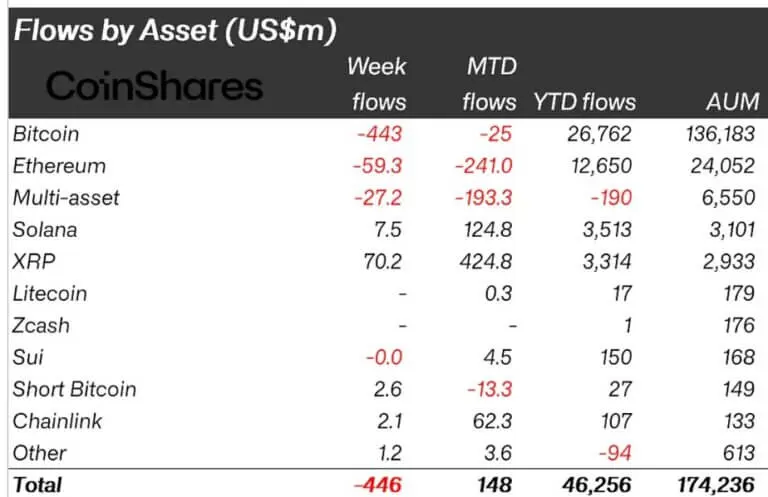
The current market structure of XRP reveals an ongoing capital transfer: retail momentum traders are exiting, while model-driven institutional allocators are stepping in. According to CoinShares data, XRP investment products attracted about $70.2 million in net inflows during the last trading week of December, pushing monthly inflows over $424 million, making it the best-performing crypto investment product of the month. Meanwhile, Bitcoin products experienced outflows of $25 million, and Ethereum funds saw outflows of $241 million.
However, the price tells a completely different story. XRP has fallen 15% this month, ranking at the bottom among the top ten cryptocurrencies, with trading prices approaching $1.87. This contradiction between record-breaking institutional inflows and the weakest price performance exposes a structural shift in the market. Retail investors see a declining candlestick chart and negative social sentiment, while institutions see an opportunity to buy long-term holdings at a discount.
The characteristics of institutional buying are entirely different from retail. ETF capital flows are not driven by traders timing the market but are process-driven. Advisory platforms, multi-asset funds, and wealth management networks only act after products are launched, performance records are established, and the spread is deemed acceptable. Once internally approved, asset allocations are usually hard-coded into portfolio models and rebalancing rules. This mechanical bidding helps explain why XRP ETPs continue to attract funds even as token prices decline and social sentiment remains negative.
(Source: Santiment)
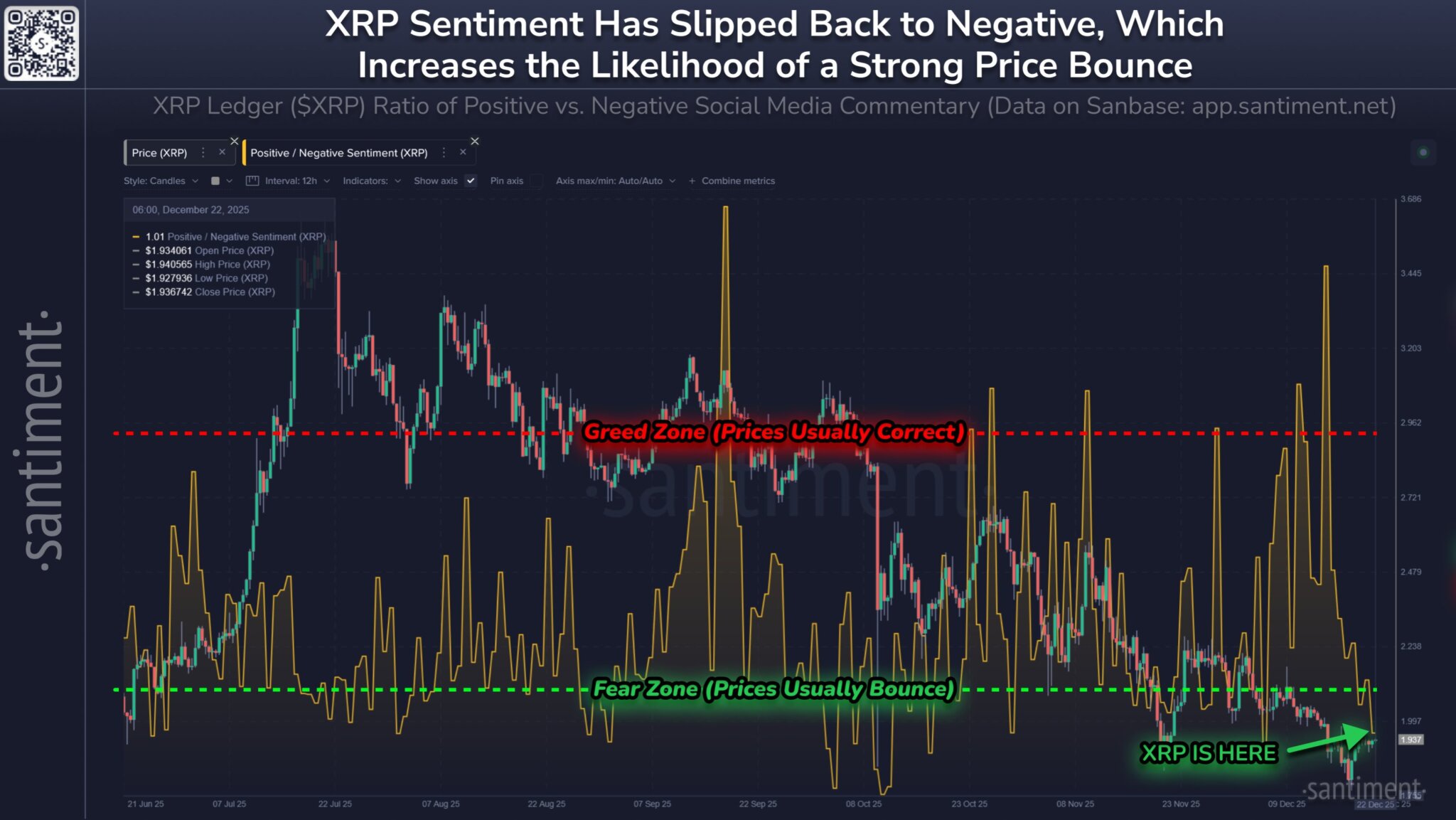
Santiment reports that recent weeks have seen significantly more negative comments about XRP than positive ones, reflecting retail disappointment over its underperformance compared to emerging high-volatility tokens. This extreme pessimism often precedes sharp contrarian rebounds historically. When retail and leveraged traders sell off due to year-end weakness, the other side of the trade—buyers—are completing strategic allocations rather than chasing breakouts.
Supply black hole created by ETF cold storage
The most critical impact of institutional buying is reflected in “circulating supply”—the amount of tokens available for active trading is shrinking rapidly. When ETFs or ETPs issue new shares to meet demand, authorized participants must acquire XRP and deliver it to custodians. As long as these shares are not redeemed, the underlying tokens are stored in cold wallets rather than on exchange order books.
Triple compression of the spring-like supply mechanism
ETF lock-up acceleration: Since mid-October, when US XRP spot products began trading, this category has attracted over $1 billion in net inflows. Canary XRP ETF (XRPC) has raised over $300 million since inception, setting a record for US ETF first-day trading volume in 2025. The XRP corresponding to these funds is locked in cold storage and will not return to the market in the short term.
Exchange balances decline: On-chain and exchange data show that although fund holdings are increasing, the balances held on centralized exchanges are decreasing. This indicates that the chips available for immediate buying and selling are diminishing, and market depth is thinning.
High redemption thresholds: While redemptions can push some supply back into tradable pools, institutional investors typically adopt long-term holding strategies, making short-term redemptions highly unlikely. These tokens are effectively “frozen” for months or even years.
This structure creates a “spring-like” market: supply is compressed but demand has not yet exploded. Once trading volume increases in January or macro catalysts trigger risk appetite, new buyers will find themselves competing in a scenario where supply has significantly decreased. In such cases, even a slight increase in demand could have a more dramatic impact on prices than when circulating supply was abundant at the start of the year. Similar supply compressions in the past have triggered over 50% short-term surges.
Hidden leverage in Ripple’s strategic layout
Some investors associate renewed interest in XRP tools with Ripple’s structural bets. By 2025, the company is actively expanding into traditional financial infrastructure, announcing acquisitions of major brokers Hidden Road and treasury management firm GTreasury, along with launching the USD stablecoin RLUSD. Once fully integrated, these moves will position Ripple across payments, custody, prime brokerage, and enterprise financial software.
Hidden Road clears trillions of dollars in transactions annually for hundreds of institutional clients, while GTreasury serves over 1,000 global corporate clients. Advocates of the “full-stack” theory believe these initiatives will transform Ripple from a payments company into a provider of vertically integrated digital asset pipelines for banks and hedge funds. In this framework, XRP ETF trading volume reflects participation in this infrastructure development; buyers are not merely speculating on tokens but gaining exposure to next-generation collateral and liquidity management networks through regulated instruments.
Looking ahead to 2026, the gap between XRP’s trading patterns and the underlying capital base is widening. Capital flow charts show new funds, new investing institutions, and increasing holdings by funds rebalancing based on calendar schedules rather than social media posts. Yet, the price trend remains weak, and community sentiment is skeptical. This contradiction may be more significant than any weekly performance—marking the completion of a market transition from retail-led to institutional-led dominance.
Disclaimer: The information on this page may come from third parties and does not represent the views or opinions of Gate. The content displayed on this page is for reference only and does not constitute any financial, investment, or legal advice. Gate does not guarantee the accuracy or completeness of the information and shall not be liable for any losses arising from the use of this information. Virtual asset investments carry high risks and are subject to significant price volatility. You may lose all of your invested principal. Please fully understand the relevant risks and make prudent decisions based on your own financial situation and risk tolerance. For details, please refer to
Disclaimer.
Related Articles
Ripple Splurges $750 Million on Share Buyback While XRP Continues Declining: Why Is the Company's Strategy Diverging from Token Value?
Ripple announced a $750 million stock buyback, with its company valuation potentially rising to $50 billion, yet the XRP token price continues to decline, exposing a decoupling phenomenon between the company and the token. Market confidence in Ripple and XRP is gradually diverging, requiring investors to clarify whether they are investing in company strength or token value, as they face challenges from regulation, utility, and market patience.
PANews1h ago
XRP Today's News: Rare Bottom Signal Appears, Technical Analysis Suggests Price Reversal Approaching
According to Glassnode data, XRP exhibits two major indicator signals indicating that the price is below its fair value, and the realized profit/loss ratio is approaching 1.0, which historically suggests a possible rebound. Additionally, XRP is consolidating within a symmetrical triangle pattern, with a key resistance at $1.50 and support at $1.30, as the market is about to experience a breakout in a specific direction.
MarketWhisper1h ago
US XRP spot ETF saw net outflows of $6.08 million yesterday, while SOL spot ETF saw net inflows of $3.92 million
Recently, data showed that as of 3 PM ET on March 12, the US XRP spot ETF saw net outflows of $6.0806 million, while the SOL spot ETF saw net inflows of $3.9248 million. The cumulative historical net outflows for XRP reached $17.8894 million, while SOL reached $961 million.
GateNews2h ago
Yesterday, the US XRP spot ETF experienced net outflows of $6.0806 million, with 21Shares and Franklin products leading the decline.
According to SoSoValue data, on March 12, the US XRP Spot ETF had net outflows of $6.0806 million, with 21Shares XRP ETF experiencing net outflows of $3.0891 million. The current total assets under management are $968 million, with cumulative historical net inflows reaching $1.208 billion.
GateNews3h ago


