
Truebit protocol experienced a security incident on Thursday, causing the TRU token to plummet from $0.16 to $0.0000000029, a decline of over 99%. According to Nansen data, hackers stole 8,535 ETH, worth approximately $26.6 million. Lookonchain has tracked the flow of funds, but the Truebit team has not yet disclosed the cause of the vulnerability, leading to a complete collapse of market confidence.
Truebit 8,535 ETH Disappeared in 24 Hours
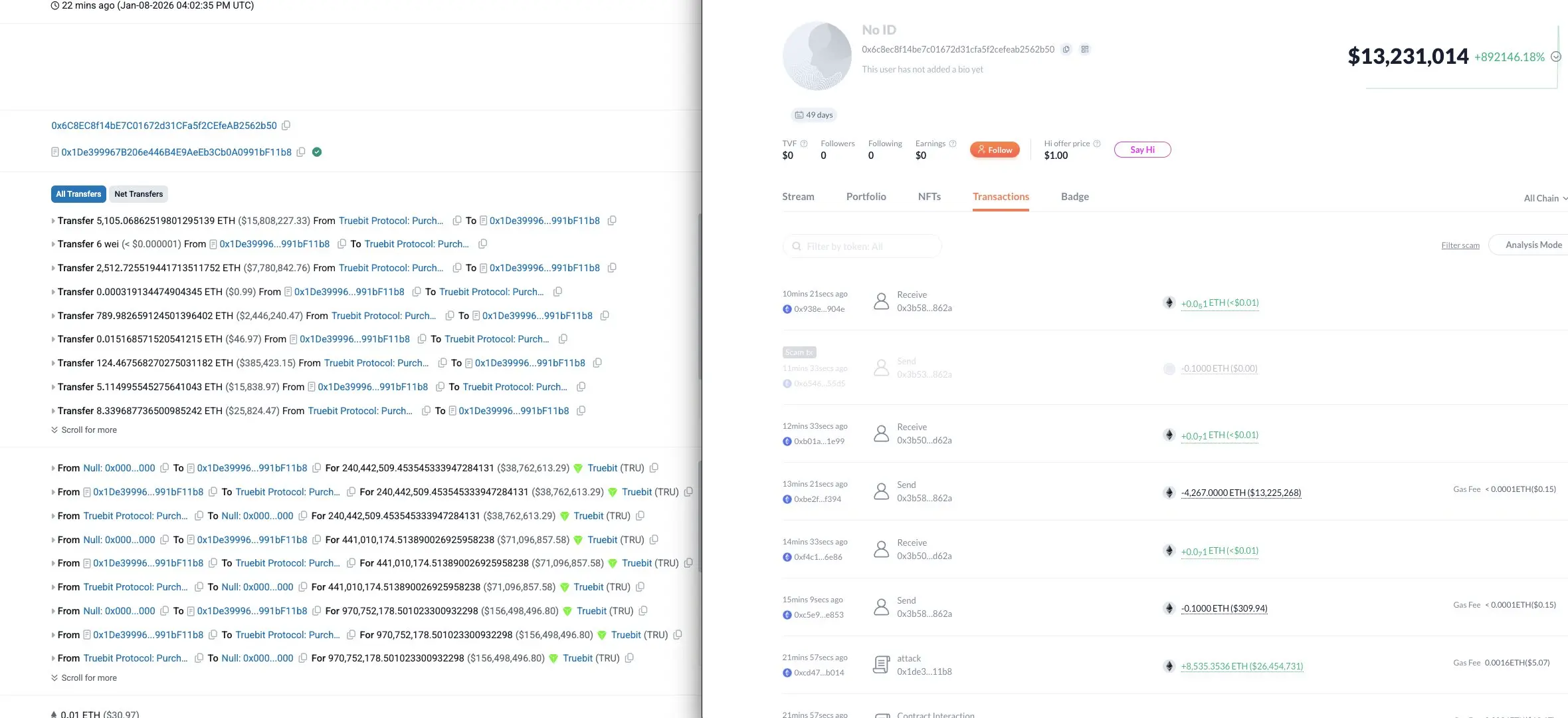
(Source: Obscicron)
On Thursday, Truebit issued an emergency announcement on X platform confirming a security incident involving “one or more malicious actors.” The affected smart contract addresses provided by the official show abnormal transaction records, but the initially disclosed stolen amount vastly underestimated the actual loss. After in-depth analysis by Lookonchain and other blockchain investigators, it was found that the total value of stolen cryptocurrencies in this attack exceeded $26 million, far higher than Truebit’s initial indication.
Crypto detective reports monitoring the protocol state that hackers successfully extracted 8,535 ETH. At the current ETH price of $3,109, this amount is worth about $26.6 million. The stolen funds have been traced to multiple addresses, indicating that the hackers employed complex mixing and transfer strategies. Some funds flowed to decentralized exchanges, while others were dispersed into dozens of newly created wallets, a typical money laundering prelude.
Truebit claims to have “taken all feasible measures” and has contacted law enforcement, but as of press time, the protocol has not announced any specific compensation plans or security audit reports. It remains unclear what technical factors caused this multi-million-dollar vulnerability event, or whether user funds are at risk. Cointelegraph has reached out to Truebit for comment but has not received a response. This silence further fuels market panic, with investors rushing to sell TRU tokens, triggering a death spiral decline.
Even more concerning is that the number of stolen ETH shown at the affected smart contract addresses provided by Truebit is far less than the actual loss uncovered by investigators. This information asymmetry raises questions: Does the protocol fully understand the scope of the vulnerability? Are there more undisclosed affected contracts? These unresolved mysteries caused TRU token’s price to crash completely within hours, from $0.16 to nearly zero at $0.0000000029.
Market Panic Mechanism Behind Price Zeroing
Shortly after the vulnerability was exposed, the price of Truebit tokens began to fall freely. According to Nansen data, TRU’s price dropped from about $0.16 to $0.0000000029, meaning that investors holding $10,000 worth of TRU saw their assets shrink to just about $0.18 within hours. This catastrophic decline is extremely rare in crypto history, even surpassing many classic Rug Pull cases.
The price collapse mechanism reveals the fragility of small-cap tokens. Truebit’s liquidity was already limited; once the news of the vulnerability spread, panic selling instantly exhausted all buy orders. Automated market makers (AMMs) on decentralized exchanges were broken through, causing prices to plummet vertically after losing support. Worse, arbitrage bots detected the abnormal price and began arbitraging between different exchanges, further driving down the price.
Centralized exchanges responded more directly: multiple exchanges temporarily suspended TRU trading and withdrawals. While these measures aim to protect users, they also trap holders unable to exit. Users stuck on exchanges watched their assets go to zero without being able to take any action. This “liquidity trap” is a typical consequence of small token hacker incidents, often causing greater secondary damage than the attack itself.
The Black Start of Crypto Security in 2025
The Truebit hacker incident is not an isolated case but the latest chapter in the 2025 crypto security crisis. Multiple major hacking and vulnerability exploitation events occurred in December, indicating that industry security defenses have not improved with technological progress.
Major Security Incidents in December 2024
Flow Foundation Fake Token Incident: On December 27, attackers successfully forged network tokens, causing approximately $3.9 million in losses
Trust Wallet Chrome Extension Attack: Hackers exploited malicious updates to steal $7 million from users
Total December Losses: $76 million (a 61% decrease from $194 million in November)
Blockchain analysis platform PeckShield reported on January 1 that although total losses in December decreased compared to November, the destructive potential of individual incidents is increasing. The $26 million loss in Truebit, if it had occurred in December, would account for over one-third of that month’s total losses. This trend indicates that while the number of small attacks is decreasing, large, carefully planned exploits are on the rise.
Even more worrying is that the technical complexity of these attacks is increasing. The fake token attack on Flow Foundation requires deep understanding of on-chain governance mechanisms, while the supply chain attack on Trust Wallet demonstrates hackers targeting infrastructure layers. Although technical details of the Truebit case have not been disclosed, the scale of the 8,535 ETH extraction suggests a long-term stealthy and meticulously planned operation.
Related cases include Gnosis announcing a hard fork to recover funds lost due to a Balancer vulnerability. Such “time-reversal” remedies can recover funds but also raise philosophical debates about blockchain immutability. Will Truebit take similar measures? The current silence from the team leaves this question unanswered.
Disclaimer: The information on this page may come from third parties and does not represent the views or opinions of Gate. The content displayed on this page is for reference only and does not constitute any financial, investment, or legal advice. Gate does not guarantee the accuracy or completeness of the information and shall not be liable for any losses arising from the use of this information. Virtual asset investments carry high risks and are subject to significant price volatility. You may lose all of your invested principal. Please fully understand the relevant risks and make prudent decisions based on your own financial situation and risk tolerance. For details, please refer to
Disclaimer.
Related Articles
Ethereum Activity at All-Time Highs Due to Mass Capitulation - U.Today
Ethereum's network shows high activity, surpassing 2021 metrics, but this surge is due to investors selling rather than genuine demand. Liquidity is declining as users withdraw capital to exchanges, signaling potential challenges ahead.
UToday2h ago
Mega Bank's Director Rui-bin Zhuang tests stablecoin remittances, but the costs of blockchain are misunderstood.
Mega Financial Holding Co. held a media briefing on the 10th. Chairman Dong Rui-bin revealed that to objectively compare the efficiency of bank and blockchain remittances, Mega Bank mobilized 17 countries worldwide and 25 overseas branches last year for testing. Branch staff opened accounts at local legal exchanges and used the virtual asset trading platform BitoPro to trade USDT stablecoins, transferring 50 USDT each time back to Taiwan, and compared this with traditional bank cross-border wire transfers.
The results showed that stablecoins do have advantages for small-scale cross-border remittances. However, for remittance amounts exceeding the equivalent of NT$200,000 (about $7,000 USD), banks remain more cost-competitive.
Mega Experiment: Banks Are More Cost-Effective for Transfers Over $7,000 USD
The test results indicated that in the scenario of "paying NT$ in Taiwan and receiving local currency at the destination," bank wire transfers generally arrive within about 2 hours, with a fee of approximately
ChainNewsAbmedia4h ago
ETH drops 1.07% in 15 minutes: whale fund concentration triggers short-term pullback
March 10, 2026, 18:00 to 18:15 (UTC), ETH's return within the 15-minute candlestick was -1.07%, with price fluctuations ranging from 2049.1 to 2073.15 USDT, an amplitude of 1.16%. During the same period, market trading volume significantly increased by over 32%, large on-chain fund flows occurred frequently, triggering short-term market sentiment fluctuations, rapidly increasing attention, and intensifying volatility risks.
The main driver of this abnormal movement is the concentrated sell-off by whale funds. On-chain data shows that within this time window, there were four large transfers exceeding 5000 ETH, all flowing to a major...
GateNews4h ago
Tom Lee’s BitMine Acquires 60,976 ETH, Holdings Now $10.3B
Bitmine Immersion Technologies reports total assets of $10.3 billion, including 4.53M ETH. With 3.04M ETH staked, it generates $174M annually at a 2.91% yield. The firm seeks to reach 5% of total ETH supply and is expanding its staking infrastructure.
CryptoFrontNews7h ago


