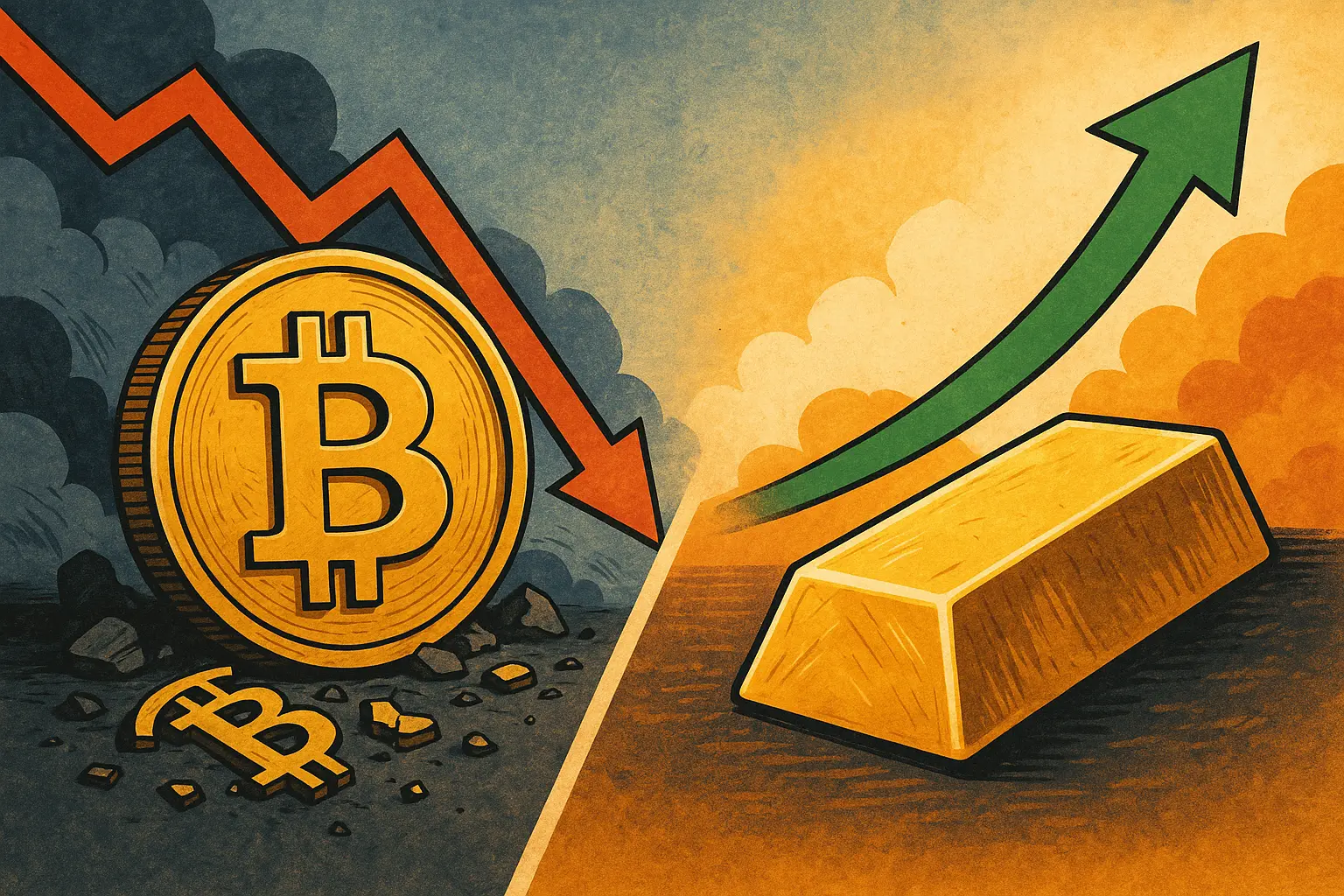
Bitcoin reached $97,500 in mid-January, then plummeted to $87,000 due to Trump’s tariff threats, while gold hit new highs. Bitcoin ETF outflows in November reached a record $3.5 billion, continued in December, and only $700 million flowed in January. USDe and USDX stablecoins face worsening crises, eroding trust. Japanese experts point out that Bitcoin lacks central bank holdings to support its value, making it difficult to replicate gold’s status.
Disparity Between Gold and Bitcoin Under Trump’s Tariff Threats
Representative cryptocurrency Bitcoin experienced a sharp decline. In mid-January, Bitcoin’s price briefly hit $97,000, a two-month high, but then sharply fell, nearly offsetting gains since the start of the year. Regarding Greenland’s ownership, when President Trump proposed tariffs on Europe, Bitcoin’s price correlated with the stock market, with selling momentum intensifying.
At the start of the new year, U.S. military strikes against Venezuela caused a surge. Bitcoin is less affected by specific national or regional situations and is more likely to be bought amid escalating geopolitical risks. As of January 15, the price had risen about $10,000 compared to late 2025, reaching the $97,500–$98,000 range.
The turning point came on the 16th. President Trump announced tariffs on eight European countries until Denmark’s autonomous territory Greenland was acquired. Bitcoin’s price began to decline after the weekend, dropping to around $87,000 on the 22nd, breaking below the late 2025 level. Concerns over trade friction led to decreased risk appetite, with Bitcoin and stock markets experiencing continuous sell-offs. On the 20th, the U.S. stock market, the Dow Jones Industrial Average, fell sharply by 870 points from the previous weekend. “Bitcoin, viewed as a risk asset, declined along with the market,” said Tomoya Hasegawa, a market analyst at bitbank.
However, amid soaring gold prices, Bitcoin was sold off. This divergence directly challenges Bitcoin’s core narrative as digital gold. Bitcoin has a cap of 21 million coins, similar to the limited reserves of gold. Compared to currencies losing value due to inflation, Bitcoin is considered a strong store of value, often called “digital gold.” By 2025, Bitcoin is expected to become an investment asset for capital fleeing the U.S., rising alongside gold, attracting attention.
Nevertheless, the market turmoil triggered by Trump’s tariff threats has completely altered this correlation. When investors seek safe havens, gold becomes the first choice, soaring to historic highs. Bitcoin, however, declines along with stocks, indicating it functions more like a risk asset during crises rather than a hedge. Although Trump later softened his stance on Europe, delaying tariffs, Bitcoin’s price trend remained weak. Muneharu Matsushima, a cryptocurrency analyst at Monex Securities, stated, “The view of Bitcoin as digital gold is weakening.”
Chain Reaction of Stablecoin Crises Deals Heavy Blow to Market Trust
The background for Bitcoin’s abnormal behavior is growing distrust in the cryptocurrency market. In October 2025, the stablecoin “USDe” sharply fell from its usual stable value of 1 USDe = 1 USD, leading investors using USDe as collateral for credit trading to face forced liquidations. In early November, a hacking incident triggered a crash in the stablecoin USDX. The outlook for the crypto market darkened.
The stablecoin crises have indirectly but profoundly damaged Bitcoin’s narrative as digital gold. Stablecoins were originally designed as “safe havens” in crypto markets, maintaining a value close to $1. However, the crashes of USDe and USDX show that even assets claiming to be dollar-pegged can experience extreme volatility. This systemic risk exposure raises doubts about the stability of the entire crypto ecosystem.
If even stablecoins are unstable, the credibility of Bitcoin as “digital gold” is naturally questioned. Gold’s reputation as a safe-haven asset is backed by thousands of years of history, whereas Bitcoin has only 15 years of history. The stablecoin crises serve as a reminder that the crypto market is still in its early stages, with systemic risks far higher than traditional finance.
The de-pegging event of USDe is particularly instructive. Issued by Ethena, this synthetic stablecoin relies on complex basis trading strategies to maintain its value. During extreme market volatility, this mechanism failed, causing a 35% plunge in value. Investors using USDe as collateral were forcibly liquidated, suffering heavy losses. This event not only affected direct participants but also triggered chain reactions across the market, raising widespread concerns about the structural risks of crypto financial products.
The USDX hacking incident exposed security vulnerabilities. If stablecoin smart contracts have loopholes, malicious actors could exploit them, leading to fund losses and collapse in value. Such technical risks are nonexistent with traditional gold, further widening the reliability gap between Bitcoin and gold.
Continuous Outflows from Bitcoin ETF Record New Low
In November 2025, U.S. Bitcoin spot ETFs saw outflows of $3.5 billion, the largest ever, with continued outflows in December. In January, there was a net inflow of only about $700 million, a much lower level.
Fund flows in Bitcoin ETFs are the most direct indicator of institutional sentiment. The $3.5 billion outflow in November set a record, indicating large-scale withdrawals by institutional investors. This occurred when Bitcoin prices were relatively high, possibly reflecting profit-taking and risk management. The continued outflows in December further confirmed this withdrawal trend, rather than a one-off event.
In January, the net inflow of only $700 million contrasts sharply with previous months’ inflows of tens of billions. This sharp decline in capital inflow indicates a clear cooling of institutional enthusiasm for Bitcoin. Possible reasons include: concerns over Trump’s policy uncertainties, systemic risks from stablecoin crises, and the underperformance of Bitcoin compared to gold during tariff crises, raising doubts about its safe-haven qualities.
The shift in Bitcoin ETF fund flows directly challenges the narrative of Bitcoin as digital gold. If Bitcoin were truly as reliable as gold, institutions would increase holdings during market volatility. Gold ETFs tend to see inflows during crises, as investors view gold as a safe haven. The large-scale outflows from Bitcoin ETFs suggest institutions see it as a risk asset needing to be reduced.
Legislative Progress and the Critical Missing Piece of National Reserves
In the U.S. Congress, the “Clarity Act,” which clarifies the overall framework for cryptocurrencies, has officially begun its review. If passed, it will make it easier for large financial institutions to engage in related activities. Watanabe Arisaka, president of Japan’s xWIN, a decentralized finance service provider, predicts, “If it passes, it will be a positive factor, and a price breakthrough of $100,000 could be within reach.”
In November, the U.S. will hold midterm elections. Some believe the Trump administration will push policies to garner support from the crypto industry. If legislation related to cryptocurrencies advances and policies support it, distrust could diminish.
However, many point out that for Bitcoin to truly establish itself as digital gold, it must, like gold, see an increase in national holdings. Gold’s price is supported by demand from central banks worldwide. Currently, only a few countries hold Bitcoin.
This is the fundamental gap between Bitcoin and gold. Over 35,000 tons of gold reserves are held by central banks globally, providing a solid institutional demand base. Central bank gold purchases are typically strategic, long-term allocations unaffected by short-term market fluctuations, making gold more reliable during crises.
In contrast, very few countries have incorporated Bitcoin into their reserves. El Salvador is the most famous example, but its economy is small and influence limited. If major economies like the U.S., China, or the EU began large-scale Bitcoin holdings as reserves, it would fundamentally change Bitcoin’s market position. However, such a shift faces significant political and technical hurdles.
Even if Bitcoin recovers its upward momentum, gaining broad investor trust comparable to gold’s may be difficult. Rebuilding the narrative of digital gold requires time, stable market performance, and wider institutional adoption.


