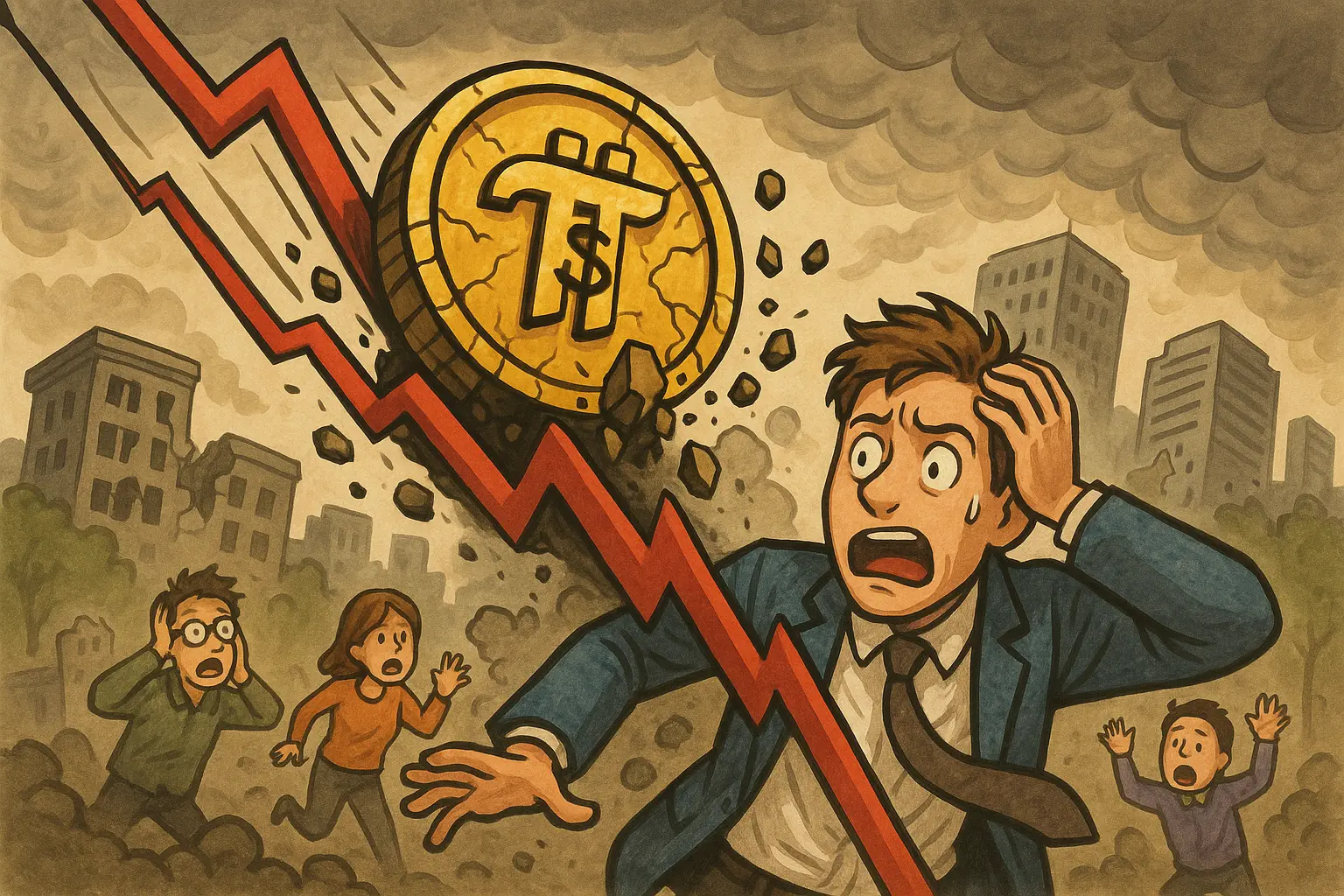
The token has fallen to $0.1717, with market capitalization crashing from $20 billion to $1.43 billion. Four fatal flaws: 134 million unlocked in January, only $10 million daily trading volume, protocol upgrade delayed for months, Pi Foundation holds 90 billion highly centralized tokens. Not listed on mainstream exchanges, lacking DeFi, considered a “ghost chain.” Technical double top breakout targets a new low of $0.15.
Fatal Flaw One: 1.2 Billion Tokens Unlocking and Dumping Countdown
(Source: Trading View)
派幣 The price plummeted amid simultaneous declining demand and increasing supply. Due to continuous token unlocks, supply increases while trading volume declines. Over 134 million tokens were released in January, and another 1.2 billion will be unlocked in the next 12 months. This “time bomb” style supply release is the core reason for the persistent downward pressure on the token price.
From a supply and demand perspective, 134 million tokens at the current price of $0.1717 equate to a potential sell pressure of about $23 million. If these unlocked token holders choose to cash out immediately and market buy-in cannot keep up, the price will inevitably fall. More critically, the 1.2 billion tokens to be unlocked over the next 12 months are valued at approximately $206 million at current prices, representing a continuous Damocles sword hanging over the market.
Unlocked tokens usually come from early teams, investors, or miners, whose cost basis is extremely low or even zero. They have a strong incentive to sell at any price. Unlike institutional investors or long-term holders, these early participants often lack confidence in the project’s long-term value and prefer to “take profits.” Historically, many crypto projects have seen their prices halved or even go to zero after large-scale unlocks, and the same could happen to this token.
Token Unlock Schedule and Dumping Estimates
January 2026: 134 million tokens unlocked (approx. $23 million dump)
Next 12 months: 1.2 billion tokens unlocked (approx. $206 million dump)
Market absorption capacity: Only $10 million daily trading volume, requiring 20 days to fully absorb a month’s unlock
This severe imbalance between supply and demand is the fundamental reason for the token’s price collapse. Unless the team can significantly boost market demand or adjust the unlock schedule, downward pressure will persist.
Fatal Flaw Two: Liquidity Drought Turns It into a Zombie Coin
Data from CoinGecko shows that the token’s trading volume in the past 24 hours is only $10 million. Considering the total crypto industry trading volume over the same period exceeds $116 billion, this figure is negligible, accounting for just 0.009% of the global market. This liquidity drought effectively turns the token into a “zombie coin,” where even a slightly large sell order could trigger violent price swings.
The lack of liquidity creates multiple vicious cycles. First, low price discovery efficiency—when buy and sell orders are thin, prices are easily manipulated or experience extreme volatility. Second, high transaction costs—users face high slippage when exchanging the token, potentially losing 5%-10% of value. Third, confidence collapse—when investors see such low trading volume, they question the project’s actual activity and may choose to exit.
The root cause of the token’s liquidity drought is its absence from mainstream exchanges. Coinbase, Binance, and other top-tier exchanges contribute over 70% of global crypto trading volume. Currently, the token is only traded on a few second- and third-tier exchanges and OTC markets, which lack the user base and trading depth of major platforms. The core team announced a strategic shift last year to prioritize ecosystem development over listing, reflecting a long-term approach but sacrificing short-term liquidity.
Compared to other projects, even smaller tokens with similar market caps usually achieve daily trading volumes of tens of millions or even billions of dollars. The $10 million trading volume of this token, given its $1.43 billion market cap, is highly mismatched, and this extreme imbalance between liquidity and market cap is why it is categorized as a “zombie coin.”
Fatal Flaw Three: Delayed Technical Upgrades and Ecosystem Hollowing
The price of the token has plummeted due to delays in upgrading the Stellar network from protocol 19 to protocol 23. The upgrade process has been ongoing for months and remains in testing. In contrast, Stellar has already upgraded to protocol 25. This technological lag indicates serious issues with the development capability and execution of the token team.
Built on Stellar’s consensus protocol, the token should theoretically be able to quickly follow Stellar’s technical upgrades. However, the months-long delay suggests the team may be facing difficulties in technical adaptation or lacks development resources. For a project claiming 60 million users, such infrastructure lag is unacceptable. Investors will question how the team can sustain operations of a large ecosystem if even protocol upgrades cannot be completed on time.
More seriously, the ecosystem is hollowing out. The token struggles to build its own ecosystem; unlike Ethereum and Solana, it lacks DeFi, real-world asset tokenization, and gaming ecosystems, thus being regarded as a “ghost chain.” Although the official claims to have 215 applications, their actual activity and trading volume data have never been disclosed. The public generally suspects most applications are in a “zombie state,” with very few daily active users.
Fatal Flaw Four: Extremely Centralized Governance and Controversies
The token remains one of the most centralized cryptocurrencies, with all decisions made by the team, and the mysterious Pi Foundation holding over 900 billion tokens in hundreds of wallets. The millions of users in the community have no opportunity to vote on updates or features, which is completely contrary to the decentralization spirit of blockchain.
What does 900 billion tokens mean? Based on the current circulating supply, the Pi Foundation controls over 90% of the total supply. This highly concentrated holding structure effectively makes the project a “team’s ATM,” capable of selling and cashing out at any time without restraint. Although the team claims these tokens will be used for ecosystem development and community rewards, the lack of transparent lock-up mechanisms and independent audits prevents investors from verifying these promises.
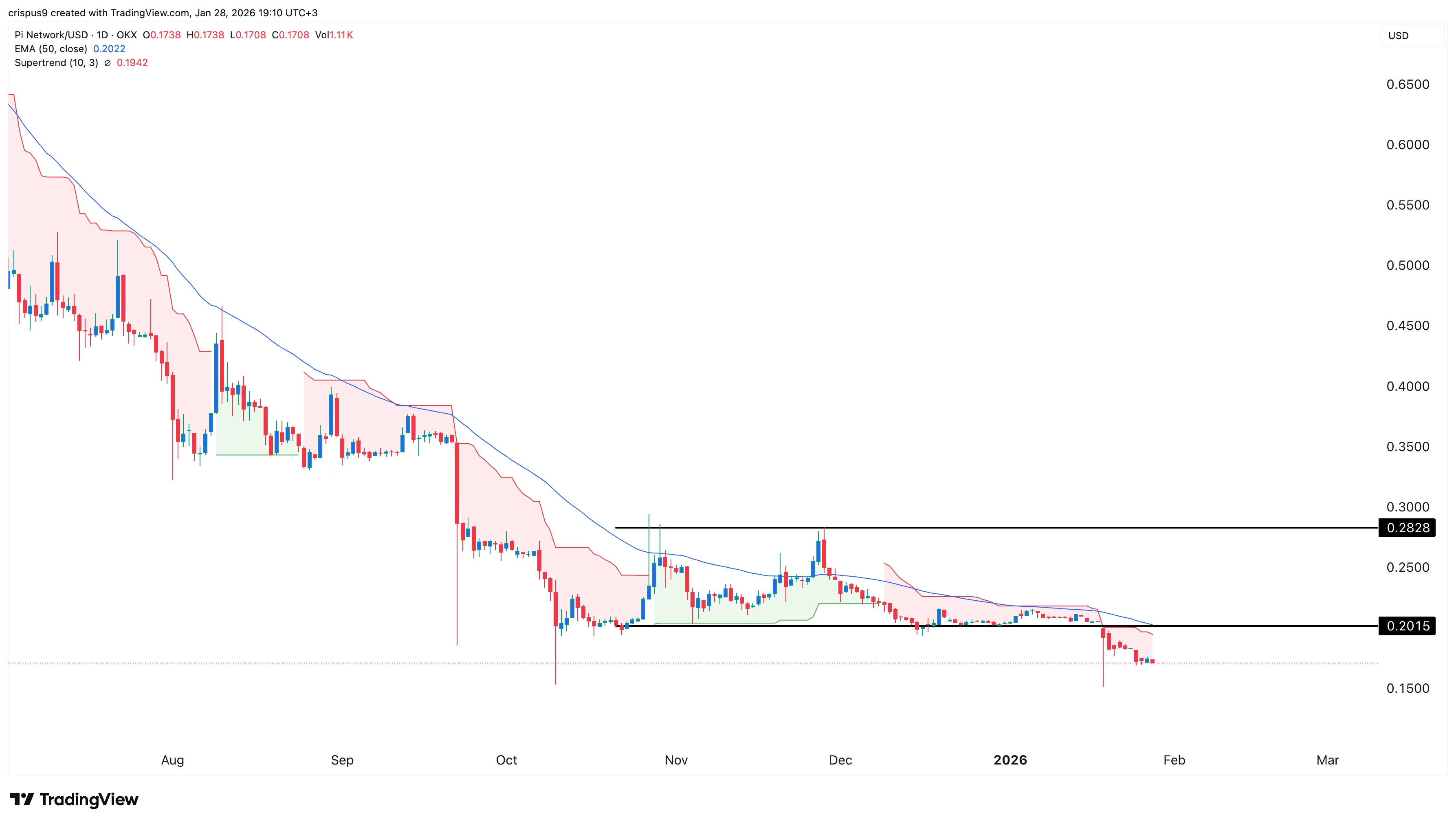
Technically, the token forms a double top at $0.2828, with a neckline at $0.2015. The double top is a classic reversal pattern; once the neckline breaks, a significant downward move often follows. The height from $0.2828 to $0.2015 is about $0.0813, so the target is $0.2015 - $0.0813 = $0.12, close to the historical low of $0.15.
The price forecast for the token is most likely bearish, with a near-term target of falling to the historical low of $0.15. The daily chart shows that the token has continued a strong downtrend this month, remaining below the super trend indicator and all moving averages, with all technical indicators confirming a bearish structure.
Disclaimer: The information on this page may come from third parties and does not represent the views or opinions of Gate. The content displayed on this page is for reference only and does not constitute any financial, investment, or legal advice. Gate does not guarantee the accuracy or completeness of the information and shall not be liable for any losses arising from the use of this information. Virtual asset investments carry high risks and are subject to significant price volatility. You may lose all of your invested principal. Please fully understand the relevant risks and make prudent decisions based on your own financial situation and risk tolerance. For details, please refer to
Disclaimer.


