Author: @WazzCrypto, Legion
Translation: Frank, PANews
Observations on Prediction Markets in the Token World
Polymarket’s TokenSale market has handled nearly $250 million in trading volume. The platform’s claimed accuracy metrics are impressive: subscription amount prediction accuracy reaches 100%, and FDV (Fully Diluted Valuation) exceeds 90%. However, deeper analysis reveals these numbers can be misleading. The real signal isn’t about what the crowd predicted, but how far off their predictions were.
By analyzing 231 predictions across 29 token sale events and cross-referencing Polymarket’s historical probability data with actual token performance on CoinGecko, we find that “prediction markets are not reliable forecasting tools.” Instead, they serve as sentiment indicators, often providing reverse signals.
Key Finding: One week before market close, the actual prediction accuracy drops to only 66.7%. At critical moments, there’s a one-in-three chance the crowd is wrong, and incorrect predictions tend to show systematic over-optimism.
24-hour Volatility Issue: Using hourly data from CoinGecko, we find that Polymarket’s “FDV higher than X one day after release” market is essentially betting on extreme volatility. The average 24-hour price change is ±23% (best performer: Monad +54.8%; worst: Trove -38.7%). 75% of tokens experience sell-offs within 24 hours of opening. Under these conditions, Polymarket’s accuracy in 24-hour FDV predictions is only 62.5%.
The Fallacy of Accuracy: One-third of the time, the market is wrong
When we track market probabilities that change over time, rather than static data at settlement, a very different picture emerges. The seeming “100% accuracy” of subscription markets is because, as sales progress, the final numbers inevitably leak out. Insiders and observers update prices accordingly, which is just post hoc price discovery.
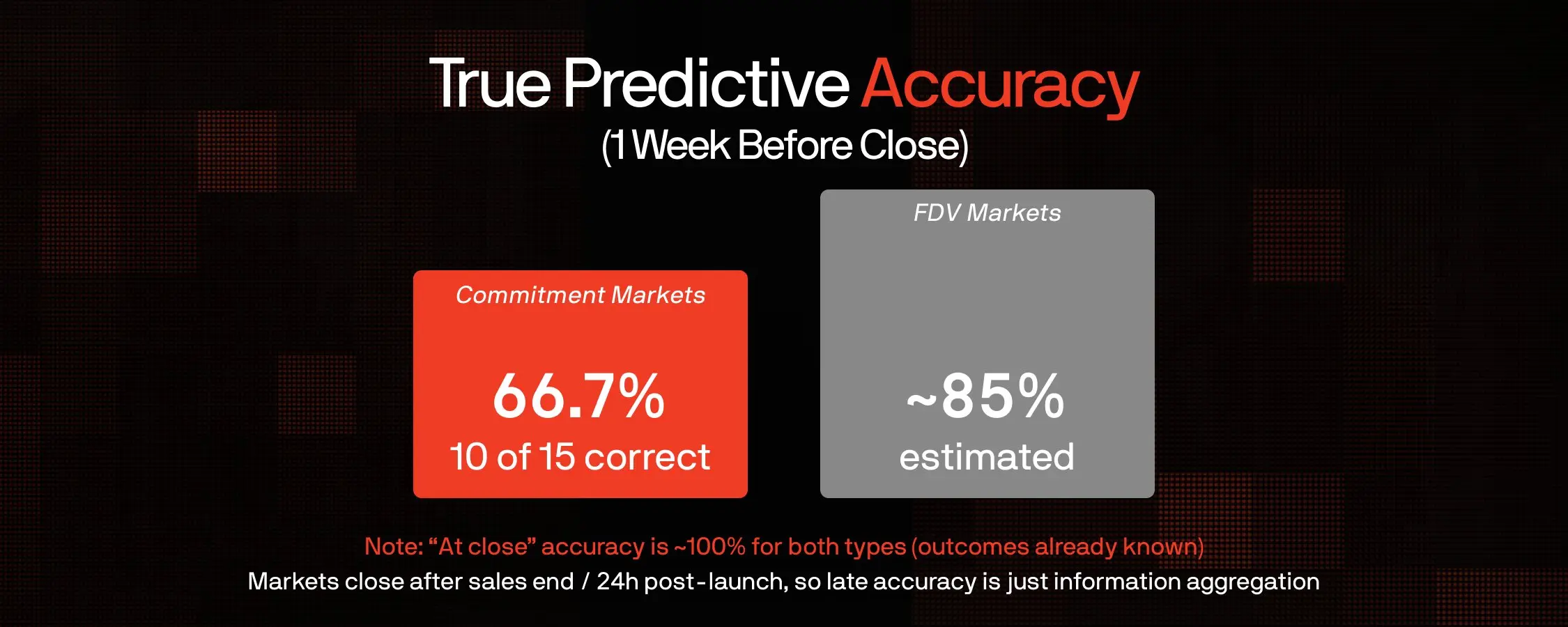
Critical Insight: The reason subscription markets and FDV markets approach 100% accuracy at close is because they settle after the outcome is essentially known. Subscription markets close after sales end; FDV markets close 24 hours after release. The only meaningful prediction window is the one week before close, when uncertainty still exists. A 66.7% accuracy rate indicates that, at critical moments, the market is wrong one-third of the time.
The crowd’s over-optimism leads to prediction errors
We reviewed every prediction market where “public confidence exceeded 60% but ultimately was not realized.” In each case, the error was consistently in the same direction: excessive optimism. The crowd always overestimates fundraising amounts and valuation.
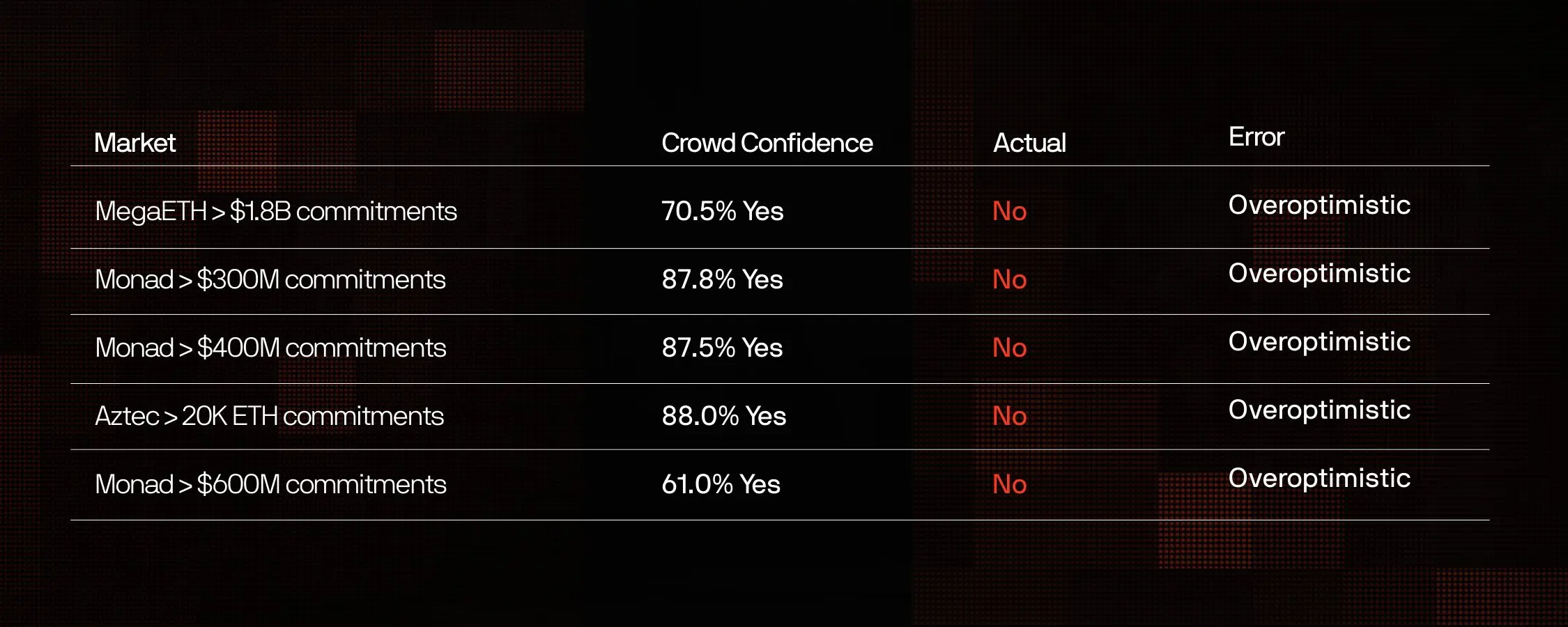
This systematic bias suggests that market participants are optimistic speculators, attracted by the bullish narrative and the allure of token sales.
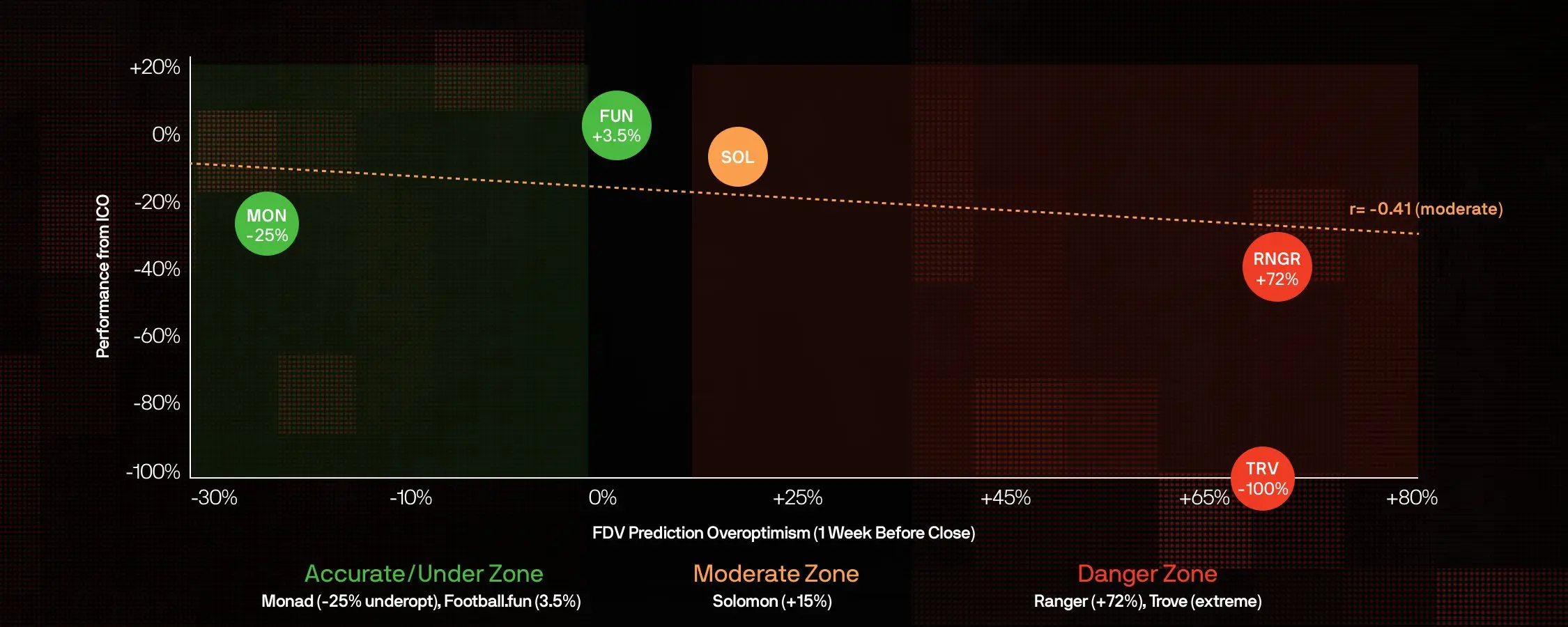
Over-optimism vs. Token Performance (based on ICO data)
Methodology: This analysis only includes markets for tokens with publicly available ICO data and issued tokens, using Polymarket odds from one week before closing.
Over-optimism degree = (Polymarket predicted FDV - actual 24h FDV) / actual 24h FDV.
Y-axis shows price performance from ICO to present.
Data shows a moderate negative correlation between over-optimism and ICO returns (r = -0.41). Monad was “undervalued/pessimistic” by -25%, yet its price still fell 24% from ICO. Ranger was “most overly optimistic” (+72%), but its current price is down 32% from ICO. Only Football.fun remains above ICO price (+1%).
Token Performance Ranking: 40% of tokens debut below valuation
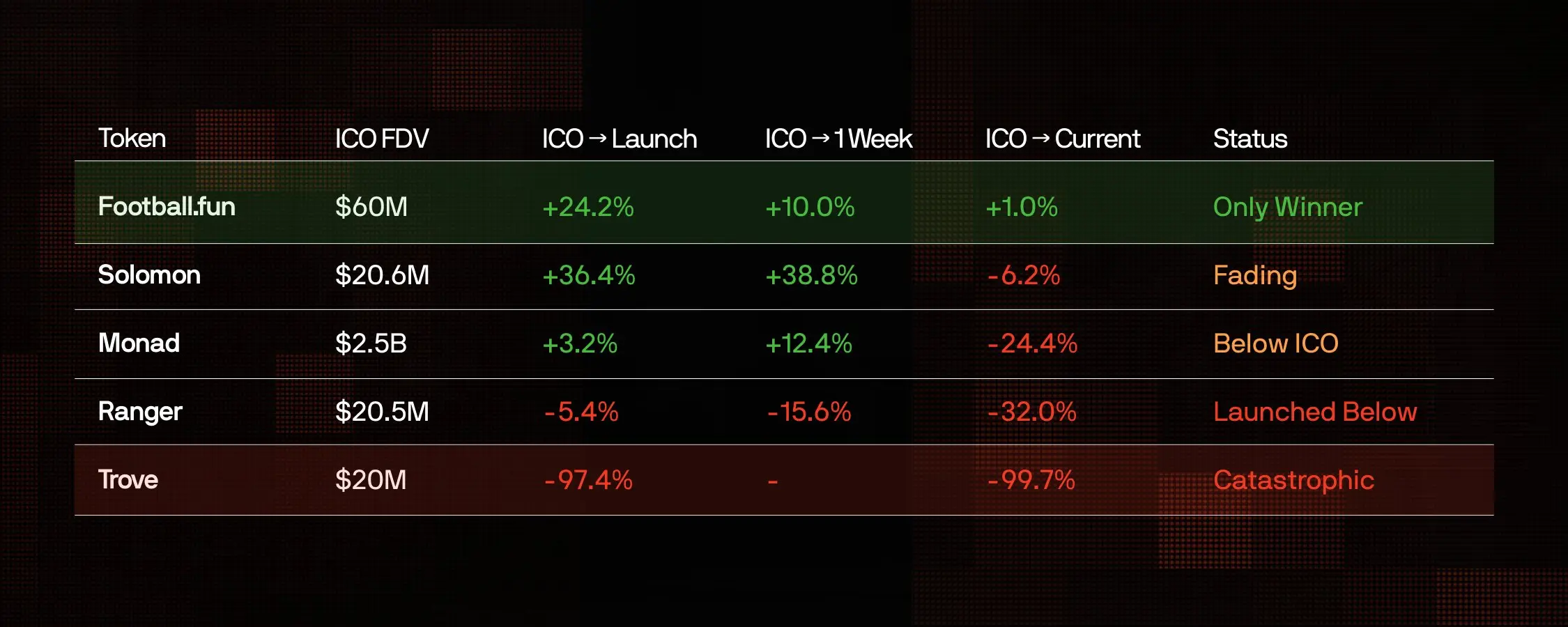
The table below uses Polymarket odds from one week before close to reveal actual prediction accuracy. The pattern is clear: extreme over-optimism predicts disaster, and high trading volume on Polymarket—even when predictions are accurate—often signals the opposite.
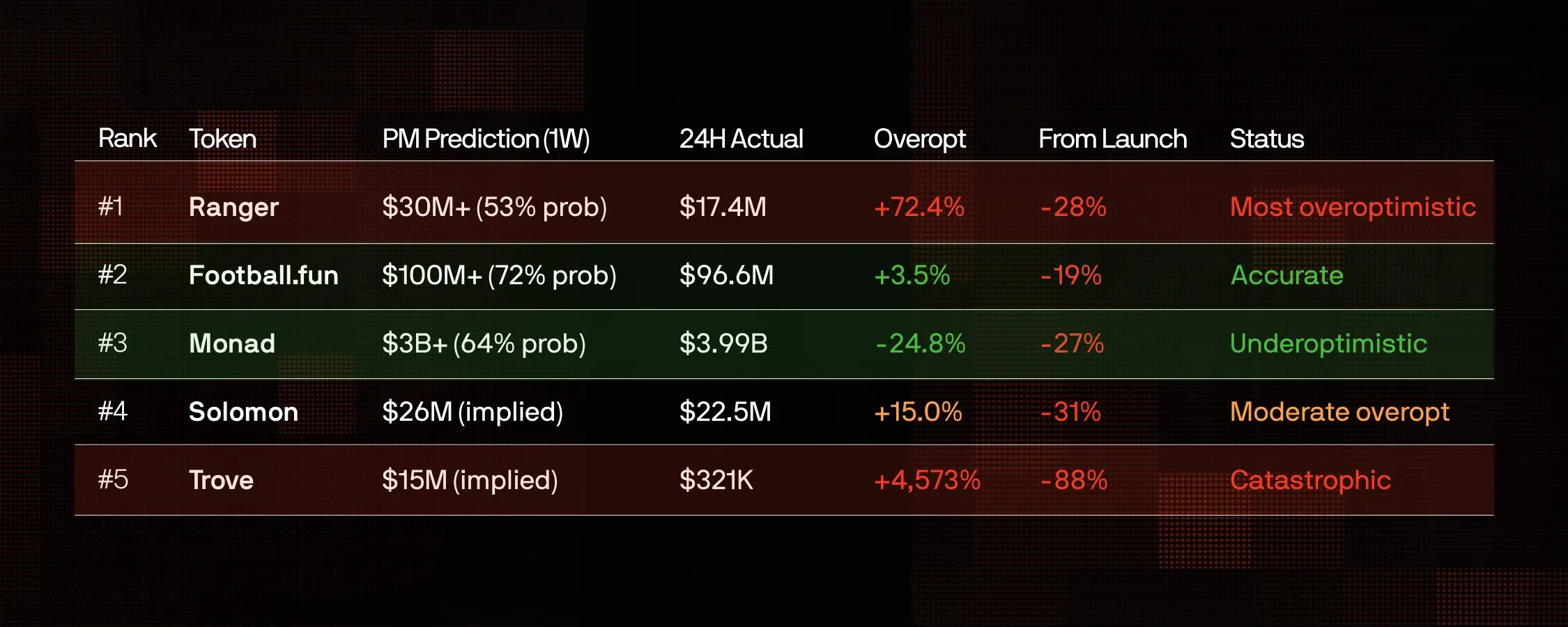
Key Finding: Among tokens with ICO data, 40% debuted below their ICO valuation. The average return from ICO to now is -32.2%. Only Football.fun traded above its ICO price.
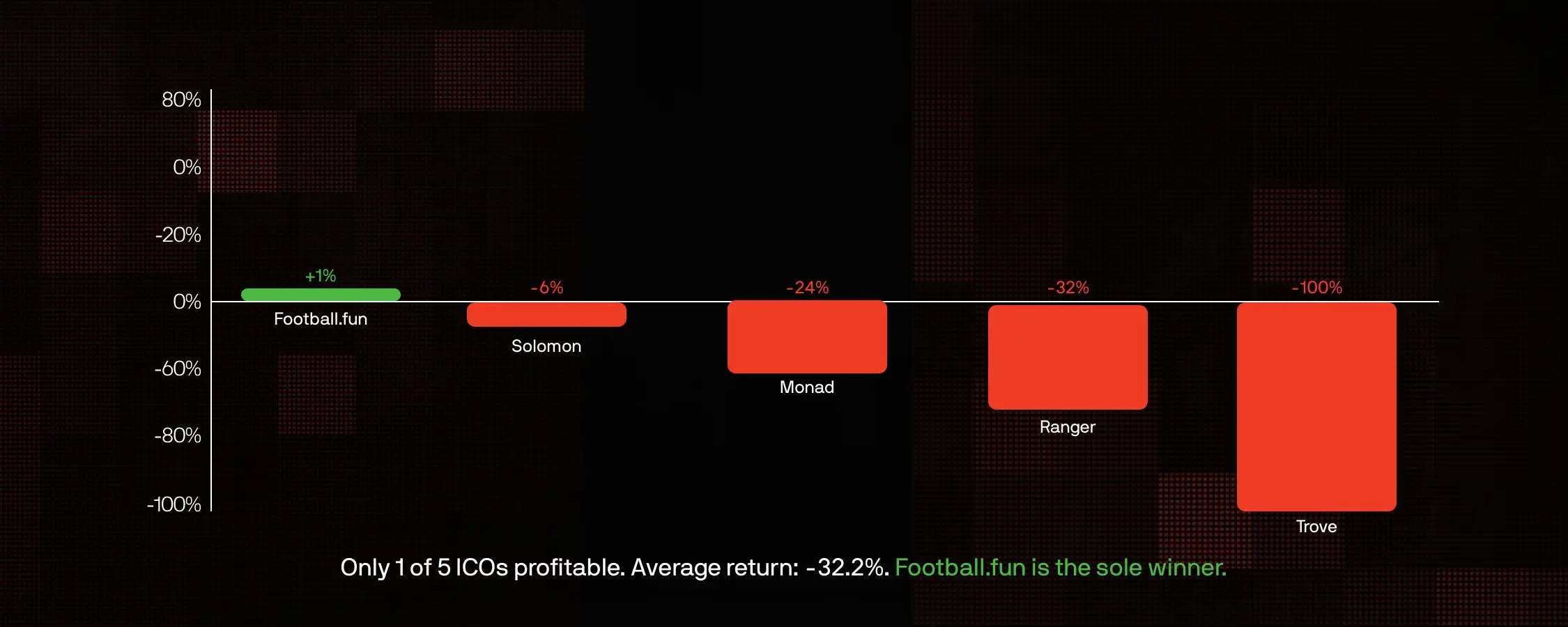
This pattern is brutal: even tokens that launched above ICO valuation (like Monad, Solomon) ultimately fell below issuance price. Football.fun is the only winner among the five ICO tokens in this dataset, currently just 1% above ICO.
Core Conclusions:
After analyzing 231 markets, $241.5 million in trading volume, and 8 verified 24-hour FDV data points, several clear points emerge:
- “100% accuracy” is meaningless. Markets settle after the outcome is known (subscription markets after sales, FDV markets after 24 hours), so their post hoc accuracy approaches 100%. But the true prediction accuracy one week before close is only 66.7%. At critical moments, the crowd is wrong one-third of the time.
- Systematic over-optimism. Among the top 15 markets, 5 show over 60% confidence in thresholds that were never reached. FDV is on average overestimated by +35%.
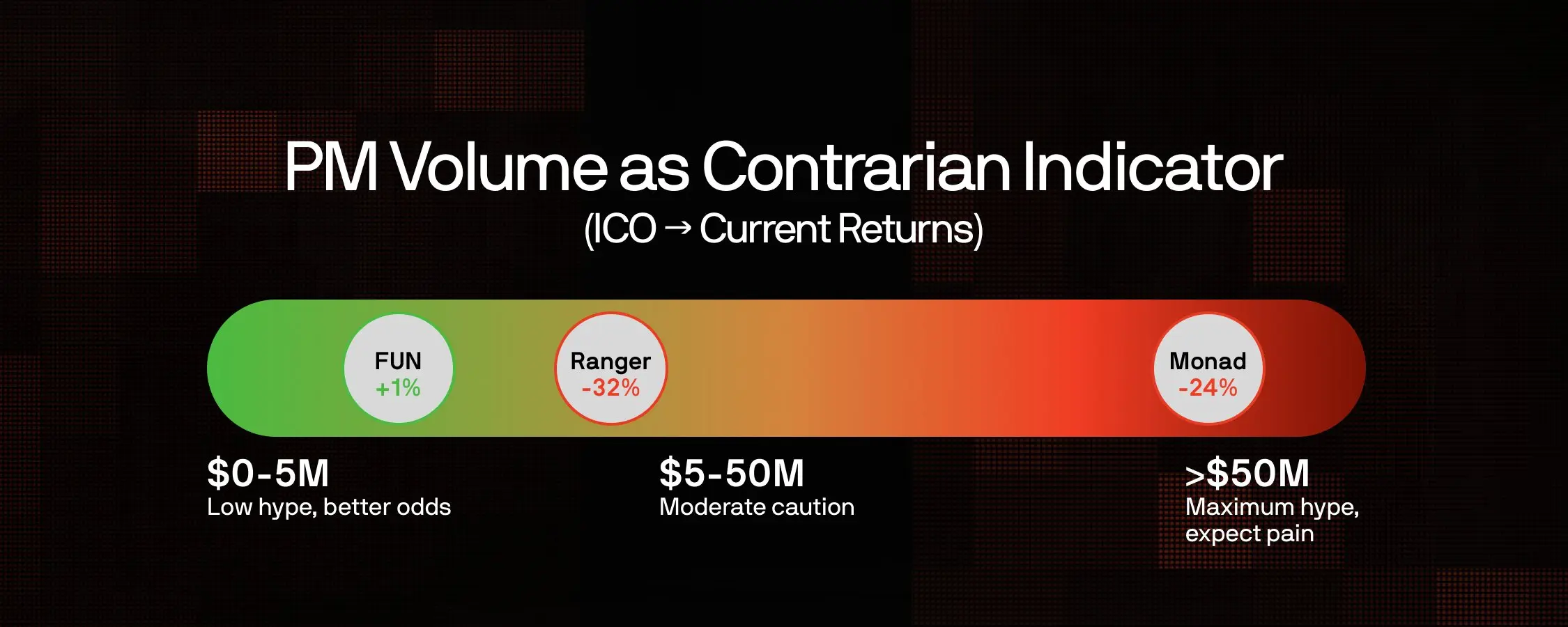
- High trading volume on prediction markets is a reverse signal. Monad ($89 million) and MegaETH ($67 million) show the highest over-optimism. The more capital the crowd bets, the more confident they are, and the more likely they are to be wildly wrong.
- Conservative predictions lead to better outcomes. Tokens with relatively accurate forecasts (Monad, Football.fun) experienced smaller declines. Low hype and accurate predictions seem to be bullish signals.
Trading signals:
Based on this analysis, we can distill actionable signals for evaluating future token sales. While not guaranteed, these reflect consistent patterns in the data.
Bearish signals:
- Polymarket trading volume > $50 million
- FDV over-optimism > 50%
- All FDV prediction thresholds likely to fail
- Subscription over-optimism > 30%
Bullish signals (relatively):
- Polymarket trading volume < $5 million
- FDV prediction deviation within 20%
- Multiple FDV thresholds achieved
- Crowd expectations are more conservative
This asymmetry is important. Bearish signals are strong indicators of poor outcomes, while bullish signals are weaker, merely suggesting the token may perform “not as badly” as overhyped alternatives. In a market where all tokens have fallen from ATH, “falling less” is already the best-case scenario.
Summary
Polymarket’s token sale sector is essentially a hype meter. The signal isn’t in the predictions themselves but in how much they deviate from reality. When the crowd floods in with capital betting on higher valuations, caution is wise. Historically, “extreme confidence” from the crowd often signals investors’ “greatest pain.”
Disclaimer: The information on this page may come from third parties and does not represent the views or opinions of Gate. The content displayed on this page is for reference only and does not constitute any financial, investment, or legal advice. Gate does not guarantee the accuracy or completeness of the information and shall not be liable for any losses arising from the use of this information. Virtual asset investments carry high risks and are subject to significant price volatility. You may lose all of your invested principal. Please fully understand the relevant risks and make prudent decisions based on your own financial situation and risk tolerance. For details, please refer to
Disclaimer.
Related Articles
Crypto Market Update – River and Hyperliquid Lead Gainers As Decentralized Infrastructure Gains M...
The crypto market is displaying its typical volatility once again, yet under the noise of price movements, the beginnings of a narrative are starting to take shape. As of today, the “Top Gainers” on CoinMarketCap leans heavily towards projects targeting decentralized infrastructure and fast Layer-1s
BlockChainReporter32m ago
Solana Approaches Key Sell Wall at $84.78 — Will Momentum Hold for a Move Toward $89?
Solana is trading at an approximate price of $83.18, although a solid sell wall is at an approximate price of $84.78, which prevents upward movement.
The price is trapped between the support at $81.99 and the resistance at $84.78 which is short term consolidation.
Once buyers hit the
CryptoNewsLand1h ago
SOL Consolidates Near $84 While Chart Highlights Possible $45 Demand Zone
Solana (SOL) trades at $83.87 within a range defined by $81.03 support and $84.43 resistance, showing consolidation below a $90 supply zone. There is a broader demand area near $45, indicating potential downward movement before recovery.
CryptoNewsLand1h ago
Santiment: The surge in active USDT addresses on a certain public blockchain is correlated with the rebound of BTC
Research firm Santiment found that over the past year, when USDT active addresses on a certain public blockchain surged three times, BTC price rebounded each time, indicating that USDT liquidity has a significant impact on BTC price.
GateNews2h ago
PEPE Consolidates Above $0.05324 Support as Momentum Strengthens and Resistance Near $0.05336 Holds
PEPE has a tight intraday price compression with a support level of $0.053243 and resistance level of $0.053363.
A RSI of 64.13 represents the moderate bullish momentum whereas MACD history is slightly positive, which indicates the gradual buying momentum.
The price is at $0.053364
CryptoNewsLand2h ago
Michael Saylor: Strategy - There is a time lag between buying Bitcoin and price appreciation
Gate News reports that on March 12, Strategy founder Michael Saylor posted: "There is a time lag between when we purchase Bitcoin and when the Bitcoin price skyrockets."
GateNews2h ago


