
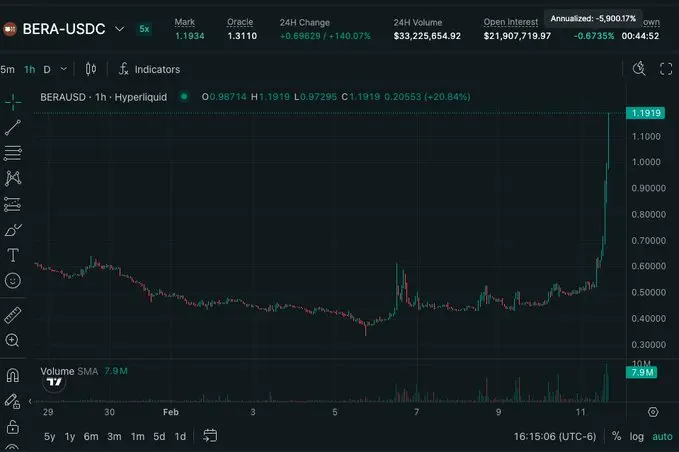
Berachain’s native token BERA surged over 150% on February 11, marking the largest single-day increase in months. The foundation announced the “Bera Build Enterprise” strategy, supporting 3 to 5 revenue-generating applications, shifting from token incentives to cash flow-driven models. The large-scale token unlock did not trigger a sell-off wave; instead, it prompted a short squeeze. Heatmaps of liquidations show a concentration of short positions above key resistance levels.
Bera Build Enterprise Strategy: From Token Distribution to Revenue-Based Model Shift
The plan was announced in January, aiming to support three to five applications capable of generating revenue to create sustainable demand for BERA. The network now intends to move away from heavy token incentives and focus on projects that produce real cash flow. This shift changes the narrative, fundamentally addressing market doubts about Berachain’s business model sustainability.
Throughout 2025, Berachain struggled, with total value locked (TVL) plummeting from early highs, and token prices falling more than 90% from their peaks. Critics questioned whether its growth driven mainly by incentives could withstand prolonged market downturns. Traditional DeFi protocols often attract liquidity through high token rewards, but this model suffers when rewards diminish or cease, leading to rapid outflows. Berachain’s poor performance in 2025 exemplifies these flaws.
The core of the “Bera Build Enterprise” strategy is to select applications capable of generating actual revenue. These could include decentralized exchanges earning transaction fees, lending protocols generating interest income, SaaS blockchain services charging subscription fees, or oracle services providing paid data. The key is that these revenues are derived from real economic activity, not token inflation.
Once these applications generate income, part of the proceeds will be used to buy back and burn BERA tokens or to distribute real earnings to BERA stakers. This model transforms BERA from a purely governance token into a cash flow-backed value token, similar to traditional corporate stocks. This business model shift provides long-term value support for BERA, no longer relying on speculation or token inflation.
Strategically, Berachain’s transformation could set a new paradigm for the entire DeFi industry. Over recent years, many DeFi protocols failed due to an inability to establish sustainable business models, often attracting “liquidity mercenaries” with high APYs who quickly left once rewards dried up. If Berachain can prove the viability of a “revenue-driven growth” model, it may trigger industry-wide strategic adjustments.
Three Pillars of the Bera Build Enterprise Strategy
Application Screening: Support only 3-5 carefully vetted projects capable of generating cash flow.
Revenue Buyback Mechanism: Income from applications is used to buy back and burn BERA or distribute to stakers.
Long-term Commitment Requirement: Supported projects must commit to operating on Berachain long-term, not just short-term arbitrage.
Implementing this strategy requires time to validate. How much revenue can 3-5 applications generate? Can this cover Berachain’s operational costs and support sufficient token buybacks? The answers will gradually emerge over the coming quarters. Nonetheless, the market has clearly responded positively to this strategic shift, as evidenced by the over 150% surge on February 11.
$25 Million Refund Bomb Disarmed: The February 6 Key Moment
Another major negative factor this month also disappeared. The controversial refund clause related to Brevan Howard’s Nova Digital fund expired on February 6, 2026. Reports indicate that this clause allowed investors to request a $25 million refund if performance conditions were not met. With the deadline passed, traders see the removal of this risk as a positive structural development.
Brevan Howard is a globally renowned hedge fund, and its Nova Digital fund focuses on crypto investments. In the Berachain investment agreement, a performance escrow clause was included: if Berachain failed to meet certain metrics (TVL, trading volume, user count) within a set timeframe, Brevan Howard could demand a partial or full refund. Such clauses are common in venture deals, but a $25 million refund threshold is significant for Berachain’s finances.
Market concern was that if triggered, the refund would force Berachain to sell tokens or other assets to raise cash, adding downward pressure on BERA. More critically, a top-tier institutional investor requesting a refund signals a negative outlook, potentially undermining confidence and triggering a chain reaction.
The expiration of the deadline indicates Brevan Howard chose not to exercise the refund. This could mean either Berachain met the performance thresholds or, despite shortfalls, Brevan Howard still sees potential and prefers to hold. Either way, “no refund” is a major positive, removing the most feared financial and confidence risks.
Post-deadline, traders seem to interpret the absence of the refund trigger as a structural positive. BERA’s price began to recover on February 6, shifting from previous lows to steady gains. This reaction shows that market fears of the refund risk had been suppressing the price; once eliminated, buying pressure was unleashed.
From an investor psychology perspective, removing uncertainty often has a stronger positive effect than good news alone. When markets price in the worst-case scenario, confirming that it won’t happen leads to rapid price correction. Berachain’s case exemplifies this: the expiration of the refund clause lifted a Damocles sword, quickly improving sentiment.
Token Unlocks Without Sell Pressure Trigger Short Squeeze
(Source: Trading View)
Meanwhile, a large token unlock event was successfully completed without triggering a massive sell-off. This supported what analysts call a “relief rally.” Token unlocks are typically major risk events, as early investors and team members’ tokens become freely tradable after lock-up periods. Markets often fear unlocks will flood the market with supply, causing prices to drop in advance.
However, Berachain’s unlock did not produce the expected sell-off. Possible reasons include: holders’ confidence in long-term prospects, choosing to hold rather than sell immediately; the announced “Bera Build Enterprise” strategy shifting holder expectations toward waiting for implementation; or market already pricing in the unlock, with actual unlock acting as a catalyst for “buy the rumor, sell the news.”
When the market sees no sell-off after unlock, many short sellers who bet on a decline get caught off guard. They had expected a price plunge but instead see prices rising, incurring losses. To cut losses, they are forced to buy back positions, which further drives prices higher—a short squeeze.
On-chain and derivatives data show increased trading volume and open interest. Heatmaps of liquidations reveal large short positions above key resistance levels, indicating that short covering could accelerate upward momentum. Once prices break through these levels, short positions face losses or forced liquidations, creating a feedback loop of buying pressure.
Short squeezes are among the most intense price movements in crypto markets. Unlike demand-driven rallies, they are driven by forced buying, often causing rapid, sharp increases. Berachain’s 150% single-day rise on February 11 is largely attributable to such a squeeze. Traders who shorted at lower levels expecting a sell-off faced heavy losses.
Risks Remain: TVL Collapse and Long Road to Strategy Validation
However, risks persist. Berachain still faces ongoing token distribution pressures and must prove that its business-centric strategy can generate sustained demand. Throughout 2025, TVL collapsed from early highs, signaling capital and user outflows—an extremely negative sign.
While the strategy shift and the removal of refund risk have sparked a price rebound, actual recovery of TVL will take time. The “Bera Build Enterprise” approach needs months or even quarters to show tangible results. During this period, Berachain must continuously demonstrate its value proposition to attract developers and users back. If TVL remains low, even a short-term price spike could be reversed.
Nonetheless, after a long period of dormancy, the market seems to be rewarding clarity and risk reduction. This rational response reflects that uncertainty is a risk premium. As refund risks are eliminated, strategic direction clarified, and unlocks absorbed, Berachain’s risk profile improves significantly, and prices naturally adjust upward.
From an investment perspective, a 150% single-day gain is enticing but also risky. Such rapid surges often lead to sharp corrections, as short-term profit-taking kicks in. Cautious investors should wait for a pullback to more reasonable levels before entering or consider small positions with strict stop-losses.


