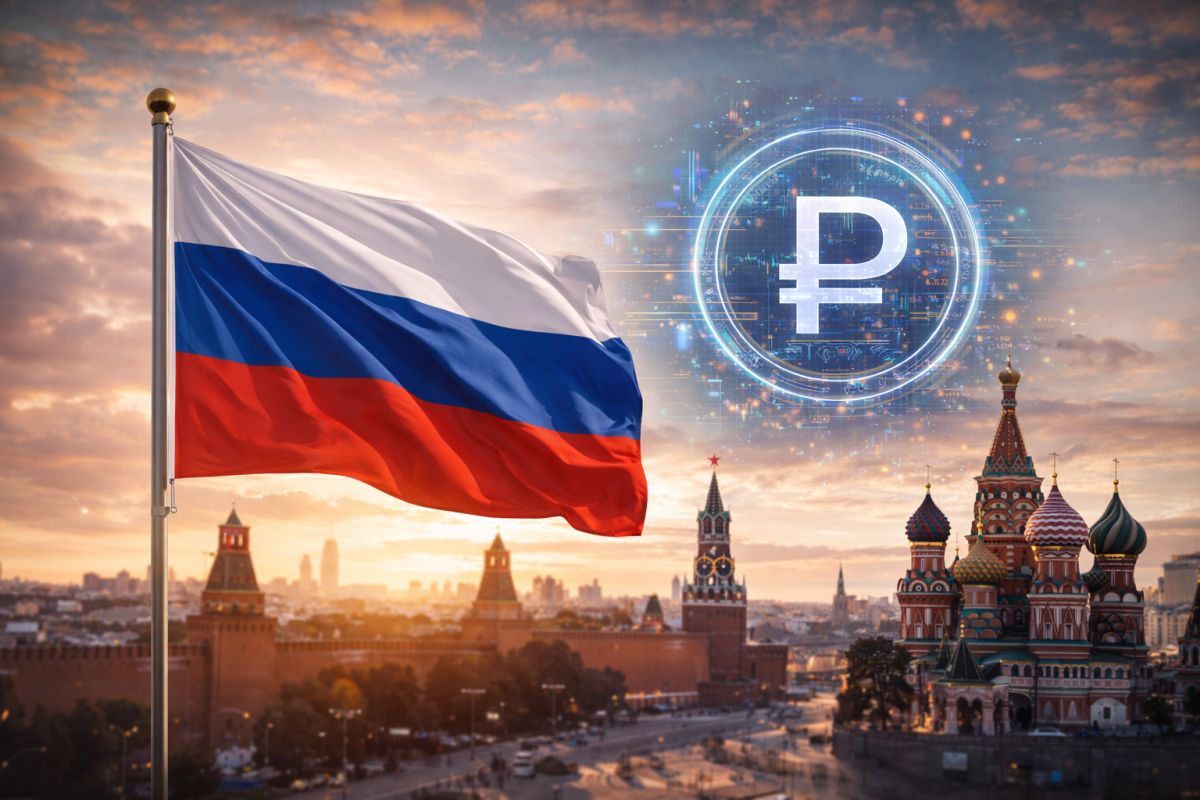
- The Bank of Russia is set to re-examine its longstanding opposition to stablecoins, conducting a feasibility test later this year.
- It follows stablecoin pushes by the US following the GENIUS Act and the EU’s ongoing pursuit of a digital euro.
After years of opposing stablecoins, Russia is reconsidering its stand and will conduct a feasibility test later this year on how these fiat-pegged tokens would fit into its financial architecture.
The Bank of Russia has softened its stance on stablecoins as most of its global rivals embrace the tokens, revealed First Deputy Chairman Vladimir Chistyukhin, as reported by Mail.ru. Speaking at the Alfa Talk conference, Vladimir said that there’s increasing pressure on the top bank to reassess its stance as demand for stablecoins in the country spikes.
He stated:
“We plan to conduct a study this year to reassess this situation. Indeed, our traditional position is that this is unacceptable, but taking into account the practices of a number of foreign countries, we will reassess the risks and prospects here and will also bring this up for public discussion.”
Russia has had a chequered past with crypto. The country is reportedly using crypto to circumvent US sanctions, including as payment for oil with China and India, as we have previously reported. The government has also looked into Bitcoin mining, while some of the country’s largest banks are now offering crypto services.
However, it has opposed most efforts to use stablecoins locally. Most stablecoins are issued by American companies, with the US dollar having a 99% share of the $314 billion market. The Russian government has expressed concerns over allowing the use of stablecoins issued and controlled by offshore companies.
A Russian Stablecoin
According to the central bank official, Russia could have its own stablecoin, pegged to the ruble. It would join dozens of other major economies that saw new local stablecoins launched in the past year. They include South Korea, where the first won-pegged stablecoin launched last September. A month later, the first stablecoin pegged to the Japanese yen launched.
The stablecoin would complement the digital ruble, a CBDC being developed by the central bank, despite opposition from commercial banks, which insist that the existing rails are sufficient for both retail and enterprise users.
But while Russia pursues a stablecoin, its adversaries have been bracing to crack down even further on any crypto transactions originating from the country. As the Financial Times reports, the European Union is preparing to ban all crypto transactions from Russia as part of its wide-ranging sanctions.
An internal document seen by the FT states:
“In order to ensure that sanctions achieve their intended effect [the EU]prohibits to engage with any crypto asset service provider, or to make use of any platform allowing the transfer and exchange of crypto assets that is established in Russia.”
Disclaimer: The information on this page may come from third parties and does not represent the views or opinions of Gate. The content displayed on this page is for reference only and does not constitute any financial, investment, or legal advice. Gate does not guarantee the accuracy or completeness of the information and shall not be liable for any losses arising from the use of this information. Virtual asset investments carry high risks and are subject to significant price volatility. You may lose all of your invested principal. Please fully understand the relevant risks and make prudent decisions based on your own financial situation and risk tolerance. For details, please refer to
Disclaimer.
Related Articles
VeChain StarGate Staking Platform Shows Strong Growth Three Months After Hayabusa Fork
VeChain's StarGate staking platform experienced significant growth post-Hayabusa fork, with a 50.2% reduction in VTHO emissions and a 93.9% increase in active stakers. The network now holds 10.7 billion VET, emphasizing the shift towards a delegation model and new entry-level node tiers which promote wider participation.
CryptoNewsFlash4h ago
Ethena Adjusts sUSDe Unstaking Mechanism, Cooldown Period Changed to Dynamic Mode with Minimum 1 Day
Gate News Report: On March 12, Ethena announced on March 13 an adjustment to the sUSDe unstaking mechanism. The new mechanism will change the cooldown period from a fixed 7 days since the project's launch to a dynamic model, linked to the amount of liquid stablecoins available in the USDe reserve. According to current reserve conditions, the sUSDe unstaking cycle has been shortened to 1 day. In the future, the cooldown period will dynamically adjust between 1 day and 7 days based on the composition of liquid assets in the USDe reserve.
GateNews5h ago
Zama and GSR Complete First Confidential OTC Transaction on Ethereum, Achieving On-Chain Sensitive Data Encryption Protection
Gate News reports that on March 12, Zama and crypto market maker GSR announced that they have completed the first confidential over-the-counter transaction on Ethereum based on the Zama protocol. The transaction achieved encrypted protection of sensitive data such as transaction size and fund flows on the public blockchain. Zama stated that the transaction aims to eliminate "privacy loopholes" for institutional participants caused by on-chain data transparency. Through fully homomorphic encryption (FHE) technology, transaction details remain encrypted on-chain while ensuring transaction verifiability and settlement finality.
GateNews5h ago
UXUY Partners with Flap to Launch PumpAI, an AI Agent Autonomous Launch Platform
UXUY and Flap Reach Strategic Partnership, Focusing on AI Agent Asset Ecosystem, Launching PumpAI Platform to Enable AI Agent Autonomous Token Issuance. AI Agents Possess Sharp Market Insights, Supporting Trading Tax Decision-Making and Diversified Distribution, Driving Community Development. Founder Kevin Emphasizes the Important Transformation and Innovation Potential of AI Agents in On-Chain Ecosystems.
GateNews5h ago
Hyperliquid Sets New Records in RWA Trading Volume
Hyperliquid, a specialized Layer 1 blockchain for DeFi, has seen outstanding growth in Real-World Asset trading, achieving over $1.3B in open interest and $1.4B in weekend volume, positioning itself as a 24/7 trading hub alternative to traditional markets.
BlockChainReporter5h ago
Circle Tests AI Agents With $30K USDC Hackathon Trial
Circle’s AI hackathon produced 204 submissions, 1,352 valid votes, and over 9,700 comments in five days.
Agents built projects across commerce, smart contracts, and skills using USDC incentives.
Experiment revealed rule-breaking, vote collusion, and possible human activity among AI
CryptoFrontNews5h ago


