Author: bootly, BitpushNews
The Ethereum Foundation (EF) once again stands at a crossroads of personnel upheaval.
Co-CEO Tomasz Stańczak announced he will step down at the end of this month. This comes just 11 months after he and Hsiao-Wei Wang jointly succeeded the long-time leader Aya Miyaguchi in March last year, forming a new leadership core.

His successor will be Bastian Aue. Very little public information is available about him; his X account was registered only eight months ago, with almost no record of public statements. He will continue to co-lead the organization that controls core resources and direction of the Ethereum ecosystem alongside Hsiao-Wei Wang.
This seemingly sudden personnel change is actually the inevitable result of internal conflicts within the Ethereum Foundation, external pressures, and strategic shifts intertwined.
A Crisis Response: A Year of Turmoil
To understand Stańczak’s departure, we must first look back at the context when he took office.
Early 2025, the Ethereum community was in a state of anxiety. At that time, the cryptocurrency market was generally bullish following the US elections, with Bitcoin hitting new highs repeatedly, and competitors like Solana gaining momentum. Meanwhile, Ethereum’s price performance was relatively weak, and the Foundation itself became a target of criticism.
Critics pointed directly at then-CEO Aya Miyaguchi. Developer communities complained that the Foundation and frontline builders were severely disconnected, with conflicting strategic interests and insufficient promotion of Ethereum. Some questioned whether the Foundation was too “laid-back,” adopting a “coordinator” rather than a “leader” stance, which was seen as causing Ethereum to lose its first-mover advantage.
As the “central authority” of Ethereum, the Foundation was expected to act decisively rather than remain passive.
Amid this public storm, Miyaguchi stepped back into the boardroom. Stańczak and Wang were suddenly thrust into the spotlight, taking on leadership roles.
Stańczak was not an outsider. He is the founder of Nethermind, one of the core execution clients in the Ethereum ecosystem, playing a key role in infrastructure development. He understands technology, has entrepreneurial experience, and has a deep understanding of community pain points.
In his own words, the initial instructions he received upon taking office were clear: “The community is calling out — you’re too chaotic — you need to be more centralized and accelerate to respond to this critical period.”
What did he do in this year?
The combination of Stańczak and Wang indeed brought visible changes.
First, organizational efficiency. The Foundation laid off 19 employees, streamlined its structure, and tried to shed bureaucratic labels. The strategic focus shifted back to Layer 1, explicitly prioritizing scaling the Ethereum mainnet rather than letting Layer 2s operate independently. The upgrade pace accelerated, with more decisive progress on EIPs.
Second, attitude adjustment. The Foundation began releasing a series of videos on social media, proactively explaining Ethereum’s technical roadmap and development direction. This “outreach” approach contrasted with the previously more closed, mysterious image.
Strategically, Stańczak pushed several new directions: privacy protection, responses to quantum computing threats, integration of artificial intelligence with Ethereum. Especially on AI, he clearly saw the trend of “agent systems” and “AI-assisted discovery” reshaping the world.
On the financial front, the Foundation started discussing more transparent budget management and fund allocation strategies, aiming to address external concerns about the efficiency of treasury use.
Vitalik Buterin commented on Stańczak: “He has greatly improved the efficiency of multiple departments within the Foundation, making the organization more responsive to the outside world.”
The Subtext of the Departure Statement
Less than a year in, why leave?
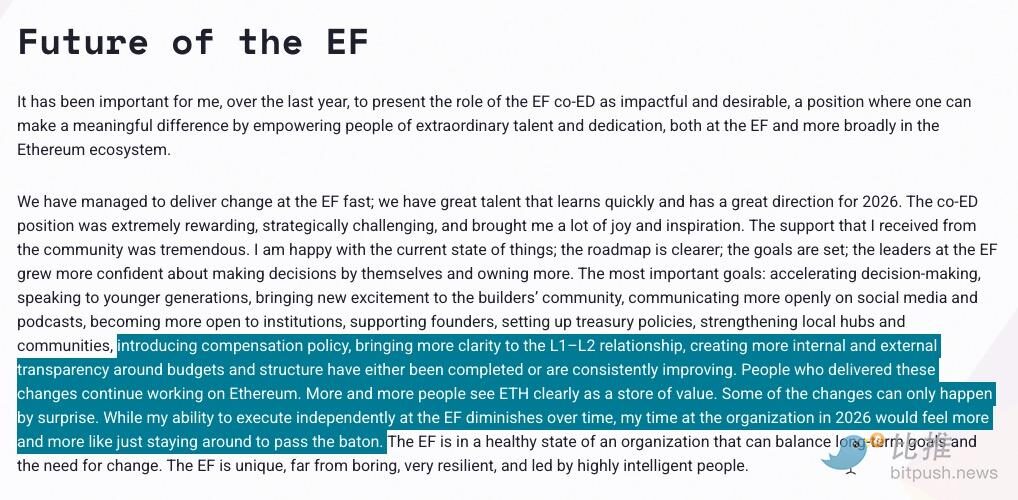
Stańczak’s departure statement is quite candid and somewhat thought-provoking. He provided several key points:
First, he believes the Ethereum Foundation and the entire ecosystem are “in good shape.” The time has come for a handover.
Second, he wants to return to being a “hands-on product builder,” focusing on the integration of AI and Ethereum. He says his current mindset is similar to when he founded Nethermind in 2017.
Third, and most intriguingly: “The Foundation’s leadership is increasingly confident in their decision-making and control over more matters. Over time, my ability to operate independently within the Foundation has diminished. If I stay longer, by 2026 I will mostly just be ‘waiting to pass the baton.’”
This statement hints at two meanings: one, a new leadership team has already formed its own momentum and no longer needs his direct involvement; two, his actual influence may be shrinking—something that doesn’t sit well with someone used to hands-on, entrepreneurial roles.
He also mentioned, “I know many ideas about agent-based AI are still immature or even useless, but these experimental, game-like endeavors define the pioneering spirit of early Ethereum.”
This somewhat subtly criticizes the current state: as organizations become more “mature” and decision-making more “steady,” the wild, experimental spirit of innovation might be lost.
Stańczak’s departure appears personal on the surface but reflects long-term dilemmas faced by the Ethereum Foundation.
Since its inception, the organization has been in an awkward position. In theory, Ethereum is decentralized, and the Foundation shouldn’t be a central authority issuing commands. But in practice, it controls significant funds, core developer resources, and ecosystem coordination voice—essentially playing a dual role as “central authority” and “regulatory body.”
This identity paradox has long put the Foundation in a dilemma: doing too much invites accusations of centralization; doing too little is criticized as inaction. Miyaguchi leaned toward a “coordinator” role, which was seen as weak; Stańczak aimed to shift toward an “executor” role, improving efficiency but naturally concentrating organizational power.
His departure exposes this tension: as the organization becomes more efficient and decisive, the space for founding members’ personal influence shrinks. For an ecosystem that must balance “decentralization” and “market efficiency,” internal friction is almost unavoidable.
What kind of person is Bastian Aue, who replaces Stańczak?
Very little public info. He described himself on X as responsible for “difficult-to-quantify but critical tasks” at the Foundation: assisting management decision-making, communicating with team leads, budget considerations, strategic planning, prioritization. His low-profile style contrasts sharply with Stańczak’s entrepreneurial aura.
Aue stated in his acceptance: “My decision-making is based on certain principled adherence to the attributes of what we are building. The Foundation’s mission is to ensure that truly permissionless infrastructure—centered on the crypto-punk spirit—can be established.”
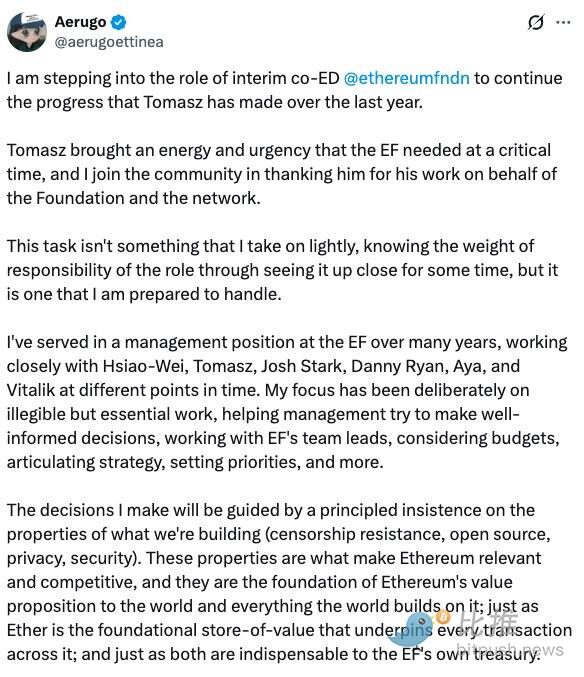
This sounds more like Miyaguchi’s language style: emphasizing principles, spirit, and coordination rather than leadership.
Does this mean the Foundation will shift back from “aggressive execution” to “principled coordination”? We’ll have to wait and see.
Ethereum’s Uncertainty
Stańczak’s departure comes at a critical moment when Ethereum is discussing several major proposals. According to him, the Foundation is about to release key documents, including the “Lean Ethereum” plan, future development roadmap, and DeFi coordination mechanisms.
The “Lean Ethereum” proposal is jokingly called “Ethereum’s weight-loss era” by some community members—aiming to simplify the protocol, reduce burdens, and make the mainnet more efficient.
These strategic documents will profoundly influence Ethereum’s development path over the coming years. The change in core leadership adds uncertainty to the implementation of these proposals.
On a broader scale, Ethereum faces multiple challenges: competition from high-performance chains like Solana, Layer 2 fragmentation issues, new narratives around AI and blockchain integration, and the overall crypto market sentiment affecting ecosystem funding and attention.
On the same day Stańczak announced his departure, ETH briefly fell below $1,800. If it continues to decline past this point, an awkward fact emerges: the total return for ETH holders might fall below the interest rate of USD cash holdings.
A more sobering calculation: in January 2018, ETH first hit $1,400. Adjusted for US CPI inflation, that amount would be roughly equivalent to $1,806 in February 2026.
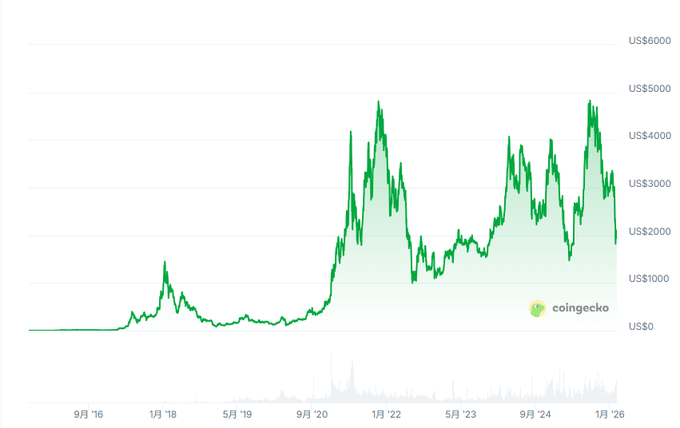
In other words, if an investor bought ETH in 2018 and held it without staking, after eight years, they would not only have failed to profit but might have underperformed simply holding cash in a bank account earning interest.
For the “ETH loyalists” who have believed all along, the real question may not be “who wins the ideological battle,” but “how much longer can they hold on?”
The only certainty is that this core organization, which controls one of the most vital ecosystems in crypto, is still searching for its position in a rapidly changing industry—and that this journey will undoubtedly be turbulent.
Disclaimer: The information on this page may come from third parties and does not represent the views or opinions of Gate. The content displayed on this page is for reference only and does not constitute any financial, investment, or legal advice. Gate does not guarantee the accuracy or completeness of the information and shall not be liable for any losses arising from the use of this information. Virtual asset investments carry high risks and are subject to significant price volatility. You may lose all of your invested principal. Please fully understand the relevant risks and make prudent decisions based on your own financial situation and risk tolerance. For details, please refer to
Disclaimer.
Related Articles
BlackRock transferred 567 BTC and 22,657 ETH to a certain CEX, with a total value exceeding $94 million
Gate News reports that on March 17, according to Onchain Lens monitoring, asset management firm BlackRock deposited 567 BTC to a certain CEX, valued at approximately $41.78 million, while simultaneously transferring in 22,657 ETH, valued at approximately $52.40 million. The total value of both transfers exceeded $94 million.
GateNews14m ago
Bitmine Buys 60,999 ETH, Boosts Treasury to $11.5B
Bitmine purchased 60,999 ETH this week, raising total holdings to 4.59M ETH worth about $11.5B.
Around 3.04M ETH is staked across its validators, generating about $180M in annualized rewards.
The firm is nearing its 5% ETH supply target while expanding validator and equity investments.
Bit
CryptoFrontNews37m ago
South Korean Police Plan to Establish Guidelines for Seizing Privacy Coins; Virtual Assets Confiscated Over Past Five Years Valued at 545 Billion Won
The Korean National Police Agency is developing new virtual asset seizure management guidelines, incorporating handling of privacy coins for the first time. The new regulations will clarify software wallet management, address virtual asset custody gaps, and improve law enforcement efficiency. Police plan to designate private custodian institutions, while experts recommend establishing a centralized public custody mechanism to reduce risks. This reform has been prompted by recent Bitcoin theft incidents, driving the management system's transition toward the digital asset era.
区块客46m ago
Crypto Market Rally Has Begun With Bitcoin and Altcoin Prices Rising, ETH Pump Could Be Strong
Crypto market rally has begun with Bitcoin and altcoin prices rising.
Some expect the price of ETH to see a very strong pump.
Analysts debate the many possibilities of a bullish rally peak.
The crypto market seems to have already entered a promising bullish recovery phase. At the
CryptoNewsLand1h ago


