A quiet regulatory document can sometimes carry more weight than a loud market rally. That idea comes into focus after a new filing connected to AAVE appeared at the United States Securities and Exchange Commission. The paperwork points to a possible path that could move decentralized finance closer to traditional investment access.
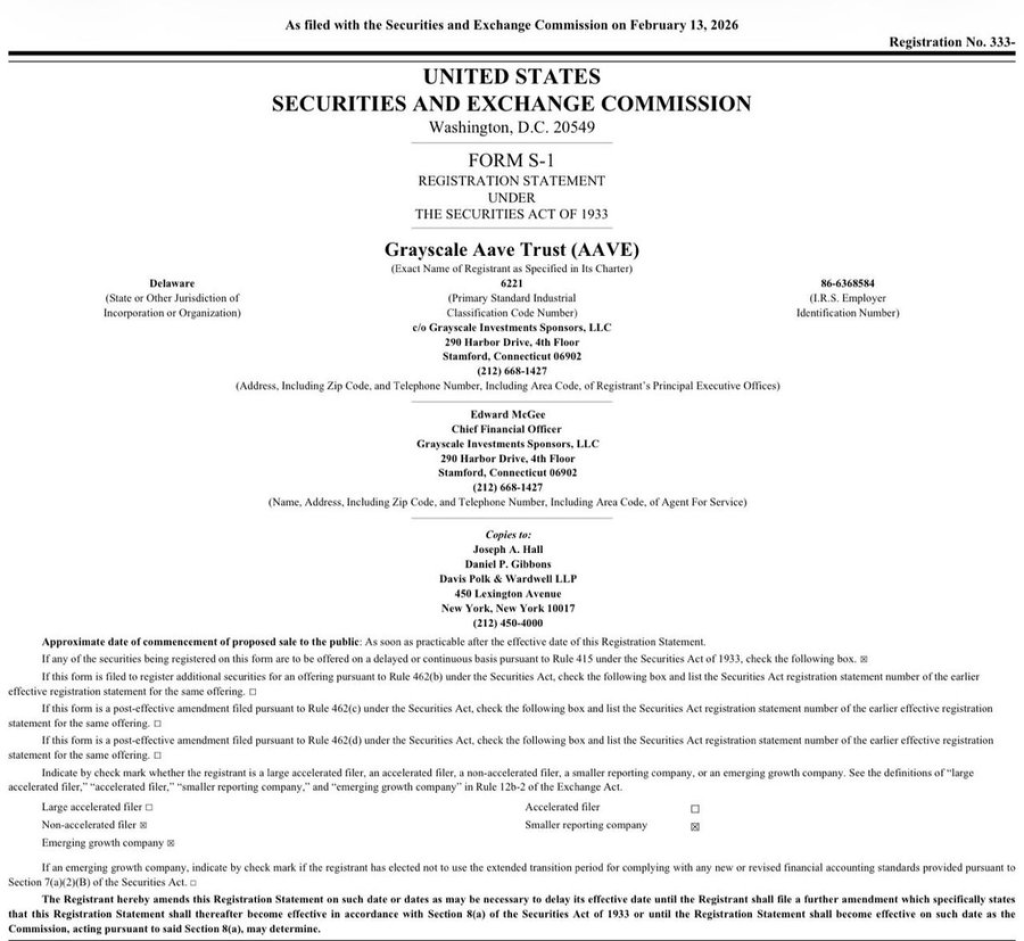
Crypto Patel noted the development in a post that framed the moment as a serious step toward a DeFi exchange-traded fund. The post notes that Grayscale submitted an S-1 registration tied to an Aave trust.
That type of filing usually marks the early stage of a product meant for public market exposure, which explains why the conversation around AAVE has started to focus on regulation instead of short term price action.
@CryptoPatel / X
SEC Filing Shows Formal Structure Behind Potential AAVE Investment Product
Details inside the document reveal that the proposed vehicle is named the Grayscale Aave Trust. The registration statement sits under the Securities Act of 1933, which governs how securities reach public investors in the United States. Grayscale Investments Sponsors appears as the listed sponsor, with corporate addresses and executive oversight clearly outlined.
Such structure matters because it shows preparation for institutional compliance rather than experimental token exposure. Traditional filings require disclosure, governance clarity, and operational transparency. Each requirement creates a bridge between decentralized assets like AAVE and regulated financial markets.
Crypto Patel connects this step to a wider pattern that includes similar ETF ambitions across the altcoin sector. Expansion beyond Bitcoin and Ethereum would mark a meaningful change in how regulators view decentralized finance infrastructure. Access through brokerage accounts could introduce AAVE to investors who never interact with on chain lending protocols.
Regulatory Approval Remains Uncertain Despite Growing DeFi Interest
Regulatory progress rarely follows a straight timeline. SEC review can stretch across months, and approval depends on market surveillance, custody standards, and investor protection rules. AAVE must satisfy those conditions before any product reaches trading desks.
Crypto Patel frames the moment as an open question rather than a guaranteed outcome. The post asks whether the SEC will allow a DeFi focused ETF during the current cycle. That question captures the tension between innovation and oversight that defines the digital asset market today.
Kaspa Crosses 600 Million Transactions: One of Crypto’s Most Underrated Growth Stories_**
Aave already holds a strong position inside decentralized lending, which gives the filing practical relevance beyond speculation. Institutional packaging could expand visibility, yet final approval still depends on regulatory comfort with DeFi mechanics. That balance will shape how quickly decentralized finance enters mainstream portfolios.
Disclaimer: The information on this page may come from third parties and does not represent the views or opinions of Gate. The content displayed on this page is for reference only and does not constitute any financial, investment, or legal advice. Gate does not guarantee the accuracy or completeness of the information and shall not be liable for any losses arising from the use of this information. Virtual asset investments carry high risks and are subject to significant price volatility. You may lose all of your invested principal. Please fully understand the relevant risks and make prudent decisions based on your own financial situation and risk tolerance. For details, please refer to
Disclaimer.
Related Articles
Rep French Hill Says CLARITY Act Can Resolve Stablecoin Debate
Rep. French Hill says the CLARITY Act may address key stablecoin regulatory issues in Congress.
The GENIUS Act set an early framework defining dollar-backed stablecoins as blockchain payment tools.
Banks warn proposed rules could favor crypto firms, while Treasury may address yield
CryptoFrontNews7h ago
CCTV 315 Gala Exposes AI Large Model Data Poisoning Industry Chain, Pay to Manipulate AI Response Content
CCTV 315 Gala exposed the AI large model data "poisoning" industry chain, involving a business named GEO. Service providers charge fees to make client products stand out in AI models, spawning press release companies that become key links in data manipulation.
GateNews9h ago
The first list of "Stablecoin Licenses" in Hong Kong is about to be announced! Rumors suggest they will go to HSBC, Standard Chartered, and OSL.
Hong Kong's first batch of "Stablecoin Issuer License" list will be announced next week. The three main applicants are HSBC, Standard Chartered Bank, and virtual asset platform OSL. This licensing round may favor banks due to their capital strength and regulatory advantages, while OSL possesses rich practical experience. Although rumors suggest the main list is finalized, the actual situation may still change.
区块客11h ago
SEC Commissioner: Will Carefully Study "Innovation Exemption" for Tokenized Securities, Focus on Key Issues Such as Information Disclosure
U.S. Securities and Exchange Commission Commissioner Hester M. Peirce announced the launch of an "Innovation Safe Harbor" program for tokenized securities, which will allow limited trading and experimentation within a restricted scope. The program will take a more cautious approach, explore different tokenization models, and consider investor protection mechanisms. The SEC is also evaluating related disclosure and regulatory issues.
GateNews11h ago
A South Korean CEX Will Face Sanctions Review Tomorrow, Fines Could Exceed 352 Billion Won
Gate News reports that on March 15, a certain South Korean CEX will undergo sanctions review on March 16. Since its unreported transaction volume exceeds another South Korean CEX, the market widely expects that fines against this exchange may exceed 35.2 billion Korean won, and some operational suspension periods may also be longer than 6 months.
GateNews12h ago
Uncertainty in stablecoin regulation causes traditional banks to delay infrastructure investments, while crypto companies offering 4%-5% returns may accelerate capital migration.
Unclear stablecoin regulations create operational difficulties for traditional banks, while crypto companies continue to develop in gray areas. Banks are hesitant to make large-scale investments in stablecoin infrastructure due to advice from legal counsel, resulting in limited deployment. While large-scale deposit outflows have not yet occurred, competitive pressure is increasing.
GateNews12h ago


